Let’s get one thing straight: quantum computing isn’t just a faster version of the computer on your desk. It’s a completely different beast, built on a fundamentally new understanding of how the universe works.
If your laptop is like a light switch—it can only be on or off (1 or 0)—a quantum computer is like a dimmer switch. Its basic unit, the qubit, can be on, off, or any shade in between, and weirdly, it can be all of those states at the very same time.
A Fundamentally New Kind of Machine
At its core, quantum computing takes the bizarre rules of quantum mechanics—the physics of the super-small—and uses them to process information. Instead of grinding through problems one step at a time like a normal computer, it explores a vast landscape of possibilities all at once.
This is why it’s not going to make your Netflix stream any faster. Its real talent lies in tackling problems so massive and complex that even our most powerful supercomputers would throw in the towel.
Think about a delivery company trying to find the perfect route to hit thousands of stops. A classical computer would have to calculate every single route, one after the other. We’re talking about a task that could take longer than the age of the universe. A quantum computer, on the other hand, can look at a huge number of these routes simultaneously, homing in on the best one in a tiny fraction of the time.
What Makes It So Different?
The magic behind a quantum computer isn’t about raw speed for everyday tasks. It’s about a unique approach to problem-solving, perfectly suited for untangling immense complexity.
This power comes from a few key ideas:
- Massive Parallelism: It can explore a staggering number of potential solutions at the same time, not one by one.
- Complexity Handling: It’s tailor-made for problems with an astronomical number of variables, like simulating new molecules for drug discovery or creating new materials.
- Probabilistic Answers: Instead of a simple “yes” or “no,” a quantum computer often gives you the most likely correct answer out of all the possibilities it explored.
Quantum computing isn’t a replacement for your laptop; it’s a specialized tool for cracking problems of a complexity we’ve never been able to touch before. It’s less about doing things faster and more about doing things that were previously thought to be impossible.
To really see the difference, it helps to put them side-by-side.
Classical vs. Quantum Computing at a Glance
Here’s a simple table to break down the core differences between the computer you use every day and the specialized quantum machines being built in labs around the world.
| Feature | Classical Computer (Your Laptop) | Quantum Computer (Specialized Machine) |
|---|---|---|
| Basic Unit | Bit (either a 0 or a 1) | Qubit (0, 1, or both at once) |
| Problem Solving | Follows one path at a time | Explores many paths simultaneously |
| Best For | Everyday tasks, data storage, defined logic | Optimization, simulation, and complex modeling |
| Error Rate | Very low and stable | High and super sensitive to its environment |
As you can see, they are designed for completely different worlds. Your laptop is a master of logic and defined tasks, while a quantum computer is a master of probability and complexity.
Understanding Qubits, Superposition, and Entanglement
To get a real handle on how quantum computers operate, you need to understand their three core “superpowers.” These aren’t just faster, beefier versions of the computers on our desks. They’re built on an entirely different set of rules drawn from the weird and wonderful world of quantum mechanics.
At the very heart of it all is the qubit—the quantum version of a classical bit. A regular bit is simple. It’s an on-or-off switch, a clear 0 or 1. A qubit, on the other hand, is more like a dimmer switch. It can be a 0, a 1, or some combination of both at the same time.
This chart helps to see the fundamental split between the two approaches.
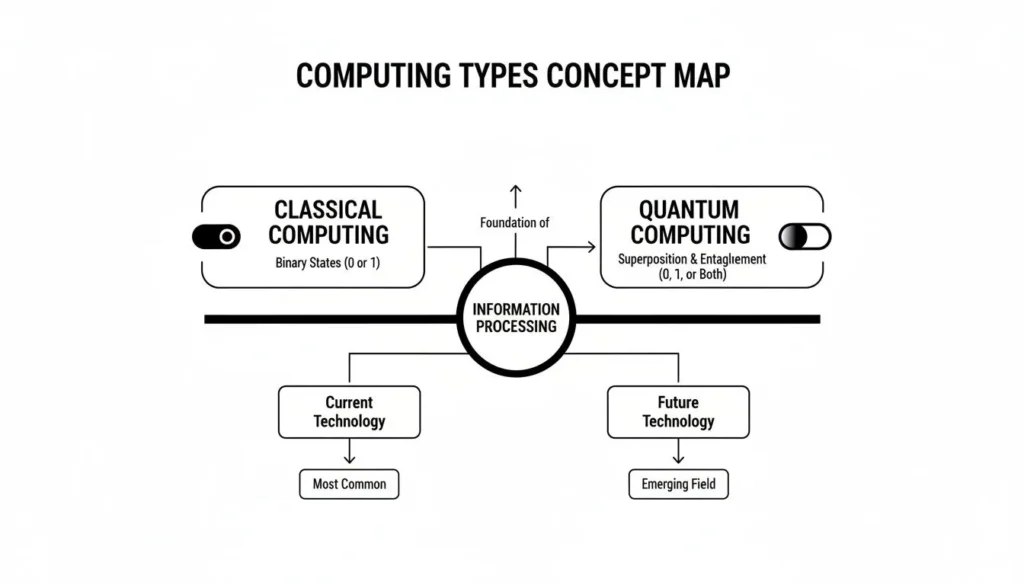
This difference—a definite “light switch” versus a probabilistic “dimmer switch”—is where all the power of a quantum computer comes from. It’s what makes the next two phenomena possible.
Superposition: The Spinning Coin
A qubit’s ability to exist in that “in-between” state is called superposition. The best way to picture it is a spinning coin. While it’s mid-air, it’s not heads and it’s not tails. It’s a blend of both possibilities. It’s only when the coin lands (or, in our case, when we measure the qubit) that it collapses into a single, definite state: heads or tails, 0 or 1.
This property is a massive deal. A classical computer with three bits can only hold one of eight possible combinations at any given moment (like 101, for instance). But a quantum computer with three qubits in superposition can represent all eight combinations simultaneously. This is what gives quantum computers their incredible horsepower—the ability to explore countless possibilities all at once.
Entanglement: Spooky Action at a Distance
If superposition sounds strange, entanglement is where things get truly bizarre. Einstein famously called it “spooky action at a distance,” and for good reason. When two qubits are entangled, their fates are linked. They become a single system, no matter how far apart they are.
Imagine you have a pair of “magic coins” that are linked. You keep one and give the other to a friend who travels to the other side of the planet. The instant you look at your coin and see it’s heads, you know—instantly—that your friend’s coin is tails. No phone call needed.
This strange connection is an incredibly powerful tool. In a quantum computer, if you change the state of one entangled qubit, its partner changes instantaneously. This allows for complex calculations and relationships that are simply impossible in a classical machine, and it’s the backbone of the most powerful quantum algorithms.
These three ideas—qubits, superposition, and entanglement—all work in concert.
- Qubits are the basic building blocks of quantum information.
- Superposition lets each qubit hold a vast range of values at once.
- Entanglement weaves these qubits together, creating powerful, intricate connections.
By combining these principles, quantum computers can chew through problems that would take the fastest supercomputer on Earth longer than the age of the universe to solve. It’s a completely new way of calculating that promises breakthroughs in everything from medicine and materials science to finance and cryptography.
How Quantum Computers Solve Problems
So, we have the building blocks: qubits, superposition, and entanglement. That’s one thing. But understanding how they all come together to actually solve something is where it gets really interesting. A quantum computer doesn’t just run the same programs as your laptop; it needs a completely different set of instructions called quantum algorithms.
I like to think of it as conducting an orchestra. The qubits are your instruments, each one capable of playing a whole range of notes at once (that’s superposition). The instructions that tweak these qubits are called quantum gates. These gates are like the specific musical notes on a sheet, precisely changing a qubit’s state or tangling it up with another one.
The algorithm, then, is the entire musical score. It guides the gates to build up an incredibly complex quantum state—a sort of “quantum symphony”—that holds the solution to a monstrously difficult problem. When the final note is played, we take a measurement, and that final chord reveals the answer.
Algorithms That Unlock Quantum Power
While researchers are cooking up new quantum algorithms all the time, a couple of classics really show what these machines are capable of. They give us a clear window into how quantum computing can chew through problems that would choke even the most powerful supercomputers.
Shor’s Algorithm: This is the big one, often called the “master key.” It’s famous for one thing: finding the prime factors of enormous numbers. That might sound like a dry math problem, but it’s the very foundation of most of the encryption that protects our data online. A big enough quantum computer running Shor’s Algorithm could, in theory, crack the security protocols we depend on every single day.
Grover’s Algorithm: Think of this one as the ultimate search engine for a totally disorganized mess. Imagine you need to find one specific name in a phone book with a billion entries, but none of them are in alphabetical order. A normal computer would have to start at the beginning and check every single name. Grover’s Algorithm offers a massive shortcut.
Quantum computing isn’t about being faster at everything. It’s a specialized tool for specific types of problems where classical computers get bogged down in a sea of possibilities.
The magic of Grover’s Algorithm is how it uses superposition to check a huge number of items simultaneously. Let’s go back to that phone book. To find one name in a list of one million, a classical computer would need, on average, 500,000 tries. The algorithm developed by Lov Grover back in 1996 slashes that down to roughly 1,000 steps.
That’s a staggering speedup, and it only gets more dramatic as the datasets get bigger. If you’re curious about the history, you can find more details about this quantum timeline on BTQ’s blog. These algorithms aren’t just abstract ideas; they are the recipes that turn the weird rules of quantum mechanics into real problem-solving power.
Real-World Applications of Quantum Technology

While it’s easy to get lost in the sci-fi feel of quantum computing, its true potential is all about solving very real, very urgent problems. This isn’t about making your Netflix stream faster. Instead, it’s a tool aimed squarely at challenges that are completely impossible for even the world’s beefiest supercomputers.
Quantum computers are uniquely suited to juggle a mind-boggling number of variables at once. This makes them the perfect tool for specific, high-stakes jobs in some of our most important industries—from discovering life-saving drugs to tackling climate change.
Revolutionizing Medicine and Materials
One of the most exciting frontiers for quantum computing is in chemistry and drug discovery. At their core, molecules are quantum systems, and trying to simulate them perfectly with a classical computer is like trying to draw a detailed map of the world on a postage stamp. It just doesn’t work.
A quantum computer, on the other hand, can model these molecular interactions with incredible precision.
This could completely change how we create new medicines. Forget years of tedious trial-and-error in a lab. Scientists could simulate exactly how a potential drug will interact with proteins in the body, helping them find effective treatments for diseases like Alzheimer’s or cancer in a fraction of the time.
This same idea extends to engineering brand-new materials. With a quantum computer, we could design:
- Better Batteries: By simulating new chemical compounds, we could invent batteries that are far more efficient and sustainable for electric cars and grid storage.
- More Effective Catalysts: We could discover materials that make industrial processes cleaner and more energy-efficient, directly helping in the fight against climate change.
Quantum computing explained simply is about using the rules of nature to understand nature itself. By building a computer that “thinks” like a molecule, we can unlock solutions that were previously hidden from us.
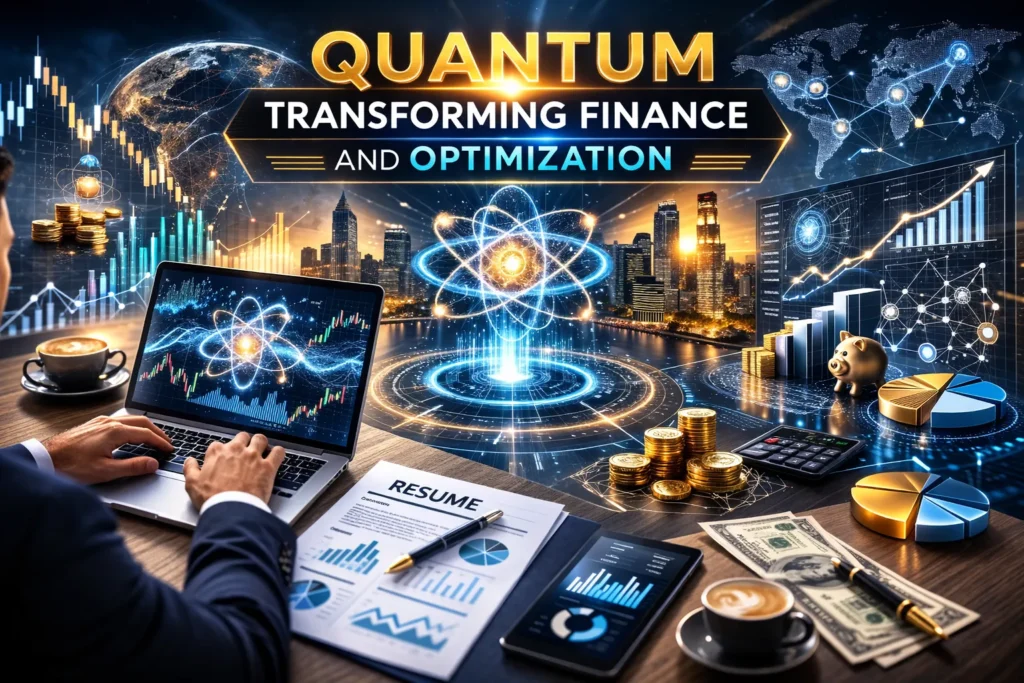
Transforming Finance and Optimization
The financial world is another area bracing for a massive shift. Global markets are driven by incredibly complex systems with countless variables, which makes trying to predict outcomes and manage risk a nightmare. These are exactly the kinds of optimization problems quantum algorithms are built for.
Financial institutions could use quantum computers to build hyper-accurate models for pricing assets, assessing risk, or optimizing an entire investment portfolio. Imagine a quantum algorithm analyzing thousands of market variables in real-time to pinpoint the absolute best trading strategy—a task far beyond what today’s machines can handle. The underlying principles are similar to the complex modeling used in data science, a field you can learn more about in our complete explainer on what data science is for beginners.
This isn’t just theory anymore. People are already building these algorithms. This screenshot from IBM’s Quantum platform shows the actual interface where researchers compose and run quantum circuits.
This visual composer is a real tool that lets people build quantum algorithms, showing how these abstract concepts are being put into practice right now.
The Biggest Challenges in Quantum Computing
If quantum computers are so mind-bogglingly powerful, why don’t we have one on our desks yet? The honest answer is that building and operating these machines is one of the hardest engineering puzzles humanity has ever faced.
The quantum world is incredibly delicate. The very properties that give qubits their magic—superposition and entanglement—also make them ridiculously fragile and tough to control.
The number one enemy is a problem called decoherence. Imagine a qubit in superposition is like a perfectly spun, shimmering soap bubble. The instant it touches anything from the outside world—a tiny vibration, a stray magnetic field, even a slight change in temperature—the bubble pops. It “decoheres,” collapsing back into a boring old classical bit, and the calculation is ruined. This can happen in a fraction of a second.
The Problem of Quantum Noise
This extreme sensitivity creates another huge headache: a high rate of errors, which scientists call quantum noise. Every single operation, every gate a qubit passes through, has a small chance of going wrong. These tiny errors pile up fast, quickly scrambling the final answer into gibberish.
To build a quantum computer that can solve real problems, we need to find a way to fix these errors faster than they can happen. And that’s a whole lot trickier than the error correction built into your laptop.
Quantum error correction is one of the hottest fields in physics right now. The basic idea is to use many physical qubits to create a single, much more robust “logical qubit.” This setup acts like a team, where some qubits can spot errors in their neighbors and fix them on the fly without destroying the quantum state.
The Road Ahead
Despite these massive hurdles, progress is happening, and it’s happening steadily. Researchers around the globe are coming up with clever new ways to shield qubits from the environment and design smarter error-correction codes.
The mission boils down to cracking a few key problems:
- Decoherence: Finding better ways to isolate qubits from environmental interference to keep them in their quantum state for longer.
- Error Rates: Cleaning up the “noise” in quantum operations to make calculations more accurate and reliable.
- Scalability: Figuring out how to build, connect, and control systems with not just a few hundred, but thousands or even millions of stable qubits.
Solving these challenges is what it’s all about for labs at Google, IBM, and universities worldwide. The work is incredibly complex—it’s like trying to build a new foundation for computing itself, not unlike the new systems of trust found in our guide on blockchain technology. Each small victory brings us one step closer to truly unleashing the power of the quantum realm.
Your Questions About Quantum Computing Answered
Alright, let’s wrap this up by tackling some of the big questions that pop up whenever people start digging into quantum computing. Think of this as a quick-fire round to clear up any lingering confusion and really lock in the core ideas.
Will a Quantum Computer Replace My Laptop?
Nope, definitely not. It’s best to think of a quantum computer as a highly specialized tool, like a deep-sea submarine built for one specific, incredibly difficult job. Your laptop, on the other hand, is like a versatile car you use for all your daily errands.
Quantum machines are being designed to work with classical computers, not replace them. They’ll be the heavy lifters for monumental problems in science and industry, while you’ll still be firing up your trusty laptop for emails, web browsing, and gaming.
Is Quantum Computing a Threat to Online Security?
This is a big one. And the short answer is: potentially, yes. A sufficiently powerful quantum computer running an algorithm like Shor’s could, in theory, crack the encryption that currently protects most of our digital lives.
But don’t panic. Researchers have been on top of this for years and are already hard at work developing “quantum-resistant” security methods. The race is on to upgrade our digital locks long before anyone builds a quantum key powerful enough to pick them.
It’s a classic cat-and-mouse game: researchers are building quantum-proof security right now to stay one step ahead. This proactive approach is crucial for keeping our digital world safe. You can keep up with the latest in this field by following the best tech news websites.
How Soon Will Quantum Computing Change Our Lives?
It’s already starting to, just not in ways you’d notice day-to-day. The earliest impacts are happening behind the scenes in hyper-specialized fields like drug discovery and designing new materials. Many experts are betting we’ll see the first major, commercially relevant breakthroughs by the end of this decade.
As for widespread changes that you and I will feel directly? That’s likely still a decade or more away. The technology is moving fast, but building stable, large-scale quantum computers is a marathon, not a sprint. The revolution will probably feel gradual, then all at once.
At maxijournal.com, we simplify complex topics to keep you informed. Explore more articles that make sense of the modern world. Learn more at https://maxijournal.com.
Discover more from Maxi Journal
Subscribe to get the latest posts sent to your email.