At its core, science communication is the art of making the complex clear. It’s all about translating dense, technical research into stories and information that everyone can understand, appreciate, and use. This isn’t just about dumping facts on people; it’s about building genuine understanding and showing how science connects to our daily lives.
What Is Science Communication Exactly?
Think about a brilliant scientist who makes a breakthrough discovery that could revolutionize medicine. That amazing find gets written up in a technical, jargon-heavy paper that only a few dozen other specialists in the field can even begin to understand.
Without science communication, that discovery would probably just sit there, locked away in an academic journal, completely out of reach for the doctors who need to apply it, the patients whose lives it could change, and the policymakers who shape our health systems.
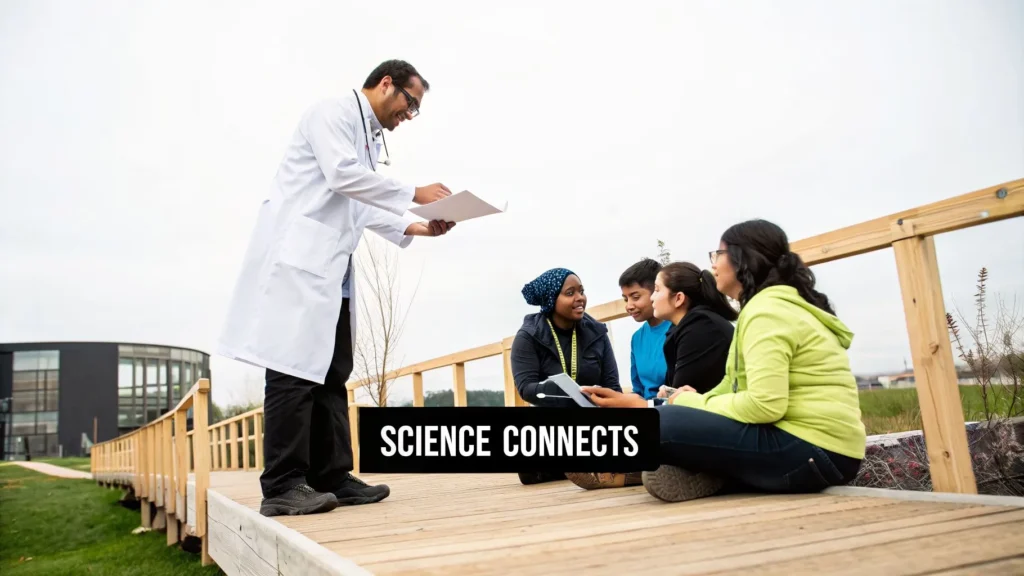
This is where the science communicator comes in. They are the essential bridge between two very different worlds.
On one side, you have the world of scientific research—a place filled with rigorous methods, complicated data, and a language all its own. On the other side, you have the rest of society—our homes, our communities, our governments. A science communicator builds a strong, accessible bridge connecting the two.
Bridging Science and Society
That bridge isn’t a one-way street where scientists just broadcast information out to the public. The best science communication is a genuine, two-way conversation. It’s about listening to the public’s questions and concerns, understanding their perspectives, and starting a real dialogue.
The whole point is to build a relationship based on trust and mutual respect. This is what separates great SciComm from a dry textbook definition.
To get a clearer picture, this table breaks down what science communication does and why.
Science Communication At A Glance
| Core Function | Common Formats | Desired Outcome |
|---|---|---|
| Translation | Articles, blog posts, videos, podcasts, social media | Making complex topics easy to grasp for non-experts. |
| Engagement | Museum exhibits, workshops, public talks, Q&A sessions | Sparking curiosity and creating a two-way dialogue with the public. |
| Informing Policy | Policy briefs, expert testimony, reports for government | Providing clear, evidence-based information for decision-makers. |
| Building Trust | “Behind-the-scenes” content, addressing misinformation | Making the scientific process transparent and relatable. |
Ultimately, effective science communication aims to achieve a few key goals:
- To Inform: Clearly explain scientific discoveries and what they mean for our everyday lives.
- To Inspire: Ignite curiosity and a sense of wonder about the world around us.
- To Build Trust: Be transparent about the scientific process, including its limitations and uncertainties.
- To Empower: Give people the knowledge they need to make smart, evidence-based decisions about their health, their communities, and the planet.
Effective science communication turns abstract data into something you can feel. It’s the difference between hearing a news report about a new pollutant and understanding exactly how it affects the air your kids breathe—empowering you to demand change.
By showing science as a messy, human process—full of dead ends, exciting breakthroughs, and unanswered questions—communicators make it far more relatable. That connection is everything.
When people feel a personal connection to science, they’re more likely to support research funding, embrace new technologies, and get on board with crucial public health efforts. Science communication makes sure that progress is for everyone, not just a handful of experts.
Why Simply Stating Facts Is Not Enough

For a long time, the world of science communication operated on a simple—and deeply flawed—premise. It was called the information deficit model, and it assumed the public was just an empty bucket waiting to be filled with facts.
The idea was that if scientists just presented the data clearly, people would listen, understand, and act accordingly. A scientist says, “The data shows X,” and the public thinks, “Great, I’ll now believe X.” But as we’ve seen with major issues like climate change, vaccinations, and public health, this “knowledge dump” approach often fails. Miserably.
The truth is, people are not empty buckets. We are all walking bundles of personal values, emotions, cultural identities, and life experiences. These factors create a powerful filter that decides what information we let in and what we immediately reject, no matter how solid the evidence.
The Psychology of Belief
When we’re hit with facts that clash with our deep-seated beliefs, our first instinct is often resistance, not acceptance. This isn’t stubbornness; it’s a well-known psychological quirk called confirmation bias. We’re hardwired to seek out information that confirms what we already believe and to dismiss anything that doesn’t.
Instead of changing our minds, we dig in our heels. If a piece of information feels like a threat to our identity or our social tribe, our brains go into overdrive to discredit it. This is precisely why lecturing a skeptic with climate statistics rarely works. The facts become secondary to the social threat.
Piling on more data can even backfire, making the expert seem arrogant and disconnected. When facts are delivered without any empathy or human connection, they can widen the divide and destroy the very trust you’re trying to build.
This is a make-or-break lesson for anyone trying to understand modern science communication. The old model of lecturing from on high is officially broken.
When Facts Fall Flat
This isn’t just theory. A massive analysis looked at 819 different social media experiments designed to boost COVID-19 vaccination rates using only facts and data. The result? A shockingly small attitude shift of just 1% on average. It proved, in a real-world crisis, that just stating the facts is nowhere near enough. You can read the full study on the limits of fact-based persuasion at phys.org.
This is why today’s best science communication is about connection, not just correction. Smart communicators have shifted their focus to building bridges instead of walls, using strategies like these:
- Dialogue over Monologue: Moving away from one-way lectures to create a two-way conversation where people feel heard and respected.
- Storytelling and Empathy: Wrapping data in relatable stories that resonate with our emotions and values.
- Finding Common Ground: Starting by identifying shared goals before getting into the weeds of contentious data.
By finally understanding that communication is a human-to-human interaction, not a data transfer, we can start doing the real work of building trust and making a difference.
The Evolution Of Science Communication
Science communication hasn’t always been the buzzing, essential field we know today. For a long time, it was a pretty quiet practice, mostly tucked away in science museums, specialized publications, and the corners of university life. It was important work, but its audience was limited.
Things have changed dramatically in the 21st century. What was once a niche specialty has been thrust into the spotlight, becoming a critical public service thanks to major global events and our ever-growing need for trustworthy information. The last twenty years, especially, have seen explosive growth.
From Niche Field To Public Imperative
The first real push came as society began grappling with huge, science-heavy challenges like climate change and genetic engineering. Suddenly, understanding science wasn’t just for scientists—it was for everyone.
Then, crises like the COVID-19 pandemic hit the accelerator. Hard.
Overnight, scientific terms like “viral transmission,” “vaccine efficacy,” and “flattening the curve” jumped from research papers into our daily conversations. Getting clear, reliable information became a matter of life and death, and science communicators found themselves on the front lines, battling a rising tide of confusion and misinformation.
You can see this shift reflected in the academic world. A review of science communication research between 2004 and 2024 found a massive surge in interest. The field went from just 47 papers in 2004 to a peak of 572 publications in 2021, right in the middle of the pandemic. You can dive deeper into how research in the field has grown on journals.sagepub.com.
Science communication went from a “nice-to-have” skill for a handful of scientists to a “must-have” pillar for a functioning society. Think of it as the public’s immune system against the virus of misinformation.
This transformation also broadened the very definition of who a science communicator is. The field now welcomes a much more diverse group of people than just traditional journalists.
The New Faces Of Science Communication
Today, the SciComm landscape is richer and more varied than ever before. It now includes:
- Digital Content Creators: YouTubers, podcasters, and TikTokkers who make science accessible and exciting for millions of followers.
- Policy Advisors: Experts who distill complex research findings into clear, actionable advice for lawmakers and government agencies.
- Citizen Scientists and Journalists: Everyday people who actively contribute to research projects and report on science-related news in their own communities. If you’re curious, our guide on what is citizen journalism explains how this works in practice.
- In-house Communicators: Specialists hired by universities and research labs to share their institution’s latest breakthroughs directly with the world.
This proves that science communication is no longer a one-way street or a top-down lecture. It’s become a lively, multi-directional conversation that’s absolutely essential for making sense of our modern world.
Exploring Modern SciComm Roles and Channels
Forget the old image of science communication being trapped in dusty textbooks or late-night documentaries. Today, it’s a dynamic, vibrant field. Science communicators are the translators, storytellers, and advocates bringing science to life across a staggering number of platforms.
Each role and channel has its own unique flavor, designed to reach different people with the right message. A TikTok creator might spark a teenager’s curiosity about black holes in a 60-second clip, while a policy advisor uses complex data to shape national climate strategy behind the scenes. Both are crucial, working in concert to weave science into the fabric of our society.
We often see a natural progression in modern SciComm. It starts with accessible digital media that captures broad public attention, which in turn fuels more serious policy discussions and, ultimately, serves the public good.
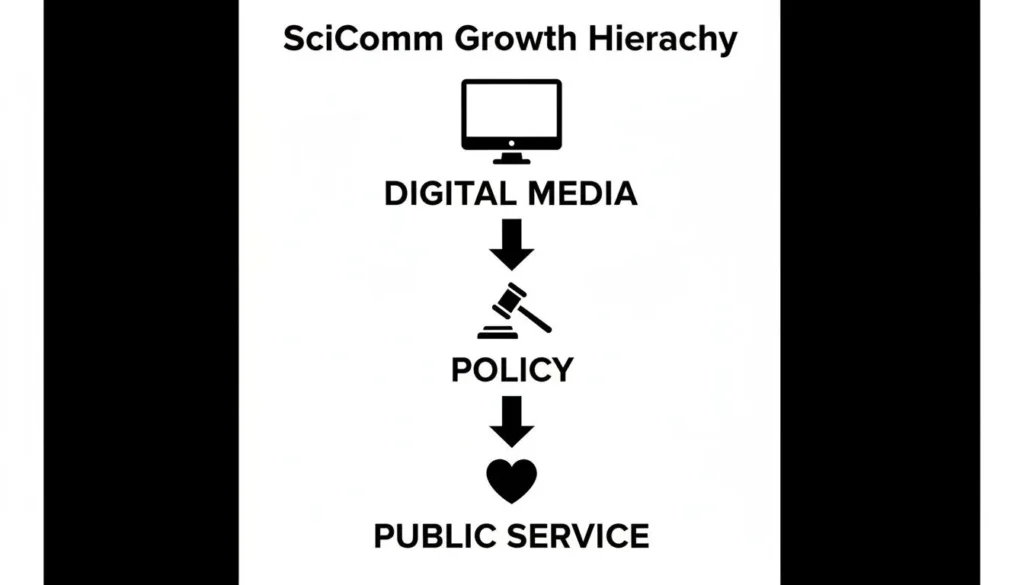
This path shows how a single viral video or popular podcast can lay the groundwork for real-world policy influence. Let’s dig into some of the key roles and channels where this incredible work happens.
From Public Engagement To Policy Making
The most visible arm of SciComm is easily public engagement. Think hands-on exhibits at your local science museum or the explosive, crowd-pleasing demonstrations at a science festival. The goal here is simple but powerful: inspire wonder and make science feel tangible.
For instance, a museum curator might design an exhibit on marine biology that lets kids and adults touch replicas of different coral species. That tactile experience builds a much stronger, more memorable connection to the science than just reading about reefs in a book.
Moving from broad outreach to more focused work, we find science journalism. Journalists who write for outlets like a dedicated science and technology magazine do more than just report. They dig into new studies, interview the experts, and hold powerful institutions accountable.
The real skill of a science journalist isn’t just grasping the science; it’s finding the story within it. They have to uncover the human element in the data—explaining why a new study on air pollution truly matters to a family living near a factory.
Finally, at the critical intersection of science and governance, you have policy advisors. These communicators are the quiet engines of change, working behind the scenes to provide clear, evidence-based briefings to government officials. Their ability to translate scientific consensus into actionable information is what turns research on public health or environmental protection into effective laws.
Comparing Science Communication Channels
So, what’s the best way to get a scientific message across? The truth is, it depends entirely on your audience and your goal. A podcast is perfect for a deep-dive conversation, while a sharp infographic can make complex data digestible in seconds.
To make this clearer, here’s a quick comparison of some of the most popular channels.
| Channel | Primary Audience | Key Skills | Main Objective |
|---|---|---|---|
| Podcasts | Commuters, niche hobbyists, curious learners | Storytelling, audio editing, interviewing | Deep-dive explanations and building a loyal community. |
| Social Media | General public, younger demographics | Visual design, brevity, trend awareness | Sparking initial interest and combating misinformation quickly. |
| Documentaries | Families, documentary enthusiasts | Narrative filmmaking, visual storytelling, research | Creating an emotional connection and in-depth exploration. |
| Policy Briefs | Government officials, lawmakers, agency staff | Synthesis, clarity, formal writing, data analysis | Informing evidence-based decision-making and legislation. |
Remember, these channels don’t exist in a vacuum. A viral TikTok can lead to a full-blown documentary, which in turn might land on a policymaker’s desk and inspire real change. This dynamic interplay is what makes modern science communication so effective.
Essential Skills For Effective Science Communicators
Knowing the science inside and out is only half the battle. To truly succeed as a science communicator, you need a toolkit of skills designed to build a bridge between dense, expert knowledge and everyday understanding. It’s less about your academic credentials and more about your ability to make a genuine human connection.
The single most powerful tool in your arsenal? Storytelling. Let’s be honest, our brains are wired for stories, not spreadsheets. A truly skilled communicator can take a dry set of data points and weave them into a compelling narrative—one with a clear beginning, a challenging middle, and a satisfying end. This is what makes information stick.
Mastering The Art Of Translation
To make complex ideas click, you have to become a master translator. One of the best ways to do this is with a powerful analogy. For instance, explaining a vaccine as a “training session” for your immune system immediately makes an abstract biological process feel concrete and familiar. It gives your audience a mental hook to hang the new information on.
Another core skill is deep audience understanding. Before you even think about what to say, you have to ask: Who am I talking to? What do they already know, and what might they believe that isn’t quite right? Most importantly, why should they care? This empathetic approach is what separates a message that resonates from one that falls flat.
The point isn’t to “dumb down” the science. It’s to “smarten up” the communication. You have to respect your audience’s intelligence while making the information as accessible and engaging as you possibly can.
Key Competencies For Modern Communicators
Beyond telling great stories and knowing your audience, a few other skills are absolutely essential in today’s world:
- Visual Communication: We live in a world of short attention spans. The ability to use sharp infographics, short videos, and powerful images isn’t a bonus anymore—it’s a requirement. A single, well-designed visual can often explain complex data more effectively than a wall of text ever could.
- Active Listening: Real communication is a conversation, not a lecture. Active listening means paying close attention to the questions, fears, and skepticism from the public. This not only builds trust but also ensures you’re addressing what people actually want to know.
- Intellectual Humility: This might be the most important skill of all. It’s the willingness to be open about what science doesn’t know yet, to admit when there are uncertainties, and to correct the record when mistakes are made. This kind of transparency makes science feel more human and builds trust for the long haul.
Getting good at these skills is a journey, not a destination. For example, becoming a great storyteller often means getting comfortable in front of a crowd. If that’s an area you want to work on, our guide on how to improve public speaking has some practical tips to get you started. By weaving all these competencies together, you can go from being just a subject matter expert to a truly impactful communicator.
Navigating Misinformation and Building Lasting Trust
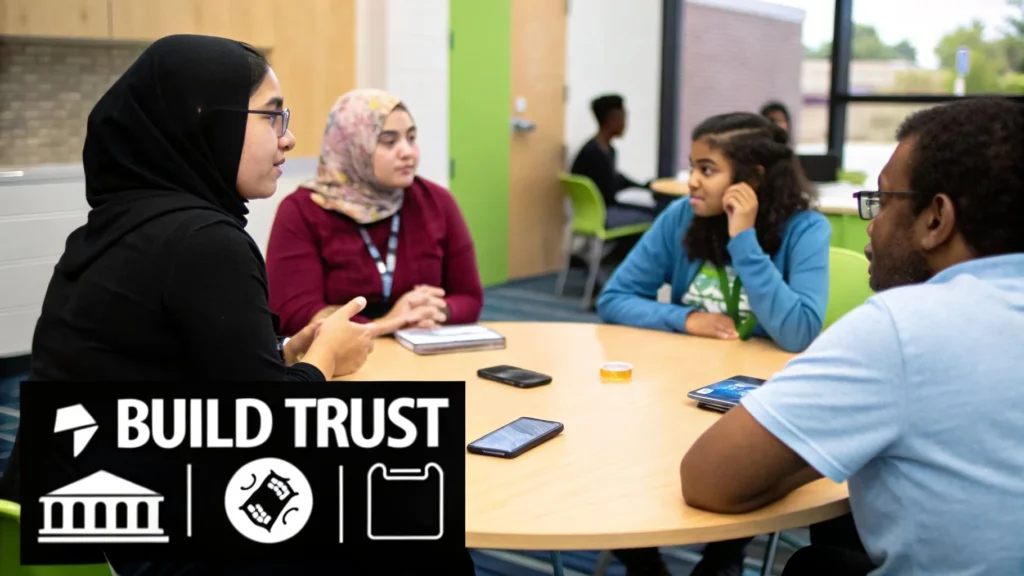
In a world flooded with information, good science communication is our best line of defense against the spread of misinformation. When clear, trustworthy science is missing from the conversation, myths and conspiracy theories will always fill the space.
This isn’t just an academic problem. We’ve seen how public debates around COVID-19 and climate change get twisted for political or ideological reasons. This has a real impact on public trust. According to research, the number of U.S. adults who have a great deal of trust in scientists dropped from 87% to 77% in just two years. For a deeper dive, you can read the full research on science news consumption and trust.
When communication fails, the trust that science depends on begins to crumble.
Proactive Strategies For Building Resilience
The most effective way to combat bad information is to make sure good information gets there first. Instead of just reacting to myths after they’ve already spread, science communicators now use proactive strategies to protect public understanding.
One of the best methods is known as pre-bunking, based on inoculation theory.
Think of pre-bunking like a vaccine against misinformation. The idea is to expose your audience to a weakened version of a misleading argument and immediately correct it. This helps them build “mental antibodies” so they are more resistant when they see the real myth out in the wild.
For example, a climate communicator might start by saying, “You’ve probably heard people say ‘the climate has always changed,’ and that part is true. But here’s the key reason today’s rapid change is so different and dangerous.” This approach prepares the audience to think critically about common but misleading talking points.
Transparency and Dialogue Are Key
Beyond specific tactics, the only way to build lasting trust is through consistent transparency and real dialogue. Science isn’t a magic box that delivers perfect answers—it’s a messy, human process of discovery, full of wrong turns and revisions.
Here are some effective strategies for building that trust:
- Embrace Uncertainty: Be open about what science doesn’t know yet. Admitting limitations doesn’t make you look weak; it shows intellectual honesty and builds credibility.
- Foster Community Dialogue: Create spaces where people can have a genuine two-way conversation and ask tough questions without being judged. This builds relationships and proves that scientists are listening.
- Show the Process: Pull back the curtain on how research actually works. Talking about the dead ends and revised hypotheses makes science more relatable and human.
By focusing on these behaviors, what is science communication moves beyond simply broadcasting facts. It becomes a vital practice of engaging with the community in a shared search for understanding.
Frequently Asked Questions About Science Communication
Diving into the world of science communication? You probably have some questions about breaking into the field. We’ve got answers to the most common ones.
Do I Need a Science Degree to Be a Science Communicator?
Not at all. While a science background can definitely help, some of the best communicators come from completely different fields like journalism, art, or education.
The most important things are deep curiosity, the ability to tell a compelling story, and a real desire to make complicated ideas easy to understand. If you can act as a translator between the technical and the relatable, you have the core skills you need.
What Is the Difference Between SciComm and Science Journalism?
Think of science journalism as just one piece of the much bigger science communication puzzle. Journalism is usually focused on reporting new discoveries, investigating scientific claims, and holding institutions accountable. It’s a specific craft with a clear purpose.
SciComm is the broader umbrella. It includes journalism, but also covers a huge range of other activities:
- Public engagement through science festivals and talks.
- Educational content for museums, websites, and schools.
- Policy outreach to help lawmakers make informed decisions.
- Entertainment, including documentaries, podcasts, and even viral social media videos.
How Can I Get Started in Science Communication?
The key is to start small and build from there. Don’t wait for the perfect opportunity.
Try writing a blog post about a scientific topic you find fascinating, or make a short video for TikTok or Instagram explaining a concept. Volunteering at a local science museum or festival is another fantastic way to get your foot in the door.
Find a subject you’re passionate about and an audience you want to connect with. Then, just start practicing.
At maxijournal.com, we champion clear and engaging storytelling across all fields, from science to art. If you have a story to tell, learn more about becoming a contributor.
Discover more from Maxi Journal
Subscribe to get the latest posts sent to your email.