You’ve heard the term a thousand times, but what exactly is the metaverse? Let’s get past the buzzwords. Imagine if you could step through your computer screen and into the internet itself.
That’s the simplest way to think about it. The metaverse is a vision for a persistent, shared, 3D digital universe where our digital and physical lives converge. You’d navigate these spaces not with a mouse and keyboard, but through a personal avatar that can socialize, work, play, and even own things.
What the Metaverse Really Is
Think of the metaverse less as a single destination and more as the next chapter of the internet. It’s not one company’s product or a single giant game. Instead, it’s a network of countless interconnected virtual worlds.
Rather than clicking links on a flat webpage, you might one day walk your avatar through a digital portal, moving seamlessly from a virtual concert to a collaborative workspace with colleagues from across the globe. This concept aims for a genuine sense of presence—the feeling that you are truly there with other people.
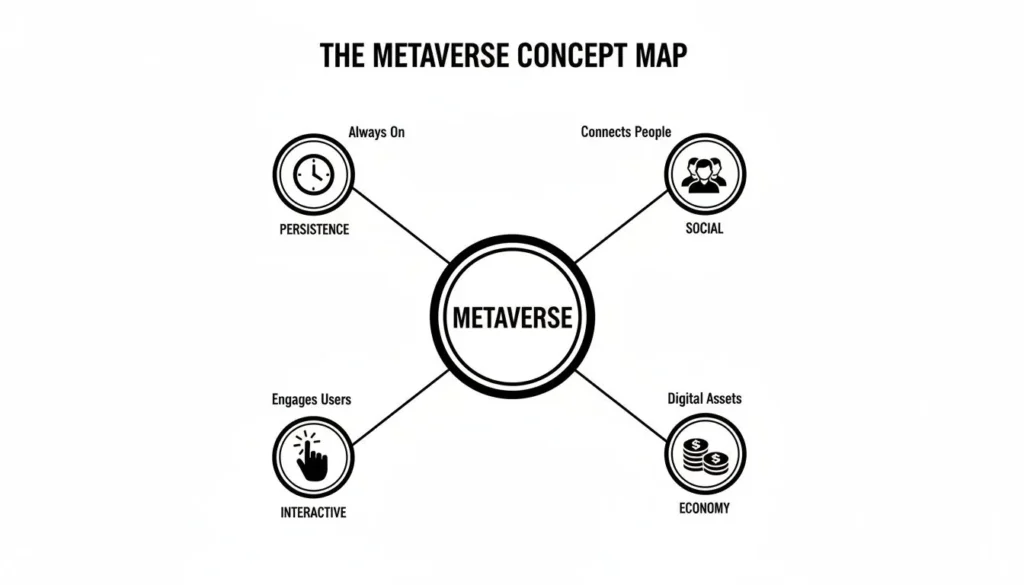
This new frontier is being built on four foundational ideas that set it apart from the web we use today.
The Four Pillars of the Metaverse
- Persistence: The metaverse doesn’t pause or reset when you log off. These virtual worlds exist continuously, evolving whether you’re there or not, much like a real-world city.
- Interactivity: You can interact with the environment and with other avatars in complex, dynamic ways. This goes far beyond just “likes” and “comments” into real-time creation, collaboration, and shared activities.
- Social Presence: Through customizable avatars, you get a tangible sense of being in a shared space with others. This allows for more natural social cues and a deeper feeling of connection than a video call.
- Economy: A fully functioning economy is crucial. Users can create, buy, sell, and truly own digital assets—from virtual clothes and accessories to digital land and art, often secured on a blockchain.
It’s this vision that has attracted enormous attention and investment. The global metaverse market is projected to climb from $314.71 billion in 2025 to $448.89 billion in 2026, a massive compound annual growth rate of 42.6%. You can dig into the numbers in this detailed market report from The Business Research Company.
To better understand this shift, let’s compare the internet we know with the metaverse that’s being built.
The Metaverse vs The Traditional Internet
This table breaks down the core differences between the internet we use every day (Web 2.0) and the immersive, decentralized vision of the metaverse (often associated with Web 3.0).
| Characteristic | Traditional Internet (Web 2.0) | The Metaverse (Web 3.0) |
|---|---|---|
| Primary Dimension | 2D (Flat pages, text, images, video) | 3D (Immersive, spatial environments) |
| User Interaction | Viewing and clicking content on a screen | Inhabiting and interacting within a shared space |
| Sense of Self | Profiles and usernames | Embodied avatars with customizable identity |
| Social Experience | Asynchronous (forums, social feeds) or 2D real-time | Synchronous, shared experiences with a feeling of co-presence |
| Economics | Centralized platforms control data and digital goods | Decentralized, user-owned economy with verifiable digital assets |
| Device Accessibility | Accessed via browsers on phones, laptops, and desktops | Accessed via VR/AR headsets, game consoles, and future devices |
| Core Metaphor | A “web” of information to be browsed | A “universe” of worlds to be explored |
As you can see, the change is fundamental. It’s about moving from a model of information consumption to one of experiential participation.
The key takeaway is that the metaverse represents a shift from viewing the internet to being inside it. It’s the difference between looking at a picture of a concert and actually attending it with thousands of other fans in a vibrant, digital venue.
This core evolution is what truly separates the metaverse from today’s online experiences, opening the door to a far more immersive and interactive digital existence.
Understanding the Technology Powering the Metaverse
The whole idea of a vast, digital universe sounds like something straight out of science fiction. But what actually makes it run? The metaverse isn’t one single program you can download; it’s a whole collection of technologies that have to work together perfectly.
Think of it like building a house. You need a foundation, walls, electrical wiring, and plumbing. Each piece does a completely different job, but without all of them, you just have a pile of materials, not a home. Let’s look at the essential tech that makes up the metaverse.
Doorways to Digital Worlds: VR and AR
First things first: how do you even get into the metaverse? The most common entry points are virtual reality (VR) and augmented reality (AR). They act as the main gateways, each offering a totally different feel.
Virtual reality is all about full immersion. When you put on a VR headset, like one from the Meta Quest series, your real-world surroundings disappear completely. You’re transported into a fully digital environment. This is perfect for things that demand your full attention, like intense gaming, virtual social events, or complex training simulations.
Augmented reality, on the other hand, doesn’t replace your world—it adds to it. It overlays digital information onto your real-life view. Think of something as simple as a Snapchat filter or as interactive as the game Pokémon GO. As AR gets more advanced, imagine seeing navigation arrows projected right onto the street as you walk, or hovering product reviews next to an item on a store shelf.
Curious about how AR pulls this off? You can dive deeper into augmented reality in our detailed guide.
These technologies are the key to unlocking the core traits of the metaverse: a persistent world that’s social, interactive, and has its own economy.
Building the 3D Space: Spatial Computing
Okay, so you’re “in” the metaverse. What about the world itself? Who builds it? That’s the job of spatial computing. This is both the architectural blueprint and the construction crew for these massive 3D environments.
Put simply, spatial computing is what allows computers to understand and interact with 3D space just like we do. It’s the reason your avatar walks around a virtual table instead of straight through it. It’s what lets you hang a digital photo on a virtual wall and know it will still be there the next time you log in.
Spatial computing is the magic that connects the digital and physical worlds. It’s what digitizes real-world objects for AR and what builds believable, interactive 3D spaces for VR.
This is the tech behind “digital twins”—perfect virtual copies of real-world objects. Engineers, for example, can build a digital twin of a new jet engine to run thousands of tests that would be far too expensive or dangerous to do with the real thing.
The Keys to Ownership: Blockchain and NFTs
In a digital world, how do you prove you actually own something? On the internet today, most of your “purchases”—like a movie on a streaming service or a skin in a game—are really just licenses. The company can take them away at any time. The metaverse is trying to fix this with blockchain and Non-Fungible Tokens (NFTs).
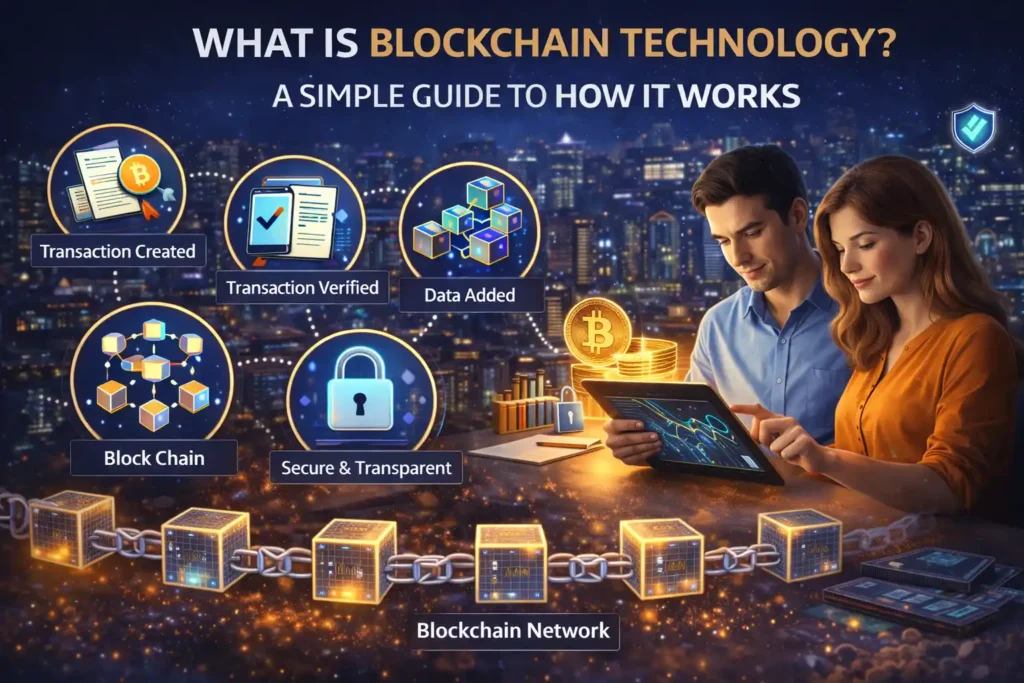
Think of the blockchain as a giant, public, and super-secure digital receipt book. Every transaction and proof of ownership is recorded there for everyone to see, and it’s almost impossible to fake or change.
NFTs are unique digital certificates of ownership stored on that blockchain. An NFT can represent ownership of pretty much anything digital:
- A one-of-a-kind piece of digital art
- A special outfit for your avatar
- Virtual real estate on a platform like Decentraland
- A ticket to an exclusive virtual concert
This system gives you true, verifiable ownership of your digital stuff. You can buy it, sell it, or trade it on open marketplaces, just like you would with physical trading cards or sneakers.
The Universal Passport: Interoperability
The final piece of the puzzle—and the ultimate dream for the metaverse—is interoperability. This is the idea that you should be able to take your avatar and your digital possessions seamlessly from one virtual world to another, no matter who built them.
Imagine buying a cool sword in one game and then being able to equip and use it in a totally different game from another developer. Or having a single, consistent avatar that represents you across every social platform, game, and virtual meeting you join.
Right now, this is the biggest challenge. Most platforms are “walled gardens,” meaning your identity and your digital items are stuck inside one company’s ecosystem. Achieving true interoperability would be like creating a universal passport for the digital world, connecting all these separate islands into one massive, interconnected continent. It’s the last, and arguably the toughest, problem to solve.
Exploring Real Metaverse Platforms You Can Visit Today
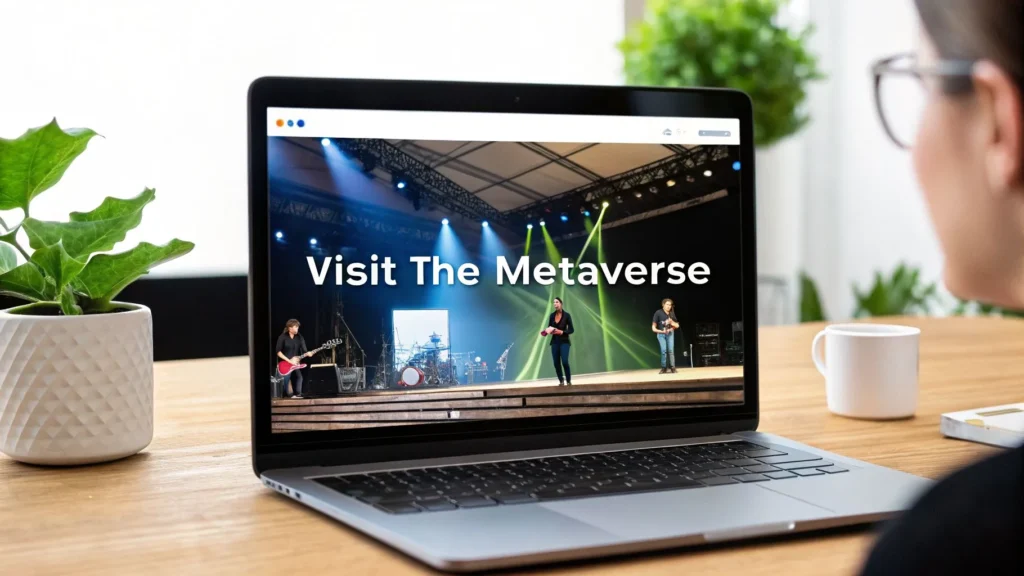
The metaverse isn’t some far-off idea from a sci-fi movie. You can actually log into dozens of early-stage platforms right now, each offering a totally different flavor of this new digital world. These aren’t just empty tech demos; they’re living spaces where millions of people already play games, hang out, build things, and even go to work.
Chances are, you’ve already brushed up against the metaverse without even realizing it, most likely through gaming. The line between a massive online game and a virtual social world has gotten incredibly blurry.
Gaming: The Accidental Front Door to the Metaverse
Gaming platforms have sort of stumbled into becoming the first real testbeds for the metaverse. They’ve evolved from just being about entertainment into huge social gathering places, proving that millions of us are more than willing to spend our time and money in these shared digital spaces.
Fortnite: What started as a battle royale game has exploded into a cultural hub. It’s hosted massive virtual concerts, like the one with Travis Scott that pulled in over 27 million viewers. It’s now a place to just chill with friends, watch a movie premiere, or see the latest brand collaboration.
Roblox: This isn’t just one game; it’s a universe of millions of them, all built by its users. You can find just about anything here, from running a virtual pizza shop to escaping a simulated tornado. It even has its own creator economy where developers can earn real cash from their virtual worlds.
VRChat: If you’re looking for something more immersive, VRChat is a social VR platform where everything—the avatars, the worlds—is created by the community. It’s a wild, creative space that hosts virtual talk shows, comedy clubs, language exchanges, and art galleries. It’s all about feeling truly present with other people.
These platforms are nailing a key part of the metaverse vision: creating persistent social worlds where having fun and interacting with others is the main event.
It’s Not Just Fun and Games
While games and social apps get most of the attention, the metaverse is quickly pushing into other areas of our lives. Businesses, fashion brands, and schools are all starting to build practical tools that solve real problems and open up new doors.
A huge part of this push is the money involved. Researchers are predicting the metaverse market could swell from $155.35 billion in 2025 to an eye-watering $7,171.54 billion by 2035, driven by a massive compound annual growth rate of 46.7%. This is all built on the success of early events, with virtual live entertainment alone now pulling in an estimated $1.5 billion a year. You can dig deeper into these projections on the future of the metaverse economy from NovaOneAdvisor.
With that kind of cash on the table, it’s no wonder development is speeding up everywhere.
The metaverse isn’t just about escaping reality; it’s about extending and enhancing it. From professional collaboration to creative expression, its applications are becoming more integrated with our daily lives.
Let’s get into some real, tangible examples of what’s happening right now.
Real-World Use Cases in Action
The practical side of the metaverse is getting clearer every day as more industries start experimenting. These aren’t just one-off marketing stunts; they’re functional platforms that are already getting real results.
Business and Collaboration
Plenty of companies are setting up digital headquarters in virtual worlds. Teams can meet up as avatars, brainstorm on virtual whiteboards, and get a sense of being in the same room that a simple video call just can’t match. It’s a game-changer for remote teams trying to build a strong company culture.
Fashion and Digital Goods
Big-name fashion brands like Gucci and Balenciaga have launched digital clothing and accessories on platforms like Roblox. People buy these virtual items for their avatars, which has kicked off a whole new market for digital self-expression and shows that we place real value on our virtual stuff.
Education and Training
Immersive simulations are a safe and cheap way to get hands-on training. Medical students can practice complicated surgeries in a zero-risk virtual OR, and engineers can build and test complex machines without needing expensive physical parts.
Tourism and Exploration
Virtual tourism lets you explore faraway places or historical sites right from your couch. You can walk through a perfect recreation of ancient Rome or visit a digital twin of a national park, making travel and learning more accessible to everyone.
These examples are really just the tip of the iceberg. As the tech gets better, what the metaverse is will keep shifting from a bunch of separate worlds into a more connected—and essential—part of our digital lives.
Your First Steps Into the Metaverse

Reading about the metaverse only gets you so far. To really “get it,” you have to experience it for yourself. The good news? You don’t need to be a tech wizard or shell out for expensive gear to get started. Many of the most popular platforms are designed to be incredibly accessible, serving as perfect, low-pressure entry points.
The easiest way to jump in is with the device you’re probably reading this on right now: your computer. Several major metaverse platforms are entirely browser-based, which means no special software downloads or new hardware are required. It’s all about removing the friction so you can explore without any real commitment.
Despite the hype around VR headsets, the metaverse is being built to be device-agnostic. The goal is for these experiences to adapt to whatever screen you have, whether it’s a 2D laptop display or a fully immersive 3D headset.
This flexibility is what will ultimately make the metaverse a mainstream reality. Let’s start with the most direct method.
Starting with Your PC or Mac
Browser-based platforms give you a solid taste of what the metaverse is all about—socializing, exploring, and digital ownership—all from a familiar interface. Think of it like navigating a 3D website. Here’s a quick guide to getting started on a platform like Decentraland, one of the most established user-owned virtual worlds.
- Head to the Website: Just open your browser and go straight to the platform’s official site.
- Pick Your Entry: You’ll usually see an option to “Play as Guest” or connect a crypto wallet. For your first time, jumping in as a guest is the perfect, no-strings-attached way to look around.
- Make a Basic Avatar: You’ll get a chance to create your digital self. You can customize its look, clothing, and features to create a style that feels right.
- Start Exploring: Once you’re in, just use your keyboard (typically the W, A, S, and D keys) and mouse to move around and interact. You can check out events, visit virtual art galleries, or just wander around and see what other people have built.
This first dive will quickly introduce you to the core idea of a shared, persistent 3D world.
Leveling Up with a VR Headset
After you’ve dipped your toes in, you might be curious about a more immersive experience. This is where virtual reality headsets, like the popular Meta Quest series, enter the picture. A headset completely swaps your real-world view for the digital one, creating an incredibly powerful feeling of presence.
The setup process has gotten surprisingly simple over the years:
- Initial Setup: Most new headsets are standalone, so you don’t need a beast of a PC. You’ll run through a quick on-screen tutorial to connect to your Wi-Fi and draw your “guardian”—a virtual boundary that keeps you from walking into your coffee table.
- Create Your Avatar: Just like the browser experience, you’ll design an avatar, but this one will be a more detailed, full-body version that represents you in VR. It will often mirror your head and hand movements, which really adds to the sense of being there.
- Navigate the Hub: You’ll start in a personal virtual space or “home” that acts as your main menu. From here, you can launch apps, browse the internet on massive virtual screens, or have friends over to hang out.
Interacting in VR is a whole different ballgame. You use motion controllers that function as your hands, letting you intuitively grab objects, point, and communicate with natural gestures. That physicality is what makes VR such a compelling way to see what the metaverse has in store.
Whether you begin on your browser or go straight for VR, that first step is all it takes to start understanding where this technology is headed.
The Opportunities and Hurdles Shaping the Future
As we look toward this new digital frontier, it’s clear the metaverse is a two-sided coin. On one side, you have incredible opportunities for creativity and connection. On the other, you’ve got some serious technical and ethical hurdles to overcome. To really get what the metaverse could become, you have to understand both sides of that coin.
The most obvious opportunity is the explosive new economy taking shape. We’re already seeing creators, developers, artists, and major brands building new ways to make money in these virtual worlds. From selling digital Nikes for avatars to constructing entire virtual concert venues, the economic potential is growing by the day.
The New Digital Gold Rush
The numbers behind this shift are pretty mind-boggling. The metaverse market was valued at around $189.67 billion in 2025 and is on track to explode to $5,697.52 billion by 2035. That’s a compound annual growth rate (CAGR) of 41.4% starting in 2026.
Even big business is jumping in. It’s expected that 75% of Fortune 500 companies will be testing out metaverse strategies by 2025. They’re looking at it for things like virtual meetings and training, building on the hybrid work trend that made tools like Zoom—which has seen 300 million daily participants—so essential. You can dig deeper into these metaverse market trends in this detailed analysis from Insightace Analytic.
This economic boom is being driven by a few key areas:
- Creator Economies: Platforms are finally giving individual creators the power to build and sell their own digital experiences, sparking a new generation of entrepreneurs.
- Virtual Real Estate: Location, location, location—it even matters online. Plots of digital land in popular metaverses like Decentraland are being bought and sold, sometimes for huge sums.
- Digital Assets: This is the big one. Thanks to blockchain, you can have true ownership of digital items, from art to clothes. These assets have real, tradable value, which is a massive change from the closed-off economies we’ve seen in gaming for years.
The metaverse isn’t just a place to play games anymore. It’s quickly becoming a place to work, invest, and build a real career. We’re moving from an internet where we just consume content to one where we actively participate and create value.
But with all this excitement comes some serious challenges. The very technologies that make this all possible also bring up tough problems we’re just starting to figure out.
Navigating the Major Challenges
If the metaverse is ever going to live up to the hype, we have to get a handle on some major technical and ethical roadblocks. The path forward isn’t a straight line, and finding the right answers will take a smart mix of new tech and sensible rules.
Data Privacy and Security
Think about it: if the metaverse is tracking where we look, how we move, and who we talk to, the amount of personal data being collected will be off the charts. Keeping that data safe from hackers or misuse is a huge undertaking. Who owns it? How can it be used? We don’t have good answers yet.
User Safety and Moderation
How do you police a virtual world? Stopping harassment, bullying, and other toxic behavior is much harder in an immersive 3D space than just moderating text on a website. Platforms are really struggling to figure out how to keep people safe without killing free expression.
The Battle for Interoperability
Is the metaverse going to be one big, open universe, or a bunch of separate “walled gardens” run by a few tech giants? The dream is that you can take your avatar and your digital stuff from one world to another, seamlessly. The reality right now is that big players are building their own closed systems. This fight over an open vs. closed metaverse will shape the future of the internet.
To really get why this is such a big deal, it helps to understand the tech behind digital ownership. If you’re curious, check out our guide to blockchain technology and how it enables true ownership.
These challenges are tough, but they’re not impossible to solve. It’s going to take a lot of smart people working together to figure it out. The kind of metaverse we end up with really depends on whether we can tackle these problems the right way.
Answering Your Top Questions About the Metaverse
Even after digging into the tech and seeing the platforms in action, it’s natural for a few questions to pop up. The whole idea of the metaverse is massive and still being built, so it’s perfectly normal to have some “but what about…” moments. We’ve put this section together to give you clear, straightforward answers to the questions we hear most often.
Our goal here is to cut through the hype and offer some practical clarity. We’ll cover everything from the hardware you need (or don’t need) to the very real economic side of things, helping you get a complete picture of what the metaverse is today and where it’s going.
Do I Absolutely Need a VR Headset?
This is easily the number one question, and the answer is a definite no. While a virtual reality headset offers the most immersive way to step into these 3D worlds, it’s not a mandatory ticket for admission. Most of the big metaverse platforms are built to be accessible right from your web browser on a PC or Mac.
Think about it like watching a movie. You can see it on a giant IMAX screen for the full, mind-blowing experience, or you can watch it on your laptop. You’re still getting the same story, just through a different window. The same logic applies here. Browser-based access is a key strategy for developers because it dramatically lowers the barrier to entry, letting anyone jump in and explore without buying hundreds of dollars in new gear.
The metaverse is being designed to adapt to the device you use, not the other way around. Accessibility on 2D screens like laptops and phones is just as important as full immersion in 3D headsets for long-term growth.
This open-door approach is what will prevent the metaverse from becoming a niche hobby for tech geeks and help it grow into a broad, mainstream evolution of the internet.
Is the Metaverse Just for Gaming?
While gaming was the gateway for millions of people, the metaverse’s ambitions stretch far beyond it. Gaming platforms like Fortnite and Roblox were the accidental trailblazers, proving that huge numbers of people were hungry to hang out, socialize, and interact in shared digital spaces. They laid the groundwork, and now other industries are building on that foundation.
We’re already seeing a massive expansion into other fields:
- Social and Community: Platforms like VRChat exist purely for social interaction, hosting everything from virtual book clubs and language classes to live stand-up comedy and support groups.
- Business and Work: Companies are building virtual headquarters for remote teams, running employee training in complex simulations, and hosting major industry conferences that feel more engaging than a Zoom call.
- Creative Arts: Digital artists are opening virtual galleries to show and sell their work as NFTs, and musicians are throwing interactive concerts for fans across the globe.
- Education: Schools and universities are using these worlds to run virtual science labs, recreate historical sites for immersive tours, and offer a more compelling take on distance learning.
Gaming was the proof of concept. The true vision is for the metaverse to become a parallel layer of interaction for almost every part of our lives.
Who Actually Owns and Controls the Metaverse?
This is a tricky one, because the answer is “it depends.” There isn’t a single, unified metaverse. Instead, it’s a collection of different platforms, and their ownership structures are completely different. This has created a central tension that will define how this digital frontier develops.
Right now, the situation is split between two main camps:
- Centralized Platforms: These are owned and run by a single company, like Meta’s Horizon Worlds or Epic Games’ Fortnite. In this model, the company sets all the rules, controls the digital economy, and owns the servers. It’s often called a “walled garden.”
- Decentralized Platforms: Built on blockchain technology, these worlds are owned and governed by their users. On platforms like Decentraland, users can buy virtual land as NFTs and vote on platform policies. This model is pushing for a more open, democratic, and user-owned digital future.
Whether the metaverse becomes an open, interconnected system or a series of siloed, corporate-run theme parks is one of the biggest debates happening in tech right now. The winner will be determined by which model ultimately attracts more users and creators. To stay on top of this, it’s worth following the best tech news websites that are covering the space in detail.
Can You Make Real Money in the Metaverse?
Yes, and people are already doing it in more ways than you might think. The rise of a true digital economy is one of the core pillars separating the metaverse from the closed, in-game economies of the past. Thanks to tech like blockchain and NFTs, users can have genuine ownership of digital assets, giving them real-world value.
Here are a few of the most common ways people are earning income:
- Creating and Selling Digital Assets: Artists and 3D modelers are making everything from avatar clothing and accessories to virtual furniture and selling them on various marketplaces.
- Developing Experiences: Programmers and designers get paid to build custom games, special events, or interactive spaces for brands and individuals within a platform.
- Digital Real Estate: Some people buy virtual land in popular areas and then rent it out or host ticketed events, creating a form of digital rental income.
- Play-to-Earn Gaming: This new genre of games allows players to earn cryptocurrency or tradable NFTs through gameplay, which can then be sold on open markets for real money.
It’s still early, but the creator economy in these virtual worlds is starting to take off. For instance, in-world purchases on Meta’s Horizon platform grew by 280% in a single year, and over 300 apps on its store have each generated more than $1 million in revenue. It’s a clear sign that the digital economy is becoming a serious part of the metaverse equation.
At maxijournal.com, we’re dedicated to bringing you clear, insightful content on the trends shaping our world. From technology and science to arts and entertainment, our goal is to keep you informed and inspired. Explore more at https://maxijournal.com.
Discover more from Maxi Journal
Subscribe to get the latest posts sent to your email.