At its heart, a fusion reaction is what happens when you smash two light atomic nuclei together so hard that they stick, forming a single, heavier nucleus. In the process, a huge amount of energy is released. It’s the same physics that has powered our sun and every other star for billions of years.
Understanding a Fusion Reaction at Its Core
Think of a fusion reaction as nature’s ultimate building block. It starts with the lightest elements, like hydrogen, and subjects them to such incredible force that they overcome their natural tendency to repel each other and merge into something new. This unlocks one of the universe’s fundamental forces, turning a tiny bit of mass into a staggering amount of energy.
The secret sauce here is Albert Einstein’s famous equation, E=mc². What it really means is that mass and energy are just different forms of the same thing. When fusion occurs, the new, heavier nucleus actually weighs a fraction less than the two original nuclei combined. That “missing” mass hasn’t vanished—it has been converted directly into pure energy.
To get fusion going here on Earth, you basically have to build a miniature star. That requires two key ingredients:
- Extreme Heat: You need temperatures over 100 million degrees Celsius. That’s many times hotter than the core of the sun. At these temperatures, atoms are stripped of their electrons, creating a superheated state of matter called plasma.
- Intense Pressure: All that heat has to be contained under immense pressure, which forces the atomic nuclei close enough together for the fusion magic to happen.
Fusion vs. Fission at a Glance
It’s easy to get fusion mixed up with its more well-known cousin, fission. While they are both nuclear processes that unleash energy, they are essentially polar opposites. Fission works by splitting heavy, unstable atoms (like uranium), whereas fusion combines light, stable atoms (like hydrogen).
This quick table breaks down the main differences.
| Feature | Nuclear Fusion | Nuclear Fission |
|---|---|---|
| Process | Combines light atomic nuclei | Splits heavy atomic nuclei |
| Fuel | Abundant light elements (e.g., hydrogen isotopes) | Scarce heavy elements (e.g., Uranium-235) |
| Energy Release | Extremely high per unit of mass | High, but less than fusion |
| Waste | No long-lived radioactive waste; produces helium | Produces long-lived, highly radioactive waste |
| Safety | Reaction is inherently self-limiting and cannot “melt down” | Risk of chain reactions and meltdown if not controlled |
As you can see, the two processes are worlds apart, especially when it comes to fuel and waste.
Gram for gram, a single fusion reaction releases nearly four million times more energy than burning coal or oil. Better yet, it does it without producing the long-lived radioactive waste that plagues fission power. This incredible energy density is exactly why it’s considered the holy grail of clean energy.
For decades, scientists have been on a quest to tame this stellar power. The ultimate goal is to build power plants that can safely harness fusion, giving us a source of clean, safe, and virtually limitless energy. Projects around the world are making real progress, bringing us closer than ever to a future powered by stars we build right here on Earth.
The Physics of Creating a Star
To really wrap your head around fusion, you have to zoom in on the forces battling it out inside every atom. It’s a constant subatomic tug-of-war. In one corner, you have the electrostatic force, which makes positively charged atomic nuclei push each other away. Think of trying to force the north poles of two powerful magnets together—they resist like crazy.
In the other corner is the strong nuclear force, one of nature’s four fundamental forces. It’s unbelievably powerful, but it only works over incredibly short distances. If you can shove two nuclei close enough together, this force takes over, slams the door on electrostatic repulsion, and fuses them into one. That’s the whole game.
Overcoming the Cosmic Barrier
So, how do you get past that repulsive barrier? You have to copy the conditions found inside a star. This means cranking up the heat and pressure to levels that are hard to even imagine. The crazy heat makes atomic nuclei zip around at blistering speeds, while the intense pressure forces them into a tiny space, making collisions almost inevitable.
When a collision is violent enough, the nuclei get just close enough for the strong force to grab hold and bind them. The result is a brand-new, heavier nucleus and a massive burst of energy. The trick is to use the right fuel. Lighter elements are better because their nuclei have a smaller positive charge, which means less repulsion to fight against. This is why scientists are zeroed in on hydrogen isotopes:
- Deuterium (D): This is a stable version of hydrogen with one proton and one neutron. It’s naturally found in seawater, which makes it an almost limitless fuel source.
- Tritium (T): A radioactive hydrogen isotope with one proton and two neutrons. It’s very rare in nature, but we can actually make it inside a fusion reactor using lithium, creating a self-sufficient fuel supply.
The most promising reaction for creating energy here on Earth involves fusing deuterium and tritium (D-T fusion). This process creates a helium nucleus, a spare neutron, and a truly enormous amount of energy.
The Fourth State of Matter: Plasma
To get the fuel moving fast enough for fusion, it has to be heated to temperatures over 150 million degrees Celsius—that’s ten times hotter than the sun’s core. At these temperatures, the fuel stops being a solid, a liquid, or a gas. It becomes plasma, the fourth state of matter.
In a plasma state, the intense heat literally rips the electrons away from their atomic nuclei. What’s left is a superheated, electrically charged soup of free-floating ions and electrons. While it sounds exotic, plasma is actually the most common state of matter in the universe. It’s what stars, nebulas, and even lightning are made of. If you’re curious about the ultimate fate of all this cosmic matter, you can explore more about how the universe might end in our related article.
Taming this turbulent, superheated plasma is one of the biggest engineering hurdles we face in the quest for fusion power.
This visual breaks down the core components of a fusion reaction, showing the inputs, the extreme conditions needed, and the resulting outputs.
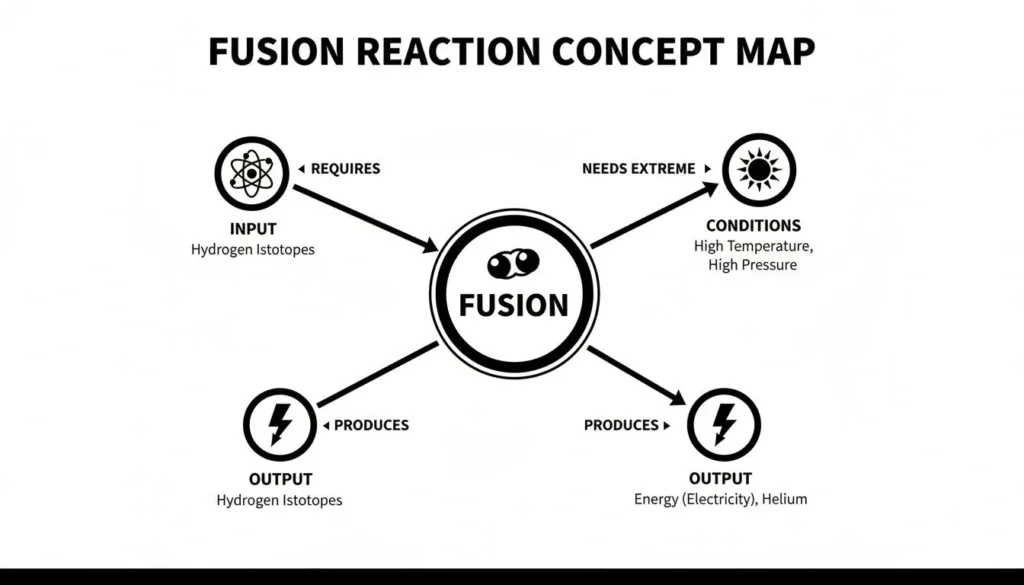
It’s a simplified map that helps visualize how we can turn hydrogen isotopes into clean energy and helium, just like the stars do.
The Recipe for Net Energy
Just sparking a few fusion reactions isn’t the goal. The real prize is getting more energy out than you put in to heat and contain the plasma. This make-or-break benchmark is known as the Lawson criterion, a concept figured out by British physicist John D. Lawson back in 1955.
The Lawson criterion is basically the recipe for a successful fusion power plant. It says that to get a net energy gain, the combination of plasma density, confinement time, and temperature has to hit a specific target.
Put simply, you need a plasma that is:
- Hot enough for the fusion reactions to happen in the first place.
- Dense enough so that there are plenty of nuclei to collide with each other.
- Contained long enough for the reactions to generate more energy than it took to get the plasma going.
Hitting this “triple product” is the scientific finish line that every fusion experiment on the planet, from giant tokamaks to high-powered laser setups, is racing toward. It’s the physics-based blueprint for bottling a star.
The Global Quest to Bottle a Star
The idea of bottling a star for energy isn’t some new-age fantasy. It actually started over a century ago, when scientists like Arthur Eddington first figured out that stars were powered by fusing hydrogen atoms together. For a long time, that was just a neat piece of cosmic trivia—a power source that seemed to belong only to the heavens.
It was the Cold War that really kicked the race into high gear. Suddenly, mastering the atom became a top national priority, and nuclear research money started flowing like never before. This intense chapter of competition and discovery laid the entire foundation for the fusion experiments we see today.
From Theory to a Terrifying Reality
The first time humanity created a fusion reaction on Earth, it wasn’t in a lab. It was in the form of a terrifying weapon. On November 1, 1952, the United States detonated the Ivy Mike device, the world’s first hydrogen bomb. It was a violent proof-of-concept, but it proved that igniting a fusion reaction here was, in fact, possible.
That opened the floodgates. Milestones came quickly, like the UK’s ZETA machine in 1957 and the US’s Scylla IV, which hit a staggering 40 million degrees Celsius in 1964. These early tests showed that you could actually heat plasma to the insane temperatures needed for fusion. You can walk through a more detailed history of these critical steps on this timeline of nuclear fusion progress on Wikipedia.
Even though these machines were nowhere near producing more energy than they consumed, they were game-changers. The question was no longer if we could create fusion on Earth, but how we could possibly control it.
Then, in 1958, something huge happened: fusion research was declassified. This move pulled the science out of the shadows and sparked an era of international teamwork. For the first time, scientists could share notes, tackle problems together, and collectively chase the same goal.
Taming the Uncontainable
Researchers quickly ran into a brick wall. The single biggest problem was figuring out how to hold onto the superheated, chaotic plasma long enough for atoms to fuse. Early devices were riddled with instabilities, causing the plasma to go cold or break free in a split second.
Think of it like trying to hold a glob of Jell-O hotter than the sun using nothing but invisible magnetic force fields. The slightest wobble, and it touches the sides of the container and instantly fizzles out. That was the daily struggle for early fusion pioneers.
The real headache was that plasma isn’t a simple gas. It’s a soup of charged particles that writhes, twists, and generates its own rogue magnetic fields, actively fighting every attempt to keep it contained.
This challenge led to a flurry of different machine designs, each one a unique take on how to solve the confinement puzzle:
- Linear Pinch Devices: Early machines like Scylla tried to violently squeeze the plasma in a straight line with powerful magnetic pulses. They got incredibly hot but couldn’t hold on for long.
- Stellarators: Invented by Lyman Spitzer in 1951, these contraptions used incredibly complex, twisted magnetic coils to guide the plasma in a racetrack loop, hoping to average out its chaotic behavior.
- Toroidal Pinch Machines: Experiments like ZETA used a donut-shaped (toroidal) chamber. They zapped the plasma with a huge electrical current, trying to get it to create its own magnetic field to hold itself together.
These early experiments, for all their limitations, were absolutely essential. They gave us a hard-won education in plasma physics and built the bedrock of knowledge that today’s advanced reactor designs stand on.
How We Build Fusion Reactors on Earth
So, if you don’t have a star’s worth of gravity to do the heavy lifting, how on Earth do you contain something ten times hotter than the sun? This is where human ingenuity gets really impressive. Scientists are chasing two main strategies to essentially bottle a star, and each one is a monumental feat of engineering tackling the same fundamental problem from a completely different angle.
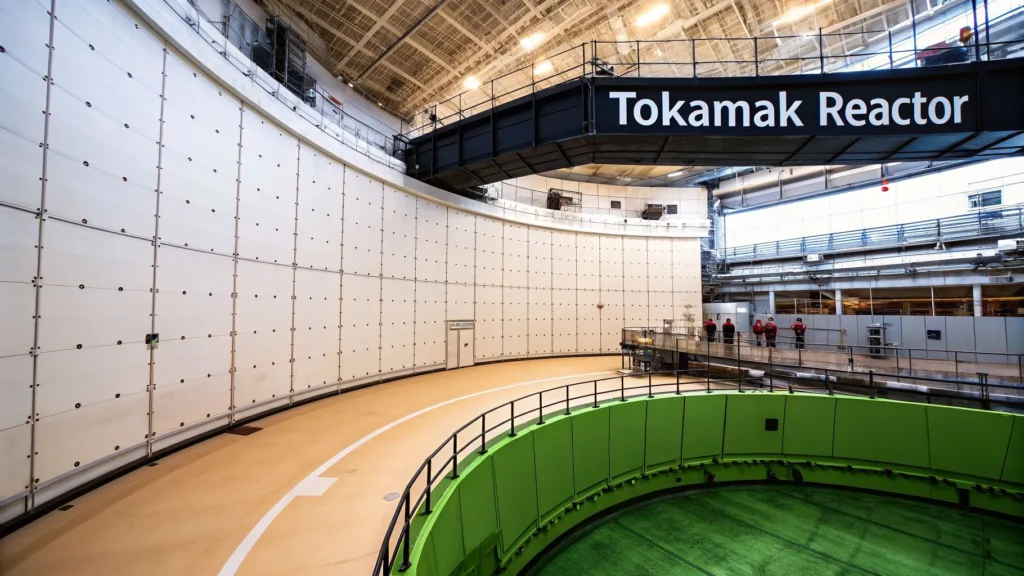
The two leading contenders are Magnetic Confinement Fusion (MCF) and Inertial Confinement Fusion (ICF). While they both want to get to the same destination—a sustained fusion reaction—their roadmaps are worlds apart. One is about maintaining a steady, long-lasting burn, while the other is more like creating a chain of tiny, controlled explosions.
Magnetic Confinement Fusion: The Magnetic Donut
Magnetic Confinement is the most well-known approach, and its star player is a machine called a tokamak. Picture a gigantic, hollow donut wrapped in some of the most powerful superconducting magnets ever built. The entire point is to suspend the superheated plasma inside this “magnetic bottle,” keeping it from ever touching the reactor walls, which would instantly vaporize.
The physics behind it is brilliant. The magnets create an intense, twisting magnetic field that grabs onto the electrically charged plasma, forcing it to circulate inside the donut-shaped chamber. This constant containment is what allows the plasma to stay hot and dense enough for fusion reactions to happen over and over again.
And it works. This method has made incredible strides. In 2023, the Joint European Torus (JET) tokamak in the UK, after 40 years of groundbreaking work, blasted out 69.26 megajoules of energy in a single pulse. All from just 0.2 milligrams of fuel. That, along with records like the mind-boggling 510 million °C hit at Princeton’s TFTR back in 1995, proves we’re getting better and better at taming plasma. You can dive deeper into these fusion power milestones and their complex engineering through the World Nuclear Association’s research.
Inertial Confinement Fusion: A Miniature Starburst
Inertial Confinement Fusion (ICF) takes a totally different, almost brute-force approach. Instead of holding plasma steady for a long time, ICF tries to create fusion in a single, unbelievably fast and powerful flash.
Imagine a tiny pellet, about the size of a peppercorn, filled with deuterium and tritium fuel. This pellet is dropped into the center of a large chamber and then zapped from all sides by the world’s most powerful lasers. The magic happens in a few distinct steps:
- Compression: The laser energy instantly vaporizes the pellet’s outer shell, making it explode outward.
- Reaction: Newton’s third law kicks in—for every action, there’s an equal and opposite reaction. The rest of the pellet is violently crushed inward on itself.
- Ignition: This implosion is so extreme it squeezes and heats the fuel to fusion temperatures and densities. For just a fraction of a second, a miniature starburst ignites.
This method generates fusion in quick, powerful pulses, not a continuous burn. The biggest challenges are hitting the pellet with perfect symmetry and, of course, getting more energy out of the explosion than you put in with the lasers.
Both MCF and ICF are pathways to the same destination: a future with clean, abundant energy. MCF is like keeping a fire burning steadily in a sophisticated hearth, while ICF is like igniting a series of powerful, controlled sparks from an internal combustion engine.
Comparing the Two Paths to Fusion
While both methods are trying to spark fusion, the engineering and physics puzzles they need to solve are completely different.
| Feature | Magnetic Confinement (MCF) | Inertial Confinement (ICF) |
|---|---|---|
| Primary Device | Tokamak, Stellarator | Laser or Particle Beam Facility |
| Reaction Type | Continuous or long-pulse burn | Pulsed, rapid explosions |
| Key Challenge | Maintaining plasma stability over time | Achieving perfectly symmetric compression |
| Analogy | A magnetic bottle holding a tiny star | A laser-driven micro-bomb |
Each path has its own unique set of obstacles, from taming an unruly plasma to perfecting a microscopic implosion. The global research community is pushing hard on both fronts, inching us ever closer to a future powered by the same nuclear fire that lights up the cosmos.
Recent Breakthroughs Driving the Future of Energy
For a long time, fusion energy felt like a running joke—always just 30 years away. But the last few years have completely flipped the script. A series of incredible achievements have pulled the dream of limitless, clean power out of science fiction and planted it firmly in our near future.
These aren’t just small, incremental gains. We’re talking about landmark events that have sent a jolt of excitement through the scientific community and triggered a new wave of investment. The quiet, decades-long work of thousands of researchers is finally hitting the headlines, and for good reason.
NIF Achieves the Holy Grail of Fusion
The biggest news dropped in December 2022. Scientists at the National Ignition Facility (NIF) in California did something that had been the primary goal of fusion research for over 70 years: they achieved ignition. This is the magic moment where a fusion reaction produces more energy than was used to start it.
Using a massive system of lasers, the NIF team zapped a tiny fuel pellet with 2.05 megajoules (MJ) of energy. For a fleeting instant, it produced a staggering 3.15 MJ of fusion power. This was the first time any lab on Earth had created a net energy gain, successfully mimicking the process that powers the sun. To put it in perspective, fusion fuel yields nearly four million times more energy per kilogram than burning coal or oil.
You can dive into the details of this historic ignition breakthrough on the LLNL website.
This wasn’t just a win for NIF’s laser-based approach. It was a massive psychological victory for the entire field. It proved, once and for all, that net-positive fusion isn’t just a theory—it’s a practical reality.
And it wasn’t a one-off. The NIF team has since repeated the experiment successfully, confirming the result and gathering a treasure trove of data. This information is now being used to design even better reactor components, speeding up the timeline for a potential power plant.
Magnetic Confinement Pushes New Limits
While NIF’s lasers were stealing the show, the magnetic confinement camp was hitting its own major milestones. The Joint European Torus (JET) in the UK, one of the world’s most successful tokamaks, ran its final, record-breaking experiments before its planned shutdown.
In its grand finale in late 2023, JET smashed the world record by unleashing 69 megajoules of sustained fusion energy over a five-second period. This was a masterclass in controlling the super-hot plasma, proving just how far we’ve come in our ability to magnetically “bottle” a star.
These successes aren’t happening in isolation. They are crucial stepping stones for the next generation of massive fusion machines, especially ITER (International Thermonuclear Experimental Reactor), which is under construction in France.
- ITER as a Stepping Stone: ITER is being built to be the first fusion device to produce net energy on a huge scale. The goal is a massive 500 megawatts of output from just 50 megawatts of input.
- A Global Collaboration: This is a monumental project, bringing together 35 nations to pool their knowledge and build a machine that proves fusion can work at power-plant scale.
- Testing Key Technologies: All the data from JET, NIF, and other labs is feeding directly into ITER’s design and operational plans, helping to iron out the kinks before it goes live.
Beyond these giant government-led projects, a whole ecosystem of private fusion companies has sprung up. Spurred on by these recent breakthroughs, they’re exploring new reactor designs and using advanced tools like artificial intelligence to accelerate their work. If you’re curious about how computing is revolutionizing complex science, our guide on how quantum computing works provides a fascinating parallel. This mix of public research and private innovation is creating a powerful feedback loop, pushing the whole field forward faster than ever.
Common Questions About Fusion Energy
As the mind-bending science of fusion moves from physics labs into the real world, it’s only natural to have a few questions. The idea of bottling a star to power our cities is incredible, but it also brings up practical thoughts on safety, fuel, and when we might actually see it happen.
Let’s cut through the complexity and tackle some of the most common curiosities. Here are some straightforward answers about what a future powered by fusion energy could really look like.
Is Fusion Energy Truly Safe?
This is usually the first question people ask, mostly because the word “nuclear” makes us think of the risks tied to traditional fission power plants. The good news is that fusion is a completely different beast, and it’s considered fundamentally safe for a couple of key reasons.
First off, a fusion reactor cannot have a meltdown. The conditions needed to get a reaction going are absurdly specific and hard to maintain—we’re talking temperatures hotter than the sun’s core and intense magnetic fields. If anything goes wrong or gets disrupted, the superheated plasma cools down in an instant, and the reaction just… stops. It isn’t a runaway chain reaction; it’s an incredibly delicate process that is designed to fail safely.
On top of that, fusion doesn’t produce any long-lived, high-level radioactive waste. The main byproduct of the deuterium-tritium reaction everyone is working on is helium—a completely harmless gas. While the reactor’s inner walls will get activated by stray neutrons over time, this material is far less dangerous and has a much shorter radioactive half-life than the spent fuel rods from a fission plant.
Where Will the Fuel Come From?
Another practical question is about the fuel supply. Luckily, this is one of fusion’s biggest strengths. The fuel is incredibly abundant and can be found almost anywhere on Earth.
The two main ingredients for the most common fusion reactions are deuterium and tritium:
- Deuterium (D) is a stable version of hydrogen that we can easily and cheaply pull from any water source, especially seawater. The oceans alone contain enough deuterium to power human civilization for millions of years.
- Tritium (T) is a radioactive version of hydrogen that’s extremely rare in nature. This is where the process gets really clever: we can actually make it inside the reactor. High-energy neutrons from the fusion reaction are used to hit a “blanket” made of lithium (another very common element), which turns the lithium into the tritium needed to keep the reactor going.
This setup creates a self-sustaining fuel cycle, where the reactor literally makes one of its own key ingredients on-site. It gets rid of the need for complex mining, enrichment, and global supply chains that come with other energy sources.
This fuel cycle is a total game-changer. It means a fusion power plant wouldn’t rely on a scarce resource or a volatile market, offering genuine energy independence. To stay current on the latest breakthroughs in this area, you can find a ton of great articles in our science and technology magazine.
When Will We Have Fusion Power Plants?
Ah, the billion-dollar question. We’ve finally had some major breakthroughs, like getting more energy out than we put in, but going from a single successful experiment to a commercial power plant is a huge engineering leap. Timelines vary, but a general consensus is starting to form.
Massive international projects like ITER are on track to prove the science and tech can work at a power-plant scale by the mid-2030s. These big experiments are crucial for testing new materials, perfecting plasma control, and showing the technology can run for long stretches without a hitch.
After these demonstrators prove their worth, the first commercial fusion power plants are widely expected to start connecting to the grid in the 2040s or early 2050s. That timeline could speed up, though. A growing number of private companies, flush with investment, are trying out nimbler and more creative reactor designs. Many of these startups are aiming for aggressive goals, with some hoping to have pilot plants running in the 2030s. This mix of public research and private competition is pushing the whole field forward faster than ever.
At maxijournal.com, we are passionate about bringing you clear and engaging stories from the frontiers of human knowledge. Explore our diverse collection of articles to stay informed and inspired by the world of science, technology, and beyond at https://maxijournal.com.
Discover more from Maxi Journal
Subscribe to get the latest posts sent to your email.