VO2 max is the highest rate at which your body can take in, transport and use oxygen during hard, large-muscle exercise, usually reported in milliliters of oxygen per kilogram of body mass per minute (mL/kg/min). The full span of human values runs from below 15 mL/kg/min in some patients with heart failure to above 90 mL/kg/min in elite endurance athletes.
Two runners can both report 48 mL/kg/min and be in completely different situations. One has a strong heart, plenty of blood volume and a genuine physiological ceiling; the other is holding a number their watch guessed from heart rate on a warm Tuesday. Same figure, opposite meanings.
That’s the question most VO2 max explanations skip: not whether your number is high or low, but what produced it and which part of your body is capping it. Once you understand what VO2 max measures, the number stops being a score and becomes a diagnosis of a delivery chain.
What VO2 Max Means and What the Number Tells You
A ceiling, not a score. Oxygen uptake climbs as the workload climbs, then it flattens while the work keeps getting harder. That flattening is the measurement.
The centenary review in the Quarterly Journal of Medicine traces the idea to 1923, when British physiologists Archibald Hill and Hartley Lupton described a maximum oxygen intake and proposed that the cardiorespiratory system imposed an upper limit on oxygen delivery to exercising muscles. A century later the definition holds: the maximum rate at which the body can take in, transport and use oxygen during progressively harder exercise, reached when oxygen uptake levels off despite a further increase in workload.
That phrase about levelling off matters more than it looks. You can’t buy a higher VO2 max with grit at the end of a test. When the plateau arrives, you’ve hit the ceiling of the system, and shouting at it doesn’t help.
Why the number isn’t about your lungs
People hear “oxygen” and assume lungs. The review is blunt about this: the measure integrates pulmonary ventilation, oxygen diffusion, cardiac output, blood oxygen transport and muscle-level oxygen use. Lungs are one link, and rarely the weakest one in a healthy runner.
The same review shows how wide the output range is, which is exactly why the figure works both clinically and in sport. A value under 15 mL/kg/min signals severely limited aerobic capacity. A value over 90 is the territory of elite endurance athletes.
A second column helps you place any number you’ve been given. The table below converts to METs, where one MET is a multiple of your resting oxygen use.
| VO2 max (mL/kg/min) | Approximate METs | What it signals |
|---|---|---|
| Below 15 | about 4 | Severely limited aerobic capacity, seen in some patients with heart failure |
| 35 | about 10 | Worked example only, not a cutoff for any group |
| Above 90 | about 26 | Exceptional endurance potential, reported in elite endurance athletes |
Find your own number and put it on that line. Then check one thing before you interpret it: whether the figure is relative (mL/kg/min, divided by body mass) or absolute (liters per minute, no division). Mixing the two is the most common reason a perfectly fit person concludes they’re unfit.
How Oxygen Travels From Your Lungs to Working Muscle
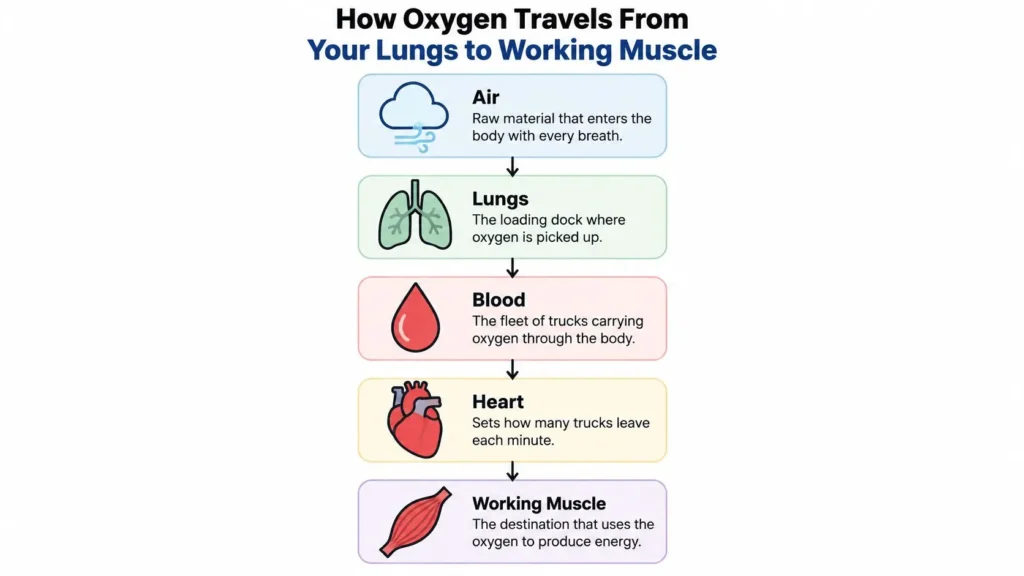
Think of oxygen as freight. Air is the raw material sitting on the dock, and every link between that dock and a contracting quadriceps has to work in sequence. The chain runs like this.
- Ventilation brings the freight in. Breathing moves fresh air to the alveoli, the thin-walled sacs where gas exchange happens. More air in means more raw material available.
- Diffusion moves it across the membrane. Oxygen crosses into the blood, driven by the pressure difference between the air in your lungs and the blood in your capillaries.
- Cardiac output sets the fleet size. Heart rate multiplied by stroke volume decides how much oxygenated blood leaves the heart each minute. This is usually the biggest single contributor.
- Hemoglobin provides the truck beds. Each red blood cell carries oxygen bound to hemoglobin, so total hemoglobin mass caps how much cargo can be in transit.
- Capillaries unload at the warehouse door. Dense capillary networks shorten the distance oxygen has to travel into the muscle fiber.
- Mitochondria burn the cargo. Oxidative energy production turns oxygen into ATP, the fuel muscles contract with.
The weak-link rule
A chain holds only as much as its slowest link. Superb lungs can’t compensate for a heart that moves too little blood per minute. A powerful heart can’t fix blood that carries too little oxygen, which is why anemia shows up as breathlessness on the same hill that was easy last month. A physiology review of oxygen transport puts it plainly: the result reflects the integrated performance of the lungs, heart, blood, circulation and skeletal-muscle mitochondria, not lung function alone.
When your number stalls, ask which link you’ve been training. Long easy runs build the fleet and the capillary bed. Short hard intervals push stroke volume and mitochondrial density. Neither touches a hemoglobin problem.
This is the practical payoff of thinking in links. Every training block, and every medical check, is aimed somewhere specific. Knowing where saves you months of hammering a link that wasn’t the limit.
How VO2 Max Is Measured in a Lab and in the Field
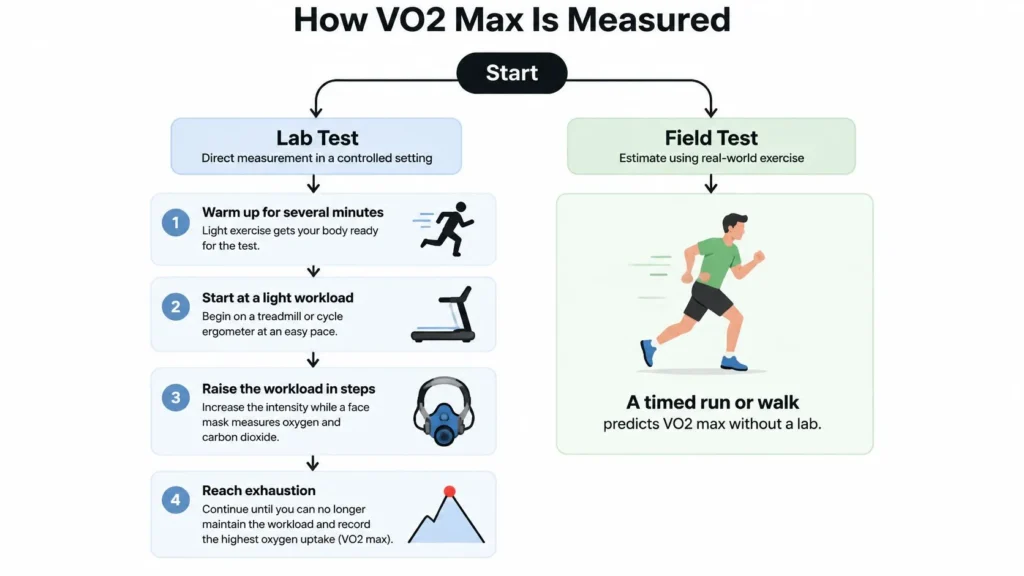
Two honest routes lead to a number, and one convenient fiction. The lab route measures the delivery chain directly. The field route times your output and works backwards. The fiction sits on your wrist, and the next section deals with what it can and cannot tell you. Start with the lab, because understanding what it does explains why the other routes drift.
The lab protocol, step by step
- Warm up for several minutes. You’re about to push to a genuine maximum, and cold legs end the test early, which gives you a peak value instead of a true plateau.
- Start light on a treadmill or cycle ergometer. The first stages should feel almost embarrassingly easy. They anchor the curve you’re about to build.
- Raise the workload in steps while a mask measures gas. Breath-by-breath airflow plus inhaled and exhaled oxygen and carbon-dioxide concentrations produce the actual oxygen consumption figure, not an inference from heart rate. This is the only method that watches the cargo arrive rather than guessing from the delivery schedule.
- Keep going until oxygen uptake stops rising. The test ends at the plateau, or when you must stop. A technician watching the traces will tell you whether you found a ceiling or just had a bad day.
- Read the peak and confirm the plateau. A max with no plateau is a peak value, useful but not identical.
The field route that made it practical
Field testing made the measure portable. Kenneth Cooper’s 12-minute run arrived in 1968, and in the original validation study 115 U.S. Air Force officers and airmen ran maximally for 12 minutes, with distances compared against maximal treadmill tests taken within three days. The correlation between distance covered and laboratory-measured maximal oxygen consumption was 0.897, a strong enough relationship to justify estimating from a simple timed run, as the Cooper Institute’s history of the 12-minute run records.
Do it this way: warm up properly, run the hardest pace you can hold for exactly 12 minutes on a flat measured track, write down the distance, then convert with a published distance-to-VO2 equation. Same protocol every time, or the comparison means nothing.
A quick warning on what the estimate captures. The equation assumes your running economy is average, and economy is the fuel efficiency of the delivery chain’s last mile. Two runners who cover the same distance can burn different amounts of oxygen doing it, so the field number describes the typical runner at that distance, not necessarily you.
Here’s a look at the lab procedure in motion, which makes the mask-and-treadmill setup easier to picture.
Treadmill and cycling values differ, sometimes substantially, because running recruits more total muscle mass than pedalling and a bigger engine draws more oxygen. A cycling test compared with a running test is not a fair fight. If a lab number matters to you, a dedicated service such as VO2 max fitness testing in Chester gives you measured gas exchange rather than an algorithm’s best guess.
| Method | What it measures | Accuracy | Best use |
|---|---|---|---|
| Lab treadmill or cycle test | Breath-by-breath oxygen and carbon-dioxide exchange | Direct measurement, highest accuracy | Clinical assessment and athlete benchmarking |
| Cooper 12-minute run | Distance covered in 12 minutes, converted with an equation | Estimate; correlation 0.897 with lab treadmill results in the original validation | Simple fitness checks without a lab |
| Wearable watch or ring | Heart rate, pace and movement fed into an algorithm | Estimate that varies by device and user | Watching long-term direction under consistent conditions |
One more reason the figure travels beyond sport. A VO2 max of 35 mL/kg/min equals roughly 10 METs, since 1 MET represents resting oxygen uptake of approximately 3.5 mL/kg/min. Clinicians use that conversion to talk about exercise capacity, and higher capacity is consistently associated with lower cardiovascular and all-cause mortality across the research literature. That’s a fitness metric doing clinical work.
Why Your VO2 Max Changes Over Time

Your ceiling moves with your body, not just with your training. That’s the part that catches people out, especially anyone who assumes a falling number means failing fitness. The delivery chain has several links, and each one can shift the final figure on its own.
| Factor | Effect on VO2 max | What the research shows |
|---|---|---|
| Age | Tends to fall as age rises | Significant negative association in a large reference analysis |
| Sex | Men score higher than women overall | The reference database held far more men than women, which limits confidence in sex comparisons |
| Body mass | Relative value drops when mass rises without added oxygen capacity | The absolute value in litres per minute ignores body mass entirely |
| Training | Endurance training commonly raises stroke volume and blood volume | Sustained aerobic volume with appropriate intervals and recovery drives the gains |
| Anemia or illness | Low hemoglobin reduces oxygen-carrying capacity directly; illness can depress the value temporarily | Hemoglobin status shows a positive link with VO2 max in a systematic review |
What training actually changes
Cardiac output governs how much oxygenated blood reaches working muscle, and endurance training commonly improves stroke volume while expanding red-blood-cell volume. That’s the adaptation you’re chasing on long runs. Hemoglobin matters for the same chain, and the systematic review on hemoglobin status and VO2 max found a positive relationship between the two.
The training recipe that follows isn’t exotic: sustained aerobic volume, plus appropriately intense intervals, plus enough recovery to absorb both. Programs built around that combination are covered in these evidence-based VO2 max training protocols, and they map neatly onto the two links that respond best.
When a drop isn’t fitness
A number that falls over a month can come from weight gain, a mild illness or a changed test protocol. Those causes sit outside the delivery chain, so they don’t mean your aerobic capacity shrank. Before you rewrite your training plan, rule them out.
Low hemoglobin belongs in a different category. Hemoglobin caps how much oxygen your blood can carry, so a genuine drop in it lowers the ceiling itself, the same reason anemia makes a familiar hill feel harder. That one deserves a blood test and a clinician, not a revised interval session.
Read race preparation and fitness testing together rather than separately. A runner following a structured build for a marathon, like the sessions in this marathon preparation guide, often sees training pace improve while a wrist estimate wobbles, because the two are measuring different things on different days.
Note which factors you can move: training load, body composition, recovery and blood health. Age and genetics aren’t on that list, so stop negotiating with them.
What a Good VO2 Max Looks Like for Your Body
There is no universal good VO2 max. Interpretation depends on age, sex, body mass, training status, test protocol and the reference population you’re being stacked against, as the large reference-value analysis in the European Journal of Applied Physiology makes clear. That same analysis found age had a significant negative association with VO2 max, and male values came out about 18% higher than female values overall. It also noted a limitation worth knowing: the reference database contained nearly four times as many men as women, so sex-specific comparisons deserve caution.
So the question to ask isn’t “is my score low?” It’s the one almost nobody asks: is my score low, or am I being compared with the wrong people?
The units trap that fools fit people
Absolute VO2 max, in liters per minute, reflects total oxygen consumption. Relative VO2 max, in mL/kg/min, divides by body mass. Watch what that does to a real example.
Say a runner produces 3.5 liters per minute at 80 kilograms. Divide 3500 mL by 80 and you get 43.75 mL/kg/min. Now that same runner loses 10 kilograms while still producing 3.5 liters per minute. The score becomes 50 mL/kg/min, an apparently large jump, with zero improvement in the body’s absolute oxygen-processing capacity. Gain muscle mass instead and the relative figure can slide while performance gets better.
Practical rule: when a relative score changes and your training hasn’t, check the denominator first. Body mass moved.
Three checks before you label yourself
- Compare against the right reference. Use an age-and-sex-appropriate table or a clinician who knows your history, not a leaderboard that includes 22-year-old national-level runners.
- Track the direction under consistent conditions. Same device, same activity, same route, same rough temperature. A single reading is a data point, not a trend.
- Escalate anything unusual. Breathlessness, chest symptoms, unusual fatigue or a known anemia belong in front of a qualified clinician, not in a training spreadsheet.
A low score also doesn’t tell you which system is limiting you. Oxygen delivery, heart function, lung function, blood oxygen-carrying capacity, muscle extraction, motivation and simple test unfamiliarity can each produce a disappointing number. If you’re new to all this, a sensible starting point is a set of fitness tips for beginners that builds the habit before it chases a figure.
Can You Trust Your Watch and What to Do Next
Most watches don’t measure VO2 max. They infer it from heart rate, pace, movement and the details you entered at setup. That distinction sounds academic until you see the size of the gap in validation work, reported in research on wearable VO2 max estimates. Apple Watch estimates underestimated laboratory VO2 max by about 6.07 mL/kg/min on average, with individual limits of agreement stretching from roughly -6.11 to +18.26 mL/kg/min. That’s a wide corridor.
Highly trained athletes fare worse. A 2025 study of Garmin Forerunner 245 data found the watch underestimated VO2 max by 6.3 mL/kg/min in highly trained athletes, with mean absolute percentage error near 10%, against roughly 3% to 4% error in moderately trained participants. The fitter and more unusual you are, the more the algorithm struggles.
Why the number falls while your races get faster
Terrain, heat, fatigue, heart-rate reading errors, running versus cycling algorithms, medication and an unusually high fitness level can all distort the trend. A hilly trail run in August, a beta-blocker, or switching from running to cycling for a month can move a wrist estimate without touching your physiology.
Useful test: if your race times are improving while your watch score slides, trust the stopwatch. It’s measuring something real.
A five-step check you can run today
- Record the value and its units. mL/kg/min or L/min. Write it down with the date.
- Name the source. Lab gas analysis, a 12-minute run, or a device estimate. Only compare like with like.
- Place it against an age-and-sex reference and note the body mass used in the calculation.
- Escalate red flags. An unexpectedly low figure, breathlessness, chest symptoms, unusual fatigue or known anemia warrants a clinician’s opinion before any fitness conclusion.
- Choose the tool for the job. For tracking, keep the same device and conditions and retest every few months. For a training or medical decision, book laboratory testing.
Then do one thing this week: open a note and record today’s number with its units, its method and the conditions you measured it under. That single entry turns a meaningless reading into the first point on a line you can read with confidence. Devices are handy for the direction of travel, and lists like these health monitoring devices help you pick one that suits the way you train, but the interpretation stays your job.
Maxi Journal covers the science behind fitness metrics like these in plain language, alongside sports, health and technology writing from independent contributors. If you want more explanations that separate a real measurement from an algorithm’s estimate, browse the health and sports sections at maxijournal.com and find the piece that answers your next question. You can also pitch your own article there if you have something worth explaining.
Discover more from Maxi Journal
Subscribe to get the latest posts sent to your email.