You unwrap a new smartwatch, fasten it to your wrist, and start tapping through the health screens. Heart rate. Sleep stages. Blood oxygen. Maybe even an ECG feature. The first reaction is usually curiosity, followed by a more important question: is this useful health information, or just polished wellness theater?
That question matters because the market now bundles very different things under the same friendly promise of “health tracking.” A step counter, a ring that estimates sleep stages, a prescribed heart monitor patch, and an implanted pacemaker may all collect body data, but they don’t belong in the same class. Some are built to motivate healthier habits. Some are good at spotting patterns worth discussing with a clinician. A smaller group has been tested closely enough to support real medical decision-making.
The need isn’t for more hype. It’s for a filter.
The best health monitoring devices aren’t just the ones with the most sensors, the brightest screens, or the longest feature lists. The best one for you is the one that matches your goal, collects the right signal, fits your daily life, and has evidence behind the claim you care about. A watch can be great for noticing trends. A prescribed monitor can be far better for answering a narrow clinical question. A home blood pressure cuff might matter more than any wearable if hypertension is the issue.
That’s where many buyers get stuck. Marketing talks about “insights” and “AI,” while actual usefulness depends on a quieter set of questions: Has this type of measurement been validated? Can I wear it consistently? Will the data mean anything outside a lab? If something looks abnormal, what am I supposed to do next?
Your Health in Your Hands An Introduction
A common scene now plays out in kitchens, offices, and living rooms. Someone gets a smartwatch as a gift, or buys a ring after hearing friends rave about sleep scores, and by the end of the day they’re checking numbers they’ve never thought about before. A resting heart rate suddenly feels important. A poor sleep score can set the mood for the morning. A high alert can trigger anxiety even if the person feels perfectly fine.
That mix of insight and uncertainty is why this category needs a calmer, clearer explanation. These devices can help people notice habits, trends, and, in some cases, warning signs. But they don’t all do the same job. A Fitbit Charge 6, Apple Watch Series 9, Oura Ring Gen3, Samsung Galaxy Watch7, and WHOOP 4.0 Band may all sit in the broad world of wearables, yet their strengths differ. Some are better at training and recovery. Some focus on all-day wellness. Some have stronger validation for specific cardiovascular uses.
The question most buyers actually need answered
The issue isn’t whether a device is “good” in the abstract. It’s whether it’s good for your purpose.
If you want motivation to move more, a consumer fitness tracker may be enough. If you want to follow blood pressure at home, you probably need a dedicated home monitor instead of a watch. If your clinician wants to investigate intermittent palpitations, a prescribed patch monitor may be more appropriate than any consumer gadget.
Practical rule: Treat body-tracking devices the way you’d treat eyeglasses. Reading glasses help with one job. Safety goggles help with another. You wouldn’t judge them by style alone.
A better way to judge the field
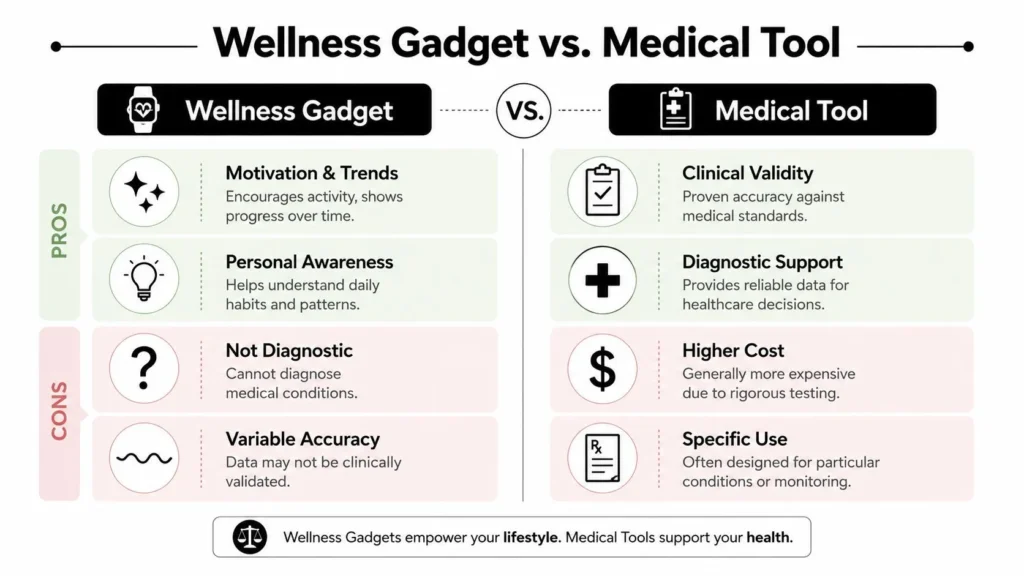
The most useful lens is the difference between consumer utility and clinical validity. Consumer utility asks, “Does this help me live better, understand my habits, and stay engaged?” Clinical validity asks, “Does this measurement hold up when compared with medical standards for a specific use?”
Those aren’t opposing ideas. A device can be highly useful without being diagnostic. A device can also be technically accurate yet too uncomfortable, short-lived, or inconvenient for real life. The best health monitoring devices sit at the point where evidence and everyday usability overlap.
More Than Just Step Counters
Health trackers do more than log walks around the block. They translate signals from your body into readable numbers and alerts, much like a car dashboard turns engine activity into speed, fuel level, and warning lights. Useful, yes. Complete, no.
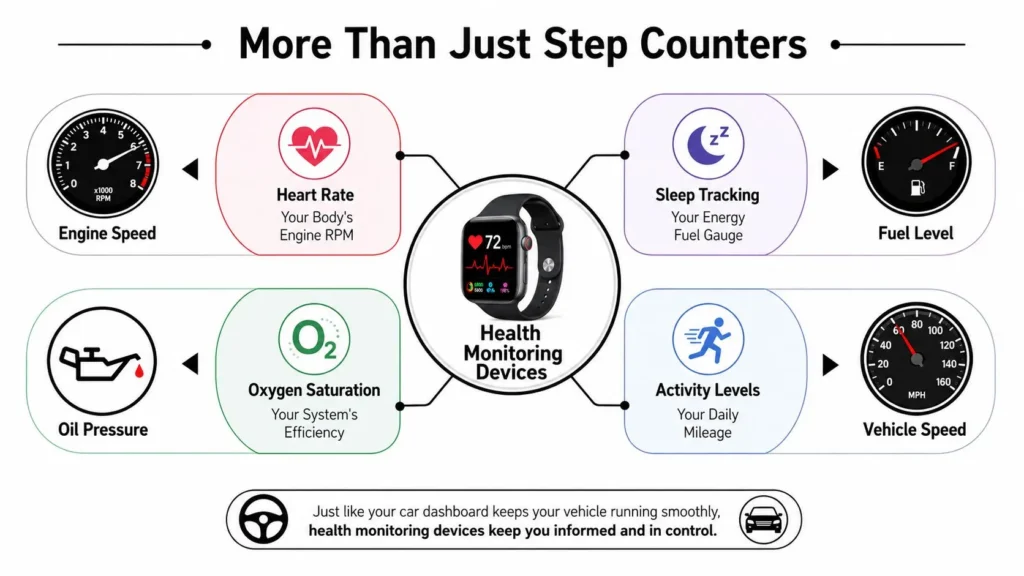
That distinction matters because many buyers see a long list of metrics and assume they are all equally meaningful. They are not. A step count, a sleep score, and an ECG reading may all appear on the same screen, but they come from different sensors, with different strengths, and very different medical value.
What the main sensors actually do
The terminology can sound more intimidating than it is. Each sensor is basically answering one kind of question.
- PPG sensor: This light-based system, common in watches and rings, estimates heart rate by shining light into the skin and measuring small changes in blood flow.
- Accelerometer: This measures motion. It helps count steps, estimate activity, infer sleep and wake periods, and detect broad movement patterns.
- ECG sensor: This records the heart’s electrical activity. On consumer devices, it is usually used during a spot check rather than all day.
- Temperature and related sensors: These track changes at or near the skin. They can help flag shifts in routine, stress, recovery, or cycle patterns, depending on the device and software.
A helpful way to sort this out is to match the sensor to the question.
Different sensors answer different questions
PPG is often answering, “What is my pulse doing right now?” An accelerometer is answering, “How much did I move, and when?” An ECG feature is better for, “What heart rhythm showed up during this recording?” Those are different jobs.
Trouble starts when device makers package all of those outputs as if they carry the same weight. They do not. Some measurements are general wellness estimates. Some are closer to medical screening tools. Some are only useful when a clinician interprets them in context.
A tracker samples a handful of signals. The app then turns those signals into a summary, score, or alert.
That summary can be helpful without being diagnostic. A sleep score may show that your routine is getting worse over time. It cannot replace a lab-based sleep study. A watch-based heart alert may tell you something deserves attention. It does not automatically confirm a heart condition.
Why the same device can feel smart and still have limits
Sleep tracking shows the tradeoff clearly. Consumer wearables usually estimate sleep from motion and heart-related signals. That works well enough to spot habits, such as late bedtimes, restless nights, or inconsistent schedules. It is still an estimate built from indirect clues.
Heart features work the same way. A device may do a solid job measuring resting heart rate during quiet periods and struggle during exercise, poor fit, cold skin, or frequent motion. A watch with an on-demand ECG may offer a useful rhythm check, while its calorie estimates remain rough guesses. Judging the whole device by one strong feature can lead to the wrong conclusion.
This is the line many buyers need to see clearly: wellness gadgets help you notice patterns, while clinically validated devices are built to measure a specific health signal against a medical standard. Both can be useful. They are just answering different levels of question.
When you shop for the best health monitoring devices, ask three things: what sensor powers this feature, what question does it answer, and is that answer meant for general awareness or actual clinical decision-making?
A Guide to Health Monitoring Device Categories
The easiest way to stop the whole market from blurring together is to sort devices by role. Individuals typically don’t need “a health device.” They need one category far more than the others.
Five groups worth separating
| Category | Primary Use | Example | Data Type | Clinical Oversight |
|---|---|---|---|---|
| Wearables | Ongoing everyday tracking | Apple Watch, Oura Ring, Fitbit tracker | Heart rate, movement, sleep-related estimates, rhythm checks on some models | Usually limited, varies by feature |
| Home monitors | Spot checks at home | Blood pressure cuff, smart scale, glucometer | Point-in-time readings | Often used within routine self-care or clinician guidance |
| Prescribed medical devices | Focused monitoring for a medical question | Continuous glucose monitor, Holter-style monitor, cardiac patch | Condition-specific clinical data | High, clinician-directed |
| Implantables | Long-term therapeutic or diagnostic monitoring | Pacemaker, defibrillator | Internal rhythm and device data | Very high |
| Health apps | Logging, journaling, trend review | Symptom tracker, medication reminder app | Self-reported data and summaries from devices | Low unless tied to clinical care |
Wearables for daily life
This is the category typically referred to when searching for the best health monitoring devices. Smartwatches, smart rings, and some patches fit here. Their biggest strength is convenience. They live on your body, collect data in the background, and can make health feel more visible.
Their biggest weakness is that buyers often expect too much from them. A wearable can be great for trend awareness and habit change. It may also be useful for certain validated measurements. But it usually isn’t a substitute for a condition-specific medical workflow.
Home monitors for focused checks
Home devices are less glamorous and often more practical. A blood pressure monitor, a blood glucose device, or a smart scale does one thing more directly than a general wearable.
If your concern is blood pressure, a proper home cuff is usually more relevant than a watch full of broad wellness metrics. The same logic applies to glucose and weight management. One strong, targeted reading often beats a stack of indirect proxies.
Prescribed medical devices for clinical questions
This category exists for people who need better answers than consumer electronics can provide. A clinician may prescribe a continuous glucose monitor to follow blood sugar patterns or a rhythm monitor to capture intermittent heart events.
The key difference isn’t just technology. It’s workflow. These devices are usually chosen because a clinician is trying to answer a specific medical question, with data review built into the process.
Implantables and apps sit at opposite ends
Implantables such as pacemakers and defibrillators are in a different universe from retail gadgets. They combine monitoring with treatment and require specialist oversight.
Health apps sit at the other end. On their own, they may not measure anything directly. But they can still matter if they help you track symptoms, medication timing, mood, or triggers in a structured way.
If you can’t name the decision the device should help you make, you probably don’t need that device yet.
Understanding Clinical Validity and Accuracy
You glance at your watch after a workout and see a heart rate, a recovery score, and a warning about rhythm irregularity. Those numbers do not all mean the same thing. Some are wellness estimates meant to guide habits. Others may be built and tested for a narrower medical purpose.
Clinical validity asks a specific question: does this feature measure what it claims to measure for a defined health use? Consumer utility asks a different one: is it useful in daily life? A sleep score can be useful without being a clinical tool. An ECG feature can be clinically meaningful for a specific screening task without turning the whole device into hospital equipment.
What the strongest evidence looks like
The safest way to read health tech claims is feature by feature, not device by device. A smartwatch is more like a toolbox than a single instrument. One tool inside it may be well tested, while another is closer to a rough lifestyle indicator.
Atrial fibrillation screening shows why that distinction matters. A systematic review and meta-analysis of 28 studies covering 13,463 participants found wrist-worn consumer wearables performed very well for this specific task, with an area under the ROC curve of 0.97 and a 95% confidence interval of 0.94 to 0.99. The same review also found that across 177 heart-rate measurement comparisons, 100 comparisons, or 56.5%, fell within a ±3% error threshold, while 44 comparisons, or 24.9%, underestimated heart rate by more than 3%, according to this Nature review on wearable detection of atrial fibrillation.
That is encouraging, but it is also narrow. It supports certain wrist-based cardiovascular measurements under studied conditions. It does not mean every health score on every wearable is ready to guide diagnosis or treatment.
How to read device data without giving it too much authority
A better frame is simple. Treat validated features like a screened thermometer. Useful for a defined measurement. Treat broad wellness scores more like a weather forecast. They can be helpful for spotting patterns, but they are not a diagnosis.
Clinical validity applies to a specific feature, in a specific context, for a specific question.
That matters in real life. A validated rhythm screening function may deserve your attention if it flags a possible issue. A readiness score that drops after a late night may only suggest you slept poorly, trained hard, or had a stressful day.
Manual checks still help. A simple guide on easy steps to take a pulse gives you a basic reference point for comparing what a device reports with what you can feel yourself.
It also helps to understand why consumer gadgets and clinical tools follow different standards before they reach your hand. Topics such as ethylene oxide sterilization in medical manufacturing offer useful context for how regulated medical devices are produced and evaluated differently from general wellness products.
Here’s a good video explainer to pair with that distinction:
Choosing Your Health Monitoring Device
A long feature list won’t save you from buying the wrong tool. A much better approach is to ask a short set of hard questions before you spend anything.
Start with the shortlist, not the ad
A review focused on community-dwelling adults found that only 20 out of 216 evaluated wearable devices were considered suitable for continuous cardiovascular monitoring as of July 1, 2024, and 18 of those validated devices had been tested in healthy adult populations, including the Apple Watch Series 9, Fitbit Charge 6, Samsung Galaxy Watch7, Oura Ring Gen3, and WHOOP 4.0 Band in this clinical review of wearable validation.
That doesn’t automatically make those models the best choice for everyone. It does mean they’re better starting points than random products making broad promises with little supporting evidence.
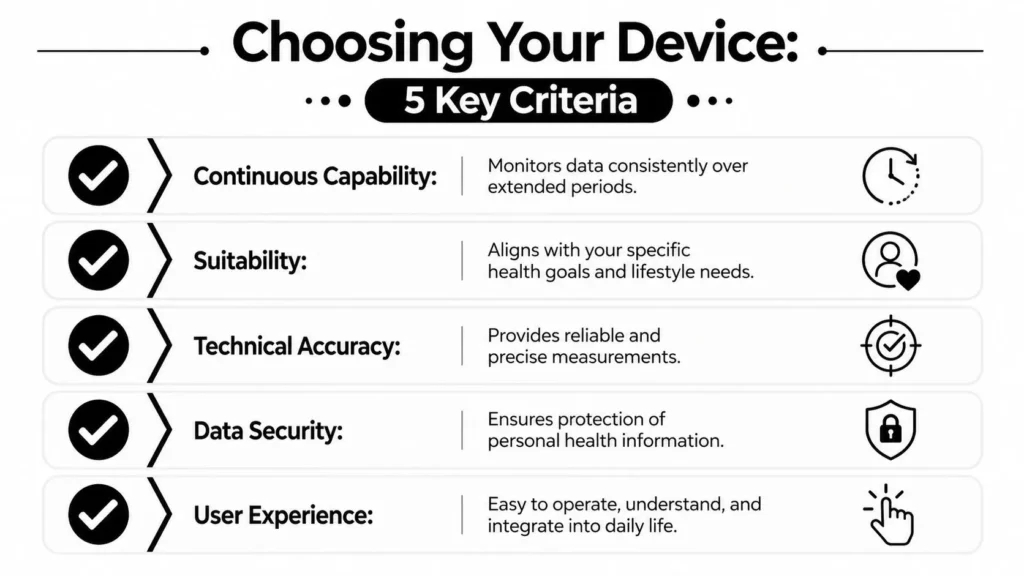
Five questions to ask before you buy
Continuous capability
Can it monitor the thing you care about often enough to matter?
A one-off reading may be fine for some goals, but not for others. If you’re interested in day-to-day rhythm trends, sporadic checks may miss the point. If you only want occasional exercise heart rate feedback, continuous wear may be unnecessary.
Suitability
Does it fit your actual health question?
A runner, a person managing a chronic condition, and someone worried about sleep disruption may all need different devices. A ring may be comfortable for overnight wear. A watch may be better if you want visible prompts and daytime interaction. A prescribed patch may beat both if your clinician is chasing an intermittent event.
Technical precision
Has this feature been validated for the use you care about?
Many buyers should slow down. Don’t judge a device by brand reputation alone. Judge the individual feature. A company can make an excellent activity tracker and still offer a less meaningful stress score or wellness summary.
Feasibility
Will you keep using it?
This matters more than buyers expect. A device can be accurate in a lab and still fail in normal life if it irritates your skin, needs frequent charging, or feels bulky while sleeping. If comfort matters for daily wear, even something as simple as swapping bands can help. People comparing fit options for Samsung hardware may find Premium Samsung Watch Ultra straps useful when trying to improve wearability.
Cost
Is the value tied to the hardware, the subscription, or both?
Some devices become much less useful without the app ecosystem that sits behind them. Others are quite functional without extra fees. Cost also includes the hidden price of frustration. A device you stop wearing after a week is expensive at any price.
Buy for the decision you need help making, not for the number of dashboards you can scroll through.
Protecting Your Personal Health Data
Health data feels intimate because it is. Sleep patterns, pulse trends, cycle tracking, symptoms, blood results, medication logs, and location-linked activity data can reveal more about your life than many people realize. When you use a monitoring device, you’re not just buying sensors. You’re entering a data relationship with a company.
That’s why privacy shouldn’t sit in the “fine print” category. It belongs near the top of your buying checklist.
What to check before you create an account
A review of chronic disease monitoring literature noted that coverage often misses the distinction between clinical validity and consumer utility, and also overlooks the five core selection criteria of continuous capability, suitability, technical precision, feasibility, and cost in this discussion of wearable selection for community use. I’d add one more practical filter for everyday buyers: data handling.
Ask these questions before you commit:
- Where is the data stored: Is it kept mainly on your device, in the company’s cloud system, or both?
- Who can access it: Can you choose whether the app shares information with partners, coaches, or advertisers?
- What happens if you stop using it: Can you export or delete your records?
- How is the account protected: Does the app offer two-factor authentication and account activity alerts?
Habits that reduce risk
You don’t need to be a security professional to make smarter choices.
- Use a unique password: Don’t recycle the same login you use for shopping or social media.
- Turn on two-factor authentication: It adds friction for attackers, not for you.
- Review permissions regularly: Apps often ask for more access than they need.
- Read the privacy settings screen: That’s where many sharing choices are buried.
If you also use at-home diagnostics, such as blood testing services, it’s worth understanding how those companies handle sensitive records too. A complete guide to UK blood tests can be a helpful companion resource when you’re thinking beyond wearables.
For broader online privacy basics, GDPR compliance for websites gives useful background on how data protection expectations are framed in web services.
The Future of Personal Health Is Now
Personal health technology has already changed the daily experience of paying attention to your body. What used to require a clinic visit can now appear on your wrist, finger, phone, or bedside table. That shift is powerful, but the primary advantage doesn’t come from owning more devices. It comes from knowing what each device can and can’t do.
The strongest buyers aren’t the people who chase every new metric. They’re the people who ask sharper questions. What signal is being measured? Has that feature been validated? Does this fit my routine? Will this data help me make a better decision, or just give me one more number to worry about?
That mindset turns technology into a tool instead of a distraction. It also makes room for a more mature view of the best health monitoring devices. Some are excellent wellness companions. A smaller number are highly credible for specific clinical purposes. Both can be valuable when you know the difference.
If you’re curious about where medical technology keeps heading next, subjects like nanotechnology applications in medicine show how quickly the line between advanced science and everyday care keeps moving.
The future isn’t just smarter devices. It’s smarter users.
If you enjoy clear, approachable writing on health, science, technology, and everyday decision-making, explore maxijournal.com. It’s an independent publication for readers who want practical commentary without the hype, and for curious contributors who want a place to publish thoughtful work.
Discover more from Maxi Journal
Subscribe to get the latest posts sent to your email.