$231.2 billion is a large number. In healthcare, it points to something ordinary people can feel. A lab result reaches a doctor sooner. A follow-up visit happens over video instead of requiring time off work and a long drive. A patient with heart failure can be checked from home before a problem turns into an emergency.
Healthcare technology innovations matter because they change the daily work of care. Software can reduce some of the clerical load that wears down nurses and physicians. Connected tools can help clinicians catch changes earlier, coordinate with specialists faster, and keep patients engaged between appointments. The goal is not technology for its own sake. The goal is better care with less friction for the people giving it and the people receiving it.
A good way to understand this shift is to picture healthcare as a relay race. Information has to pass cleanly from patient to nurse, from primary care doctor to specialist, from hospital to home. Digital tools are supposed to make those handoffs smoother. But if one runner drops the baton, the whole team loses time. In healthcare, that dropped baton might be a missing record, a video visit that fails on a weak connection, or a remote monitoring tool a patient cannot use because broadband access is unreliable. The promise of connected care depends on the quality of the connections behind it, including fast networks such as the systems explained in this guide to how 5G technology works.
That human reality is easy to miss. The field includes exciting advances, but it also exposes old faults in the healthcare system. A clinic may adopt an impressive digital platform and still struggle with staff burnout. A hospital may offer remote care and still leave out patients who lack devices, internet access, language support, or trust in the system.
That is why health tech deserves a closer look. What it is matters. Why it helps, who it helps, and where it falls short matter just as much.
The Digital Transformation of Medicine
Healthcare is shifting from stand-alone tools to connected systems. That sounds abstract, but the effect is easy to see in everyday care. A blood pressure cuff no longer just records a number. It can send that reading into a patient portal, alert a nurse when a value looks dangerous, and add context to a follow-up visit.
As noted earlier, industry spending reflects that shift. More health systems are putting money into software and IT services rather than treating technology as a room full of separate machines. In plain language, they are paying for systems that keep information updated, shared, and usable across settings.
Why this feels different from earlier medical technology
Older medical equipment usually stayed in one place and did one task well. A heart monitor tracked a patient in one bed. An X-ray machine captured an image in one department. Digital medicine works more like a transit network than a parked vehicle. Its value comes from routes, timing, and coordination, not only from the hardware itself.
That difference matters because care is rarely delivered by one person in one room. A patient may move from primary care to a specialist, then to a hospital, then back home with follow-up instructions and remote check-ins. Digital systems try to carry the medical “baton” across those handoffs without losing key information.
The communication layer matters here. Remote visits, connected devices, and shared records all depend on reliable data transfer. For a plain-English explanation of the network behind many of these tools, this guide to how 5G technology works makes the idea easier to grasp.
Practical rule: In healthcare, digital transformation usually means improving how information moves and how quickly people can act on it.
The human stakes behind the market shift
This change is not about replacing doctors with screens. It is about changing where care happens, how early problems are noticed, and how much administrative work falls on already stretched staff.
For patients, the benefits can be concrete and immediate:
- A follow-up can happen from home when travel, work, or caregiving makes an office visit hard.
- A connected device can catch warning signs earlier than a visit scheduled weeks away.
- A shared digital record can reduce repeated paperwork and repeated tests when several clinicians are involved.
For clinicians, the picture is mixed. A well-designed system can reduce phone tag, speed up referrals, and make trends easier to spot. A poorly designed one can pile on alerts, logins, and documentation steps that pull attention away from the person in front of them.
That tension is one of the overlooked truths in health tech. A hospital can buy advanced software and still struggle with nurse burnout. A clinic can offer telehealth and still miss patients who lack broadband access, device literacy, translation support, or trust in the system. The true test of digital transformation is not whether the technology is impressive. It is whether care becomes clearer, faster, fairer, and easier to deliver.
Understanding the Core Health Tech Categories
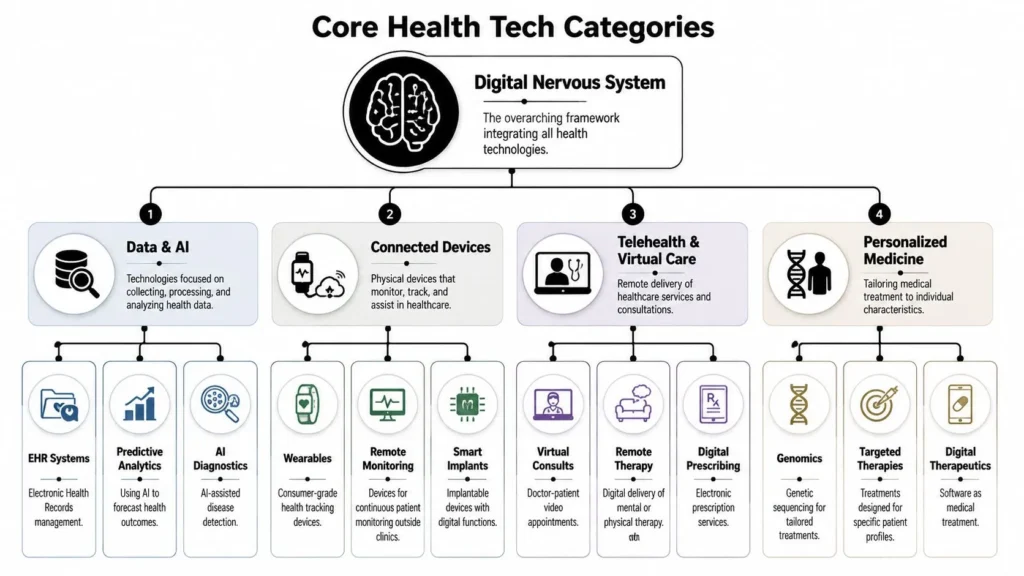
One useful way to sort health technology is by the job each tool does in care. Some tools collect signals. Some organize and interpret them. Some deliver care across distance. Others tailor treatment to the individual patient. That framework keeps the field from turning into a blur of buzzwords.
Data and AI
Data and AI form the interpretation layer. If a hospital generates thousands of lab results, notes, images, and vital-sign readings each day, clinicians need help spotting what matters first. AI works like a fast pattern checker. It can scan an image for suspicious features, estimate which patients may need closer follow-up, or sort information so a care team is not hunting through screens.
That sounds abstract, so a concrete example helps. A radiologist may review hundreds of images in a shift. Software can flag a scan that appears to contain an urgent abnormality, helping the specialist decide what to review first. The doctor still makes the clinical judgment. The software helps with triage and pattern detection.
This category also includes electronic health records. They rarely get the same attention as AI, but they are the shared memory of modern care. If that memory is fragmented, every newer tool becomes harder to use. If it is well organized, referrals, medication checks, and follow-up decisions become clearer.
The stakes are human, not just technical. A well-built system can reduce duplicate work and lower cognitive overload. A poorly built one can bury clinicians in alerts and clicks, which adds to burnout instead of easing it.
Connected devices
Connected devices are the sensing layer. They capture health information outside the brief window of an office visit and send it to a larger system. That group includes smartwatches, glucose monitors, home blood pressure cuffs, pulse oximeters, smart inhalers, and some implanted devices.
The simplest analogy is this. A clinic visit is a snapshot. A connected device can create a time-lapse.
That difference matters in chronic care. Blood pressure, heart rhythm, blood sugar, and oxygen levels can change across the day, across a week, or after a medication adjustment. A single reading may miss the pattern. Ongoing measurements can show whether a patient is stable, drifting, or getting worse.
For a plain-language companion on how continuous tracking works outside the clinic, this guide to continuous wearable monitoring explains the idea clearly.
Some of the most promising versions of this category depend on much smaller sensors and materials. For a broader scientific overview, this primer on nanotechnology applications in medicine shows how miniaturized systems may expand what clinicians can measure and treat.
Connected devices also reveal an equity problem that often gets ignored. A home monitor is only useful if a patient can afford it, set it up, keep it charged, connect it to broadband or cellular service, and understand what the readings mean. A tool can be advanced and still leave gaps in care if those practical barriers are not addressed.
Telehealth and virtual care
Telehealth is the access layer. It uses video visits, phone calls, secure messaging, remote prescribing, and virtual follow-up to bring care to the patient instead of requiring every interaction to happen in a clinic building.
A single NIH-hosted review of digital healthcare trends noted both the rapid rise of the AI healthcare market and major projected growth in telehealth, which helps explain why these categories now sit at the center of health system planning. The deeper reason is simpler. Distance, transportation, mobility limits, caregiving duties, and work schedules all shape whether a person can receive care.
Telehealth can improve access for a parent who cannot leave work, an older adult who struggles with travel, or a rural patient who lives far from a specialist. It can also create new barriers. Some patients lack private space, internet access, language support, or comfort with digital tools. For providers, virtual care can save time in some cases and create extra documentation and inbox volume in others.
So telehealth is not just a video call. It is a new care channel, with benefits and tradeoffs that depend on workflow design, reimbursement rules, and who gets left out.
Here’s a simple way to compare the main categories:
| Category | What it does | Simple analogy |
|---|---|---|
| Data and AI | Finds patterns in health information | A fast pattern checker |
| Connected devices | Collects signals from daily life | A time-lapse recorder |
| Telehealth | Delivers care across distance | A remote clinic doorway |
| Personalized medicine | Tailors treatment to the individual | A custom-fit care plan |
A short visual explainer can help tie those branches together:
Personalized medicine
Personalized medicine focuses on fit. Two patients can share the same diagnosis and still respond differently to the same drug, the same dose, or the same care plan. Genetics, clinical history, lifestyle, environment, and treatment response all shape what works.
This category includes genomics, targeted therapies, biomarker-guided decisions, and digital therapeutics. A digital therapeutic is not just a general wellness app. It is software designed to play a treatment role, often for a defined condition and with a specific clinical purpose.
Why does this matter to a non-specialist reader? Because medicine has long relied on averages. Personalized medicine tries to move from “what works for the typical patient” toward “what is more likely to work for this patient.” That can improve outcomes, reduce trial-and-error prescribing, and make care feel more humane.
It also raises a hard system question. If personalized tools are expensive or available only in well-resourced settings, the patients who could benefit most may get them last. That is why the category matters for health equity as much as for scientific progress.
Healthcare Innovations in Real-World Practice
The clearest way to understand healthcare technology innovations is to follow them into ordinary moments of care. Not product demos. Not investor slides. Actual situations where someone is trying to solve a problem.
A patient at home, not in a waiting room
A person with a heart condition may feel fine during a scheduled visit and still have symptoms later that week. That’s where remote monitoring changes the picture. Instead of relying only on occasional check-ins, clinicians can review trends from connected devices and respond when patterns shift.
For readers who want a plain-language explanation of how this works outside the clinic, this guide to continuous wearable monitoring gives a useful overview of what ongoing data collection can and can’t do. The key idea is simple: one measurement is a snapshot, but continuous monitoring is a movie.
That difference matters. A snapshot can miss a developing issue. A movie shows direction.
A scan that gets a second set of eyes
Now consider a radiology or imaging workflow. A clinician reviews an image, but software can also examine the same image for suspicious patterns. In practice, that means AI can act like a second set of eyes. It may flag something subtle, organize urgency, or reduce the chance that an important detail is buried in a crowded workday.
That’s why AI has become such a major focus in healthcare. Its role isn’t magical automation. Its real value is narrower and more practical. It helps clinicians manage complexity.
A simple example is diabetic eye screening. The core challenge isn’t only whether a disease can be detected. It’s whether detection can happen early enough, in enough places, without exhausting the workforce. Tools that support earlier review can make a routine screening pipeline more responsive.
Software that behaves like treatment
Some people still assume digital health means appointment scheduling, portal messages, or a nicer user interface. But some software now tries to influence health behavior directly. That’s where digital therapeutics enter the conversation.
Think about a person managing type 2 diabetes or recovering through a structured therapy program. Instead of receiving advice only during appointments, they may use a digital program that offers prompts, tracks adherence, guides exercises, or reinforces habits between visits. The software becomes part of treatment, not just administration.
Three real-world patterns show up again and again:
- Detection support: Tools help clinicians spot warning signs sooner.
- Care continuity: Monitoring keeps the care team connected between visits.
- Patient guidance: Digital programs reinforce treatment outside the hospital.
The best health tech often feels less like “using technology” and more like “getting help at the right moment.”
Why these examples matter
Each example solves a different problem. Remote monitoring deals with gaps between visits. AI-assisted review deals with information overload. Digital therapeutics deal with the reality that treatment doesn’t happen only in the doctor’s office.
That’s why healthcare technology innovations shouldn’t be judged only by novelty. A flashy tool can fail if it doesn’t fit into daily life. A quieter tool can matter more if it helps a patient stick with treatment or helps a clinician catch a problem earlier.
Clinical Breakthroughs and Business Realities
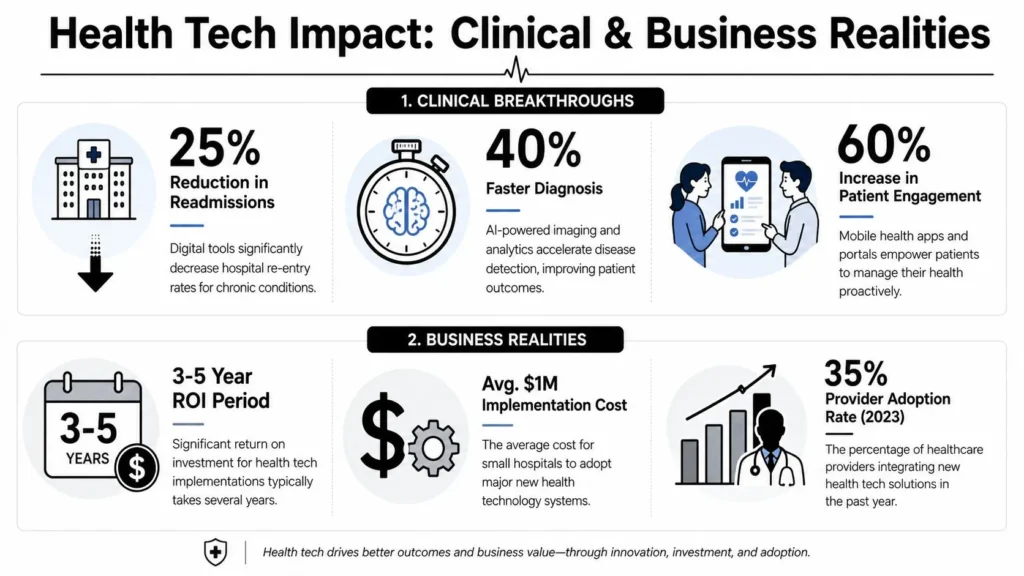
The promise of health tech is easy to describe from the patient side. More personalized care. Earlier warnings. Fewer unnecessary trips. Better access to specialists. The harder part is what happens inside the organization trying to deliver that care.
The clinical upside
Some healthcare technology innovations make medicine more specific. Personalized medicine is a good example. Instead of treating a diagnosis as a uniform category, clinicians can look for the traits that make one patient’s case different from another’s. That can shape how treatment is chosen and how closely someone is monitored.
Other innovations improve continuity. A connected device can capture signals outside the clinic. A telehealth platform can make follow-up easier. A digital prescribing system can reduce friction between appointment and treatment. These changes may sound administrative, but they affect whether care is provided.
Clinicians often value technology most when it does one of three things well:
- Clarifies a decision when the case is complex
- Extends observation beyond a brief visit
- Reduces friction between diagnosis, instruction, and follow-up
The business and workflow problem
The public conversation often treats technology adoption like a straight line: buy a tool, improve care, save time. Real healthcare work is messier. New systems must fit regulations, budgets, staffing patterns, and old software that may not communicate well.
One overlooked reality is paperwork. According to Icario Health, up to two-thirds of a physician’s day is still spent on paperwork. That detail changes how you evaluate innovation. A tool that helps a patient but adds even more clicking and typing for staff may solve one problem while deepening another.
Here’s the tension in a simple comparison:
| If technology does this | It usually helps | It may also create |
|---|---|---|
| Adds more data streams | Better visibility into patient status | More alerts and review work |
| Expands remote access | Easier follow-up and convenience | New scheduling and documentation tasks |
| Supports decisions with software | Faster pattern recognition | Pressure to verify, document, and reconcile outputs |
Why documentation tools deserve more attention
Administrative burnout doesn’t get the same attention as AI diagnostics or futuristic robotics, but it may be one of the most human issues in digital medicine. If clinicians spend huge parts of the day documenting instead of listening, explaining, and deciding, then the quality of care suffers even when the software is technically impressive.
That’s why voice recognition and remote scribe tools matter. They aim to reduce the amount of manual typing and after-hours charting that drains clinicians. Their appeal is not glamour. It’s relief.
If you want an example of how wearable and assisted-exercise technology is being presented to patients in practical terms, this piece on BionicGym’s cardio technology shows how some companies frame the connection between device innovation and daily use.
Takeaway: In healthcare, a technology isn’t successful just because it works. It has to fit the lives of patients and the workflows of clinicians.
Navigating the Hurdles of Health Tech Adoption
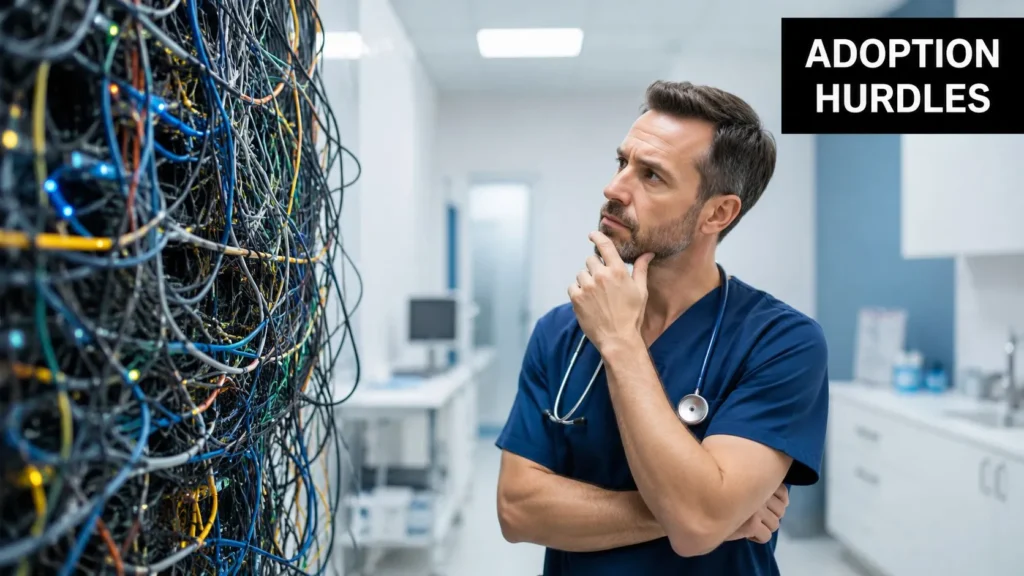
A promising idea in healthcare doesn’t move straight from prototype to routine care. It has to get through a gauntlet of practical barriers. That’s one reason innovation in medicine often feels slower than innovation in consumer apps.
Regulation is not a side issue
Healthcare tools can influence diagnosis, treatment, records, and privacy. Due to the profound implications involved, regulation sits close to the center of the process. Developers and healthcare organizations have to think about safety, intended use, documentation, and legal compliance very early.
Readers sometimes find this frustrating. If a tool looks helpful, why not deploy it quickly? Because “helpful” isn’t enough in medicine. A system that gives flawed advice, mishandles data, or confuses clinical responsibility can create harm at scale.
The same principle appears in older parts of healthcare technology too. Safety and process discipline apply whether you’re talking about software or medical equipment preparation. Even a topic like ethylene oxide sterilization shows how healthcare depends on controlled procedures, not just clever inventions.
Cybersecurity and trust
Health data is personal. A breach in a retail app is serious. A breach involving medical records is different. It can expose diagnoses, medications, mental health information, and family details that people never expected to share beyond care teams.
That’s why cybersecurity isn’t just an IT issue. It’s a trust issue.
When a hospital adopts a new platform, leaders have to ask:
- Who can access the data
- How is the data stored and shared
- What happens if the system is attacked or fails
- How will staff use the system safely in daily practice
A good tool can still fail adoption if staff don’t trust it, don’t understand it, or feel it creates hidden risk.
Interoperability is the daily frustration people rarely see
Interoperability sounds technical, but the basic problem is easy to grasp. Different systems often speak different digital languages. One device records information one way. Another platform stores it another way. The clinician then has to bridge the gap manually.
That leads to familiar frustrations:
- Duplicate entry: staff type the same information into multiple systems
- Fragmented history: clinicians can’t see the full story in one place
- Delayed action: useful data exists, but not where it’s needed
The irony is that a technology can be excellent on its own and still underperform if it can’t fit the rest of the environment. Healthcare organizations don’t buy innovation into an empty room. They add it into busy, legacy-heavy, high-stakes settings.
A digital tool in healthcare is only as useful as its ability to fit safely into a crowded clinical workflow.
Addressing the Ethical Questions in Digital Health
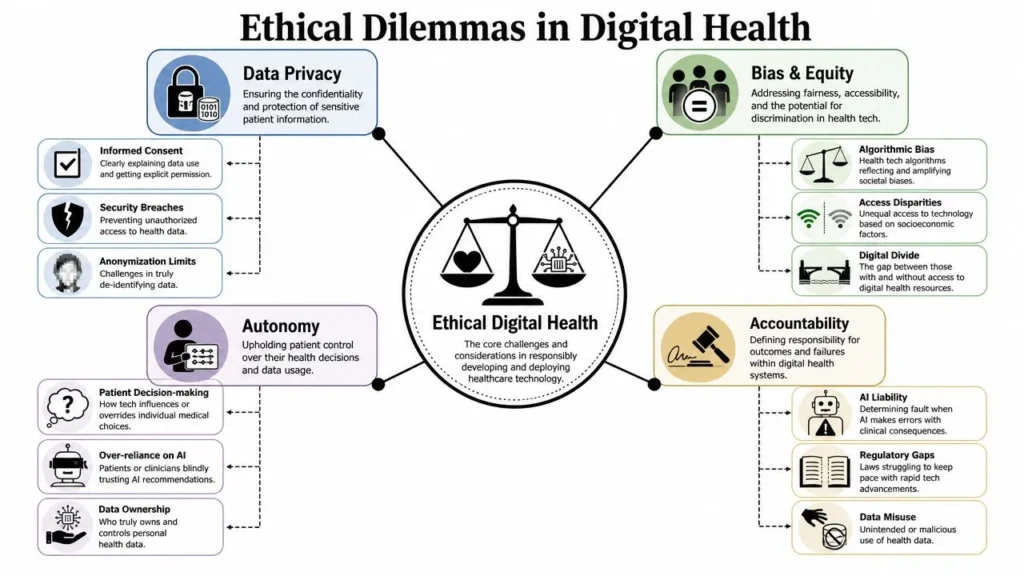
The most common mistake in digital health writing is assuming that innovation automatically equals progress for everyone. It doesn’t. A new tool can improve care for one group and widen the gap for another.
The digital divide is a healthcare problem
A major ethical issue is access. As Nonprofit Quarterly notes, the digital divide remains a serious barrier. In low-resource settings, a lack of reliable internet and electricity can make advanced tools unreachable. That means a glowing story about AI diagnostics or mobile care can ring hollow for communities that can’t consistently connect to the system.
Healthcare technology innovations are often designed around assumptions. The patient has a smartphone. The home has broadband. The user has time, privacy, literacy, and confidence with apps. In real life, many people don’t.
A useful way to test a digital health idea is to ask: who has the easiest time using this, and who gets filtered out before the benefit even begins?
Bias, privacy, and autonomy
Ethics in digital health isn’t only about access. It’s also about fairness, consent, and control. If an algorithm is trained on narrow data, its recommendations may be less reliable for people who weren’t well represented in that data. If a platform collects intimate health information, patients deserve clarity about how it’s used and who sees it.
Three concerns keep coming up:
- Bias and equity: Does the system work equally well across populations?
- Privacy: Is sensitive information protected and handled transparently?
- Autonomy: Does the patient still understand and control key decisions?
For readers exploring the operational side of patient communication and privacy expectations, a practical HIPAA compliant answering service guide can help show how compliance thinking extends beyond flashy software into everyday contact points.
Designing with communities, not just for them
The ethical standard shouldn’t be “build something advanced and hope people adapt.” It should be “build something useful in the conditions where people live.”
That changes the questions developers and healthcare leaders ask. Not just, can the app work? But can it work with unreliable connectivity? Can it support different languages and literacy levels? Can it respect cultural context? Can it be affordable enough to matter?
The strongest digital health tools aren’t the most futuristic ones. They’re the ones people can actually reach, trust, and use.
That’s where the human impact of healthcare technology innovations becomes sharpest. The field isn’t only deciding which tools are powerful. It’s deciding who benefits first, who benefits later, and who might be left out entirely.
The Future of Health Tech and Your Role In It
The next phase of healthcare technology won’t be defined only by smarter algorithms. It will be defined by whether systems become more usable, more connected, and more humane. The most important trend to watch is not “more tech.” It’s better fit between technology, care delivery, and real life.
What the near future is likely to look like
Care will likely keep moving outward from hospitals and clinics into homes, phones, and everyday routines. That doesn’t mean hospitals become irrelevant. It means more parts of care happen earlier, remotely, and continuously.
You can expect several shifts to keep gaining attention:
- More care between appointments: monitoring and digital follow-up will matter as much as the visit itself.
- More support for clinician workflow: documentation tools, voice systems, and better interfaces will get more attention because burnout is too costly to ignore.
- More pressure for equity: digital health teams will have to prove not only that a tool works, but that it works fairly and accessibly.
What patients should ask
Patients don’t need to become engineers to engage with health tech wisely. They need better questions.
Ask things like:
- How does this tool help my care decision
- What happens to the data it collects
- What should I do if the device or app gives a worrying reading
- Is this replacing a visit, or supporting one
Those questions bring the discussion back to purpose. A device or app should make care clearer, not more confusing.
What students and professionals should learn
People entering this field often think they must choose between medicine and technology. In practice, the field rewards translators. It needs people who can understand clinical reality and also work with software, data, design, policy, ethics, or operations.
Useful skills include:
| Role or interest | Helpful focus |
|---|---|
| Clinical professionals | Digital workflow, documentation tools, patient communication |
| Technologists | Interoperability, privacy, usability, clinical context |
| Writers and educators | Plain-language explanation, ethical framing, real-world examples |
The field especially needs communicators who can explain hard topics without hype. Healthcare technology innovations affect readers best when they’re described in human terms: what changes, who gains, what risks remain, and what questions still need asking.
Why your role matters
You don’t have to invent a device to shape the future of health tech. Patients shape it by asking informed questions. Clinicians shape it by pushing back on tools that waste time or undermine care. Designers and developers shape it by building for real conditions instead of ideal ones. Writers shape it by refusing to flatten the story into simple optimism.
Healthcare technology is becoming part of ordinary life. That makes public understanding more important, not less. When more people can recognize the difference between useful innovation and empty novelty, the whole field gets better.
If you enjoy clear, approachable writing on science, health, technology, business, arts, travel, and more, explore maxijournal.com. It’s a place for curious readers and prospective contributors who want thoughtful, accessible articles that make complex topics easier to understand.
Discover more from Maxi Journal
Subscribe to get the latest posts sent to your email.