A true Labrador Yorkie mix is biologically impossible through natural means because the parent breeds differ in size by about 20 times, from a Yorkshire Terrier at about 3.2 kg/7 lbs to a Labrador Retriever at about 65 kg/145 lbs. Therefore, what is commonly referred to as a ‘Labrador Yorkie mix’ is typically something else: a Labrador mix that looks terrier-like, a terrier mix with retriever features, or a made-up label used to market a mixed-breed puppy.
That surprises a lot of people, and it should. “Designer dog” names can make almost any pairing sound established, even when the pairing doesn’t exist in any meaningful biological or kennel-club sense. If you’re asking about a Labrador Yorkie mix, you’re not asking a silly question. You’re bumping into a real problem in pet marketing: names get invented faster than dog genetics changes.
I’m coming at this like a veterinary technician who has spent a lot of time explaining breed expectations, mixed-breed surprises, and why good intentions don’t always line up with anatomy. The useful question isn’t “What is a Labrador Yorkie mix like?” The useful question is “What dog did I probably see, and how can I choose responsibly?”
The Biological Reality of a Labrador Yorkie Mix
A naturally bred Labrador Yorkie mix is not a real-world dog you should expect to find. The label sounds plausible because both parents are dogs, but canine genetics still have to work within anatomy, pregnancy risk, and basic welfare.
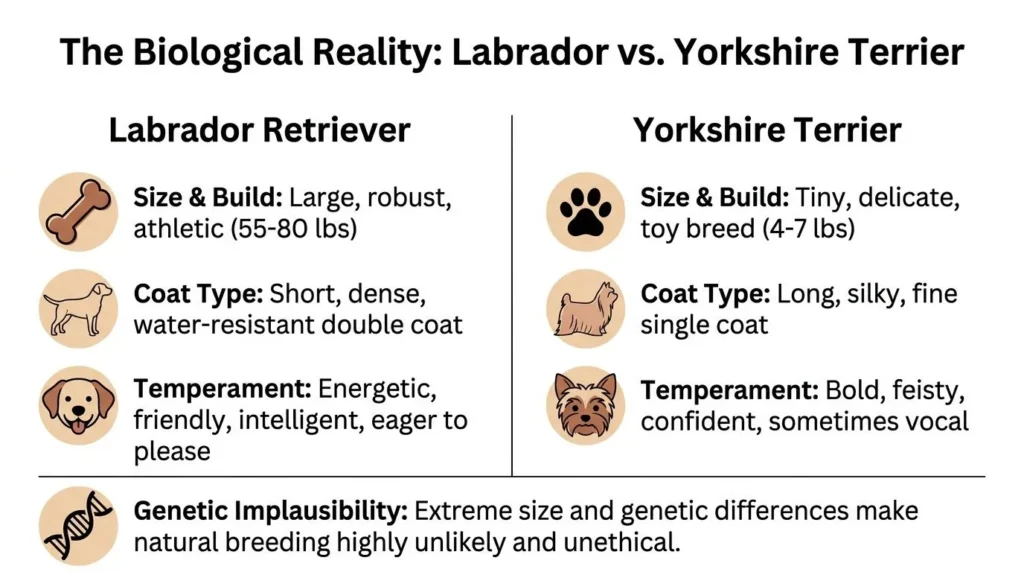
A peer-reviewed source describes this pairing as a biologically non-existent crossbreed because the size gap between a Labrador Retriever and a Yorkshire Terrier is so extreme that natural mating is not realistic, and assisted reproduction would raise serious ethical and clinical problems (peer-reviewed discussion of size mismatch and breeding limits).
Why this pairing breaks down in practice
People often hear “mixed breed” and assume any two breeds can be combined if someone tries hard enough. In veterinary settings, the question is narrower. Can reproduction happen without putting the dogs, especially the smaller female, at unreasonable risk?
Here, the answer is no.
A Labrador and a Yorkie differ in height, bone size, body weight, pelvic capacity, and fetal expectations. That last point confuses people, so it helps to say it plainly. Pregnancy is not just about fertilization. The mother’s body has to carry and deliver puppies safely. A toy-breed frame is built very differently from a large sporting breed frame.
The mismatch works a bit like trying to fit large-breed pregnancy demands into a toy-breed body. The problem is not branding. The problem is biology.
Why “couldn’t a vet just do it?” is the wrong standard
Veterinary medicine can do many technical things. That does not make those things humane, responsible, or appropriate for breeding.
Good breeding starts with the health of the parent dogs and the likely welfare of the puppies. If a proposed cross depends on extreme intervention, creates obvious risk for the smaller dog, or has no reasonable path to safe gestation and delivery, responsible professionals do not treat it like a clever designer mix idea. They treat it like a welfare concern.
That matters for buyers too. A dramatic breed name can distract from the questions that protect a dog. Has this puppy been bred responsibly? Does the breeder understand inherited disease risk? Is the dog’s background being described accurately?
Why the label still shows up
Usually, the name appears because someone is guessing.
Shelters and rescues sometimes make visual breed estimates, and those guesses are often imperfect. Sellers may also use catchy labels to make an ordinary mixed-breed puppy sound unusual or rare. In other cases, a dog may resemble parts of both breeds to an untrained eye. Scruffy facial hair, a smaller body, or a dark coat can push people toward a Yorkie or Lab comparison even when neither breed is present in the mix.
That is one reason DNA results and individual health assessment matter more than a memorable nickname.
If what you really want is a small dog with lower-shedding coat traits, it helps to compare breeds that fit that goal, such as these best small hypoallergenic dogs, instead of relying on a made-up cross name.
A better way to read the situation
If you saw a “Labrador Yorkie mix” online, in a shelter listing, or in a social media post, the safest interpretation is that the label is informal and probably inaccurate. What you are more likely looking at is a terrier mix, a retriever mix with scruffy features, or a dog whose ancestry is too blended for visual ID to be reliable. For a useful comparison point, this guide to flat-coated retriever crossbreed information shows how retriever-type mixes can vary widely without matching a catchy label.
The kindest response is curiosity, not embarrassment. Dog breed names are often used loosely. The responsible response is to ask better questions about the actual dog in front of you.
Appearance and Genetics of Plausible Alternatives
Labels like “Labrador Yorkie mix” usually start with a visual guess. A dog may have a dark coat, a medium-length muzzle, and scruffy facial hair, so the brain grabs for two familiar breeds and stitches them together. That is a very human mistake, and it happens often with mixed-breed dogs.

The genetics behind appearance are messier than the label suggests. Coat type, ear set, body size, leg length, and facial furnishings are controlled by different genes, and those traits do not arrive as a tidy package. Mixed-breed inheritance works more like a shuffled deck of cards than a 50-50 blend. You can get a dog with a retriever-style head shape, terrier-like eyebrows, and a body that does not closely match either breed people guessed.
What you may have actually seen
Several real-world alternatives make more sense:
- A small-to-medium retriever mix with a shorter frame, scruffy coat, or wiry facial hair
- A terrier mix with a broader head, heavier chest, or dropped ears
- A retriever cross with another sporting or companion breed, creating a softer Lab-like expression in a smaller dog
If you are comparing retriever-type mixes, this guide to flat-coated retriever crossbreed information helps show how retriever traits can show up in mixed dogs without producing one standard, predictable look.
Mixed-breed genetics do not average out neatly
A lot of confusion comes from expecting puppies to look like perfect halves. They do not. One puppy in a litter may inherit a smoother coat and longer legs, while another gets a rougher coat, shorter body, and a completely different face shape.
Here is what that can look like in a plausible terrier-retriever type mix:
| Feature | Possible outcome in a plausible terrier-retriever type mix |
|---|---|
| Coat | Smooth, shaggy, wiry, or a mix of textures |
| Build | Lean and leggy, compact and sturdy, or unevenly proportioned |
| Face | Broader muzzle, narrower muzzle, or mixed features that are hard to place |
| Shedding | Moderate to heavy, or lower shedding with higher grooming needs |
Some dogs get mislabeled because people identify the traits they recognize and overlook the rest.
Photos add another layer of confusion. A haircut can make a dog look more terrier-like. Puppy coats often change as the dog matures. Even camera angle, lighting, and body condition can shift how “Lab-ish” or “Yorkie-ish” a dog appears in a single image.
If your real goal is a smaller, lower-shedding dog
Many people searching this term are really trying to describe a wish list. They want a friendly dog in a smaller body, often with less shedding and easier apartment fit. That is a reasonable goal. It just helps to search by size, coat care, energy level, and temperament instead of by an impossible cross name.
A practical starting point is this guide to best small hypoallergenic dogs. That approach gives you choices that exist, and it makes it easier to match a dog to your home, budget, and grooming tolerance.
Temperament and Behavior in Lab and Terrier Mixes
Temperament is where labels can really lead people astray. A seller might imply that combining a friendly Labrador with a bold little terrier automatically creates a cute, manageable family dog. Real behavior doesn’t work that neatly.
Labradors are widely known for being social, energetic, and eager to work with people. Yorkshire Terriers are known for confidence, intensity, and a surprisingly big attitude in a tiny body. In a plausible retriever-terrier type mix, those traits don’t politely blend. They can clash.
How those traits can combine
Here’s what that might look like in real life:
- Friendly with pushiness mixed in. The dog loves people but barrels into greetings, grabs toys, and has poor impulse control.
- Smart but selective. Training clicks fast when rewards are exciting, then falls apart when the dog decides something else is more interesting.
- Brave beyond good judgment. Terrier confidence can be charming until it shows up around larger dogs, wildlife, or busy environments.
A future-dated source describes a 2025 study in which 72% of owners of mixed breeds with significant size differences in parentage reported moderate aggression only when unsupervised with smaller dogs, highlighting how unpredictable large-and-small breed combinations can be (2025 owner-report study reference).
That finding fits what many behavior professionals already treat cautiously. A dog can be affectionate in the living room and still be too rough, too aroused, or too intense in play.
Why supervision matters more than labels
People often ask whether a “Lab-terrier type” dog will be good with kids, cats, or tiny dogs. The honest answer is that the individual dog matters more than the fantasy mix name.
Watch for these behavior clues instead:
- Play style: Does the dog body-slam, chase hard, or ignore stop signals?
- Frustration response: What happens when the dog is blocked from getting a toy or reaching another dog?
- Recovery time: Can the dog settle after excitement, or does it stay revved up?
A dog doesn’t need to be “aggressive” in the dramatic sense to be unsafe with a very small pet. Overarousal and rough play can be enough.
For readers interested in broader retriever-cross behavior patterns, this overview of a Lab retriever mix can help you compare common retriever traits against what terrier influence may change.
Training needs tend to be specific, not generic
These dogs usually do best with structure. Not harshness. Not vague “be the alpha” advice. Structure means clear routines, short training sessions, reward timing, and active management of the environment.
If you’re dealing with jumping, chasing, guarding, leash reactivity, or rough play, an individualized plan helps more than generic obedience tips. This guide to PawCraft’s personalized dog training is a good example of the kind of individualized behavior approach owners should look for.
A cute mix name can’t tell you whether a dog is safe off leash, gentle with seniors, or easy with toddlers. Observation can.
Health Lifespan and Daily Care Needs
A supposed Labrador Yorkie mix does not come with a real health profile. It comes with uncertainty.
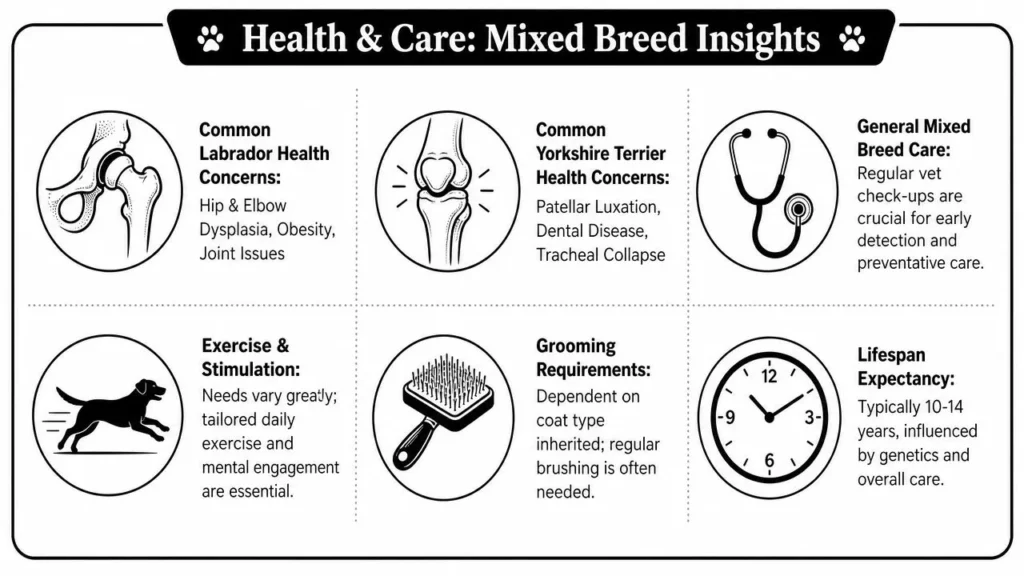
That distinction matters because health planning depends on predictable size, body structure, and inherited risk. With established breeds, veterinarians can look at patterns seen across many dogs. With a mislabeled or biologically unrealistic cross, you have to work from the individual dog’s actual body and medical history instead.
A large retriever frame and a toy-breed frame are built for very different jobs. One is designed to support much more weight through the hips, elbows, and long bones. The other is built with much finer joints, a smaller airway, and crowded small-breed teeth. In essence, the body plan is the issue.
Here is the practical concern:
| Parent type | Common concern area | Why it matters in care planning |
|---|---|---|
| Labrador type | Hips, elbows, weight-bearing joints | Larger dogs need close attention to growth rate, body condition, and joint stress |
| Yorkie type | Kneecaps, airway, dental crowding | Smaller dogs often need monitoring for patella issues, tracheal sensitivity, and dental disease |
That does not mean every mixed-breed dog with Lab or terrier ancestry will be unhealthy. It means the label “Labrador Yorkie mix” does not give you a safe shortcut. A name cannot tell you whether a dog should be managed like a medium sporting dog, a small terrier mix, or something in between.
What lifespan information can and cannot tell you
There is no breed-specific lifespan record for this claimed cross. If someone offers a precise prediction for adult size, life expectancy, or inherited disease risk based on the name alone, they are guessing.
A better question is: what has this dog already shown? Age, current weight, body condition, orthopedic exam findings, dental status, breathing sounds, and parentage evidence are all more useful than a fantasy mix label.
That is the same reason veterinary teams focus on the dog in the exam room. A dog with long limbs, heavy paws, and rapid growth needs different daily management than a small scruffy terrier-type dog, even if both were advertised under the same catchy mix name.
Daily care depends on the dog you actually have
For realistic Lab-terrier or small-to-medium mixed breeds, daily care usually centers on four areas.
- Exercise: Some dogs need steady aerobic activity and training games. Others do better with shorter walks, sniffing time, and lower-impact play.
- Weight control: Extra pounds put more strain on joints, especially in dogs with larger-breed influence.
- Coat and skin care: A short double coat, wiry coat, or silky coat all need different grooming routines.
- Dental care: Smaller dogs and small-mix dogs often need more frequent attention to plaque buildup and gum disease.
Puppies need special caution. Repetitive jumping, slick floors, obesity, and overexertion can all make orthopedic problems harder to manage later.
If you want practical help with routines, grooming, preventive care, and day-to-day decisions, this library of pet care advice is a useful place to start. If your goal is to find your next companion, choose a rescue or seller who can provide exam records, vaccine history, and honest observations about the dog’s current needs.
How to Responsibly Find a Mixed Breed Dog
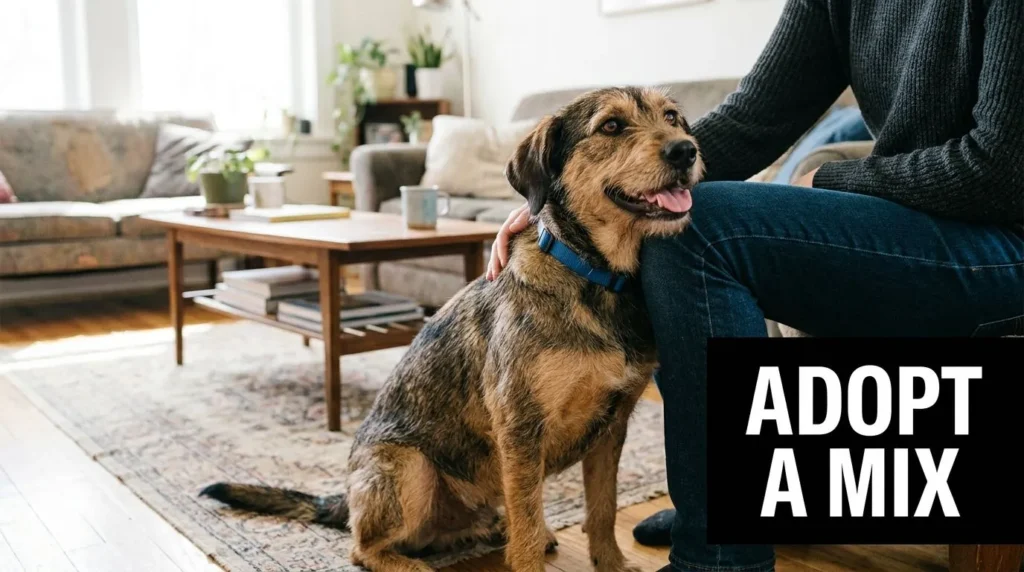
The safest way to search is to stop shopping for the name and start evaluating the dog in front of you. A “Labrador Yorkie mix” label can sound specific, but it does not give you a reliable picture of adult size, coat care, energy level, or health risk. In practice, that label often means someone is guessing.
That can feel frustrating at first. It also gives you a better path.
A mixed breed dog is a bit like a mystery recipe without a full ingredient list. The final result matters more than the guess on the label. For a potential owner, that means asking practical questions about the individual dog’s behavior, body type, medical history, and daily needs instead of chasing a rare-sounding cross that may not be real.
Better places to look
If you want a friendly family dog, a scruffy companion, or a medium-energy pet, adoption is often the most responsible starting point. Shelter and rescue staff may not always know exact breed ancestry, but they can often tell you how the dog acts in a home, around strangers, and during routine handling. That information is usually more useful than a creative breed name.
Look for an organization that can clearly explain:
- How the dog behaves in foster care or in the shelter
- Whether it has lived safely with cats, children, or other dogs
- How it handles grooming, nail trims, restraint, and car rides
- What veterinary care has already been completed
- Whether there are known concerns about anxiety, guarding, house training, or reactivity
If you are starting your search online, a rescue-focused directory can help you find your next companion through more humane channels than social media listings from private sellers.
Red flags that should make you walk away
Sellers who rely on an unusual mix name are often marketing the story more than the dog. That is the part to slow down and examine.
Be cautious if you see any of these patterns:
- Rarity claims without records. “Super rare” means very little if the person cannot document parentage.
- Confusing or changing explanations. One ad says Yorkie-Lab, another says terrier mix, and a phone call adds a third breed.
- Pressure to send money quickly. Responsible breeders and rescues expect questions.
- Big promises about personality or coat type. No one can guarantee “the best of both breeds” in a mixed puppy.
- Little interest in your home or experience. Ethical sources screen adopters because placement matters.
A good rescue or breeder talks openly about the hard parts too. They should be willing to discuss training needs, fear issues, bite history if any exists, and the veterinary record. If the conversation stays focused on cute photos and unusual labels, that is a warning sign.
Focus on fit
A better search starts with your household and your routine. A dog that fits your life is safer and kinder than a dog chosen for a catchy breed claim.
Ask yourself:
- Do you want an active dog for long walks and training sessions, or a smaller companion with lower exercise needs?
- Can you keep up with brushing, coat trimming, and dental care if the dog has small-breed traits?
- Is your home set up for a dog that may bark, chase, dig, or need slow introductions to children or other pets?
- Are you prepared for some uncertainty if you adopt a young mixed breed puppy?
Those answers narrow the field quickly. They also steer you toward real dogs with real needs, which is the whole goal of responsible ownership.
Labrador Yorkie Mix FAQs
Can a male Yorkie and female Lab make the mix instead?
That pairing doesn’t solve the problem in a responsible way. Reversing the sexes doesn’t erase the extreme mismatch in body size and reproductive practicality. If someone claims that this is how the mix was created, ask for veterinary documentation and prepare for the possibility that the label is inaccurate.
Could DNA testing prove a dog is a Labrador Yorkie mix?
A dog DNA test may identify breed ancestry, but it can’t turn an implausible marketing story into a normal or advisable cross. It can, however, help explain why a dog looks confusing. A scruffy medium dog might come back as a combination of several breeds rather than the two breeds someone guessed by eye.
Why do so many dogs get mislabeled?
Most of the time, people aren’t trying to be deceptive at first. Shelter staff, neighbors, and even veterinarians sometimes make visual estimates because mixed dogs can resemble multiple breeds at once. Problems start when a guess becomes a sales pitch.
Is a made-up mix name always a scam?
Not always, but it should make you cautious. Some people genuinely repeat a label they were told. Others use unusual breed names because they attract clicks and inquiries. Either way, you should evaluate the dog as an individual and ask for records, not slogans.
What small dog should I look at if I like the Yorkie side of the idea?
Start with real small breeds or small mixes that match your lifestyle. Think about coat care, barking tendency, confidence level, and handling tolerance. If you like a terrier look but want a dog that’s easier to source responsibly, rescues often have small scruffy mixed breeds whose behavior is easier to assess than their exact ancestry.
What dog should I look at if I like the Lab side of the idea?
Consider actual Labrador mixes, spaniel mixes, or other retriever-type dogs that are already common in shelters and rescues. Meet the dog in person and ask about energy, sociability, and training history. Those answers matter more than whether the face reminds someone of a Yorkie.
Is a “designer mix” different from a mutt?
The practical difference is mostly marketing. “Designer mix” usually means someone intentionally paired or claimed to pair two named breeds. “Mutt” usually means mixed ancestry without branding. Neither label guarantees health, temperament, or predictability.
What should I ask before adopting any mixed breed dog?
Use questions that reveal the dog’s daily reality:
- How does the dog react to handling?
- What does it do when left alone?
- Has it lived with kids, cats, or other dogs?
- What grooming has it tolerated?
- What does the vet record show right now?
Those answers are more useful than a fantasy breed profile.
If you enjoy clear, practical pet articles that cut through myths without talking down to readers, explore more at maxijournal.com. You’ll find approachable reading on pets, health, science, and everyday questions that deserve straight answers.
Discover more from Maxi Journal
Subscribe to get the latest posts sent to your email.