Most startup marketing advice is wrong at the exact moment a company can least afford it.
Founders get told to do SEO, LinkedIn, Instagram, email, paid search, partnerships, PR, webinars, and short-form video all at once. That sounds extensive. In practice, it usually creates weak execution across too many fronts, muddy attribution, and a steady drip of wasted budget.
The leaner approach is harder emotionally but better operationally. Pick one channel. Learn it thoroughly. Prove it can produce customers. Then expand.
That’s the version of digital marketing for startups that survives contact with cash constraints, tiny teams, and short runways.
The Startup Marketer’s Dilemma
Early-stage startups usually don’t have a marketing problem. They have a focus problem.
The common playbook says to build a “balanced” channel mix from day one. That sounds sensible until a founder realizes each channel has its own learning curve, creative requirements, analytics setup, audience behavior, and optimization cycle. Trying to run all of them at once stretches a small team thin fast.
The better approach is more disciplined. Early-stage startups that systematically experiment to identify and double down on exactly one core marketing channel gain a primary growth lever, avoid budget fragmentation, and often get traction faster than startups that spread effort too broadly, as noted by BolsterBiz’s write-up on startup marketing strategies.
Startups rarely lose because they ignored one more channel. They lose because they never got one channel working well enough to matter.
This is a key dilemma. Founders want optionality. Startups need traction. Those are not the same thing.
Why broad plans fail early
A broad plan creates three predictable failures:
- Weak execution: A startup publishes inconsistently, runs shallow campaigns, and never stays in one lane long enough to learn.
- Bad measurement: Traffic comes from everywhere, conversions come from nowhere obvious, and the team can’t tell what to keep.
- Team burnout: The founder becomes the strategist, copywriter, designer, analyst, and media buyer at the same time.
That’s why “be everywhere” is such expensive advice.
What one-channel mastery looks like
One-channel focus doesn’t mean blind commitment. It means testing with intent, then concentrating effort once you see signal. The first winning channel becomes your base of operations. It gives you message clarity, customer language, and real performance data.
From there, the rest of digital marketing for startups gets easier. Your landing pages improve because you know what buyers care about. Your email gets sharper because you understand objections. Your paid campaigns get better because you’ve already found what resonates.
Master one channel first. Diversify later, when the first engine is working.
Set Your Foundation Before Spending a Dollar
Before you launch anything, get the basics right. A startup that skips this work usually pays for it in confused messaging, bad targeting, and campaigns that generate activity without revenue.
Startups should allocate approximately 7% to 15% of expected annual income toward marketing, and the plan should be SMART, meaning Specific, Measurable, Achievable, Relevant, and Time-bound, based on the verified guidance provided for this topic.
Start with goals that can survive scrutiny
“Get awareness” is not a marketing goal. It’s a hope.
A useful startup marketing goal ties to a business outcome and a time frame. If you can’t tell whether you hit it, it’s too vague. SMART planning forces discipline. It also protects you from vanity metrics that look good in a weekly update but don’t help the company grow.
A good goal usually answers four questions:
- What outcome matters: trials, demo requests, qualified leads, purchases, or repeat usage.
- Who it applies to: a specific customer segment, not everyone.
- What time window matters: a quarter is often enough for early traction work.
- How you’ll judge success: with metrics tied to acquisition or conversion, not applause.
Practical rule: If a goal can’t change budget decisions, it’s probably not specific enough.
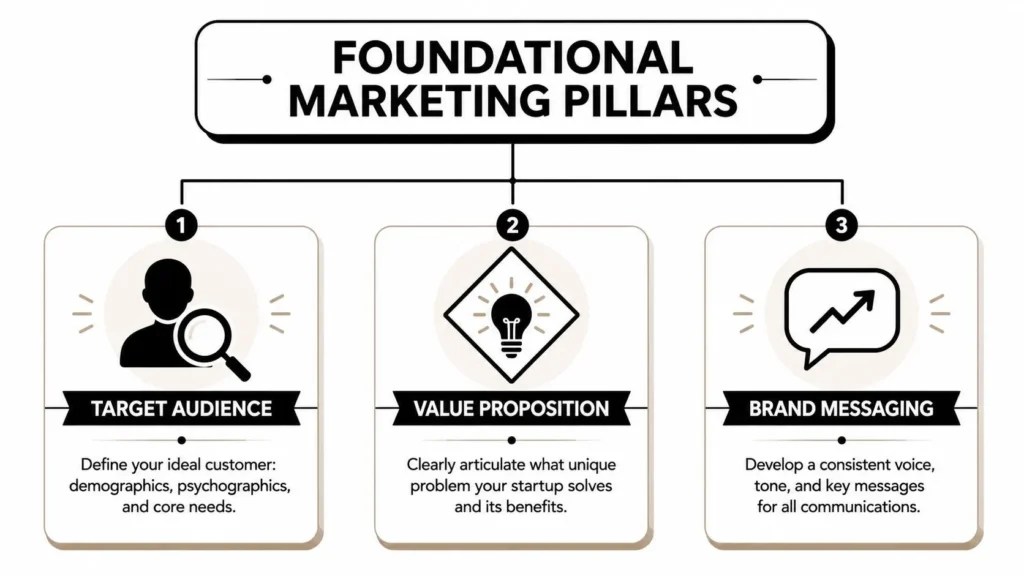
Define the audience before you write copy
Most founders describe their product more clearly than their buyer. That’s backwards.
Your ideal customer profile should include concrete details about who buys, what problem pushes them to act, what alternatives they already use, and what friction keeps them from switching. This work makes every marketing asset better, from ad creative to onboarding email.
A simple way to pressure-test your audience definition is to write down:
- The trigger: what happened that made this person start looking?
- The pain: what’s frustrating or costly right now?
- The desired outcome: what does “better” look like in plain language?
- The objection: what would make them hesitate?
That exercise usually reveals whether your messaging is grounded in buyer reality or founder assumptions.
If your positioning still feels fuzzy, it helps to tighten the fundamentals first. This practical guide on how to build brand identity is useful for clarifying the customer-facing language your marketing will depend on.
Set a budget that matches the stage you’re in
A lot of startup teams underfund marketing, then conclude marketing “doesn’t work.” What happened is simpler. They didn’t commit enough money or time to learn.
Use the 7% to 15% range as a planning guardrail, then decide how much of that you can test without putting the company at risk. In the beginning, the goal isn’t maximum scale. It’s learning efficiency.
A workable early budget often covers:
- Core tools: analytics, email platform, landing page software, and creative production.
- Test spend: enough to run controlled experiments without judging a channel too early.
- Content and creative: because even lean channels need assets that look credible.
- Iteration room: budget reserved for the second and third attempts, not just the first launch.
A startup with clear goals, a defined audience, and a realistic budget is already ahead of many better-funded teams.
Choose Your First High-Impact Channel
The first channel shouldn’t be the one you like most. It should be the one that best matches your buyer, your sales cycle, and your team’s actual capabilities.
For most startups, the smartest short list is content and SEO, email marketing, and social media distribution. Each can work. Each can also waste time when chosen for the wrong reason.
Content and SEO when patience is an advantage
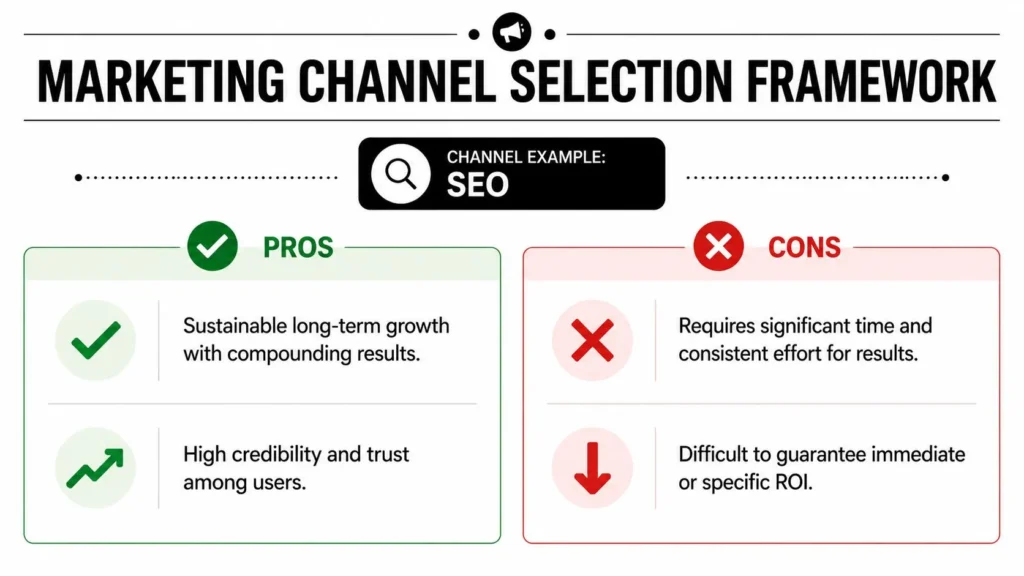
SEO is a strong fit when buyers actively search for solutions, compare options, and need education before they convert. It compounds over time, and search remains a major force in digital acquisition. In the verified data for this topic, search engines account for 40.9% of the global digital advertising and marketing market, and the source material argues that startups should prioritize SEO accordingly.
The upside is durability. The downside is time. SEO usually punishes inconsistency, thin content, and weak site structure.
Content-led SEO tends to work best when you can answer real buyer questions better than competitors. That means comparison pages, use-case pages, and decision-stage content, not generic blog filler.
Email marketing when you need efficient ROI
If you can collect leads early, email is one of the best channels a startup can own. According to the verified data, 30% of companies report returns between $36 and $50 for every $1 spent, while 35% report returns between $10 and $36 per $1 invested. That’s why email keeps earning a place in lean startup stacks.
Email is especially effective when the purchase isn’t instant. It lets you educate, follow up, handle objections, and reactivate interest without paying for every touchpoint again.
If your list is still small, build the asset now instead of waiting. This guide on how to build an email list is a practical place to start.
A few conditions make email stronger:
- You have a clear lead magnet or signup reason: demos, waitlists, templates, or useful education.
- Your product needs repetition: most buyers won’t convert on the first visit.
- You can write well: email rewards clarity more than flashy design.
Social media when discovery matters most
Social is useful when your product is visual, easy to demonstrate, or naturally shareable. It also matters when discovery is part of the buying journey. In the verified data, 93% of marketers use social media, and 53% of shoppers discover new products directly on social platforms.
That doesn’t mean every startup should chase every network. It means some startups should choose one platform where buyer attention is already concentrated.
Later in the process, it can help to study broader acquisition frameworks like this startup customer acquisition strategies resource from UFO Performance Marketing, especially if you’re weighing paid acquisition against content-led growth.
Here’s a simple decision lens:
| Channel | Best when | Hard part |
|---|---|---|
| Content and SEO | Buyers search before buying | Results take time |
| Email marketing | You can capture and nurture leads | List quality matters |
| Social media | Buyers discover products in-feed | Consistency and creative fatigue |
A short explainer can help founders think through the trade-offs visually:
Pick the channel that matches buyer behavior, not the one that’s trending in your feed.
Build Your Minimum Viable Marketing Plan
Once you’ve chosen a channel, keep the plan lean. A startup doesn’t need a giant annual marketing document. It needs a short operating plan the team can follow for the next quarter.
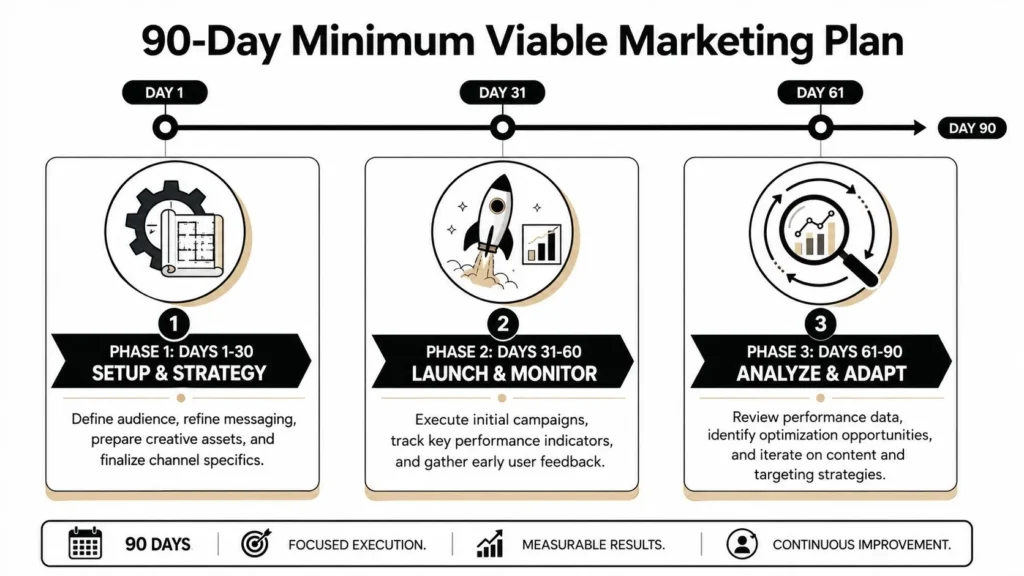
Think in 90-day cycles. That’s long enough to produce meaningful learning and short enough to correct mistakes before they get expensive.
What belongs in the plan
The best minimum viable marketing plan answers a few operational questions clearly:
- Primary objective: one business outcome for the quarter.
- Channel focus: one main channel, with tightly scoped support work.
- Key initiatives: the small set of actions you’ll ship.
- Success metrics: what you’ll track to decide whether to continue, revise, or stop.
- Cadence: who does what each week.
A good startup plan should feel a little boring. Boring plans get executed. Clever plans often sit untouched.
Many teams overcomplicate this stage by adding too many campaigns. A better move is to commit to a small number of repeated actions long enough to learn from them.
A simple 90-day template
Here’s a copy-ready structure you can use.
| Component | Description | Example (Content Marketing Focus) |
|---|---|---|
| Objective | The main business result for the quarter | Generate qualified demo requests from organic content |
| Audience | The specific segment you want to reach | Operations leaders at small software companies |
| Core message | The main problem-solution positioning | Reduce manual workflow bottlenecks without adding headcount |
| Primary channel | The single channel receiving most effort | Content marketing and SEO |
| Key initiatives | The few activities you will execute consistently | Publish decision-stage articles, update product pages, create comparison content |
| Supporting assets | Materials needed to make the channel work | Landing pages, email follow-up, clear CTAs, product screenshots |
| Metrics | Measures tied to traction and efficiency | Qualified leads, conversion rate, CAC, assisted conversions |
| Review rhythm | How often the team checks and adjusts | Weekly review, monthly deeper analysis |
Keep execution narrow enough to finish
A minimum viable plan should create momentum, not admin. If your team can’t explain this quarter’s marketing plan in a few minutes, it’s probably too broad.
For example, a content-led quarter might look like this:
- Month one: lock messaging, publish core pages, and improve conversion paths.
- Month two: add decision-stage content and tighten internal links.
- Month three: review which topics and CTAs created real pipeline, then refine.
If you want a more modern view on systemizing this process, especially when a team starts layering AI into production, this guide to scaling startup marketing with AI from The AI CMO is a useful companion.
The best plans are specific enough to guide execution and small enough to survive startup reality.
Execute and Measure Your Growth Experiments
Startup marketing gets interesting when you stop asking, “What should we do?” and start asking, “What can we learn this week for a small amount of money?”
That shift matters because early traction usually comes from experiments, not from one perfect campaign. You place a series of small bets, measure hard, and keep only what proves itself.

Set up tracking before the test
Startups must implement Google Analytics 4 with pixel tracking and UTM parameters from day one, and they should allocate a minimal test budget to 3 to 5 channels, or to experiments within one channel, with clear success metrics like CAC before scaling, according to Helpware’s startup digital marketing guidance.
If you skip this, you’ll end up optimizing for noise. Clicks will look promising. Traffic will rise and fall. Nobody will know what created customers.
Your base setup should include:
- GA4: to see sessions, events, and conversion paths.
- UTM parameters: to identify exactly which campaign, creative, or placement drove visits.
- Platform pixels: to connect ad delivery with downstream conversion behavior.
- A conversion event map: so the team agrees on what counts as a meaningful action.
Run one cheap experiment with a clear question
A good experiment starts with a question, not a tactic.
Example: can a short paid social test drive qualified trial signups from a narrow audience using one problem-focused message?
Use a small budget. The amount matters less than the discipline. The startup mistake isn’t spending too little. It’s spending without a question and then drawing conclusions from weak signals.
A clean experiment usually looks like this:
- Choose one audience: keep targeting narrow enough to interpret.
- Write one message angle: focus on one pain point, not five benefits.
- Build one landing page: match the ad promise exactly.
- Define success before launch: CAC, signup quality, and conversion rate are better than likes.
- Review behavior after the click: bounce patterns, form completion, and downstream actions matter.
Don’t ask whether the ad got attention. Ask whether the traffic behaved like future customers.
Learn from the result, then change one thing
The value of a test is often diagnostic. Sometimes the channel is fine and the message is wrong. Sometimes the ad works and the landing page leaks. Sometimes the audience clicks but doesn’t buy because the offer attracts curiosity instead of intent.
That’s why startups need to measure content and campaign behavior together, not in isolation. If you want a practical framework for evaluating what your assets are doing, this guide on how to measure content performance is worth using.
Creative quality matters here too, especially when you’re testing paid social or short-form acquisition. Founders exploring faster production workflows may find this guide on AI video ads for marketers from Seedance helpful for generating ad variations without building a full studio workflow.
The discipline is simple. Test small. Tag everything. Read behavior objectively. Then adjust one variable at a time so the next result teaches you something useful.
Scale Success and Thoughtfully Diversify
Once a startup finds a working channel, the next danger appears quickly. Teams either scale too fast and break unit economics, or diversify too early and lose the focus that created traction in the first place.
The right move is neither caution for its own sake nor expansion for appearances. It’s controlled scaling.
Know when the first channel is actually working
A working channel does more than produce conversions. It produces predictable conversions with messaging that buyers respond to repeatedly. You should be able to explain who converts, why they convert, and which assets consistently help.
Customer feedback is useful here. In the verified data for this topic, startups with an aggregate Net Promoter Score above 9.0 are statistically likely to experience exponential growth, and the same guidance recommends asking customers how likely they are to recommend the product to a friend, then using tools like Intercom or Survey Monkey to find friction points. That framework comes from Venture Harbour’s startup marketing strategy guide.
A strong score doesn’t replace revenue data, but it can tell you something important. It often means your product promise, customer experience, and acquisition message are lining up.
How to scale without losing the plot
When the first channel works, scale it in layers:
- Increase depth before breadth: publish more of the content formats, campaigns, or offers that already convert.
- Improve conversion paths: tighten headlines, calls to action, and landing page flow before buying more traffic.
- Systemize production: document what “good” looks like so output stays consistent as volume rises.
- Use customer language everywhere: the winning channel gives you phrasing that should shape sales, onboarding, and retention too.
This stage is also where startups benefit from the technical discipline many teams delay. The source guidance tied to this topic highlights A/B testing on headlines and calls to action, plus conversion-focused optimization such as pixel-based bidding. Those changes matter more after a core channel has proved itself.
The second channel should inherit the lessons of the first. If it starts from zero, you diversified too loosely.
Add a second channel with a reason
Thoughtful diversification means choosing the next channel based on evidence.
If SEO is producing strong demo intent, email might be the natural second channel to nurture non-converters. If social is generating attention but not enough purchase intent, content may become the support layer that closes the trust gap. If email performs well after lead capture, paid search might become the demand capture layer worth testing.
The logic should be sequential:
- Protect the first winning channel
- Identify the biggest gap in the funnel
- Choose one new channel that addresses that gap
- Test it with the same discipline you used the first time
That’s how digital marketing for startups grows up without getting bloated. One channel proves the message. The next channel extends it. The system becomes multi-channel only after it earns the right to.
If you want more practical, readable articles on business, technology, and growth topics, visit maxijournal.com. It’s a solid place to keep up with fresh writing and approachable analysis across a wide range of categories.
Discover more from Maxi Journal
Subscribe to get the latest posts sent to your email.