You open the grade portal, already bracing yourself. Maybe you thought that exam went fine. Maybe you knew it was shaky but hoped your effort would carry you. Then the number shows up, and it doesn’t match the hours you put in.
That’s the moment when most students get bad advice. “Study more.” “Try harder.” “Stop being lazy.” None of that helps if the actual problem isn’t effort. A lot of students are working. They’re just working in ways that don’t transfer to quizzes, papers, and exams when it counts.
If you want to know how to improve grades, treat it like a system problem. Grades usually rise when you fix the process behind them. That means diagnosing where points are being lost, changing how you study, planning your time in a practical way you can follow, and dealing with the part many students ignore until it hurts them: grade anxiety.
Moving Beyond “Just Study More”
You can spend three hours with your notes and still walk into an exam underprepared. I see that pattern all the time. The student worked, but the work stayed at the level of recognition. The test demanded recall, application, and clear thinking under pressure.
That gap matters because low grades are not always an effort problem. They are often a method problem, and anxiety makes the method worse. If study time is built around rereading, highlighting, and passive review, the material can feel familiar without being usable. Then the test starts, stress spikes, and access to what you know gets even shakier.
Strategic studying produces better results than piling on more hours. Research cited earlier found that students who made better decisions about how they used academic resources before studying earned higher exam scores than comparable classmates.
Practical rule: Judge a study session by what you could retrieve, solve, or explain without help, not by how long you sat there.
Students get stuck in a fake productivity loop for predictable reasons. Passive study feels safe. It creates the sense of progress without the discomfort of struggling to remember something from scratch. But that struggle is usually where learning hardens, and avoiding it often keeps grades flat.
Anxiety feeds the same loop. A student feels behind, chooses the least demanding study method just to get started, leaves the session without much usable retention, then feels more pressure the next day. That is not just a wellness issue. It is an academic performance issue.
Start with a harder, more useful question tonight: what did your last hour of studying ask your brain to do?
If the answer is mostly rereading, highlighting, copying, or watching, there is a good chance your study routine is improving comfort more than performance. Grades tend to rise when your work matches the way points are earned. That means solving problems, recalling key ideas without notes, outlining answers before you look at examples, and practicing in conditions that feel a little uncomfortable.
A weak quiz score, a rushed paper, missing assignments, and test-day freezing do not come from the same cause. Treating them as the same problem wastes time and usually raises stress.
First Diagnose Before You Prescribe
Before changing your routine, look at the evidence. A low grade is only useful if you can identify the pattern behind it.
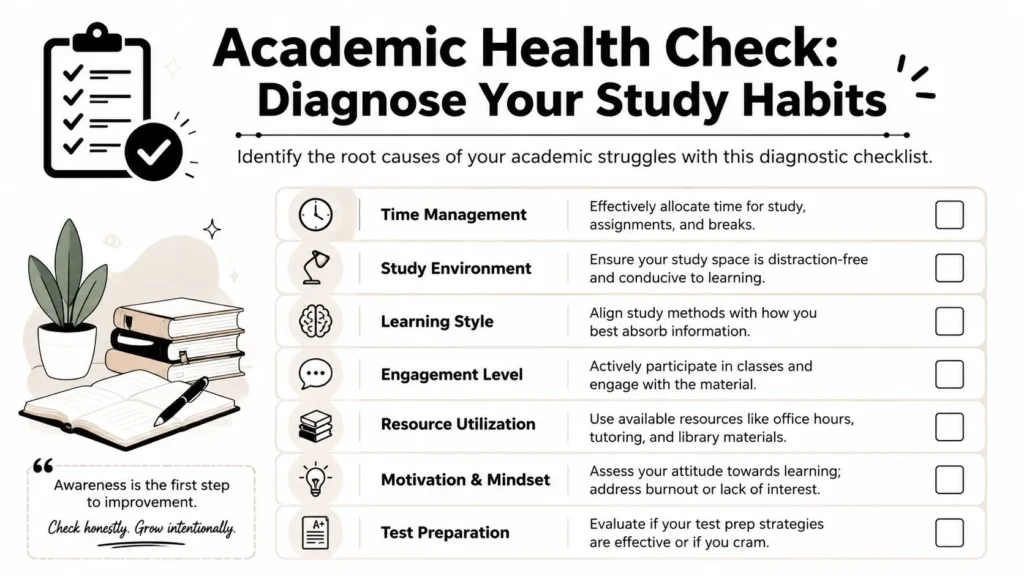
Run an honest postmortem
Pull out one recent test, quiz, paper, or lab report. Don’t start by staring at the final score. Start by marking every place you lost points and sorting each miss into a bucket.
Use these categories:
Content gap
You didn’t know the concept, formula, definition, or process well enough.Application gap
You knew the material in isolation but couldn’t use it in a new problem, essay prompt, or scenario.Question-reading mistake
You misread a word, skipped a condition, answered only half the prompt, or missed a direction.Time problem
You ran out of time, rushed, left blanks, or wrote a weak ending because the clock beat you.Careless execution
Arithmetic slips, formatting mistakes, missing labels, citation errors, or forgetting to show work.
If you do this carefully, your next move becomes clearer. A student with content gaps needs a different plan than a student who understands the course but keeps bleeding points from speed and misreading.
Ask better questions
Most students ask, “Why am I bad at tests?” That’s too vague to help. Ask questions that force a specific answer.
Try this checklist after each graded item:
- What kind of mistakes happened most often
- Did I study the same way the course tests me
- Did I practice retrieval, or did I just review
- Did I leave enough time between learning and testing
- Did I get feedback quickly enough to use it on the next assignment
- Did I avoid help because I was embarrassed or overwhelmed
Timely feedback matters here. Classter notes that assignment comments should be provided within 24 to 48 hours to support improvement, as described in their discussion of feedback and academic performance.
When feedback arrives late, students often repeat the same mistake on the next assignment before they even understand the first one.
Match the symptom to the fix
A quick diagnosis table helps.
| Pattern you notice | What it usually means | What to do next |
|---|---|---|
| You forget facts during tests | Weak recall | Practice without notes |
| You know notes but miss problem-solving questions | Shallow understanding | Explain ideas in your own words and solve mixed examples |
| You start strong but crash late in the term | Poor systems, not ability | Build a weekly schedule and protect class attendance |
| You blank out under pressure | Anxiety is interfering | Add stress regulation to your study plan |
| You lose points on details | Rushing or low review discipline | Create a final-check routine before submitting |
This step feels less exciting than buying new flashcards or making a color-coded planner. It’s still the step that saves the most wasted effort. You can’t improve grades consistently if you keep solving the wrong problem.
Build a Smarter Study System
The students I see improve fastest usually do one thing differently. They stop judging a study session by how long they sat there and start judging it by what they could recall, explain, and apply after the session ended.
Most grade drops tied to “studying hard” come from a weak method, not low effort. Anxiety makes this worse. If a student already feels behind, passive review feels safer because it is familiar and low-pressure. The problem is that comfort can hide confusion until the quiz, lab, or exam exposes it.
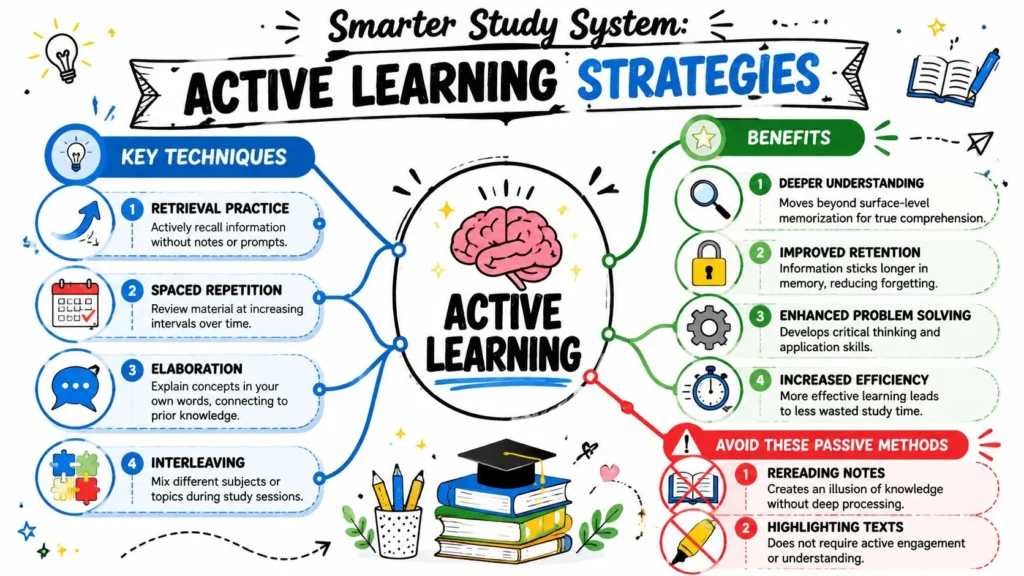
Replace passive review with active work
A study system that raises grades usually includes four repeated moves:
Retrieval practice
Close the notes and pull the idea from memory. Use blank paper, flashcards, practice questions, or say the answer out loud.Spaced repetition
Return to the material across several days instead of trying to force it all into one long session.Elaboration
Explain what the concept means, why it matters, and how it connects to another idea from class.Interleaving
Mix related topics or problem types so you practice choosing the right method, not just repeating one procedure.
As noted earlier, studying strategically beats adding more unfocused hours. It also lowers panic. Students who test themselves regularly get fewer nasty surprises, which matters because uncertainty feeds grade anxiety.
A real example from biology
Take cellular respiration.
A passive session often looks productive on the surface. You reread the chapter, highlight glycolysis, the Krebs cycle, and the electron transport chain, then stare at the diagram until it feels familiar. That feeling is unreliable.
A stronger session looks like this:
- Write every stage you remember on blank paper.
- Check your notes and fix only what you missed.
- Explain the process aloud in plain language.
- Answer a few comparison questions, such as how glycolysis differs from the Krebs cycle.
- Return to it later in the week and do the recall again before looking at anything.
That method feels harder because it exposes weak spots. That is the point.
Use explanation to find the real gap
If you cannot explain a concept clearly, you do not know it well enough yet.
One of the fastest ways to catch this is the Feynman method. Write the topic at the top of a page. Explain it like you are tutoring a classmate who missed the lecture. Mark the places where your wording gets vague or where you slip in a textbook phrase you do not fully understand. Then go back only for those gaps and rewrite the explanation in simpler language.
This works well in history, science, economics, and psychology because those courses reward flexible understanding. Memorized wording breaks down fast under test pressure.
A good study session exposes confusion early enough to fix it before grades suffer.
Build a weekly pattern your nervous system can handle
A study plan should help learning and reduce avoidable stress. Students often build systems that look ambitious on paper and collapse by Wednesday. A better approach is smaller, repeatable contact with the material.
Here is a workable pattern:
| Day | What to do |
|---|---|
| After class | Write key ideas from memory for 10 to 15 minutes |
| Next day | Do short recall practice or 5 practice questions |
| Midweek | Explain major concepts aloud and fix weak spots |
| Weekend | Mixed review across topics, plus one timed practice set |
This kind of routine does two jobs at once. It strengthens memory, and it cuts the last-minute panic that leads to blanking out, rushed mistakes, and avoidant studying. If your current setup feels scattered, this guide to improve your study habits can help you tighten the basics. For another practical framework, Maxi Journal has a useful piece on how to develop good study habits.
One trade-off is worth stating plainly. Active studying feels less comfortable than rereading or highlighting. Students sometimes mistake that discomfort for failure, especially when anxiety is already high. In practice, mild mental strain during study is often a sign that the material is sticking.
Master Your Time and Defeat Procrastination
At 8:40 p.m., a student opens the laptop, sees four assignments, checks the grade portal, feels the pulse jump, and spends the next hour doing low-stakes tasks instead of the work that moves the course grade. That pattern gets labeled procrastination. In practice, it is often a mix of unclear planning and anxiety avoidance.

Students usually procrastinate more when the task feels vague, too large, or threatening to their self-image. If starting chemistry homework might confirm that you do not fully understand equilibrium, your brain will happily offer a safer substitute, like answering email, cleaning your desk, or color-coding notes. The problem is not laziness. The problem is that stress keeps steering attention toward relief instead of results.
A good schedule fixes part of that. It reduces the number of decisions you have to make while already tired.
Put assignments on the clock
“Study biology tonight” is too loose to survive a stressful evening. Put the task, the time, and the finish line in the calendar.
Use three kinds of blocks:
Fixed commitments
Class, work, commuting, meals, appointments, sleep.Academic production blocks
Work that directly affects grades, such as problem sets, outlining papers, lab write-ups, timed practice, and revision.Maintenance blocks
Checking the syllabus, submitting files, replying to instructors, organizing materials, and planning the next day.
This is the trade-off many students resist at first. A structured calendar feels restrictive. An unstructured week feels free until deadlines pile up and anxiety takes over. The first option gives up a little spontaneity. The second usually costs sleep, focus, and points.
Shrink the start point until resistance drops
Students delay work most often at the beginning. Once the task is underway, the emotional friction usually falls. So the first move is to lower the activation cost.
Write the next step at a level that is almost too small to avoid.
For an essay
Open the document, write the working claim, paste in two quotes, draft the introduction only.For math or science
Solve two problems, check errors, write one line on where the method broke.For reading-heavy classes
Read four pages, note the author’s main claim, and write one question you could bring to class.
If homework delay is your main bottleneck, Cramberry’s guide on procrastination offers practical ways to start before panic takes over. If attention drifts after you begin, tighten your study setup with this guide on how to improve concentration while studying.
Use deadlines before the real deadline
A lot of missed work comes from treating one due date as the only due date. That is risky because schoolwork expands to fill the time available, and anxious students often avoid the assignment until the discomfort becomes worse than the task.
Set your own earlier checkpoints:
- Choose the course tasks that matter most this week.
- Break each one into two or three visible milestones.
- Put each milestone on a specific day and time.
- Leave one catch-up block open later in the week.
For example, a Friday paper becomes a Tuesday source-gathering block, a Wednesday outline block, and a Thursday draft review block. That approach protects grades in two ways. It improves the quality of the work, and it lowers the panic that leads to rushing, freezing, or giving up.
Make the room support the plan
Environment matters more than students want to admit. A cluttered desk, open phone, and six active tabs create constant invitations to escape.
Use a short reset before each block:
- Put the phone out of reach.
- Close every tab you do not need.
- Put the exact materials for this session on the desk.
- Start with the course that needs your best concentration.
- End by writing the first step for the next session.
That last step matters. Students with grade anxiety often waste the first ten minutes of the next study block deciding where to restart. A written re-entry point removes that friction.
A visual walkthrough can help if you need a reset on scheduling and focus:
Good time management is not about squeezing work into every open minute. It is about building a week that you can follow under pressure. The more predictable your study routine becomes, the less often anxiety gets to decide what you do tonight.
Tackle Tests and Grade Anxiety Head-On
You walk into an exam knowing the material well enough to pass. Then one hard question hits first, your breathing changes, and the facts you reviewed last night suddenly feel out of reach. That is not a character flaw. It is a performance problem, and it deserves a performance solution.
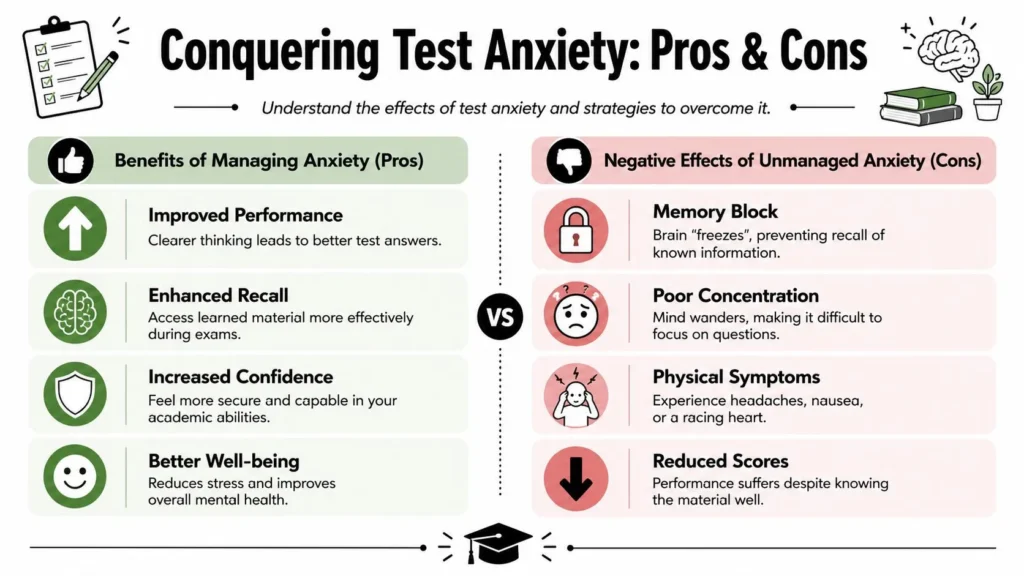
InnerDrive highlights research showing that students under heavier stress can perform worse on demanding academic tasks even when study time is similar, according to their review of better-grade strategies. That matches what I see with students every term. Anxiety does not just make school feel harder. It interferes with recall, concentration, and judgment right when grades are being decided.
Treat stress control as part of test prep.
What anxiety does during a test
Test anxiety narrows attention. Students start scanning for danger instead of reading carefully. They rush easy questions, misread directions, or stall on one item long enough to lose time on five others.
Working memory takes the hit first. You may know the formula, the concept, or the quote, but panic clogs access to it. That is why students often walk out of an exam and remember answers in the hallway.
The goal is not to feel perfectly calm. The goal is to stay functional enough to use what you already learned.
Build a repeatable pre-test routine
Good routines reduce decision-making. They also give your body familiar signals, which matters if your stress response tends to spike on exam days.
Use a sequence like this:
The night before
Stop trying to learn brand-new material late. Review summaries, solved problems, flashcards, or outlines you already understand.The hour before
Avoid frantic group quizzing with classmates who are spiraling. That energy spreads fast. Choose a quiet spot, review a short sheet, and keep your inputs controlled.Right before the test starts
Sit down early enough to settle. Loosen your shoulders. Slow your exhale. If allowed, jot down formulas, dates, frameworks, or essay structures as soon as the exam begins.During the test
If one question triggers panic, mark it and move. Getting traction on easier questions settles your pace and protects points you can earn right now.
Use grounding that works in a classroom
Grounding is not a wellness extra. It is a way to interrupt the physical stress response before it hijacks your attention.
Keep it simple:
- Put both feet on the floor.
- Exhale longer than you inhale for three to five breaths.
- Unclench your jaw.
- Relax your hands on the desk.
- Read one line only, then answer one part only.
Some students also do better with a consistent sensory cue used during studying and testing, such as the same pen, a ring, or a brief breathing pattern. The method matters less than repetition. Familiar cues can help your brain shift out of threat mode faster.
If anxiety shows up outside exams too, this guide on natural ways to calm anxiety and lower your baseline stress can support the academic work you are already doing.
Break the grade-anxiety cycle
Here is the pattern that drags grades down. Fear of a bad score leads to cramming. Cramming cuts sleep and raises stress. Higher stress hurts recall and decision-making. Then the disappointing grade confirms the fear.
Break the loop earlier.
Practice under test-like conditions once or twice before the actual exam. Set a timer. Work without notes for part of the session. Review mistakes calmly instead of treating them as proof that you are behind. Students who do this start to separate one hard question from total failure, and that shift alone improves performance.
Nerves will still show up. They just do not get to run the exam.
Communicate for Success and Measure Your Growth
Strong students use teachers, professors, and office hours as tools. Struggling students often avoid them until the semester is almost over. That’s backwards.
Research summarized by BestColleges states that consistent attendance and engagement with faculty correlate with higher academic performance, and that regularly showing up to class and attending office hours leads to boosted grades, according to their guidance on improving grades.
Treat office hours as strategy, not confession
Office hours aren’t only for students in crisis. They’re where you shorten confusion before it spreads.
Here are scripts that work:
“I reviewed my last test and noticed I lost points mostly on application questions. Can you show me what a strong answer looks like?”
“I’m putting more structure into my study routine. If I only focus on two things before the next exam, what should they be?”
“I understand the comments on my paper at a surface level, but I want to make sure I can apply them next time. What pattern do you want me to fix first?”
Those questions are specific. Teachers can answer them. “How do I get an A?” usually goes nowhere.
Go to class like it counts, because it does
Attendance does more than expose you to content. It keeps you connected to pace, expectations, reminders, and examples of what the instructor prioritizes. Students who skip often think they can “catch up later,” but they usually miss the framing that makes the material easier to study.
A practical rule is simple:
- Go even if you’re behind
- Go even if the last grade embarrassed you
- Go especially when attendance feels uncomfortable
Missing class because you feel guilty creates a fast academic slide.
Measure more than the final grade
You should track your course grade, but don’t stop there. Better indicators of real improvement include:
Assignment turnaround
Are you starting earlier?Error patterns
Are you making fewer of the same mistakes?Recall strength
Can you answer without notes more often?Anxiety control
Are you recovering faster when you get stuck?Faculty contact
Have you asked for feedback before the next test, not after the term is over?
If you track these, progress becomes visible before the transcript changes. That matters because momentum keeps students working when the grade hasn’t caught up yet.
Good academic communication isn’t about pleasing teachers. It’s about getting clearer targets, faster correction, and less wasted effort.
If you want more practical, readable advice on learning, focus, health, and everyday performance, maxijournal.com publishes approachable articles across education and other real-life topics. It’s also a place to explore if you enjoy clear commentary or want to follow new writing from independent contributors.
Discover more from Maxi Journal
Subscribe to get the latest posts sent to your email.