Most advice on how to build brand identity starts in the wrong place. It starts with mood boards, logos, and color palettes, as if the job is to make a business look polished before deciding what it stands for.
That’s backwards.
A brand identity isn’t a decorative layer you apply at the end. It’s the system people use to recognize you, understand you, and decide whether they trust you. The logo matters, but only as one visible part of a larger operating system made of positioning, voice, design rules, and repeated choices.
That matters even more for modern brands with mixed audiences. A software company may sell to different buyer types. A publisher may speak to readers who care about technology one day and fashion the next. If your identity only works for one narrow slice of your audience, it breaks as soon as the business grows. The better approach is to build something stable at the center and flexible at the edges.
Why Your Brand Is More Than Just a Logo
A logo gets too much credit.
In practice, customers build their impression of a brand from dozens of small encounters. They read a headline, skim a landing page, open an email, see a social post, talk to support, compare a sales deck, and notice whether all of it feels like it came from the same company. The logo sits inside that experience. It does not carry the whole thing.
That distinction matters even more for businesses that operate across categories or audiences. A publisher may cover fintech, fashion, and culture under one parent brand. A software company may need one identity that works for enterprise buyers, startup users, and hiring candidates. In those cases, the job is not to create one rigid look. The job is to build a recognizable core with flexible parts, so the brand can shift by vertical without turning into a different company every time.
Practical rule: If someone removes your logo and the brand is still recognizable from the writing, layout, color use, imagery, and tone, you have an identity system. If recognition disappears, you have a logo package.
I see the same mistake often. A team approves a polished mark, then every channel starts making independent decisions. The website sounds restrained. Instagram sounds witty. Sales materials use a different visual style. Product emails use a third voice entirely. Nothing repeats, so memory never builds.
Strong brand identity comes from controlled repetition. That means choosing a few signals and using them on purpose: a clear point of view, a distinct verbal rhythm, a tight type system, a small set of color relationships, and rules for how each audience segment can adapt them. Tech coverage may need cleaner diagrams and sharper language. Fashion coverage may need richer imagery and more expressive styling. The parent brand should still be visible in both.
A stronger approach treats brand assets as a system of decisions, not a stack of one-off deliverables. This guide to strong business branding is useful for that reason. It reinforces a simple point many teams miss. Identity gets stronger when the same core principles show up across touchpoints, while the execution adjusts to context.
What customers remember
Customers remember signals that repeat:
- How you sound: concise, opinionated, technical, warm, plainspoken
- How you look: typography, spacing, color behavior, image style, motion
- How you frame value: the promise or perspective you return to consistently
- How you adapt: whether different products or verticals still feel tied to one parent brand
- How you behave: the experience people get when something goes wrong
When those signals line up, trust comes faster. When they conflict, each campaign has to introduce the brand again from zero.
Uncovering Your Brand’s Core Foundation
A weak foundation creates expensive design problems.
I see this when a team asks for a new logo, then struggles to approve headlines, product naming, visuals, and campaign ideas because the actual issue sits deeper. The brand has no clear center. It has a rough sense of what it sells, but no shared answer for who it serves, what it stands for, or how far it can stretch across different audiences without becoming inconsistent.
Guidance summarized by Fuel for Brands supports that order of operations. Brand strategy must be defined before design. The article also notes that companies with a defined brand strategy often see stronger revenue performance, and that a compelling brand story can increase future purchase intent.
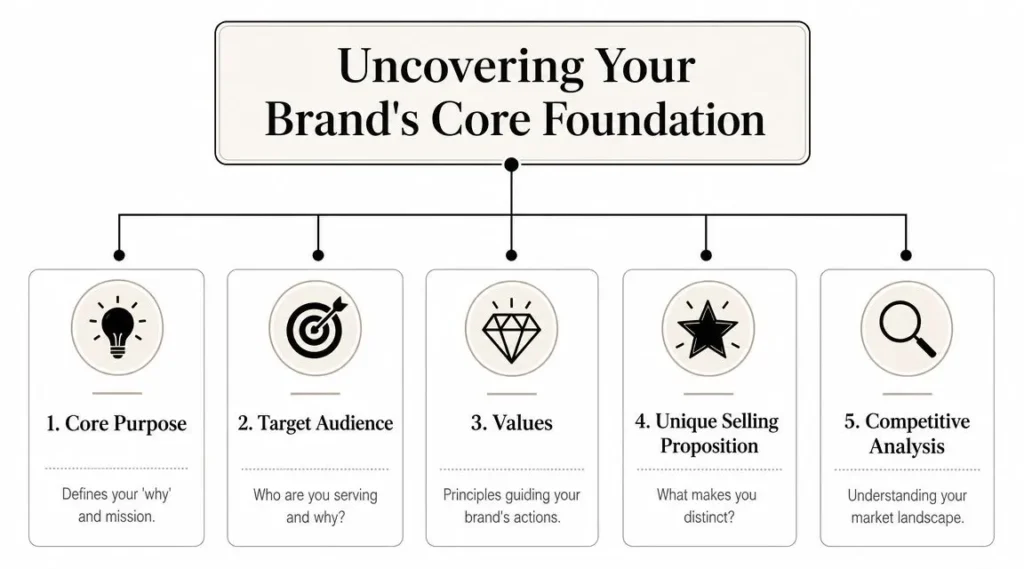
Start with the decisions that shape every later choice
Foundational work answers five practical questions.
Why do we exist beyond the product?
Purpose works as a decision filter. It helps a team choose partnerships, campaigns, and product bets that fit the brand instead of chasing whatever looks popular this quarter.Who needs us to matter?
A usable answer is narrower than a market category. “Founders at early-stage SaaS companies” is still broad. “First-time B2B founders who need to look credible to buyers before they can afford a full marketing team” gives a strategist and designer something to work with.What job are people hiring us to do?
The answer is rarely the product category itself. People buy speed, confidence, status, clarity, reassurance, entertainment, or a better way to make sense of something complex.Why this brand instead of the available substitutes?
Substitutes include competitors, freelancers, internal teams, templates, marketplaces, and doing nothing. If your difference only makes sense against direct competitors, the positioning is still too shallow.What must stay consistent as the brand adapts?
This matters even more for multi-product businesses and publishers serving different verticals. A tech audience may expect sharper hierarchy, tighter copy, and cleaner diagrams. A fashion audience may respond better to richer imagery, more expressive art direction, and a different content rhythm. The core brand still needs fixed elements people can recognize across both.
That last point gets missed in a lot of branding advice. The goal is not one rigid identity that treats every audience the same. The goal is a modular system with a stable center and controlled variation around it.
Turn audience research into operating material
Demographics rarely help enough on their own. They describe a group. They do not explain buying context, emotional stakes, or the kind of proof that builds trust.
Use questions your team can act on:
| Question | Weak answer | Useful answer |
|---|---|---|
| Who are they? | Busy professionals | First-time founders comparing options after work, with limited budget and low tolerance for jargon |
| What are they trying to get done? | Growth | A credible brand presence they can launch fast without looking generic |
| What frustrates them? | Bad service | Advice that sounds smart but does not translate into decisions a team can make this week |
| What do they compare you against? | Competitors | Agencies, templates, internal shortcuts, AI tools, and postponing the work |
For editorial and media brands, this same discipline applies to content planning. A team publishing across niches needs to know which audience needs curation, which needs analysis, and which needs opinion. This breakdown is useful if you’re defining content roles inside the brand system: what content curation actually means.
A good audience profile gives your writer, designer, sales lead, and product marketer the same picture. If each team describes the audience differently, the identity will drift.
Audit the category for patterns you should avoid
Competitive review is less about admiration and more about pattern recognition.
Look at websites, social posts, sales decks, packaging, app screens, email design, and About pages. Then sort what you find into three buckets: what the category expects, what the category overuses, and where there is open space. That third bucket is where strategy starts to become useful.
Here are common patterns worth mapping:
- Visual sameness: identical blues, interchangeable sans serifs, startup gradients, polished but anonymous photography
- Messaging sameness: “trusted,” “advanced,” “customer-focused,” “premium”
- Voice sameness: corporate caution or forced relatability
- Offer sameness: generic claims with no proof, process, or point of view
I often tell clients to mark any phrase that could be swapped onto a competitor site without anyone noticing. Those lines are usually the first ones to cut.
Define the fixed core before you design the flexible parts
A foundation is strong when it gives the team constraints they can use. In practice, that usually means documenting:
- Purpose and mission: why the brand exists and what it is trying to change
- Values: principles that help people make trade-offs under pressure
- Audience segments: primary audience first, then secondary groups with different needs
- Positioning: who you serve, what problem you solve, and why your approach stands apart
- Personality traits: a small set of traits that can guide both writing and design
- Core versus variable elements: what never changes, and what can adapt by vertical, product line, or channel
That last line is where modular identity systems become more useful than classic one-brand-fits-all models. The parent brand might keep the same editorial posture, typography rules, and color logic across every vertical, while image style, pacing, and messaging emphasis shift by audience. That balance protects recognition without forcing every product or category into the same template.
Without this groundwork, design choices turn into personal preference debates. With it, design becomes a translation job.
Crafting Your Authentic Brand Voice and Message
Most brands don’t struggle because they have nothing to say. They struggle because they say different things in different ways depending on who wrote the post, page, or campaign.
Voice fixes that.
A useful brand voice isn’t a performance. It’s a set of language choices that feels native to the business and legible to the audience. When it’s right, readers stop noticing the writing and start trusting the source.

Voice comes from personality, not slogans
One way to make voice tangible is to define where the brand sits on a few spectrums:
- Formal or casual
- Serious or playful
- Expert-led or peer-like
- Warm or restrained
- Provocative or reassuring
You don’t need to force yourself to an extreme. In fact, the most usable brand voices often combine traits that create a clear edge. A cybersecurity brand might be calm, plainspoken, and authoritative. A beauty brand might be warm, stylish, and encouraging. A media brand might be curious, sharp, and accessible.
The point is to create a repeatable pattern.
Build message pillars people can recognize
A voice tells you how to say things. Message pillars tell you what you keep returning to.
For most brands, three to five pillars are enough. Any more than that, and the story starts to blur. Common examples include expertise, simplicity, sustainability, speed, craftsmanship, or independence. What matters is not the label. What matters is whether each pillar can produce real copy.
For example:
- A brand that owns clarity should write short headlines, avoid inflated jargon, and explain hard ideas clearly.
- A brand that owns craft should show process, details, standards, and the care behind decisions.
- A brand that owns accessibility should remove insider language and make beginners feel included.
That same discipline matters in publishing too. Teams that curate information need a clear editorial filter, not just a publishing schedule. A practical explanation of that difference appears in this piece on what content curation actually involves, and it reflects an important branding truth. Your message gets stronger when you decide what belongs under your name and what doesn’t.
The fastest way to weaken a brand voice is to let every channel invent its own personality.
Write examples, not abstractions
Most voice guides fail because they stay abstract. They say things like “be authentic” or “sound human.” That doesn’t help a writer decide between two headlines.
A better method is to write paired examples.
| Situation | On-brand | Off-brand |
|---|---|---|
| Product intro | Clear explanation with one central promise | Buzzword-heavy paragraph trying to sound impressive |
| Social caption | Short, opinionated, useful | Vague, trendy, and interchangeable |
| Customer support reply | Calm, direct, solution-focused | Defensive or robotic |
| Newsletter subject line | Specific and relevant | Clever but unclear |
Make room for channel shifts without changing identity
Voice is stable, but tone can flex.
Your homepage may need more authority. Customer support may need more reassurance. Social posts can handle more energy. The core identity shouldn’t change. The level of intensity can.
That distinction matters in practice. Brands often overcorrect by writing every message in the exact same tone. The result feels stiff. The better move is to keep the same underlying personality while adapting for context.
Designing Your Visual Identity System
Visual identity should solve recognition problems, not create new ones.
By the time you start designing, the strategic work should already narrow your options. You’re no longer asking, “What looks good?” You’re asking, “What helps people identify us quickly, trust us, and distinguish us from competitors?”
That’s a healthier question, and it tends to produce better design.
Early in the process, a simple visual summary can help teams think in systems instead of isolated assets.
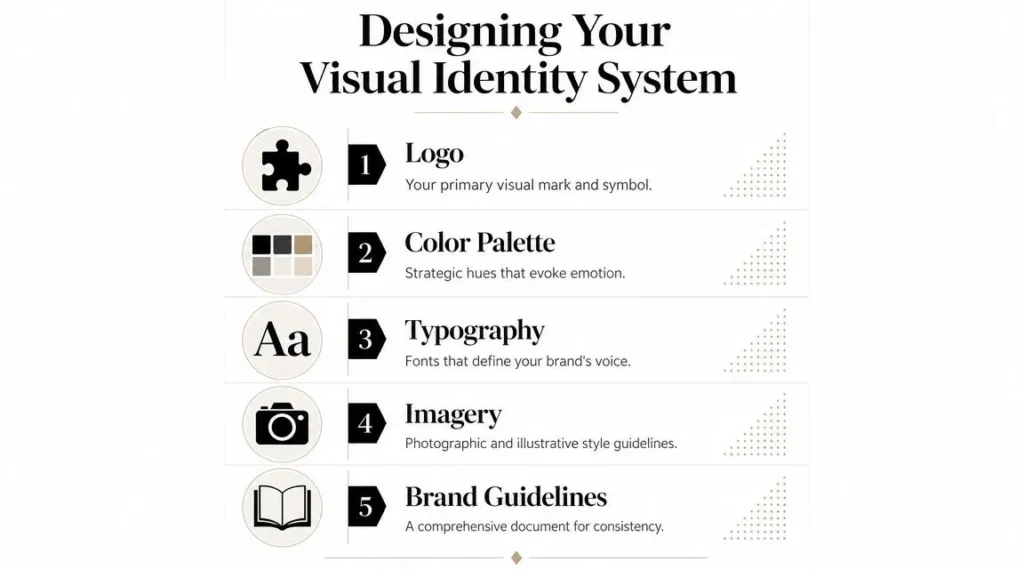
Start rough and narrow down fast
Experienced identity designers rarely begin on a polished screen. They begin with loose exploration. A documented workflow summarized by Prototypr describes the pattern well. Generate many options through sketching and low-fidelity exploration, refine only a small subset digitally, and present 2 to 3 strong directions instead of overwhelming a client with too many choices. The same summary notes one workflow that selects 8 to 12 sketches for scanning and iterates through 5 to 7 refinement rounds.
That sequence matters because polished software can trick people into committing too early. Once a concept looks finished, teams start debating details before they’ve agreed on the idea.
Sketches are cheap. Premature polish is expensive.
For teams doing their own early exploration, beginner-friendly tools can help with layout tests, mockups, and simple asset creation. If you need a starting point, this roundup of graphic design software for beginners is a practical way to compare approachable options before you invest in a full workflow.
A visual walkthrough can also help non-designers understand how identity decisions come together:
Build the logo for real-world use
A logo has one job. It must be recognizable and usable in the places your brand appears.
That means it needs to work at small sizes, in dark and light contexts, and in environments where attention is limited. Website nav bars, social avatars, slide decks, email signatures, app icons, invoices, merchandise, and favicons all put different stress on the mark.
When reviewing concepts, ask practical questions:
- Can it survive reduction? Tiny contexts expose weak detail.
- Can someone describe it after one glance? Overcomplication hurts recall.
- Does it feel native to your positioning? A playful mark for a serious legal service creates friction.
- Does it depend on effects? If the mark only works with gradients, shadows, or animation, it’s probably fragile.
Treat color as an identity asset
Color isn’t decoration. It’s one of the fastest recognition tools you have.
Branding-focused sources summarized by We Are Tenet report that color can increase brand recognition by up to 80%. That’s why good palettes aren’t chosen only by taste. They’re chosen for distinction, usability, and repeatability.
A smart palette usually includes:
| Layer | Purpose | Practical note |
|---|---|---|
| Primary color | Main recognition cue | Should appear often enough to become familiar |
| Secondary colors | Support and variation | Useful for categories, campaigns, or interfaces |
| Neutrals | Structure and readability | Prevent the system from feeling noisy |
| Functional colors | Status and UI states | Must remain clear and accessible |
If your category is crowded with similar palettes, difference matters. But forced novelty can backfire. The best choice is often a color system that stands apart while still fitting the job.
Typography carries more personality than people think
Typography does quiet work. It shapes credibility, readability, and emotional tone long before a reader notices it consciously.
Some practical rules hold up across sectors:
- Choose readability first: Body text has to perform across mobile screens, landing pages, and documents.
- Limit the system: One dependable text family plus one expressive display style is often enough.
- Match the job: Editorial brands can carry more typographic character than compliance-heavy industries.
- Define hierarchy early: Headings, subheads, captions, quotes, and body copy need predictable roles.
The most common mistake is building a visual identity from attractive parts that don’t behave like a system. A logo, three trendy fonts, six accent colors, and inconsistent imagery styles won’t scale. A tighter set of choices usually does.
Building and Using Your Brand Guidelines
A brand identity becomes real when other people can use it correctly without you standing over their shoulder.
That’s what guidelines are for. Not to police taste. To reduce ambiguity.
A rigorous process summarized by Column Five ends by codifying the identity in brand guidelines. That separation between strategic inputs and execution matters because it allows the identity to roll out across articles, newsletters, and social channels without fragmentation.
What good guidelines actually include
Many brand documents are too thin to be useful or too bloated to be usable. The best ones are specific enough to prevent drift and simple enough that teams will open them.
At minimum, include these pieces:
- Brand foundation: Purpose, positioning, audience, values, and personality in plain language
- Voice rules: Tone principles, preferred vocabulary, and examples of what good writing sounds like
- Message pillars: The core ideas the brand should keep reinforcing
- Logo usage: Approved versions, spacing rules, minimum sizes, and misuse examples
- Color system: Primary, secondary, neutral, and functional colors
- Typography: Font choices, hierarchy, and use cases
- Imagery direction: Photography, illustration, icon style, and composition preferences
- Templates: Slide decks, social layouts, email modules, one-pagers, and other repeat assets
Write the guide for the people who will actually use it
A founder may understand the brand intuitively. A freelancer, new hire, agency partner, or guest writer usually won’t.
So write the guide with real users in mind. Replace abstract labels with examples. Show what a brand headline looks like. Show how social graphics should feel. Show the difference between acceptable variation and identity drift.
A guideline earns its keep when a new contributor can produce on-brand work without asking ten clarifying questions.
That often means including small examples that feel mundane but save hours later. Email sign-offs. Author bio formats. CTA phrasing. Byline treatments. Pull quote styles. Header image rules. The boring details are often where brands become inconsistent.
Keep it alive
Guidelines shouldn’t be a static PDF buried in a shared drive.
If the business expands into new channels, launches a new product line, or develops sub-brands, the guide needs updates. Otherwise the team starts improvising around outdated rules, and the system slowly loses shape.
A good sign of maturity is when the guide grows through use. The team notices edge cases, resolves them, and folds those decisions back into the documentation.
Implementing and Evolving Your Identity
A brand identity isn’t finished when the files are approved. It’s finished when the market starts experiencing it consistently.
That rollout needs sequencing. If the website updates but the newsletter, sales deck, and social assets still reflect the old brand, people get mixed signals. The launch doesn’t feel intentional. It feels partial.
For modern brands, especially those serving different audience segments, implementation should also assume variation. The core has to stay recognizable while the expression adapts by context.
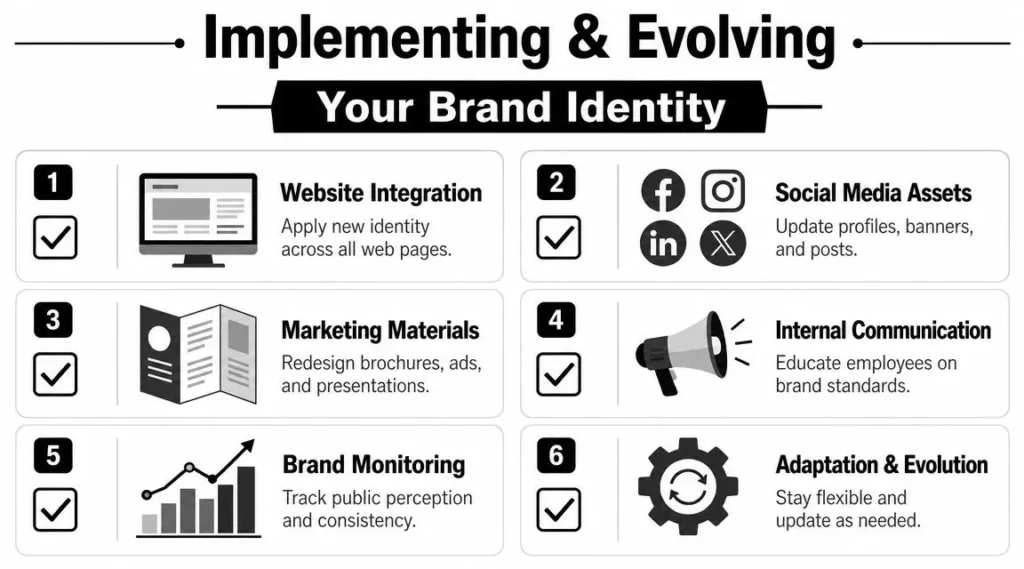
Roll out the highest-visibility touchpoints first
Start where recognition is built most often.
A practical sequence usually looks like this:
Website and key landing pages
This is often the clearest expression of the brand system.Social profiles and recurring content formats
Update profile images, bios, banners, cover templates, and post treatments.Email and presentation assets
Sales decks, investor materials, outreach templates, and newsletter modules shape trust quickly.Internal materials
Teams need updated templates and simple usage rules before they create the next wave of assets.Physical expressions
Packaging, event materials, printed leave-behinds, and branded merchandise should come after the core system is stable. If your rollout includes physical brand touchpoints, a solid enterprise custom swag guide can help teams think through how identity translates into usable merchandise without turning it into generic logo placement.
Build a modular identity, not a rigid one
Most brand advice often falls short because it assumes a single audience with one set of expectations.
That isn’t how many businesses operate now. A publisher may serve readers across technology, health, sports, arts, and fashion. A multi-product company may speak to different buyer mindsets. If every vertical looks and sounds identical, the brand can feel tone-deaf. If every vertical invents its own look, the parent brand disappears.
Guidance from Branded by Woods points to the better answer: build a modular brand identity with a fixed core promise and voice, plus adaptable sub-styles for different verticals.
That usually means fixing a few elements at the center:
- Core promise
- Primary voice
- Master logo system
- Base typography
- Primary recognition cues
Then allowing controlled variation in areas such as:
- Topic-specific color accents
- Illustration or photography style by category
- Tone shifts by audience intent
- Layout modules for different content types
The best modular systems don’t feel fragmented. They feel related.
For teams applying that system across campaigns and channels, practical execution matters as much as the theory, making broader digital marketing tips for small business useful, because brand consistency often breaks during promotion, not during design.
Let the brand mature without losing itself
A healthy identity evolves. But it shouldn’t drift every time someone wants novelty.
Change what needs to adapt. Keep what builds memory. That’s the balance.
If audiences expand, document new use cases. If a visual style becomes limiting, refine the system instead of replacing it impulsively. If a sub-brand starts overshadowing the parent, tighten the connection points. Evolution works when it feels like a sharper version of the same brand, not a different company wearing familiar colors.
If you publish, create, or market across multiple topics, maxijournal.com is a useful place to follow for approachable writing on business, technology, arts, media, and digital growth. It’s also a strong destination for readers and contributors who want practical commentary without the usual jargon.
Discover more from Maxi Journal
Subscribe to get the latest posts sent to your email.