Each year, 20 billion medical devices are sterilized with ethylene oxide, or EtO, and that represents about 50% of all U.S. medical devices according to a U.S. Environmental Protection Agency statement summarized in this peer-reviewed overview. That single fact changes the frame. EtO isn’t a niche chemical used in a few specialty plants. It sits under modern healthcare like a hidden utility.
That creates a difficult public question. The same process that helps keep pacemakers, catheters, surgical kits, gowns, drapes, ventilators, syringes, and heart valves sterile is also tied to serious health and environmental concerns. So the main issue isn’t just whether ethylene oxide sterilization works. It’s how society manages a technology that healthcare still depends on while communities and regulators push, rightly, for lower exposure and tighter control.
The Hidden Backbone of Modern Medicine
Ethylene oxide sterilization matters because many medical products can’t tolerate the conditions used in other sterilization methods. Some devices are damaged by heat. Others are damaged by moisture. Some have narrow internal channels, layered packaging, embedded electronics, or delicate plastics that make simpler approaches unreliable or destructive.
That’s why EtO became part of the medical-device supply chain rather than just a lab technique. It can sterilize products after they’re packaged, and it can reach places that are hard to access with other methods. If you want a quick refresher on why sterilization is a much stricter standard than routine cleaning or disinfection, BacteriaFAQ on infection control gives a useful plain-language breakdown.
Many readers first encounter this topic as a hazard story. That’s understandable, but incomplete. Ethylene oxide sterilization is also an infrastructure story, much like water treatment or grid reliability. Hospitals don’t function only because doctors and nurses are skilled. They function because huge numbers of devices arrive ready to use, sterile, and compatible with the materials they’re made from. For readers who like seeing how biology and industrial systems connect, this broader context fits naturally with a basic overview of what biotechnology is.
Ethylene oxide sits at the intersection of infection prevention, industrial chemistry, environmental justice, and supply chain resilience.
That mix is what makes EtO so difficult to debate thoroughly. If you talk only about medical necessity, you miss the burden placed on workers and nearby neighborhoods. If you talk only about emissions, you miss how many devices still lack a straightforward replacement pathway.
How Ethylene Oxide Disables Microbes
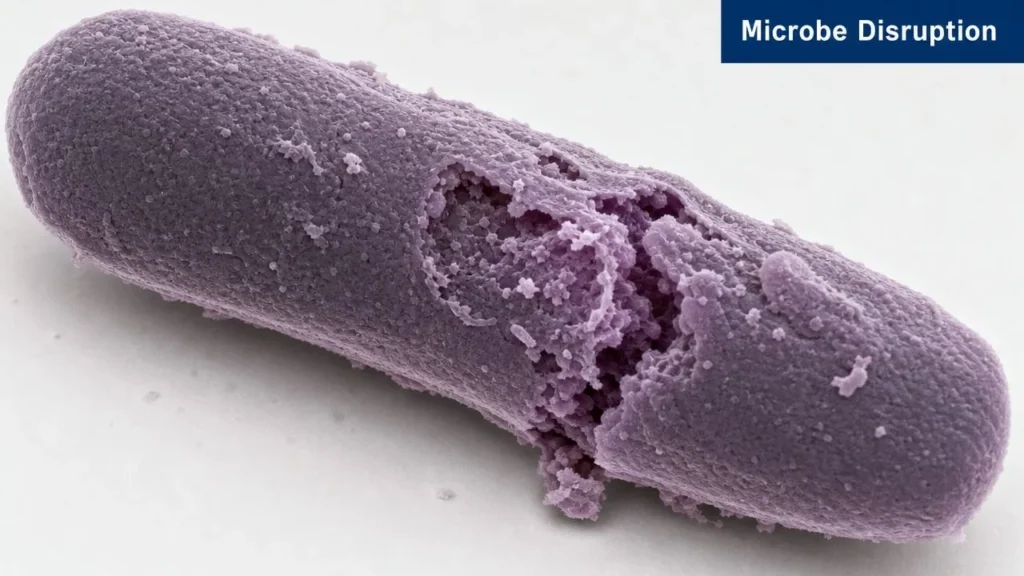
At the microscopic level, ethylene oxide sterilization works by chemically damaging the parts of microbes they need to survive and reproduce. The core mechanism is alkylation, which means EtO reacts with important biological molecules such as DNA and proteins.
A simple analogy helps. Think of a bacterial cell as a workshop full of instructions and tools. DNA is the instruction manual. Proteins are the machines that carry out the work. EtO acts like a tiny reactive tag that sticks to both. Once enough of those tags attach in the wrong places, the manual can’t be read properly and the machinery can’t run as designed.
Why chemical damage matters
Some disinfectants mainly injure cell surfaces. Ethylene oxide goes deeper. Because it’s a gas, it can diffuse into tight spaces and contact microbes hidden in hard-to-reach areas. Once there, it doesn’t merely irritate them. It alters essential molecules.
Often, readers get confused. If EtO is a gas, they assume it works like a room deodorizer or fumigant that “fills the space.” That’s not enough. The gas has to reach microbes in a form and environment where it can react effectively. The chemistry matters just as much as the presence of the gas.
Why spores are such a challenge
Microbial spores are hard to kill because they’re built for survival. They can tolerate conditions that would destroy ordinary bacteria. Sterilization methods are judged in part by whether they can deal with these worst-case biological targets, not just easy ones.
Practical rule: A sterilization method has to succeed where microbes are hardest to reach and hardest to inactivate, not only on open, simple surfaces.
That’s one reason EtO remains so important for packaged, complex, and heat-sensitive devices. A long catheter lumen, a dense surgical kit, or a sealed pouch can create exactly the kind of difficult geometry where penetration and chemical action both matter.
The chemistry also explains why ethylene oxide sterilization demands careful control later in the process. A reactive gas that can disable microbial DNA and proteins is useful in manufacturing. It also has to be removed from the product and contained from the surrounding environment.
Inside the EtO Sterilization Cycle
Industrial ethylene oxide sterilization is a controlled sequence, not a single blast of gas. Operators tune temperature, moisture, gas concentration, exposure time, and post-cycle ventilation so the process reaches microbes effectively and leaves the product suitable for use.
Here’s the overall flow:
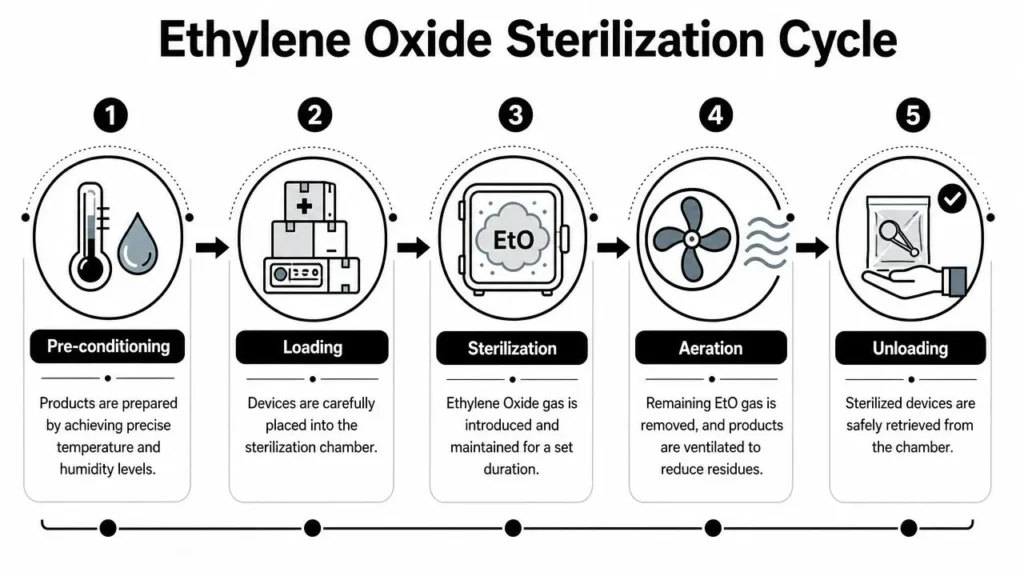
Pre-conditioning and loading
Before sterilization starts, products are brought toward the right environmental state. This usually means controlled temperature and humidity. That may sound minor, but it isn’t. Moisture helps the process work.
The major operating window for EtO sterilization is typically 450–1200 mg/L EtO, 25–55 °C, and 30–80% relative humidity, and humidity is critical because water supports EtO transport to reactive sites, while overly dry conditions reduce kill efficiency, as explained in Tuttnauer’s technical overview of EtO sterilization. In plain terms, dry products can make the gas less effective.
Once the load is ready, technicians place devices into the chamber in a way that allows the gas to circulate and penetrate packaging properly. Placement matters. A sterilizer isn’t a magic box that fixes poor loading practice.
Gas exposure and controlled lethality
The chamber phase is where the entire process is often thought to happen. It’s important, but it’s only one stage. During exposure, EtO gas enters the chamber and is maintained under carefully chosen conditions for the validated cycle.
A multilayer kit, for example, may include plastic trays, breathable packaging, small crevices, and components with different shapes and materials. The cycle has to account for all of that. If one part of the load is slower to absorb moisture or harder for gas to penetrate, the process has to be designed around that worst-case location.
To see the sequence in motion, this short explainer is useful:
Aeration and unloading
Aeration is the stage many non-specialists overlook. After exposure, products can retain residual EtO. Facilities ventilate the load so remaining gas leaves the product and packaging.
That’s why ethylene oxide sterilization often takes longer than people expect. The job isn’t done when microbes are inactivated. The devices also have to be safe to handle and use.
A good EtO cycle doesn’t end with microbial kill. It ends when the product has also passed through enough ventilation and handling controls to move safely through the supply chain.
A simple way to think about the cycle is this:
- Prepare the load so temperature and humidity are in the right range.
- Expose the devices to EtO under validated conditions.
- Vent the devices so residual gas falls to acceptable levels.
- Release the load only after process criteria are met.
That’s industrial process engineering, not just sterilization in the everyday sense of the word.
Why Some Devices Depend on EtO Sterilization
The strongest case for ethylene oxide sterilization is material compatibility. Many modern medical devices are built from plastics, adhesives, polymers, coatings, sensors, electronics, and mixed-material assemblies. Steam can be too hot and too wet for them. Other methods may struggle with long internal channels or final packaging.
That practical reality explains why EtO is used for products such as pacemakers, catheters, surgical kits, gowns, drapes, ventilators, syringes, and heart valves, as noted in the earlier peer-reviewed source. If you want a broader non-technical look at the kinds of products that fall under the medical-device umbrella, this roundup of examples of medical equipment gives helpful context.
What EtO does well
EtO’s main advantage is combination, not just one feature. It’s a low-temperature gas, it penetrates permeable packaging, and it can reach complex internal spaces.
Consider a long catheter with multiple narrow lumens. Steam may not be suitable if the materials deform or if moisture creates problems. A radiation method may raise different compatibility questions depending on the product. EtO is often chosen because it can move through the package and into the hard-to-reach geometry without cooking the device.
A simple compatibility snapshot
| Material | Ethylene Oxide (EtO) | Steam (Autoclave) | Gamma Radiation |
|---|---|---|---|
| Heat-sensitive plastics | Often suitable | Often problematic due to heat and moisture | Sometimes suitable, depends on material response |
| Devices with electronics | Often suitable because of low temperature | Often unsuitable | Sometimes limited by component sensitivity |
| Long lumens and complex assemblies | Strong penetration advantage | Can be difficult depending on design | Penetration works differently and compatibility still varies |
| Sealed final packaging | Often suitable with breathable packaging | More limited by heat and moisture demands | Often possible for some products, but not universally interchangeable |
That table is intentionally qualitative. The precise answer depends on the exact device, packaging, and validation data. A syringe is not a ventilator component. A custom surgical kit is not a pacemaker. Manufacturers have to match the method to the product, then prove it works.
For readers interested in how manufacturing innovation affects these choices, especially for custom geometries and complex parts, what 3-D printing is is a useful adjacent topic. New device designs often make sterilization planning more important, not less.
Validating Sterility with Scientific Proof
Medical sterilization isn’t accepted on trust. Manufacturers have to validate that a cycle delivers the intended result in a reproducible way. In EtO, the benchmark is formalized through AAMI/ANSI/ISO 11135:2014 and a target sterility assurance level, or SAL, of 10^-6, meaning the probability of a non-sterile unit is targeted at one in a million, according to this cited market report summary of the standard and validation practice.
That sounds abstract, so it helps to translate it. SAL doesn’t mean someone opens a box and “sees” sterility. It means the process has been designed, challenged, and documented to a very stringent probability target.
What validation looks like in practice
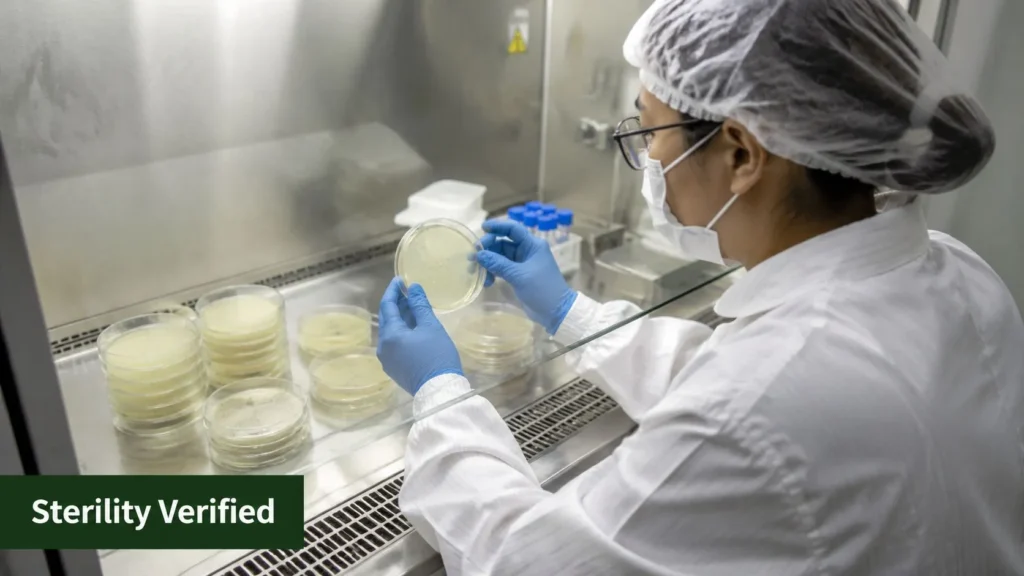
Validation combines physical process control with biological challenge. The physical side tracks the conditions the cycle is supposed to maintain. The biological side asks a harder question: can the process inactivate highly resistant test organisms placed in challenging locations?
Facilities often use biological indicators, which are standardized carriers containing resistant bacterial spores. If a cycle can reliably inactivate those indicators under defined conditions, that provides strong evidence that the process is lethal enough for routine production loads.
Why standards matter
Without standards, sterilization would be vulnerable to guesswork. With standards, manufacturers have a common framework for chamber design, cycle development, product family grouping, and routine monitoring.
Why this matters: Validation turns “the gas should work” into “this exact cycle works for this exact product in this exact packaging configuration.”
The same source also notes that products could be sterilized using less than 400 mg/L of 100% EO while still reaching the 10^-6 SAL target in validation work. That detail matters historically because it shows how the field moved toward tightly controlled validation rather than relying on brute force gas exposure alone.
Where readers often get tripped up
Three ideas are easy to mix together:
- Sterility means the intended microbiological endpoint.
- Validation means proving the process can achieve that endpoint consistently.
- Routine release means each production run met the established controls.
Those aren’t interchangeable. A device maker doesn’t just “run EtO.” The company has to define the cycle, challenge it, document it, and keep running it within the validated window.
Navigating Health Risks and Regulatory Rules
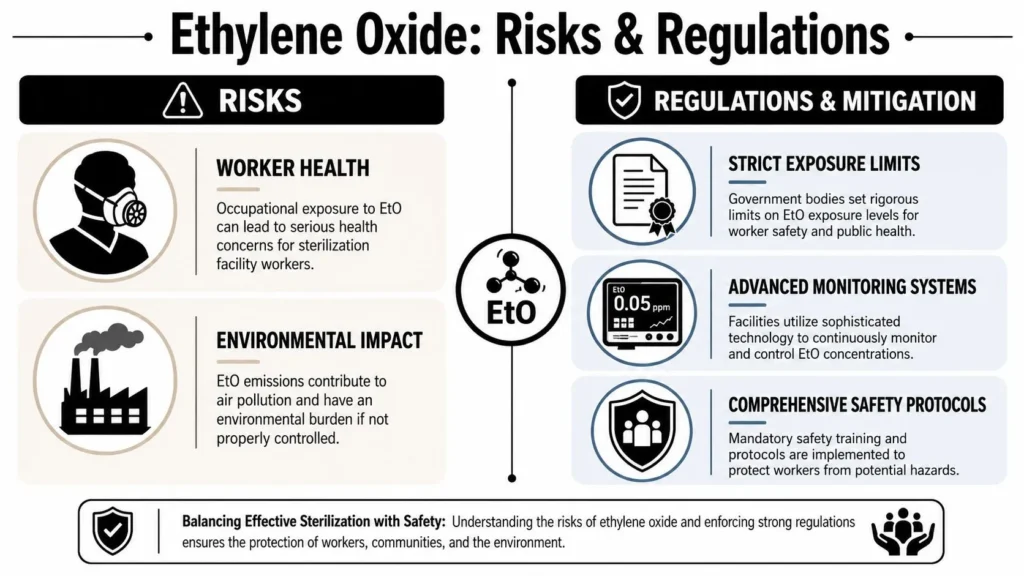
Any honest discussion of ethylene oxide sterilization has to separate two different risk settings. One is occupational exposure inside facilities where workers handle or work near the process. The other is environmental exposure from emissions that can affect surrounding communities.
Those are related, but they aren’t the same problem and they aren’t managed in exactly the same way.
Workers inside the fence line
Inside a sterilization plant, EtO is an industrial chemical that requires engineering controls, monitoring, training, and strict operating procedures. Workers may interact with chambers, gas delivery systems, aeration areas, maintenance tasks, and leak-response protocols.
The practical challenge is obvious. The same reactivity that makes EtO useful against microbes means facilities have to prevent unnecessary human exposure. That’s why plant design, ventilation, and process discipline matter so much.
Communities outside the fence line
The broader public debate often focuses on emissions. The Union of Concerned Scientists found that two types of EtO-emitting facilities disproportionately pollute communities of color, low-income communities, and non-English-speaking communities, and that more than one quarter of commercial sterilizers are in hotspots with multiple nearby emitters, as described in its analysis of EtO’s inequitable impact.
That shifts the conversation from chemistry to equity. A technology can be essential to hospitals and still impose a heavy burden on people living nearby. Both facts can be true at the same time.
Communities don’t experience EtO as an abstract supply-chain input. They experience it as a local air-quality and health issue.
What regulators are doing now
Recent policy changes try to narrow that gap. The White House noted that the EPA’s April 5, 2024 EtO rule added new emissions-control requirements for sterilization facilities while still recognizing EtO’s role in sterilizing roughly half of sterile medical devices in the United States, as noted in the earlier source discussion of that policy change.
The hard part is implementation. Tighter rules can reduce emissions, but compliance depends on equipment upgrades, monitoring, enforcement, and operational continuity. If regulators move too slowly, nearby residents remain exposed. If capacity falls too fast, hospitals and manufacturers may face sterilization bottlenecks.
That’s the central infrastructure dilemma in one sentence.
The Future of Sterilization Beyond Ethylene Oxide
Everyone wants a cleaner answer than “keep using a hazardous gas carefully.” The problem is that replacement isn’t a simple swap. Alternative methods exist, including other low-temperature approaches and radiation-based options, but each candidate has to be matched against specific materials, package designs, internal geometries, and regulatory requirements.
That’s why the transition question matters more than the abstract alternatives list. About 56% of all critical medical devices in the U.S. are sterilized with industrial EtO, and industry panelists have cited that it can take up to 10 years to fully validate and industrialize another chemical sterilization modality to replace it for a given device, according to ECRI’s discussion of the EtO sterilization dilemma.
What a realistic transition looks like
A serious transition would likely include several things at once:
- Better emissions control at existing facilities.
- Device-by-device assessment of which products can move first.
- Regulatory coordination so manufacturers can validate changes without unnecessary delay.
- Investment in design innovation so future products are easier to sterilize with lower-risk methods.
Medicine, engineering, and manufacturing strategy meet. The future probably isn’t one universal replacement. It’s a long, uneven shift where some products move sooner and others remain dependent on EtO for much longer. Readers interested in that broader innovation field may also like this overview of nanotechnology applications in medicine, because device miniaturization and material complexity often make sterilization choices more challenging.
The most realistic conclusion is also the least satisfying. Ethylene oxide sterilization is both indispensable and dangerous. Healthcare systems need its function. Communities need stronger protection. The essential work lies in managing both truths without pretending one cancels out the other.
If you like clear, accessible explanations of complex science and technology topics, maxijournal.com publishes approachable writing across health, science, business, arts, education, and more. It’s also a useful place to explore fresh commentary or learn about contributing as a guest writer.
Discover more from Maxi Journal
Subscribe to get the latest posts sent to your email.