You hit max level, the match ends, and the game offers a new button: Prestige. If you’ve never used it before, that prompt feels half reward, half trap. You worked for your guns, perks, loadouts, and routines. Resetting all of that on purpose sounds ridiculous until you realize some games hide their best long-term progression behind that choice.
That’s why most prestige guides feel incomplete. They tell you where the button is. They don’t tell you whether pressing it is smart right now. Knowing how to prestige matters. Knowing when to prestige matters more.
What Does It Mean to Prestige in a Game?
Prestige is an optional progression reset that appears after you reach a game’s level cap. You give up your current rank, start over from the bottom or near it, and receive some form of prestige reward in return. Depending on the game, that reward might be a new icon, cosmetics, permanent gains, extra challenges, or access to progression tracks that only open after the reset.
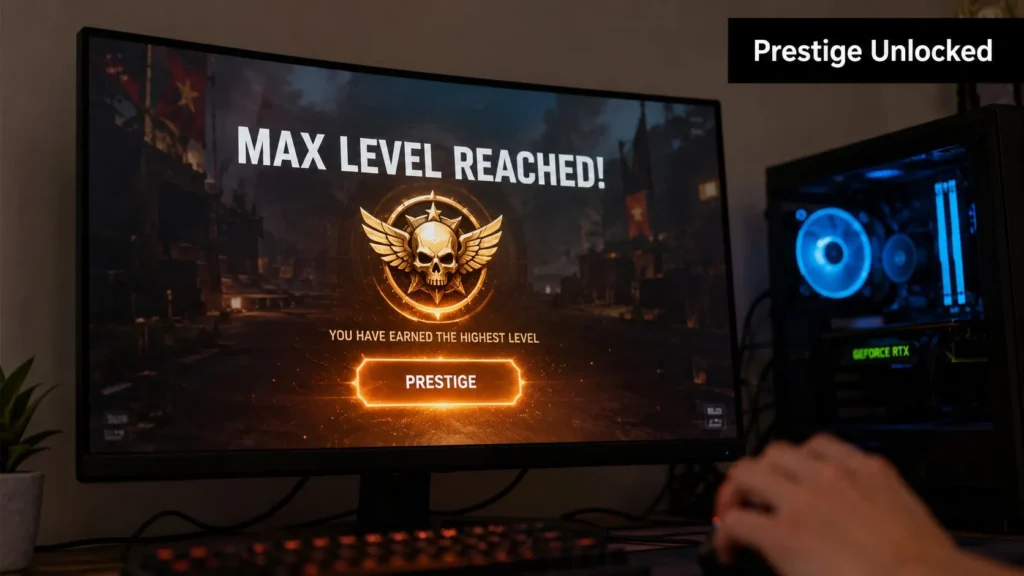
For a lot of players, Call of Duty is the series that made prestiging famous. You climb to the cap, then decide whether to loop back through the rank grind for status and rewards. That basic idea spread because it solves a simple problem. Once players hit max level, many stop feeling forward momentum. Prestige gives the game another runway.
Why games use prestige systems
Developers add prestige because max level can feel like a dead end. A reset turns familiar content into a second run with higher stakes. Suddenly, early-game items and abilities matter again. Weapon choices matter again. Match efficiency matters again.
Prestige also creates a visible badge of commitment. A player with a prestige icon tells the lobby, “I’ve done this before.” That social signal is part of the appeal, especially in competitive games where your profile, emblem, or rank border sits next to your name every match.
What prestige is not
Prestige is not always just a cosmetic flex. In some games it changes what you can equip, what stays accessible, and what gets locked again. In others, it works more like a character-specific sacrifice for themed rewards.
If you’re still getting comfortable with terms like XP, loadout, perk, or meta, a quick gamer lingo explained glossary helps make prestige systems much easier to read at a glance.
Prestige only feels simple until a game asks you to give up convenience for long-term value.
That’s the core of it. Prestige is a trade. You reset short-term power to gain long-term identity, rewards, or progression options. Whether that trade is worth it depends entirely on the game and your goals.
The General Workflow for Prestiging
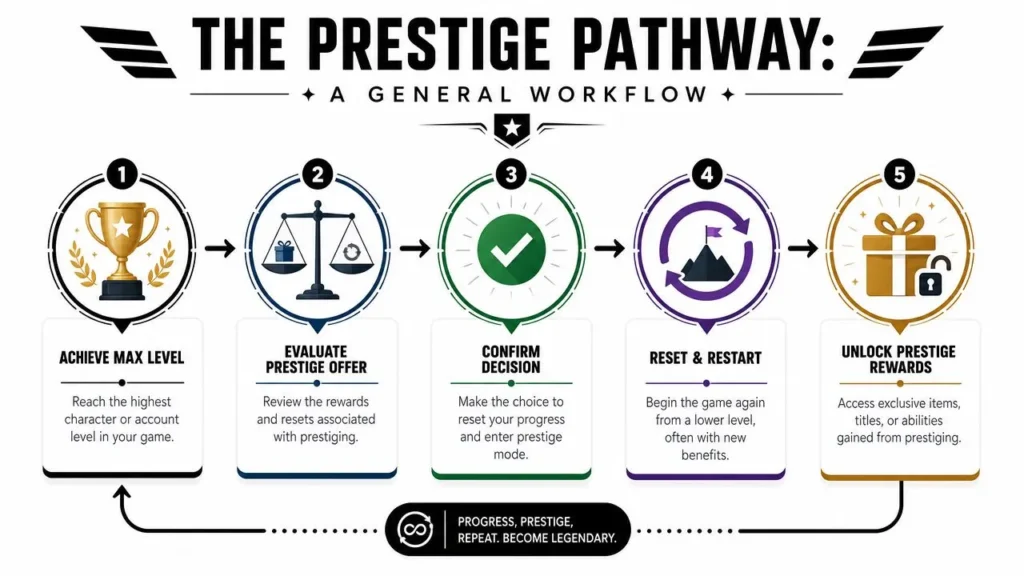
Most games follow the same broad pattern. First, you reach the level cap. Then you go into the progression or career menu. Then the game asks for confirmation and warns you what will reset. The exact menu names differ, but the rhythm is familiar across shooters and other progression-heavy games.
Reaching the cap efficiently
The first part is the least glamorous. You need to finish the main rank climb. In Call of Duty, Activision’s official prestige guidance says the practical route is to hit the cap first, then use the in-game progression menu to confirm the prestige prompt. It also recommends stacking challenges, prioritizing objective modes, rotating weapon classes to fit challenge goals, and taking advantage of Double XP windows because those approaches raise XP earned per match more effectively than chasing eliminations alone in the official Prestige Primer.
That advice matches what works in practice. Players who tunnel on kill count often level slower than players who combine objective play with challenge progress. If you’ve ever trained a Pokémon efficiently, the logic is similar to planning a focused build instead of grinding blindly, which is why structured progression guides like this one on EV training basics feel oddly familiar.
Finding the prompt
Once you hit cap, don’t mash through menus. Open the game’s progression tab, career tab, or rank screen and read the prestige prompt. Most games place the decision in a menu built for that exact purpose, not as an automatic forced reset.
That confirmation screen matters because it usually tells you three things:
- What resets: Rank, previously available gear, perks, or account-level access.
- What stays: Cosmetics, challenge progress, weapon attachments, or specific currencies.
- What you gain: Prestige emblem, access token, new challenge track, or cosmetic rewards.
Confirming the reset
The last step is the one players rush. Don’t. A prestige button is easy to press and annoying to regret.
Practical rule: Never prestige at the end of a session when you’re tired or tilted. Read the reset screen when you can actually think about what you’re giving up.
If the game lets you prestige at any time after max level, that flexibility is useful. You can wait until you finish a weapon challenge, use a temporary event, or spend a reset-sensitive currency first. The workflow itself is simple. The decision around it is where players usually mess up.
Weighing the Rewards Against the Sacrifices
“How to prestige” becomes a real strategy question. Prestiging can feel great when the rewards line up with how you play. It can also feel awful when you realize you’ve locked yourself out of your best setup for the next stretch of matches.
What you usually gain
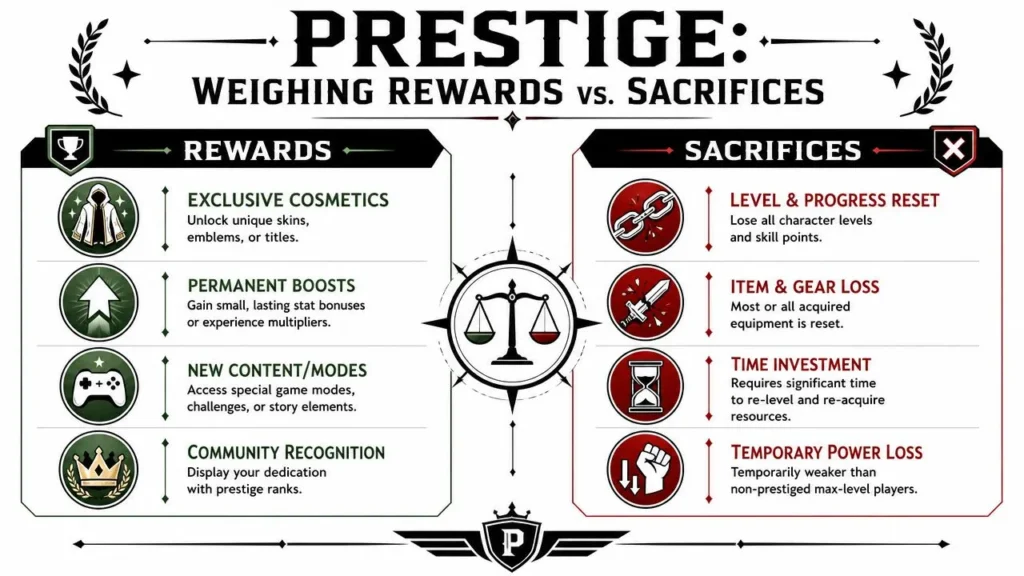
The upside of prestiging is rarely raw power alone. It’s usually a mix of status, exclusive content, and progression depth.
| Reward type | What it means in practice |
|---|---|
| Prestige identity | New icon, badge, emblem, or visible profile status |
| Exclusive cosmetics | Calling cards, skins, camos, charms, or themed rewards |
| Fresh progression | New reasons to play after max level |
| Long-term account value | Permanent unlocks or prestige-only challenge tracks in some games |
For some players, that’s enough. If you love the core gameplay loop, prestige turns repetition into purpose. If you only wanted your strongest build and nothing else, the rewards may feel thin.
Here’s a useful example of why the downside matters. Activision states that entering prestige in Black Ops III resets the player to Level 1 and relocks all items acquired using tokens, while keeping attachments, challenge progress, camos, calling cards, and some customization items in its official Prestige Mode support article.
That one detail changes everything. Prestige there is a state reset, not just a shiny icon.
What you actually sacrifice
The biggest loss is convenience. You stop having immediate access to the exact loadout that made you comfortable. If your favorite weapon, perk package, or wildcard appears late in the progression path, your next run can feel clunky for a while.
A lot of players also underestimate token pressure. In systems where available items are refunded or relocked, your early “best gun” decision can backfire later if the next prestige cycle forces you to rethink the whole build.
The most common mistake is treating prestige like a victory lap. It’s closer to a soft reboot.
To see the mechanic in motion, this short clip gives a visual sense of how prestige decisions are framed in shooter progression systems:
When prestiging is smart
Prestige is usually worth it when:
- You’ve already built around flexibility: You can play well with early game features and don’t rely on one late-game crutch.
- You care about prestige rewards: Cosmetics, badges, or extra progression truly matter to you.
- You finished key chores first: Challenge milestones, event tasks, and important acquisitions are already handled.
It’s often a bad idea when:
- You’re still testing your main setup: Resetting too early just creates friction.
- Your favorite tools become available late: You’ll spend too much time playing with gear you don’t enjoy.
- You haven’t checked what stays and what goes: That’s how players prestige into instant regret.
How Prestige Varies Across Different Games
Prestige isn’t one universal system. The word stays the same, but the cost and reward package changes a lot from game to game. If you assume every prestige works like old-school Call of Duty, you’ll make bad decisions fast.
The classic shooter model
In a shooter like Call of Duty, prestige usually revolves around account rank. You hit the cap, reset that rank, and repeat the climb with some rewards carried over. The tension is about access. Which guns relock? Which perks disappear? Which parts of your build survive the reset?
That makes prestige a broad account-level choice. It affects your whole multiplayer routine, not just one character or one weapon. Modern shooters have also made this more layered, with menu-based progression, weapon-specific progression, and separate cosmetic grinds sitting next to the main prestige path. That’s one reason many basic guides miss the core question of what players keep or lose.
Character-based prestige feels different
Other games use a more focused version. In Dead by Daylight, for example, prestige is tied to individual characters rather than a single global military-style rank. The decision becomes less about resetting your entire shooter toolkit and more about whether one survivor or killer is worth reinvesting in for themed rewards and longer-term progression value.
That difference matters. A character-based prestige system lets you specialize. You can prestige one favorite without disrupting everything else you use. It feels more surgical and less like detonating your whole account setup.
Before you prestige, ask what is being reset. Your account, one character, one weapon, or a whole progression tree.
Some games hide prestige under other names
RPGs and action games often use a similar concept without calling it prestige. New Game+ is the closest cousin. You finish the main run, restart with some carried-over advantages or altered conditions, and chase rewards, challenge, or completion. The spirit is the same even if the mechanics aren’t.
A game can also split prestige into multiple layers. One layer might reset your player level. Another might reset weapon progression. Another might lock cosmetics or special challenges behind repeated clears. If you want a reminder that game systems often vary more than players expect, even something seemingly simple like platform compatibility gets messy fast, as this piece on Fallout 76 cross-platform support shows.
The rule that travels well
Don’t prestige based on the word alone. Prestige in one game can mean “cool badge and mild inconvenience.” In another it can mean “rebuild your entire loadout logic from scratch.”
That’s why the right move is always the same. Open the in-game explanation, read exactly what resets, and judge the mechanic by scope. The wider the reset, the more careful you should be.
The Concept of Prestige Beyond the Screen
Prestige isn’t just a gaming idea. It shows up anywhere people accept a formal trade-off. You give up one status, one assumption, or one comfortable baseline to earn a stronger result under a stricter rule.
Statistics is a good example. In modern statistical practice, a result is commonly treated as significant when the p-value is below 0.05, which means the observed outcome would occur less than 5% of the time under the null hypothesis of no effect, according to this explanation of statistical significance and decision rules. That’s not intuition. It’s a threshold-based decision.
Why that comparison fits
Prestiging in a game works the same way at a conceptual level. You don’t just “feel” ready. You check the rule set. What became available? What will reset? What stays? What reward justifies the reset?
In stats, analysts also start with descriptive measures like mean, median, and mode before making bigger claims. In games, smart players do the equivalent. They inspect the state of their account first. Then they decide whether the reset is justified.
That same loop appears in work systems too. Teams use goals, visible progress, and reward structures to keep motivation high. If you’re interested in how these feedback loops work outside games, this write-up on WhatPulse gamification advice is a useful parallel. Competitive systems keep people engaged when the rules are clear and the rewards feel earned.
There’s a similar mindset behind getting serious about ranked play, team structure, and improvement paths in competitive gaming spaces like starting in esports. The players who improve fastest usually don’t chase status blindly. They understand the system first.
Your Final Checklist Before Hitting the Button
If you’re still undecided, that’s good. Prestige should feel deliberate. A smart reset comes from clarity, not hype.
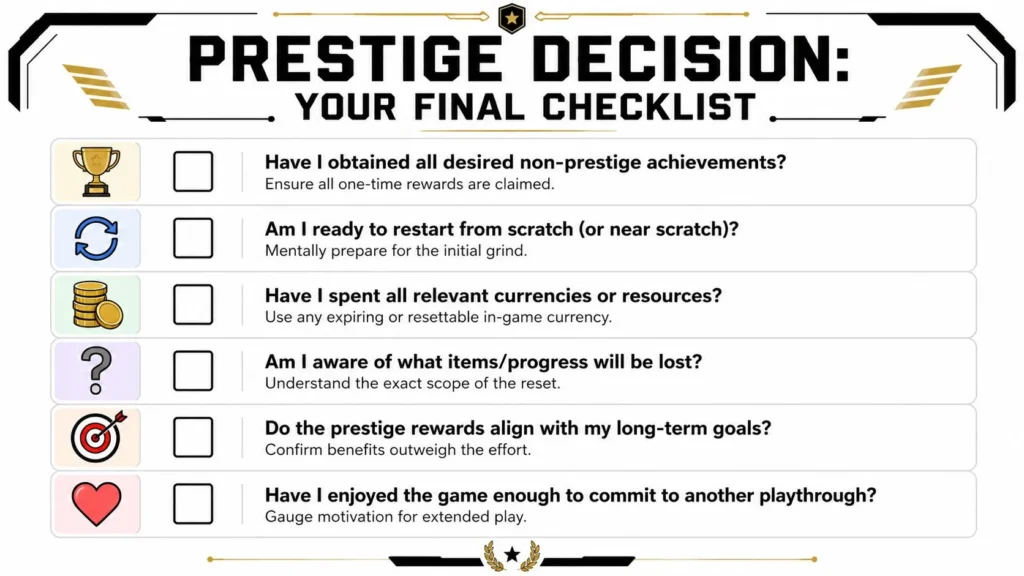
Run through these questions before you commit:
- Have you obtained your essentials: If your favorite weapon, perk combo, or class setup is still doing important work for current challenges, wait.
- Do you know what gets reset: Don’t guess. Read the prompt and check whether rank, tokens, loadouts, or character progress are affected.
- Have you claimed what matters first: Finish event tasks, challenge milestones, or one-time rewards that become annoying after a reset.
- Do the prestige rewards genuinely matter to you: If you don’t care about the icon, cosmetics, or extra progression path, the reset may not be worth the hassle.
- Can you play comfortably with early options: Your next few sessions will probably involve weaker or less familiar setups.
- Are you still enjoying the game enough to repeat the climb: Prestige only pays off if you want another run.
If you’re asking whether you should prestige, you probably need to read the reset screen one more time.
The best prestige decision is the one you won’t complain about an hour later. If the rewards fit your goals and the reset won’t wreck your current plans, go for it. If not, hold the button. Prestige will still be there.
If you like practical gaming breakdowns like this, maxijournal.com publishes approachable writing across games, tech, science, entertainment, and more. It’s also a good place to keep up with fresh articles or explore contributing if you’ve got your own angle to share.
Discover more from Maxi Journal
Subscribe to get the latest posts sent to your email.