Why do two ingredients that show up together in a mocha or a chocolate bar with coffee taste so familiar, yet come from different plants, different regions, and very different supply chains? That question matters more than the usual “coffee or cocoa” comparison, because these crops are tied together by taste, by fermentation, and by the price shocks that shape what people pay at cafés and grocery stores.
Coffee and cocoa are often treated as separate pleasures, one for mornings and one for dessert. In practice, they meet in the same cup, the same pastry case, and the same trading system, which makes them better understood as one connected food story than as two unrelated habits. A useful place to start is the basics of science communication, because the topic gets easier once the jargon is translated into plain language, and this overview of what science communication is is a good reminder that clear explanation matters when a subject mixes farming, chemistry, and markets.
Why Coffee and Cocoa Belong in the Same Conversation
A mocha on a counter, a square of dark chocolate beside an espresso, or a tasting tray that pairs a cappuccino with cocoa-dusted sweets all reveal the same thing. Coffee and cocoa are not separate worlds, they overlap in flavor, ritual, and economics.
The overlap starts with daily use
These crops are rarely encountered as raw beans. They are met as drinks, desserts, or hybrid products, and that’s where the connection becomes obvious. A café menu might pair espresso with chocolate cake, while a home baker reaches for cocoa powder and instant coffee in the same recipe.
That overlap matters because it changes the questions worth asking. Instead of only asking which one tastes better, it helps to ask how each ingredient was processed, why they behave differently in a cup, and why both can become expensive at the same time.
Practical rule: If a coffee and a chocolate product taste “flat” together, the issue is often processing, not the pairing itself.
Coffee and cocoa also sit next to each other in the public imagination because both are comfort foods with a serious industrial side. The market for coffee is larger in trade value and scale, and it supports a vast web of farms, roasters, importers, baristas, and consumers, while cocoa remains smaller in volume but is structurally essential to chocolate manufacturing, especially when supply gets tight.
Why this guide treats them as a pair
The connection becomes even clearer once you look at the farm gate. Both crops depend on post-harvest fermentation, both are sensitive to origin and processing, and both are exposed to volatility in weather, transport, and political conditions. The result is a shared story of aroma, bitterness, sweetness, and scarcity.
That’s why a tasting seminar on coffee and cocoa works best when it moves in layers. First the plant, then the fermentation box, then the roast or conche, then the cup or bar. Once you follow that sequence, the two ingredients stop feeling like a random pairing and start looking like a single sensory system.
Origins and Botany of the Two Crops
Coffee and cocoa grew up on different continents and belong to different plant families, which is part of why they behave so differently in the field. Coffee comes from the Rubiaceae family, while cocoa belongs to the Malvaceae family, and each crop was domesticated through a different cultural history.
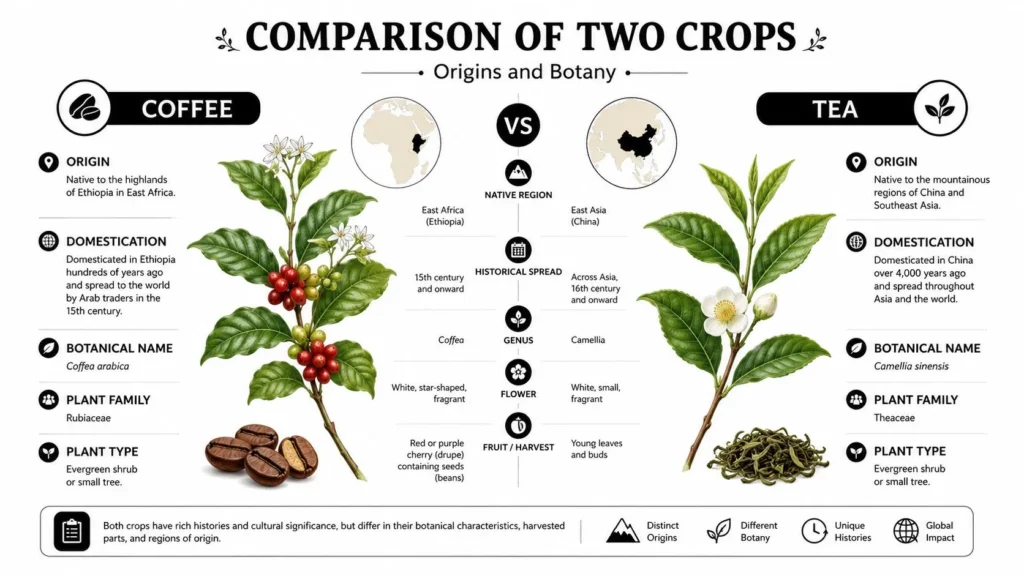
Coffee’s highland story versus cocoa’s tropical lowland story
Arabica coffee is tied to Ethiopian forest origins, where altitude and cooler nights helped shape the plant’s character. Coffea canephora, or Coffea canephora, is associated with Central Africa and tends to tolerate warmer, lower-elevation conditions better than arabica. That difference matters because the same name, coffee, covers plants with distinct growing preferences and flavor potential.
Cocoa tells a different origin story. Theobroma cacao is native to the Amazon basin, but its cultural domestication and ceremonial life became especially important in Mesoamerica, where Olmec and Maya cultures used cacao long before it became a global confectionery commodity. In other words, coffee is a forested highland crop with deep Ethiopian roots, while cocoa is a humid lowland crop with Amazonian ancestry and a long Mesoamerican cultural history.
A quick comparison helps:
| Crop | Botanical family | Origin pattern | Growing tendency |
|---|---|---|---|
| Coffee | Rubiaceae | Ethiopian and Central African roots | Altitude matters strongly for arabica |
| Cocoa | Malvaceae | Amazonian origin, Mesoamerican domestication | Warm, humid lowlands suit the plant |
Trade spread changed both crops
Colonial trade routes carried both plants far beyond their centers of origin. Coffee moved into the Americas, Asia, and other parts of Africa, while cocoa spread widely through plantation systems and later into West African production zones that now dominate global supply. The modern consumer rarely sees that history, but it’s still embedded in where the beans are grown and how they reach market.
For readers who want a visual way into the raw materials themselves, this comparison of cocoa and coffee bean differences is a useful companion. The physical differences are easy to overlook once both crops are roasted, ground, and mixed into familiar products, yet the underlying botany still shapes everything from harvest timing to flavor concentration.
How Fermentation Builds the Flavor in Both
Fresh coffee cherries and cacao pods don’t taste like the finished drink or bar. Their flavor has to be built after harvest, and fermentation is the step that does much of that work. In both crops, pulp sugars feed yeasts and bacteria, which create alcohols, acids, heat, and chemical shifts that prepare the seed for later roasting.
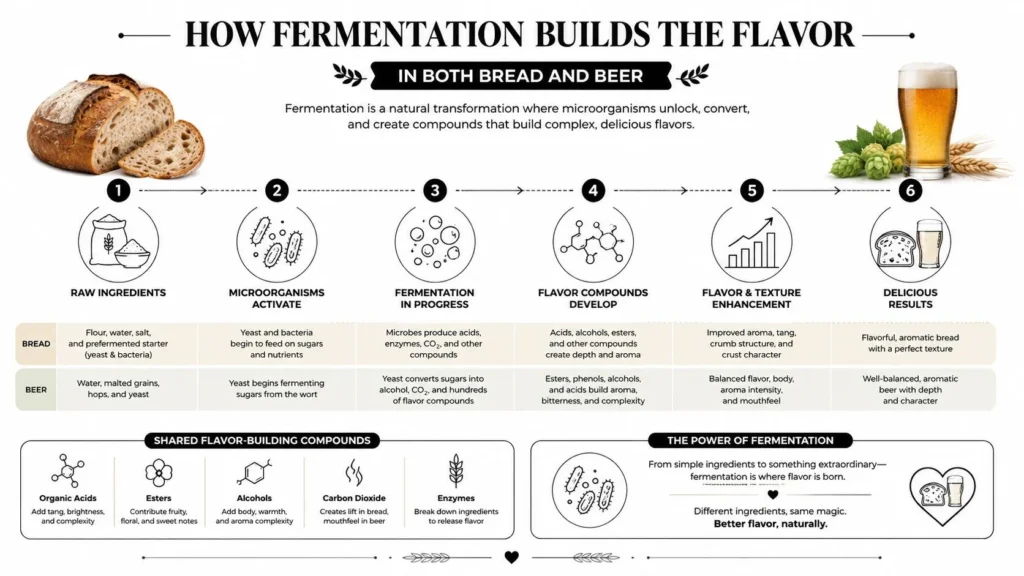
Why the box matters so much
The easiest mistake is to think of fermentation as a waiting period. It isn’t. The process is a managed time-temperature-pH sequence, and that’s why small differences in handling can produce a very different aroma profile or create defects that follow the bean all the way to the final product.
In cocoa, the pulp sugars are transformed by microbes into ethanol and acetic acid, and the heat generated helps trigger the biochemical changes that create flavor precursors. In coffee, microbial succession during fermentation and later drying reshapes carbohydrate, acid, and amino-compound profiles that influence what happens in roast chemistry. That means a farmer isn’t just storing fruit. They’re steering a biochemical conversion.
Practical rule: If fermentation smells sharp, sour, or unclean too early, the final cup or bar can carry those problems forward.
Where coffee and cocoa diverge
The two crops don’t use identical protocols, and they shouldn’t. Washed coffees often spend a few days in fermentation, while box-fermented cacao follows its own post-harvest rhythm. The details vary by region, equipment, and climate, but the principle is the same, manage the environment so microbes do useful work instead of chaotic work.
That’s where the science communication angle becomes valuable again, because fermentation sounds abstract until you connect it to taste. The farmer is shaping future sweetness, bitterness, and fruit notes before roasting ever begins. If you want a broader primer on microbial production and processing logic, this biotechnology explainer fits well with the same idea of controlled biological change.
The Flavor Chemistry You Actually Taste
Coffee and cocoa can taste fruity, nutty, bitter, floral, roasted, or sharp, but those words map back to a handful of chemical families. The main levers are acids, sugars, alkaloids, and roast-derived compounds, and each one affects how the drink or bar lands on your palate.
Start with acids, then add roast chemistry
Coffee’s bright notes often come from acids such as citric and malic, while cocoa often carries acetic and lactic impressions from fermentation. During roasting, both crops undergo Maillard and Strecker reactions, which create melanoidins and pyrazines, compounds strongly linked to brown color, toasted aroma, and nutty depth.
That’s why a light-roasted coffee can taste fruit-forward and sharp, while a darker roast drifts toward cocoa, smoke, and caramelized edges. Cocoa behaves similarly, but in a different register, because the fermentation stage already leaves a noticeable imprint before roasting, pressing, or conching make the flavor smoother.
Alkaloids shape bitterness and alertness
Caffeine appears in both crops, but cocoa also contains theobromine, which is dominant in cocoa and only minor in coffee. Those two alkaloids are often lumped together in casual conversation, yet they don’t behave identically in the cup or in the body.
If you’re trying to tune a brew recipe, grind size matters because it changes extraction and therefore what acids and bitter compounds end up in the cup. A practical overview like espresso grind size explained can help you connect particle size to flavor, which is useful whether you’re pulling a straight shot or building a mocha.
Tasting cue: If a pairing tastes muddy, the coffee may be over-extracted, the cocoa may be too dark, or both.
A mocha-style drink works when roasted notes, gentle bitterness, and enough sweetness line up. It fails when one ingredient bulldozes the other. That’s why the best pairings often feel balanced rather than intense, the coffee lifts the chocolate, and the cocoa rounds the roast.
Where Coffee Meets Cocoa on the Plate and in the Cup
The most familiar meeting point is the mocha, where coffee and cocoa share the same cup instead of competing for attention. That idea has traveled through different food cultures for centuries, from spiced chocolate drinks to espresso-era café menus, and it still works because the ingredients solve each other’s weaknesses.
A simple mocha frame
A practical home mocha doesn’t need a recipe card full of extras. Start with a shot of espresso or a small, strong brew, whisk in cocoa powder with sugar while the liquid is hot, then add steamed milk or warmed milk. The goal is not to make chocolate milk with coffee in it, it’s to create a balanced drink where roast, sweetness, and cocoa bitterness are all present.
Here’s a quick pairing table for home tasting:
| Coffee | Cocoa Match | Why It Works |
|---|---|---|
| Bright filter coffee | Milk chocolate square | The acidity keeps the pairing lively |
| Espresso | Dark chocolate | Shared roast notes make the match tighter |
| Medium roast drip | Cocoa nibs or unsweetened cocoa | Lets bitterness and toast show clearly |
A tasting method for readers at home
Use one coffee and one chocolate at a time. Sip the coffee, let it cool slightly, then eat a small piece of chocolate and notice whether the finish turns more fruity, more bitter, or more nutty. Repeat with a second pairing, and the differences become easier to hear, almost like matching a voice to the right instrument.
Mexican-style champurrado works on the same principle, though the texture is thicker and the spices broaden the profile. Craft chocolatiers also use this logic when they pair single-origin bars with coffees from similar regions, because shared origin often means shared fruit, spice, or roast cues.
What Health Questions Actually Have Answers
People often ask whether coffee or chocolate is “good” or “bad” for health, but that question is too blunt to be useful. A better starting point is the chemistry in the cup, especially caffeine, theobromine, and serving size, because dose changes everything from alertness to sleep disruption.
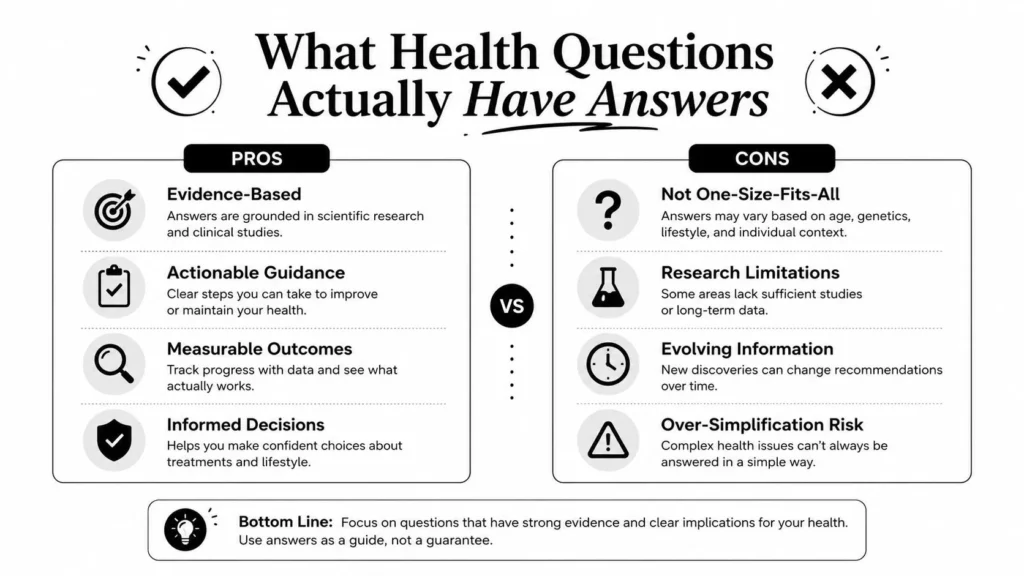
Caffeine and theobromine are not interchangeable
Coffee capsules in one intervention averaged about 74 mg caffeine per serving, according to the intervention described in the literature, while cocoa-based coffee drinks can carry much less caffeine but relatively more theobromine. That difference matters because the sensory effect and the body effect are not the same thing, even when the drinks sit side by side on a menu or in a snack aisle.
A 2024 review noted that theobromine may behave differently from caffeine, so it deserves attention on its own terms rather than as a weaker version of the same stimulant. The evidence base is still developing, and the right reading is careful rather than dramatic. Readers often want a clean verdict, but the honest answer is that combined exposure is still a moving research question.
A practical way to think about it
If a coffee-and-cocoa product is early in the day, the main issue is often alertness. If it’s later, sleep disruption becomes the bigger concern, especially when caffeine is high. Theobromine adds another layer because it is part of cocoa’s appeal, but it should not be treated as a free pass for unlimited chocolate or hybrid drinks.
The label matters as much as the flavor. A mocha built around strong coffee can hit very differently from a cocoa-forward drink, even if both taste sweet and familiar. A batch of bars made with better fermentation and cleaner sourcing can also change how you respond, because origin, roast, and formulation shape both taste and tolerance.
If you want a home example that connects tasting with sourcing, compare one coffee-and-cocoa drink made from beans you would choose for a latte with another made from a bar bought through direct trade vs fair trade coffee. The market story behind the ingredients does not change the chemistry in your body, but it often changes how carefully the product was selected, processed, and priced.
For the most practical kitchen test, read the ingredient list, notice whether the product is coffee-heavy or cocoa-heavy, and pay attention to timing. If you are curious about the bigger loop between ingredients and waste, how to compost at home is a useful next step for handling leftover grounds and husks. The point is not to ban anything, it is to understand what kind of stimulation you are buying.
Farming, Sustainability, and the Volatile Markets Behind Your Morning Cup
Why does a latte or chocolate bar cost what it does? The answer starts long before the café register or grocery shelf. It starts with farms, weather, logistics, and the fact that both crops sit inside commodity systems, where shocks move fast and consumer prices move slowly.
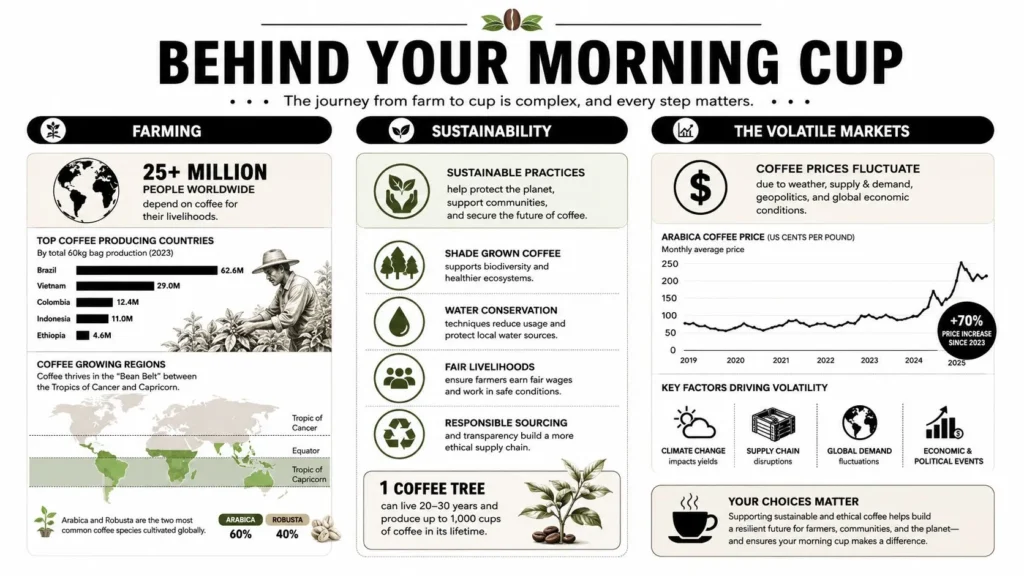
Cocoa is concentrated, coffee is broad, and that changes risk
Cocoa production is heavily concentrated in West Africa, with about 70% coming from the region and roughly 40% from Côte d’Ivoire, while 40 million to 50 million people depend on cocoa for their livelihoods, according to the National Confectioners Association and its coverage of cocoa sourcing and labor. Coffee is more geographically dispersed, which gives it a different risk profile, even though it is also exposed to climate pressure and market swings. That difference helps explain why cocoa supply shocks can feel sharper and more immediate in chocolate markets.
The World Bank reported that global cocoa production fell to 4.2 million metric tons in the 2023 to 24 season from 4.9 million the previous season, and prices surged as supply worries intensified. For coffee, the supply picture is still huge in scale, with production estimated at 169.8 million 60-kg bags in 2023 to 24 and 172.4 million bags in 2024 to 25, while USDA/FAS projects 175.32 million bags in 2024/25 and 178.85 million bags in 2025/26. Those projections show why traders, roasters, and manufacturers keep watching harvest revisions so closely.
Sustainability labels don’t erase farm economics
Fair Trade, direct trade, and Rainforest Alliance all try to address parts of the same problem, how smallholders stay viable when weather, input costs, and market volatility squeeze margins. If you want a clear comparison of those models, this guide to direct trade versus fair trade coffee is a useful starting point, especially if you are trying to understand how sourcing claims translate into farm-level outcomes.
Practical rule: A sustainability label can signal better practices, but it does not tell the full story of farm income, crop risk, or crop loss.
Consumers often ask why prices stay high even after headlines about easing commodity markets. The answer is that supply chains do not reset instantly, especially when buyers, importers, and manufacturers are working through earlier contracts, freight costs, and stock rebuilding. If you are also interested in reducing waste around these ingredients at home, this home composting guide fits neatly with the broader sustainability conversation.
How to Experience Coffee and Cocoa More Deeply
The easiest way to understand coffee and cocoa is to taste them with more attention than usual. Visit a craft roaster, a bean-to-bar chocolatier, or a café that offers origin coffees and a simple chocolate pairing, then compare what changes when the roast, origin, or cacao percentage shifts.
What to look for in real life
A public cupping table lets you smell the same coffee at different temperatures, which teaches you more than a single hot sip ever could. A chocolate tasting does something similar, especially when bars come from different origins or processing styles. If you travel, origin trips to coffee and cocoa regions make the supply chain feel less abstract, because you can see how climate, labor, and post-harvest decisions shape flavor before the product ever reaches export.
You don’t need a long reading list to keep learning, either. The most useful habit is to follow research and field updates from organizations that work directly with crops, such as coffee breeding programs and cocoa research centers, then compare that information with what you taste. That closes the gap between theory and cup.
Useful habit: Taste one coffee and one chocolate separately before you combine them. Your palate learns faster when each ingredient has a clear baseline.
The market side still matters, because the 2025/26 outlook for coffee and cocoa remains in flux and prices are still reacting to supply conditions, weather, and stock rebuilding. That uncertainty is part of the modern story, not a side note. Informed consumers don’t control the market, but they do influence which sourcing stories get rewarded, which products survive, and which questions get asked at the shelf.
If you want more clear, science-friendly writing that connects food, markets, and everyday life, visit maxijournal.com for fresh explainers that keep complex topics readable. You’ll find practical coverage that turns subjects like coffee and cocoa into something you can use, whether you’re tasting, buying, or just trying to understand why the price changed.
Discover more from Maxi Journal
Subscribe to get the latest posts sent to your email.