You’re in a meeting, a product manager is proud of a new AI feature, and a compliance lead is asking a simple question nobody seems ready to answer: how do we know this system is fair, explainable, and safe after it goes live? That’s the starting point for AI ethics and governance, not a theory lecture. It’s the moment when a model stops being a demo and becomes part of someone’s hiring decision, loan review, medical workflow, or content feed.
That shift is why the topic has moved from a niche policy discussion to a business and public accountability issue. UNESCO’s member states took a major step in November 2021 when 194 of them adopted the Recommendation on the Ethics of Artificial Intelligence, the first global standard-setting instrument on AI ethics, and UNESCO’s observatory data now show broad policy uptake, uneven implementation, and major gaps in representation and data safeguards (UNESCO AI ethics observatory). At the same time, corporate disclosure and governance pressure have become far more visible, with AI no longer treated as a side project.
Good governance is the difference between reacting after damage and building controls before harm spreads. That distinction matters whether you’re a policy reader, a publisher using AI tools, or a team trying to decide who signs off on a model before it reaches users. The practical question is no longer whether to have principles, it’s how to turn them into decisions, records, reviews, and accountability that hold up.
Why AI Ethics and Governance Matter Now
A hiring team ships a model that looks efficient on paper. A few weeks later, someone notices that strong candidates from certain neighborhoods keep disappearing from the shortlist, and the compliance officer asks for proof that the system is fair. That is the moment AI ethics and governance stop sounding abstract and start looking like operations, evidence, and responsibility.
A second scenario is even more common. A generative AI tool has already been rolled out, teams are using it every day, and no one is sure who reviews harmful outputs, who fixes drift, or who answers when the model says something misleading in public. Governance has to work after deployment, not just during approval, because the risks continue once the system is live.
The reason this matters now is that AI has moved from experimentation into routine use faster than many oversight functions have matured. Many organizations are scaling use faster than they are scaling controls, so ethics work often lags behind technical adoption. That gap shows up most sharply in two places that explainers often miss, the implementation gap across the Global South, where guidance, infrastructure, and review capacity may be uneven, and the need for post-deployment accountability for systems already in production.
Ethics isn’t a slogan, governance isn’t paperwork
When teams treat ethics as a checkpoint at the end, they usually end up with damage control. When they treat ethics as part of the system design, they can ask better questions earlier, like who might be excluded, what gets logged, and who can override a bad decision. A hiring filter, for example, should not be judged only by speed. It should also be judged by whether the review trail shows how edge cases were handled and whether someone can explain a rejection.
That shift also affects investor scrutiny and reporting, not just internal policy. Corporate AI disclosure has become more visible, which shows that governance is moving into the same conversation as enterprise risk management and public accountability.
Practical rule: if a model can affect people outside the engineering team, it needs an owner, a review path, and a way to challenge the outcome.
A useful way to hold the pieces together is simple. Ethics gives you the values, governance gives you the machinery, and responsible AI is the umbrella term that connects the two to real-world practice.
What AI Ethics and Governance Actually Mean
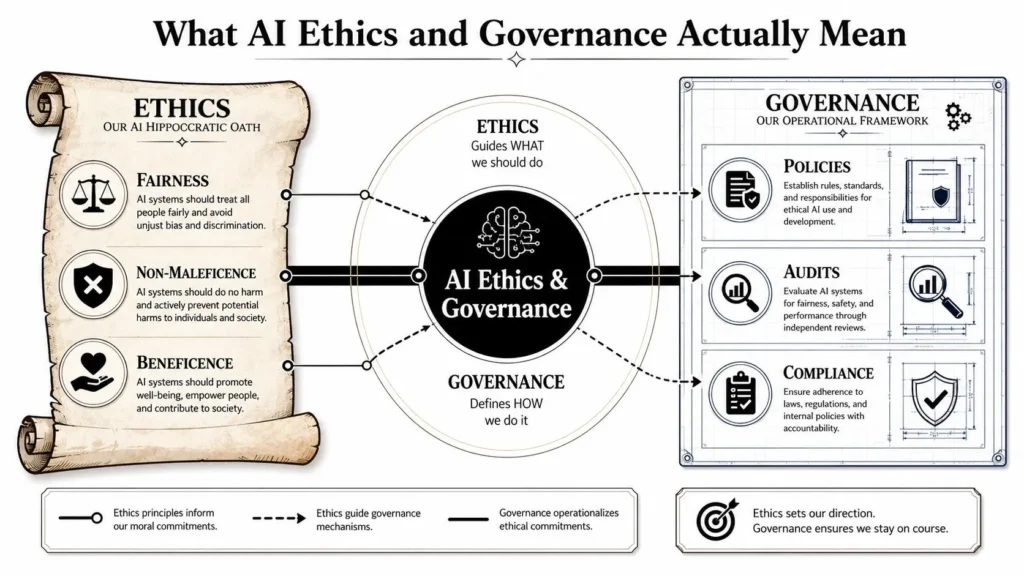
The cleanest way to separate the terms is to compare them to medicine. AI ethics is the Hippocratic oath, the moral commitments about fairness, transparency, non-maleficence, and accountability. AI governance is the hospital system, the policies, roles, audits, and escalation paths that make those commitments real.
The three layers people confuse
The first layer is principles, meaning the values an organization says it cares about. Fairness, transparency, privacy, safety, oversight, and redress usually show up here. The second layer is frameworks, meaning the organizing structure that says how those values should be applied across teams and systems.
The third layer is standards, meaning the way an organization checks whether the framework is working. If a company says it cares about fairness but can’t show documentation, testing, or review decisions, it’s talking about ethics as branding, not ethics as practice.
That distinction matters because a principle can sound good while still failing in the practical world. A policy that mentions accountability means little if no one is named as the accountable owner. A privacy commitment means little if data retention, access controls, and legitimate use aren’t written into the workflow.
A principle is what you promise. Governance is what you can prove.
That’s also why people increasingly use responsible AI as the umbrella phrase. It points to the full stack, values, processes, controls, and measurement. If you can explain those three layers to a colleague, you’re already ahead of most vendor decks and many internal policy memos.
The Core Principles That Show Up Everywhere
Most major AI frameworks repeat the same backbone, and that’s not an accident. These principles map to recurring harms, bias, opacity, privacy misuse, unsafe behavior, and the absence of accountability. Think of them as the load-bearing walls of the structure, not decorative trim.
The EU Trustworthy AI framework makes that logic visible by tying principles to concrete obligations like technical reliability, human oversight, privacy and data governance, transparency, fairness, and accountability (EU Trustworthy AI guidelines). AI systems should be accurate, reliable, reproducible, and designed with fallback plans, which is a practical way of saying they shouldn’t fail in ways that leave no one able to intervene.
The recurring pillars
- Fairness and non-discrimination, meaning the system shouldn’t systematically disadvantage protected or underrepresented groups.
- Transparency and explainability, meaning people should know when AI is involved and, where appropriate, why it reached a result.
- Privacy and data governance, meaning data should be handled lawfully, minimally, and with legitimate access.
- Safety and reliability, meaning the system should be accurate enough for its use case and stable enough to trust.
- Human oversight and accountability, meaning a person or team can review, override, and answer for outcomes.
- Contestability and redress, meaning affected people need some way to challenge decisions and seek remedy.
These ideas recur across regions and sectors because the harms recur too. A hiring model, a medical chatbot, and a content recommender are different products, but they all raise the same basic question: who is responsible when the system gets it wrong?
If you’re scanning a policy document, use this as a quick test. If those six ideas are missing, or if they’re present only as broad statements with no controls attached, the document is probably more aspirational than operational.
Frameworks and Standards Worth Knowing
A policy team can get lost in the volume of AI guidance until it sorts the material by purpose. Some texts set shared ethics baselines, some define how to run internal controls, and some create legal duties. The difference matters because a recommendation shapes expectations, a standard supports discipline inside an organization, and a regulation can trigger enforcement.
| Framework | Type | Region | Best for |
|---|---|---|---|
| UNESCO Recommendation on the Ethics of AI | Global recommendation | Global | Public institutions, multilateral policy alignment |
| OECD AI Principles | Soft-law principles | Global | Strategy teams, policy benchmarking, cross-border alignment |
| EU AI Act | Binding regulation | European Union | Regulated businesses, vendors serving EU users |
| NIST AI Risk Management Framework | Risk framework | United States | US organizations building internal controls |
| ISO/IEC 42001 | Management system standard | International | Enterprises seeking structured, auditable governance |
The UNESCO Recommendation matters because it established a shared baseline for AI ethics across 194 member states. UNESCO’s later observatory work shows that policy uptake has widened while implementation remains uneven, a gap that matters most for institutions trying to turn principles into day-to-day practice. The lesson is straightforward. Global agreement does not automatically create local capacity, especially where budgets, expertise, and procurement systems are thinner than the policy language suggests.
Soft law, hard law, and management standards
Soft law gives direction without legal penalties. That helps when technology changes quickly and policymakers need room to adjust. Hard law, like the EU AI Act, turns obligations into enforceable duties, so legal teams have to track where a product is deployed, not only how the model behaves.
ISO/IEC 42001 sits in a different category. It does not tell an organization what to believe about AI, it tells it how to run a management system around AI work. That makes it useful for teams that need repeatable controls, audit trails, and clear responsibilities instead of a one-off policy statement. A manager trying to coordinate those pieces may also benefit from leadership skills for managers, because governance often depends on who can assign owners, review exceptions, and keep people aligned when systems fail.
A practical deployment checklist tied to European requirements is available in the deployment checklist for EU AI Act. If you are connecting AI use with broader website privacy practices, the internal guide on GDPR compliance for websites helps connect AI governance to familiar data-protection habits. For teams that want outside guidance on operating rules and escalation paths, AI governance advice from By Design Law is another useful reference.
The right starting point depends on your footprint. A startup may begin with NIST-style risk controls, a European enterprise has to account for the EU AI Act, and a multinational publisher often needs policy, review, and disclosure practices that work across regions. Generative AI adds one more layer. A model already in production still needs monitoring, incident handling, and decisions about who can pause outputs when the system starts drifting, because governance does not end at launch.
Global AI Regulation and Enforcement
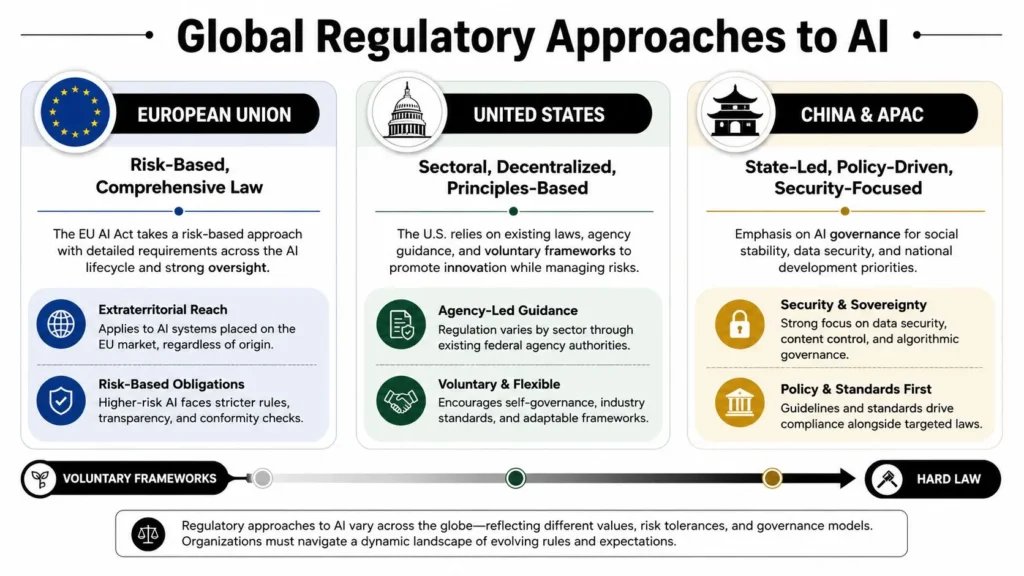
A practical way to understand regulations around the world is to think of them like traffic signals. Some AI uses are clearly lower risk, some are clearly higher risk, and others fall somewhere in between. In those cases, review, documentation, and human oversight are needed. The EU AI Act takes a risk-based approach, which is why many organizations use it as a reference point even if they are not based in Europe.
Different Regions, Different Enforcement Styles
The European Union has moved toward a risk-based legal framework. The United States still has more of a patchwork structure, combining federal guidance with sector-specific rules rather than relying on a single comprehensive AI law. China takes a more centralized approach, with stricter controls over algorithms, generative AI systems, and services offered to the public.
This means product teams cannot assume that a single governance approach will work across every market. A model that appears acceptable in one jurisdiction may trigger different disclosure, review, or content requirements in another. For publishers, platforms, and SaaS teams, jurisdiction is not merely a legal footnote—it is part of product design.
For multinational teams, another frequently overlooked issue is the gap across the Global South. Regulations may look comprehensive on paper, but implementation can be much more difficult in markets with limited resources, weaker regulatory enforcement, or less mature compliance processes. These environments often require simpler tools, more local training, and clearer allocation of responsibilities. If governance systems are designed only around the standards of well-resourced markets, the documentation may look impressive while proving difficult to apply in practice.
Generative AI introduces another layer of responsibility. Once a system has been deployed, governance cannot stop at launch. Organizations also need ongoing monitoring, incident management, and clear rules defining who has the authority to suspend outputs when a model begins to drift or behave unexpectedly. For systems already operating in production environments, this kind of post-deployment accountability is often easier to overlook than the initial review process.
If you are planning a deployment in the European market, this deployment checklist for EU AI Act can serve as a practical starting point. If you are also connecting AI use with website data processing, this practical guide to GDPR compliance for websites can help connect AI governance with familiar data-protection practices.
If a system is intended to operate across multiple regions, it is best to treat each new market as a new rulebook until the legal or compliance team confirms that some processes can safely be shared. Someone should then be assigned responsibility for continuously tracking regulatory changes and connecting them early to product, legal, and editorial decisions. One of the most common mistakes is assuming that governance can simply be added after launch. By that point, records, disclosures, and review procedures are often already incomplete.
Governance Models Inside Organizations
AI governance breaks down when no one can say who can stop a launch, ask for more testing, or reopen a decision after deployment. The stronger organizational setups resemble a clinic’s quality and safety process, where a named group reviews cases, records incidents, and routes issues to the right people. That kind of structure matters because governance has to do two things at once, it has to make decisions and leave a trace.
A workable setup usually includes an AI policy, a cross-functional review board, a named owner, documentation such as model cards and data sheets, impact assessments before deployment, and monitoring after release. The Responsible AI Measures Dataset helps show why these controls need to be measurable, it brings together 12,067 data points across 791 evaluation measures covering 11 ethical principles, 5 AI system components, 5 assessment types, 9 application areas, and 5 sociotechnical harm types (Responsible AI Measures Dataset). That scale matters because principles on a policy page do not become operating controls by themselves.
Centralized or federated
A centralized model works well when one team needs to approve everything, especially in smaller organizations. A federated model fits larger enterprises better, where product teams operate in different regions but still need common standards. In either case, the org chart matters less than the existence of a single accountable owner, someone who can answer for the system and has the authority to act. That owner also needs the judgment to weigh tradeoffs, which is why practical leadership skills for managers matter in governance roles.
A committee can advise. Someone still has to own the decision.
That ownership matters even more once the discussion moves beyond high-level ethics. Research on policy documents shows little consideration of the Global South and underrepresented populations in major AI policy materials, even though those users often face the most direct implementation harms. If a governance process does not include those perspectives, it can miss the people most likely to absorb the downside.
Generative AI adds another layer of responsibility. Once a system is already in production, governance cannot stop at approval and launch, it has to include ongoing monitoring, incident handling, and a clear decision about who can pause outputs when model behavior drifts. For systems that are already live, that post-deployment accountability is often the part teams forget first.
For teams looking for practical policy structure, the AI governance advice from By Design Law is useful context for role assignment and review design. If your work involves editorial or content workflows, AI tools for content creation can change where oversight sits inside a publishing process, so the governance model has to match the way work moves through the organization.
Case Studies and Controversies Worth Studying
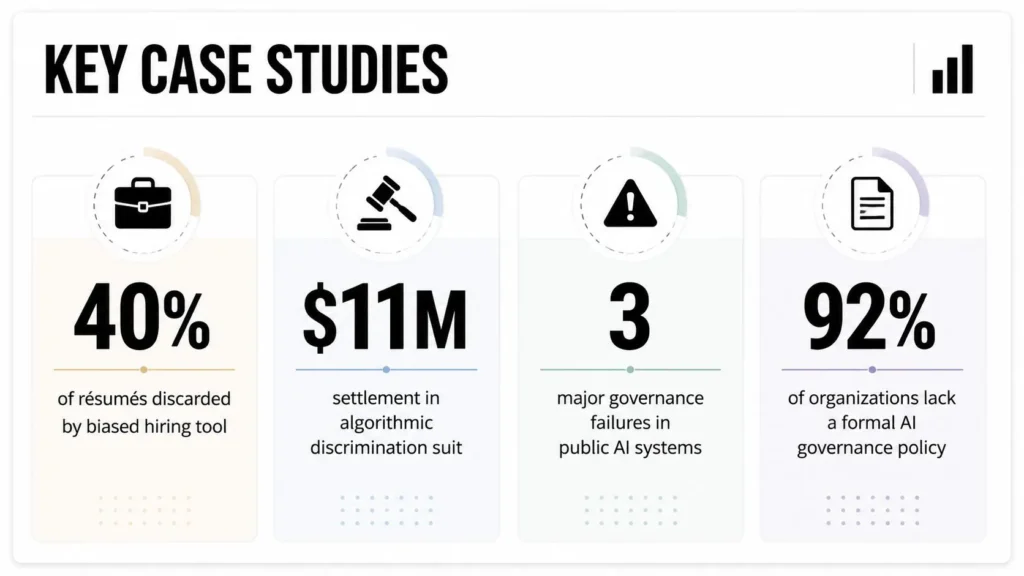
The clearest way to understand governance failure is to follow the trail after a system has already caused harm. A recruitment tool learned from historical hiring data and began filtering out women’s résumés. A large language model gave confident medical-sounding advice that was not safe to follow. A facial recognition system showed documented racial bias. A content moderation algorithm amplified harmful material because engagement logic moved faster than safety checks.
The same four questions reveal the failure
First, what principle was violated. In many of these cases, fairness, transparency, safety, or accountability existed on paper, but not in day-to-day practice. Second, who was accountable. In several incidents, no one had a clear enough mandate to stop launch, pause deployment, or require a redesign.
Third, what governance gap allowed it. The usual pattern is weak testing, poor documentation, no post-release monitoring, or no clear route for users to challenge the result. Fourth, what changed afterward. The answer is rarely a clean fix. More often, teams added reviews, narrowed use cases, or introduced tighter oversight only after public failure made the gap impossible to ignore.
The deeper problem is that many AI ethics documents still read like values statements rather than operating manuals. Research on AI policy and strategy documents found little consideration of the Global South, the SDGs, and underrepresented populations, while wider review work also shows that voices from the Global South and alternative ethical approaches are largely absent from mainstream AI discussion. That is like drafting a safety manual for a global product without asking people in lower-resource markets how the system behaves under pressure.
The blind spot most explainers miss
The first blind spot is Global South implementation and redress. As noted earlier in the Global South and AI governance review, policy coverage often misses the people most likely to face uneven infrastructure, weaker complaint channels, and limited access to remedy. UNESCO’s ethics guidance points toward inclusive multilateral governance, cross-border harm mitigation, and AI literacy to reduce digital divides, but most explanations stop at the principle level. They do not show how a person outside a major market can file a complaint, get an investigation, or obtain a remedy when an AI system causes harm across borders. That gap shapes who gets protected and who gets ignored.
The second blind spot is post-deployment governance for generative AI. As noted earlier in the post-deployment governance review, many frameworks stay aspirational unless they are tied to transparency reporting, periodic audits, bias reporting, and lifecycle accountability. The operational questions are plain, but they decide whether governance works. Who monitors the system, how often audits happen, what evidence gets published when behavior changes, and how consent and data drift are handled all need clear answers.
If a model is already in production, governance starts with monitoring, not with a policy memo.
That is why each case works best as a checklist of missing controls. If your team can answer those four questions before launch, you are already closer to responsible practice than most public examples were at the start.
A Practical Playbook for Practitioners and Publishers
A useful governance plan starts with work that has an owner and a deadline. A policy that sits in a folder does little; a policy tied to daily decisions changes how teams use AI tools. Start by naming the person who answers for the program, writing or refreshing the policy in plain language, and listing every AI tool in use so no one is guessing which systems are in scope.
A 90-Day Implementation Sequence
- Day 30, foundation: write a plain-language policy, assign a single owner, and set an approved-tool list so people stop guessing.
- Day 60, implementation: add human review for sensitive actions, run a lightweight assessment for each high-risk use case, and make logging mandatory.
- Day 90, review: test incident response, review what the logs show, and report gaps to leadership with specific next actions.
By the middle stage, the work should become more operational. That means checking the highest-risk uses, deciding where human review is required, and making sure the system keeps a record that someone can audit later. For teams that generate drafts, summaries, or metadata, the guide for SaaS marketing teams is a helpful reference for how content workflow discipline works in practice. The internal guide on AI tools for content creation shows where approval, disclosure, and review fit inside the publishing process.
The same logic matters outside marketing. If a generative model is already live, governance starts with monitoring the output, checking for drift, and defining what happens when the system changes behavior after deployment.
A few quick checks show whether the program is real. If nobody can name the accountable owner, it is not working. If vendor assurances are carrying all the responsibility, it is not working. If users cannot challenge an AI-assisted decision, it is not working.
Good governance is visible in the receipts, not just the policy page.
Maxijournal.com publishes approachable coverage across science, technology, business, education, and related topics, and it is a practical place to keep learning how AI governance connects to publishing, product decisions, and everyday digital work. If you want more clear explanations like this, visit maxijournal.com and keep building a sharper, more usable view of AI ethics and governance.
Discover more from Maxi Journal
Subscribe to get the latest posts sent to your email.