A leadership team usually reaches for AI governance after the tool is already in use.
Marketing has adopted a writing assistant. Sales is pasting call notes into a meeting summarizer. HR is testing a screening tool. Someone in operations connected a copilot to internal documents because it saved time. The results look promising, but the basic questions arrive late. Who approved this? What data is flowing into it? Can anyone explain a bad output? If a regulator asks for records, what can you produce?
That’s the moment when AI governance compliance stops sounding abstract. It becomes a business control problem.
The good news is that this isn’t a mystery discipline. It’s closer to financial auditing than science fiction. You need an inventory, clear ownership, documented controls, and evidence that the controls are working. Large enterprises talk about this in formal frameworks. Smaller firms need the same discipline, just with lighter machinery.
The Hidden Risks of Ungoverned AI
A common failure starts innocently. A marketing team finds a new AI tool that drafts campaign copy faster than the old workflow. No one means to break policy. They just want output by Friday. So they upload customer notes, product positioning, maybe a few internal documents, and move on.
That’s Shadow AI. It means employees use AI tools outside approved oversight.
The risk isn’t only that the tool might produce weak copy. The bigger problem is that your company may have no record of what data went in, what model produced the answer, who reviewed it, or where the output was reused. If the tool stores prompts, trains on inputs, or exposes sensitive information to the wrong person, the damage starts before leadership even knows the system exists.
Why this gets expensive fast
Ungoverned AI creates three kinds of trouble at once:
- Security trouble: Staff may paste confidential data into a tool with unclear access controls.
- Decision trouble: A tool might generate a biased, incomplete, or misleading result that an employee treats as fact.
- Reputation trouble: Customers rarely care whether the problem came from a human shortcut or an algorithm. They only see your brand.
Practical rule: If your company can’t list its active AI tools, it can’t govern them.
That’s why AI governance compliance matters. It gives the business a repeatable way to answer ordinary leadership questions. What tools are in use? Which ones are high risk? What rules apply? Who approves deployment? What evidence proves compliance?
Without those controls, AI behaves like an unsupervised contractor with access to your files and no manager checking the work.
With them, AI becomes much more predictable. Teams can still move quickly, but they do so inside guardrails. That’s the difference between innovation and avoidable exposure.
What is AI Governance and Why It Matters Now
Think of AI governance as building code for intelligent systems.
A skyscraper needs design rules, inspections, sign-offs, and ongoing maintenance. Not because construction is bad, but because unsafe construction creates serious harm. AI works the same way. A model can be useful and still need controls. Governance is the set of rules, roles, and checks that keep AI systems safe, accountable, and usable in practical contexts.
AI management asks, “Is the system running?”
AI governance asks, “Should it run this way, on this data, for this purpose, with this level of oversight?”
Governance is more than a policy document
Many companies already have an AI policy somewhere in a shared folder. That isn’t enough.
While 60–75% of organizations have drafted formal governance policies, 63% of them lack any formal governance policy in active implementation, 97% of organizations that experienced AI-related breaches failed to implement proper access controls, and projected global spending on AI governance is expected to reach $492 million in 2026 according to AI governance compliance statistics compiled by Prefactor.
Those figures tell a simple story. The failure usually isn’t awareness. The failure is execution.
A leadership team often gets confused here because “governance” sounds legalistic. In practice, it’s operational. It means turning broad statements into controls people can follow.
What good governance actually does
A working program usually answers five practical questions:
| Question | Why leadership should care |
|---|---|
| What AI systems are in use? | You can’t govern unknown tools |
| What data do they touch? | Sensitive data changes the risk |
| Who owns each system? | Responsibility has to be named |
| What approvals are required? | High-risk uses need stronger review |
| What evidence is retained? | Audits and investigations depend on records |
If your team needs a plain-English refresher on the underlying technology, this overview of what machine learning is can help separate the model itself from the governance layer around it.
Governance isn’t there to slow builders down. It’s there to stop avoidable mistakes from reaching customers, employees, or regulators.
That’s why it matters now. AI has moved from experimentation into ordinary business processes. Once that happens, leadership can’t treat it as a side project. It becomes part of the control environment.
Navigating the Global AI Regulatory Maze
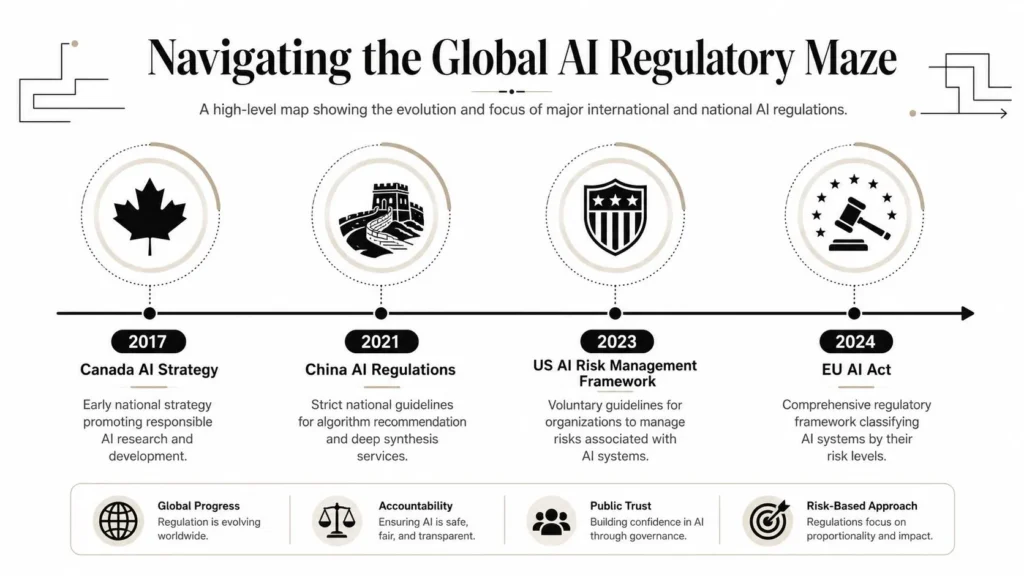
AI regulation is easier to understand if you stop reading it country by country and start reading it by regulatory philosophy. Most rules fall into three buckets. Some laws classify systems by risk. Some offer management frameworks. Others set broad principles that shape future obligations.
The EU model
The European approach is the most direct. It treats AI compliance as a structured legal obligation, especially for high-risk systems. Under the EU AI Act, high-risk uses face mandatory requirements tied to documentation, oversight, and traceability.
For leadership teams, the lesson is clear. The EU model asks not just whether your system works, but whether you can prove it was designed, tested, and monitored responsibly.
The US model
The United States is less unified. One challenge is fragmentation. The verified data notes that the US has over 50 distinct state-level approaches compared with the EU’s more unified model, as described in Prefactor’s AI governance statistics overview.
That doesn’t mean US rules are soft. It means compliance teams have to watch multiple jurisdictions. The practical impact shows up in state requirements. In 2025, 13% of organizations reported data breaches involving AI models or applications. Colorado’s AI Act takes effect June 30, 2026, and California’s CCPA Automated Decision-Making Technology regulations take effect January 1, 2026, requiring documented risk assessments and consumer opt-outs for high-risk systems, according to Knostic’s review of AI governance statistics.
If your website already handles privacy obligations, this guide to GDPR compliance for websites is a useful parallel. AI rules often build on the same habits: notice, documentation, access control, and evidence.
Global principles and standards
A third bucket comes from global frameworks and standards. These don’t always look like hard law, but they strongly shape internal programs. Leadership teams often build their governance stack around recognized frameworks because they create a common language across legal, security, and product teams.
Here’s the practical way to think about the maze:
- Risk-based laws tell you which systems need the strictest control.
- Management frameworks tell you how to organize the control system.
- Principle-based guidance tells you what “responsible” should look like when the law is still evolving.
The smartest response to fragmented regulation is not separate programs for each rule. It’s one strong internal control system that maps to multiple obligations.
That’s the heart of AI governance compliance. You don’t chase every new rule with a new committee. You build one disciplined operating model and adjust the mapping as requirements change.
The Core Components of an AI Governance Framework
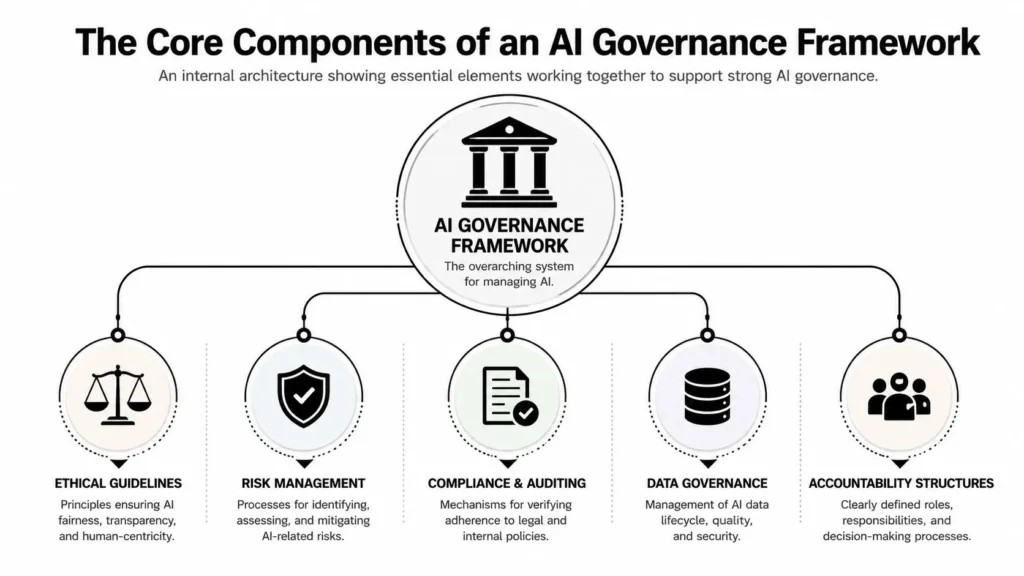
A strong governance program works like a five-part support structure. If one pillar is weak, the whole system becomes unreliable. You may still ship features, but you won’t know whether they’re secure, explainable, or defensible.
Risk assessment and classification
Not every AI use case deserves the same level of scrutiny. A note summarizer for internal meetings isn’t the same as a tool that influences hiring, healthcare triage, or customer eligibility decisions.
Risk assessment is the gatekeeping function. It asks what the system does, who it affects, how much harm a failure could cause, and how easily a human can intervene. High-risk systems need tighter controls because the consequences are larger.
A simple example: a support chatbot that answers shipping questions may get lightweight review. A model that recommends employee discipline should trigger executive, legal, and HR oversight before anyone deploys it.
Data governance and confidentiality
Most AI risk begins with data handling, not model theory. If teams can’t explain where data came from, who approved its use, and who can access outputs, then the system is already unstable from a compliance perspective.
That’s why access rules, retention limits, and approved data sources matter so much. If your team needs a practical companion on handling sensitive information around internal workflows and AI-assisted communication, this robust confidentiality protection guide is worth reviewing.
Lifecycle control and auditability
A compliant framework has to preserve evidence. It requires exhaustive audit trails, including model versions with cryptographic hashes, decision rationales, and data access events. For high-risk systems, compliance mandates fundamental rights impact assessments, end-to-end traceability, demonstrated transparency, and persistent human oversight in decision-making, as outlined in the IFAIS publication on AI governance and compliance.
That sounds technical, but the idea is familiar. In finance, you keep records so an auditor can reconstruct what happened. In AI, you do the same.
A practical audit trail often includes:
- Version history: Which model version was active at the time of a decision
- Approval records: Who signed off on deployment or a material change
- Data events: What data was accessed, changed, or transferred
- Decision logs: Why the system reached a recommendation and whether a human overrode it
Audit lens: If an investigator asked you to reconstruct a disputed AI decision six months later, could you do it from records alone?
Accountability and human oversight
Someone must own the system after launch, a point where many organizations stumble. Product builds it, legal reviews it, security comments on it, and no one owns the outcome end to end.
For higher-risk uses, human oversight has to be real, not ceremonial. That means people can review, challenge, or stop the system when it behaves unexpectedly.
Trust controls
Trust isn’t a slogan. It’s a control category. It includes fairness checks, transparency about how outputs are used, privacy safeguards, and clear limits on where the system should not be used.
A hiring model, for example, should be tested before deployment to check whether it disadvantages certain groups. A customer-facing assistant should disclose that AI is involved and route edge cases to a human.
Together, these pillars create something leadership teams can manage. Not perfect certainty, but a defensible control environment.
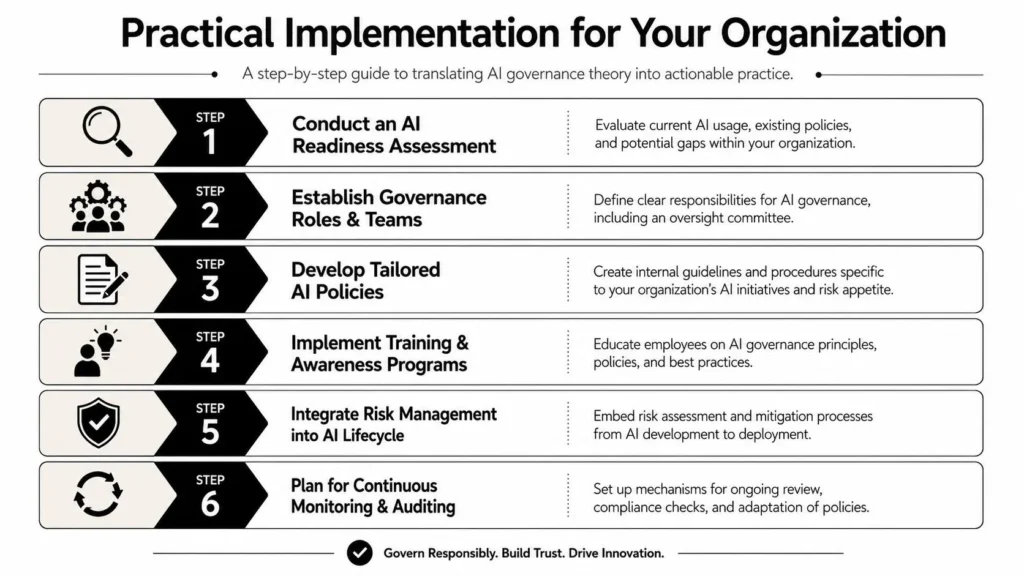
Practical Implementation for Your Organization
A small company shouldn’t copy an enterprise governance office line for line. That usually creates paperwork nobody maintains. The better approach is to scale the controls to the risk and maturity of the business.
Start with this short explainer before rolling anything out across teams.
The startup checklist
If you’re a startup or a very lean team, don’t begin with an ethics board. Begin with visibility.
Your first checklist should be short:
- List every AI tool in use: Include copilots, browser extensions, embedded features, and vendor platforms.
- Tag the data each tool touches: Public, internal, confidential, regulated.
- Name one owner per tool: Not a department. A person.
- Write allowed and prohibited uses: Keep the first version plain and concrete.
- Require approval before connecting AI to internal knowledge bases or customer data.
For teams publishing marketing or product material, this review of AI tools for content creation can help you spot where routine content workflows evolve into governance issues.
The SME roadmap
Most guidance falters at this stage. It assumes you can fund dedicated governance roles and frequent outside reviews. Many small-to-mid-sized businesses can’t.
The better path is to use lower-cost controls built into architecture and workflow. Existing guidance often fails SMEs by emphasizing dedicated governance roles they can’t afford. Emerging trends show a shift toward more cost-effective architectural safeguards like built-in circuit breakers and automated human-in-the-loop verification, according to the American Arbitration Association’s analysis of the AI governance gap.
What does that look like in practice?
- Circuit breakers: Set rules that stop an AI action when it reaches a threshold you define. For example, the system can draft a response but cannot send it without human review.
- Human-in-the-loop verification: Require a manager or trained reviewer to approve outputs in sensitive workflows such as HR, finance, or customer remediation.
- Approved tool list: Don’t let employees choose from the entire internet. Offer a shortlist of accepted vendors and block unapproved use where possible.
- Template-based assessments: Use one standard intake form for every new AI use case so review stays lightweight and consistent.
Training matters here, but dry policy decks usually fail. If you need a practical model for better employee participation, Learniverse helps boost training engagement with approaches that fit compliance education better than one-off slide sessions.
Smaller organizations don’t need smaller standards. They need simpler mechanisms.
The enterprise scale-up
Larger organizations face a different problem. They usually have policies, but those policies don’t travel well across business units.
A scalable enterprise model often includes:
| Need | Practical response |
|---|---|
| Multiple business units | Use one central policy with local implementation playbooks |
| Many vendors and tools | Create a standard intake and review workflow |
| High audit pressure | Standardize evidence retention and approval records |
| Diverse risk profiles | Classify use cases by risk tier and control strength |
A workable cadence
Whatever your size, keep the operating rhythm simple:
- Monthly: Review new AI use cases and tool requests
- Quarterly: Revisit risk classifications and policy exceptions
- When systems change: Update documentation, approvals, and monitoring rules immediately
That cadence won’t make the organization perfect. It will make it governable. For most leadership teams, that’s a significant milestone.
AI Governance in Action Examples and Case Studies
Stories make governance clearer than policy language.

The cautionary story
A mid-sized services firm let teams adopt AI tools informally. Marketing used one for copy drafts. Sales used another for meeting notes. Operations tested a copilot against internal files. None of this was malicious. It was ordinary productivity behavior.
Then legal asked for an inventory of AI systems touching enterprise data. No one had a complete answer. That’s a common blind spot. Recent data shows that 78% of organizations lack an extensive AI inventory, making it impossible to catalog every AI agent or copilot accessing enterprise data, according to Kiteworks’ 2026 business compliance guide on AI regulation.
The firm’s problem wasn’t only compliance paperwork. It couldn’t tell which prompts contained confidential information, which vendors processed that information, or whether any manager had approved those uses. A minor internal review became a wider control failure because the company had no reliable starting map.
The success story
Now take a different company. A mid-sized e-commerce business wanted to use AI in its recommendation engine and customer support workflows. Instead of starting with a large committee, leadership required three things first: an inventory, a risk label for each use case, and named owners.
The recommendation engine was approved with clear boundaries. Product could tune it, but only within documented data sources. Customer support could use AI-drafted replies, but a human had to approve responses involving refunds, complaints, or policy exceptions. Logs captured model changes and override decisions.
The result was more than cleaner compliance. Teams trusted the process because they knew where the guardrails were. Customers received faster service without the company surrendering accountability. Governance didn’t remove speed. It removed ambiguity.
Good governance rarely feels dramatic when it’s working. People simply know which tools they can use, what requires review, and who is responsible when something changes.
That’s the operational win most firms are after.
Building a Future-Proof AI Strategy
AI governance compliance is often framed as a burden. That’s the wrong frame.
Governance is a way to make AI usable at scale without relying on luck. It helps leadership trust internal deployments. It helps employees know the rules. It helps customers see that automation hasn’t replaced accountability. When regulators ask questions, it gives the company records instead of guesses.
The first moves don’t need to be grand. Start with an inventory. Identify your highest-risk use cases. Assign owners. Require review before sensitive data enters a tool or before an AI output influences an important decision. Those steps sound basic because they are. Basic controls are what most organizations skip.
For leaders who want a broader policy lens on where international governance debates may head next, this Analysis for AI policymakers adds useful context beyond internal operations.
If you do one thing this week, ask each department head for a list of the AI tools their teams currently use. Not the approved list. The actual list. That single exercise often reveals where your governance program really begins.
If you want more approachable technology and business analysis like this, explore maxijournal.com for practical articles that translate complex topics into clear, useful guidance.
Discover more from Maxi Journal
Subscribe to get the latest posts sent to your email.