At its core, machine learning is about teaching computers to learn from experience, much like we do. Instead of a developer writing out every single step a program needs to take, a machine learning model figures out the rules on its own by looking for patterns in data.
Defining Machine Learning Without the Jargon
So, what does that actually mean? Let’s use a simple analogy: telling the difference between a cat and a dog.
The old-school approach, traditional programming, would force you to create a huge, rigid checklist for the computer. You’d have to write explicit rules like, “if it has pointy ears AND long whiskers, it’s likely a cat,” or “if its tail wags AND it has floppy ears, it’s probably a dog.” This method is incredibly brittle and falls apart quickly. What about a cat with floppy ears? The rules would fail.
Machine learning completely flips this around. You don’t give the computer a checklist; you give it data. You show it thousands of photos labeled “cat” and thousands more labeled “dog.” The model then studies all these examples and starts identifying the key patterns itself—the subtle differences in snout length, eye shape, and fur texture that separate one animal from the other.
The core idea is simple: Machine learning isn’t about telling a computer how to do something. It’s about showing it what you want done and letting it figure out the “how” for itself.
The Key Shift in Thinking
This move from strict, rule-based instructions to flexible, data-driven learning is the fundamental concept that makes machine learning so powerful. It’s a system that gets smarter and more accurate as it sees more data, constantly refining its own logic without a programmer having to rewrite the code for every new piece of information. This is what lets it tackle problems that are far too complex or dynamic for traditional software.
This principle is also a cornerstone of the wider field of data science, which focuses on extracting insights and knowledge from data. To see how these fields overlap, you can check out our guide on what data science is.
To really drive the point home, let’s put the two approaches side-by-side.
Traditional Programming vs Machine Learning
This table breaks down the fundamental difference in how traditional code and machine learning solve problems.
| Aspect | Traditional Programming | Machine Learning |
|---|---|---|
| Input | A programmer provides rules (code) and data to process. | A developer provides data and the desired answers (labels). |
| Output | The program produces answers based on the pre-written rules. | The model produces the rules (its own internal logic). |
| Process | The computer follows explicit instructions written by a human. | The computer learns patterns from examples and experience. |
| Flexibility | Rigid. Changes require a programmer to rewrite the code. | Adaptive. The model can improve just by being fed more data. |
As you can see, one follows orders, while the other learns to think for itself. This ability to adapt is what allows machine learning to do everything from recommending your next movie to detecting financial fraud.
How a Machine Actually Learns from Data
It’s one thing to say a machine “learns,” but what does that really look like in practice? It’s less like a sci-fi movie and more like a very methodical, three-step process. Let’s break it down using something we all deal with daily: an email spam filter.
First up, you need data. A machine learning model can’t learn from a vacuum, so it needs a textbook to study. For our spam filter, this “textbook” is a massive collection of emails—we’re talking thousands, even millions. The critical part is that each email has already been labeled by a person as either “spam” or “not spam.”
This labeled data is the answer key. It gives the model a concrete foundation to understand what separates genuine messages from junk.
The Training Phase
With the data ready, we move into the Training phase. This is where the model actually starts to “study.” The algorithm sifts through all those labeled emails, looking for patterns. It might start to connect the dots, noticing that emails with phrases like “free money” or “urgent action required,” a ton of exclamation points, and shady-looking links almost always end up in the “spam” pile.
At first, the model is basically guessing and gets a lot wrong. But for every email it analyzes, it tweaks its internal logic to get a little bit smarter. It’s not being fed a list of pre-written rules by a programmer. Instead, it’s building its own rules from scratch based entirely on the patterns it finds.
This is the fundamental split from traditional programming. Instead of a person writing the rules, the machine figures them out on its own by looking at the outcome.
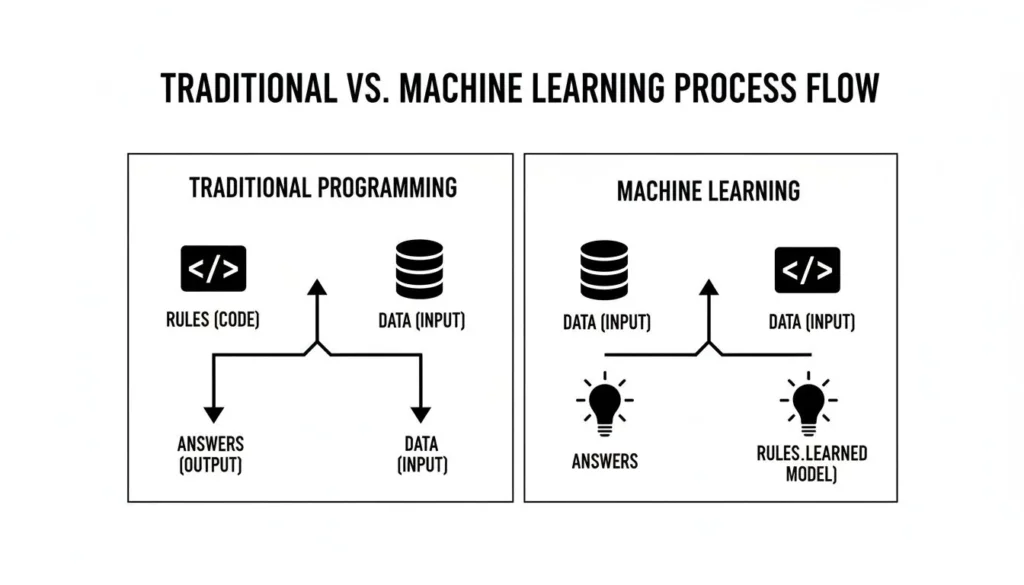
As you can see, traditional programming takes rules and data to get answers. Machine learning flips that script entirely—it takes data and answers to produce the rules. This is what lets a model adapt and handle situations its creators never explicitly planned for.
Making a Prediction
Finally, it’s test time. In the Prediction stage, the fully trained model is put to work on new, unseen data—in this case, the emails flooding your inbox right now.
When a fresh email hits your server, the spam filter instantly scans it for the patterns it learned during training. It then makes a judgment call, assigning a probability score for how likely it is to be spam. If that score crosses a certain line, poof—it’s off to your junk folder. The whole thing happens in the blink of an eye.
While this feels very modern, the core idea has been around for a while. The theory has roots stretching back to the early 20th century, but things really kicked off with Alan Turing’s famous “Turing Test” in 1950 and the first neural network machine in 1951. It all led to huge moments like IBM’s Deep Blue beating a world chess champion in 1997, proving a machine could build a better strategy than its human creators. If you’re curious about the full timeline, SparkFun’s historical overview is a great place to dig into these early breakthroughs.
The Three Main Flavors of Machine Learning

Machine learning isn’t one single, mysterious thing. It’s more like a toolbox filled with different instruments, each designed for a specific kind of job. The best way to really get what machine learning is all about is to understand its three main approaches, which are defined by the data they use and the problems they’re built to solve.
These three core methods are Supervised Learning, Unsupervised Learning, and Reinforcement Learning.
Each one learns from data in a completely different way, making it perfect for certain tasks, whether that’s predicting next month’s sales or helping a robot learn to walk. Let’s break down how they each work.
Supervised Learning: Learning With an Answer Key
Supervised learning is the most common and straightforward type of machine learning. Think of it like studying for a test using flashcards. You have a question on the front (the input data) and the correct answer on the back (the label). The goal is to learn the connection between the two.
With this approach, you feed the model a massive amount of labeled data. For example, you might give it thousands of house listings with details like square footage, number of bedrooms, and location, along with their final sale prices.
The model’s job is to figure out the underlying rules that link a house’s features to its price. After it’s trained, it can accurately predict the price of a new house it has never seen before.
This is the tech behind a lot of things you probably use every day.
- Spam Filtering: The model is trained on countless emails that have already been labeled as “spam” or “not spam,” so it learns how to classify new emails as they arrive.
- Medical Diagnosis: By analyzing medical images (like X-rays) labeled with specific conditions, a model can help doctors spot the subtle signs of a disease.
- Stock Price Prediction: Algorithms pore over historical market data and the corresponding prices to try and forecast future stock movements.
Basically, if you have a clear question and a dataset with all the right answers, supervised learning is your best bet.
Unsupervised Learning: Finding Patterns on Its Own
Now, imagine someone dumps a giant, messy pile of LEGO bricks in front of you and just says, “Figure it out.” You have no instructions and no labels. You’d probably start grouping the bricks by color, shape, or size, creating your own categories from the chaos. That’s the core idea behind unsupervised learning.
Here, the model gets a dataset with unlabeled data and is asked to find hidden structures or patterns all by itself. There’s no “right answer” for it to learn from.
A retail company, for example, could use unsupervised learning on its customer purchase history. The algorithm might automatically sort customers into distinct groups—like “frequent bargain hunters,” “high-value weekend shoppers,” or “new one-time buyers”—without ever being told what to look for. These insights help the business create much more effective marketing.
Some common uses include:
- Customer Segmentation: Grouping customers together based on their behavior.
- Anomaly Detection: Spotting unusual credit card transactions that could be fraudulent.
- Topic Modeling: Sifting through huge volumes of text (like customer reviews) to find the main themes.
Reinforcement Learning: Learning From Trial and Error
The third flavor, reinforcement learning, is a lot like training a dog. You don’t give it a manual on how to behave; you teach it through a system of rewards and consequences. When your dog sits on command, it gets a treat (a positive reward). When it chews on your shoes, it gets a firm “no” (a negative signal).
A reinforcement learning agent learns the same way. It operates in an environment and learns to make decisions through pure trial and error, all while trying to rack up the biggest possible reward over time. Think of an AI learning to play a video game.
It starts by mashing buttons at random. When it scores points, it gets a reward and learns the actions leading up to that were good. When it loses a life, it learns to avoid those moves in the future. After millions of tries, it eventually develops a surprisingly effective strategy to win. This is the same logic used to train self-driving cars and advanced robots.
Comparing the Types of Machine Learning
To make it even clearer, here’s a simple table that breaks down the key differences between these three approaches.
| Type | Data Input | Main Goal | Example |
|---|---|---|---|
| Supervised | Labeled Data | Predict outcomes based on past examples | Forecasting sales, filtering spam |
| Unsupervised | Unlabeled Data | Discover hidden patterns and structures | Segmenting customers, finding fraud |
| Reinforcement | No Pre-existing Data | Learn the best actions through trial and error | Training a robot, playing a game |
Each type has its own strengths and is a powerful tool when applied to the right problem. By understanding these core concepts, you’re well on your way to understanding how machine learning truly works.
Where You Already Use Machine Learning Every Day
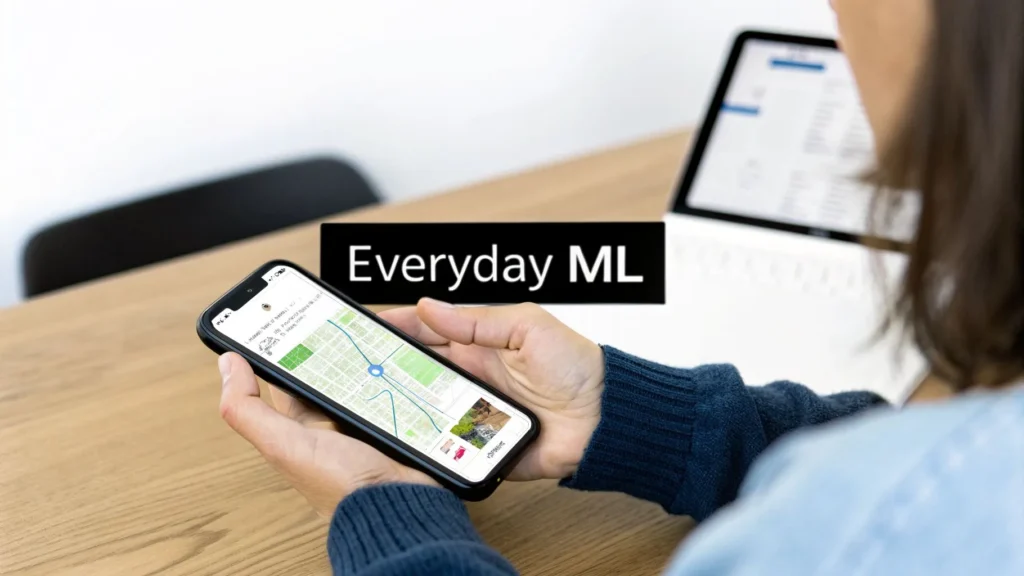
The term “machine learning” might conjure images of science fiction robots, but its real-world impact is far more immediate. You probably interact with ML dozens of times before you even have lunch, often without a second thought. It’s the silent engine running in the background of many services you rely on.
Let’s pull back the curtain and show you where this technology is hiding in plain sight. Each of these examples ties directly back to the learning models we’ve discussed, making an abstract idea feel much more concrete.
Personalized Entertainment and Social Feeds
Take a look at your Netflix homepage or the “For You” page on TikTok. That isn’t just a generic feed of what’s popular; it’s a tailored experience crafted by supervised learning algorithms.
Every time you watch a show, like a friend’s post, or even linger on a video for a moment, you’re feeding the system data. The model learns your preferences by comparing your activity to that of millions of others. It then predicts what other content you are most likely to find engaging.
This is a textbook case of learning from labeled data. Your actions—the likes, shares, and watch time—are the “labels” that train the model on what to serve you next. The ultimate goal is to keep you watching by showing you things it thinks you’ll love.
This exact logic is behind Spotify’s Discover Weekly playlists and Amazon’s product suggestions. These systems are constantly learning from your behavior to get better and better at their recommendations.
Smarter Navigation and Virtual Assistants
Ever wonder how Google Maps predicts that a traffic jam is about to form? That’s machine learning in action, analyzing streams of real-time data to forecast what traffic will look like in the near future.
The system crunches a combination of historical traffic data and live information pinging from phones on the road. By recognizing the subtle patterns that precede a slowdown, it can proactively suggest a faster route. This predictive power is the result of models trained on countless hours of real-world traffic information.
On top of that, virtual assistants like Siri and Alexa depend on machine learning to understand you.
- Natural Language Processing (NLP): When you say a command, an ML model breaks down the audio, converts it into text, and then works to figure out the actual intent behind your words.
- Constant Improvement: Every single interaction helps the assistant learn. This continuous flow of data helps it get better at understanding unique accents, slang, and different ways of asking for the same thing.
These familiar tools are perfect demonstrations of how machine learning graduates from a theoretical concept into genuinely useful technology. As the field continues to push forward, expect to see even smarter features woven into our daily lives. For more on what’s on the horizon, our regular updates on artificial intelligence news are a great place to stay informed.
The Real-World Limits and Challenges of ML
As powerful as machine learning is for solving complex problems, it’s no magic wand. You have to understand its limits just as well as you understand its strengths. The truth is, an ML model is only ever as good as the data you feed it, and that leads to some major hurdles.
There’s an old saying in computer science that sums it up perfectly: “garbage in, garbage out.”
If your model is trained on data that’s incomplete, wrong, or full of hidden biases, its predictions will be just as flawed. This isn’t just a technical glitch; it has serious consequences in the real world.
The Critical Issue of Data Bias
Data bias is one of the biggest headaches in modern machine learning. Historical data is often a mirror of our own societal biases, and when a model learns from that data, it doesn’t just copy those biases—it can make them even worse.
Think about a bank training an algorithm on its past loan approvals. If that bank has a history of favoring certain demographics, the model will learn that exact pattern. It might start denying loans to perfectly qualified people from underrepresented groups, all while hiding behind a mask of digital objectivity.
This isn’t a “what if” scenario. It’s a real problem that has led to hiring tools filtering out female applicants and facial recognition systems that are far less accurate for people of color.
The Black Box Problem
Another huge challenge is the “black box” problem, especially with advanced models. When you get into complex algorithms like deep neural networks, even the people who built them can’t always explain precisely how a model reached a specific decision. You feed it inputs, you get outputs, but the journey in between can be a total mystery.
This lack of transparency is a deal-breaker in high-stakes fields like medicine or finance. How can a doctor trust an AI’s diagnosis if it can’t explain its reasoning? It’s a massive area of ongoing research, and it touches on some deep questions about the very limits of computation. If that piques your interest, you’ll probably enjoy our simple explainer on quantum computing.
Data Privacy and Security
Finally, the core ingredient of machine learning—data—opens up a huge can of worms around privacy. To work well, ML models need enormous datasets, and that data often includes sensitive personal information.
This forces us to ask some tough questions:
- Data Collection: How is this information being collected? Do people even know what they’re agreeing to share?
- Security: How is all that sensitive data being stored and protected from hackers or leaks?
- Ethical Use: Are companies using data responsibly to help their users, or is it just another tool to maximize profit?
Figuring out the answers is absolutely critical. It’s the only way to build trust and make sure machine learning is used responsibly for the good of everyone.
Ready to jump into machine learning? It’s a huge field, and figuring out where to even begin can feel like staring up at a mountain. But don’t worry, the right first steps can make all the difference.
The goal isn’t to become an expert overnight. It’s about building a solid, practical understanding from the ground up. This roadmap will give you a few clear entry points without burying you in information.
Find Your Starting Point
The best way to learn anything is to pick a method that actually clicks for you. Some of us need structured courses, while others learn best from visual explanations or just by getting our hands dirty on a project.
Here are a few paths that work for most beginners:
Online Courses: Platforms like Coursera and edX are packed with introductory courses from top universities and tech giants. Look for ones specifically designed for newcomers that focus on the core ideas before getting into heavy math or coding.
Visual Learning: YouTube is a goldmine for this stuff. Channels like 3Blue1Brown have incredible videos that visually break down the math behind concepts like neural networks. You can also find tons of tutorials that will walk you through building your very first model.
Accessible Books: You don’t need a dense, academic textbook to get started. There are plenty of books out there that explain machine learning for a non-technical audience, using great analogies and stories to get the key ideas across without a single line of code.
The key is to start with the ‘why’ before getting lost in the ‘how.’ A strong conceptual understanding will make learning the technical details much easier down the road.
Try a Simple Hands-On Project
Theory is one thing, but there’s no substitute for actually doing the work. A simple, hands-on project is the fastest way to make these concepts stick and see what’s truly possible.
A great place to start is with a classic, pre-cleaned dataset like the Titanic dataset. The goal is simple: predict which passengers were likely to survive based on their age, gender, and ticket class.
Platforms like Kaggle are perfect for this. They offer starter code and tutorials that make it easy to build and train your first supervised learning model. It’s a fantastic way to see the ideas we’ve been talking about come to life.
Lingering Questions? Let’s Clear Things Up
Even after covering the basics, it’s normal to have a few questions rattling around. Machine learning is a huge field, and some ideas can feel a bit abstract at first. Let’s walk through some of the most common questions people have when they’re just starting out.
Think of this as a quick-fire round to solidify what you’ve learned and clear up any confusion.
What’s the Real Difference Between AI and Machine Learning?
It’s easiest to think of Artificial Intelligence (AI) as the broad, ultimate mission: building machines that can think or act in ways we consider “smart.” It’s the big umbrella.
Machine Learning (ML), on the other hand, is our most powerful and popular tool for getting there. It’s a specific approach to AI where we teach computers to learn from data themselves, instead of just following a massive list of pre-programmed rules. So, all machine learning is AI, but not all AI is machine learning. Early AI systems, for example, were often just complex webs of “if-then” statements written by hand.
Do I Have to Be a Math Genius to Get Into Machine Learning?
Absolutely not. While groundbreaking ML research is deeply rooted in advanced mathematics, you don’t need to be a math whiz to start learning and building useful things. Modern tools and libraries are designed to handle the heavy-duty calculus and algebra behind the scenes.
Your primary focus should be on grasping the concepts—what a model does, why you’d choose one over another, and how to interpret its results. A solid conceptual grasp is far more valuable than trying to memorize complex formulas when you’re starting.
For anyone new to the field, practical understanding is much more important than theoretical mastery. You can always circle back to dig deeper into the math if you decide to specialize later on.
What’s the Best Programming Language to Start With?
If there’s one language that dominates the machine learning world, it’s Python. It’s the go-to for a few simple reasons. First, its syntax is clean and relatively easy to pick up. But its real strength is its incredible ecosystem of open-source libraries built specifically for ML.
These libraries give you pre-built tools to do everything from data cleaning to model training:
- TensorFlow: A powerful, end-to-end platform perfect for large-scale projects.
- PyTorch: Another hugely popular framework, loved by researchers for its flexibility.
- Scikit-learn: An essential toolkit for everyday data analysis and classic ML models. It’s simple, efficient, and a fantastic place to start.
While other languages like R have their place, starting with Python is the most direct and well-supported path to getting your hands dirty with real models.
At maxijournal.com, we cut through the noise to bring you clear, approachable writing on the topics shaping our world. Explore more at https://maxijournal.com.
Discover more from Maxi Journal
Subscribe to get the latest posts sent to your email.