A team narrows a decision to three options. Then someone asks for more data. Finance wants a clearer cost view. Product wants to protect speed. Operations wants less risk. A senior leader has a gut preference but can’t fully defend it. The meeting ends with a follow-up meeting.
That’s the point where most business decisions start getting expensive. Not because the options are bad, but because the process is vague. People debate from different assumptions, use different criteria, and confuse discussion with progress.
Decision making frameworks fix that problem. They don’t eliminate judgment. They make judgment usable. A good framework forces the team to define what matters, compare options on the same basis, and show where the disagreement is.
That matters more than ever because the cost of unstructured decision-making rises fast in data-heavy environments. One widely cited business statistic says data-driven businesses are 19 times more profitable and 23 times more likely to acquire customers than competitors that don’t use data in the same way, which is one reason evidence-based decision processes carry so much weight in modern organizations (peer-reviewed discussion).
From Analysis Paralysis to Confident Action
The familiar version of decision gridlock doesn’t look dramatic. It looks reasonable. A leadership team reviews software vendors. Every option is “good.” Every person has a valid concern. The shortlist gets smaller, but confidence doesn’t improve.
I’ve seen this happen in budgeting decisions, hiring decisions, platform migrations, and partner selection. The pattern is usually the same. People think they’re arguing about the answer, but they’re really arguing about the decision method.
What goes wrong in real teams
Most stalled decisions break down in one of four ways:
- Criteria stay implicit. One person optimizes for speed, another for cost, another for political feasibility.
- Evidence arrives unevenly. Teams dig thoroughly into the option they already like and skim the rest.
- Authority is fuzzy. Everyone can comment, but nobody knows who ultimately decides.
- Risk gets handled emotionally. Reversible choices get overanalyzed, while hard-to-reverse choices get rushed.
Practical rule: If a team can’t say what criteria it’s using, it isn’t deciding yet. It’s reacting.
Frameworks help because they slow down the right part of the process. They don’t slow action. They slow sloppy thinking. That’s a useful distinction.
What confident action actually looks like
A sound decision rarely feels perfect. It feels clear enough to act on. The team knows the goal, knows the trade-offs, knows who made the call, and knows what would cause a re-evaluation later.
That’s the core value. Not certainty. Shared clarity.
When teams use a framework well, meetings change tone. Opinions still matter, but they stop floating around as disconnected preferences. They get tied to criteria, evidence, timing, and ownership. The decision becomes easier to explain upward, sideways, and after the fact.
What Are Decision Making Frameworks Really
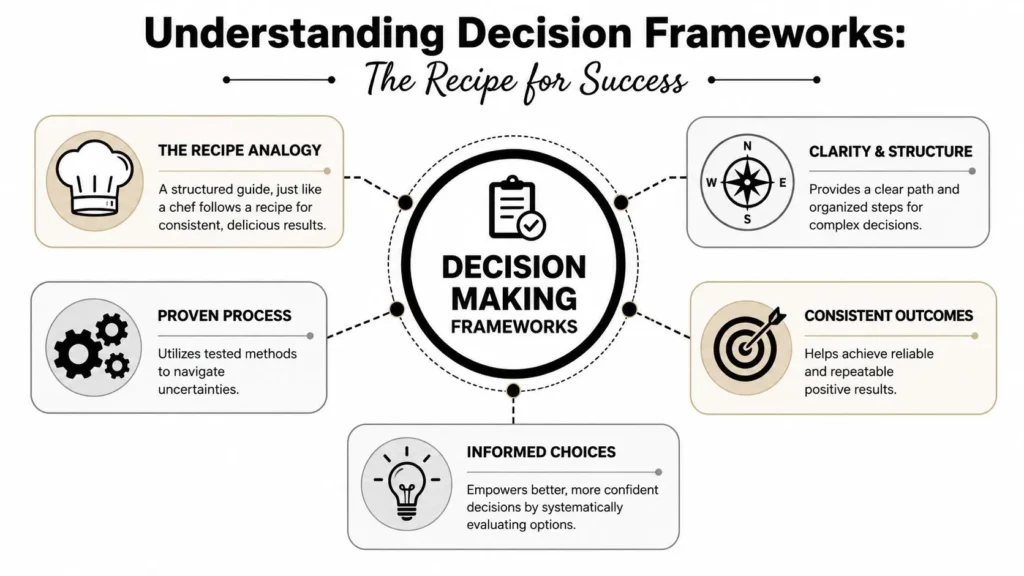
A decision framework is best understood as a recipe, not a robot. A chef still tastes the dish, adjusts seasoning, and responds to the ingredients on hand. But the recipe provides structure, sequence, and consistency. Without that structure, results depend too heavily on mood, memory, or whoever speaks first.
That’s how good decision making frameworks work in business. They give you the ingredients for a better call: the problem definition, the options, the criteria, the constraints, the risks, and the method for comparing choices.
Structure is the point
The modern habit of formalizing decisions has deep roots. The field became more systematic in the mid-20th century through the rise of decision analysis, and Howard Raiffa’s 1968 book helped establish a structured way to compare alternatives under uncertainty, a foundation that still shapes current practice (historical overview).
That history matters because it explains what frameworks are for. They’re not productivity hacks. They’re methods for moving a choice from intuition alone to explicit reasoning.
A useful framework usually does some version of this:
- Define the decision clearly
- List realistic alternatives
- Choose the criteria
- Compare the options consistently
- Make the trade-offs visible
That last part is where most value shows up. Trade-offs exist whether you name them or not. Frameworks just stop teams from pretending they don’t.
What frameworks don’t do
Frameworks can’t rescue a badly framed question. If a company asks, “Which vendor do we like most?” instead of “Which vendor best fits our operating model and risk tolerance?” the process will still drift.
They also don’t remove leadership judgment. They make it easier to apply judgment in a way other people can follow. If you want a simple practical primer on that mindset, Lucas Hubert’s piece on how to overcome indecision with this framework is a useful companion.
A framework should make disagreement sharper, not quieter. If everyone suddenly agrees too early, the team may be hiding the real trade-off.
The strongest teams treat frameworks as shared operating discipline. They know when to use more structure, when to use less, and when the process itself needs adjustment.
Four Essential Frameworks for Business Decisions
Some frameworks help you compare options. Some help a group stop tripping over authority. Some are good for quick calls that don’t justify heavy analysis. Others are useful when the environment itself is unclear.
That’s why a long list of models isn’t enough. What matters is matching the tool to the problem.

Decision matrix for multi-factor choices
The decision matrix, also called a weighted scoring model, is one of the most practical frameworks in business. Each option gets scored against predefined criteria, each criterion gets a weight, and the weighted total helps identify the strongest fit. It’s especially useful for choices like software platforms, suppliers, or operating models because it makes the decision rule explicit (practical guide).
This is the framework I reach for when the team has several credible options and keeps drifting into subjective debate.
Use it when:
- You have multiple options and none is obviously dominant
- The decision involves several criteria such as cost, implementation burden, security, or support
- You need a defensible record of why one option won
What works:
- Clear criteria before scoring. Decide the criteria first. Don’t build them around a favored option.
- Weights tied to strategy. If reliability matters more than speed, the model should show that.
- A final qualitative review. If tiny weight changes flip the winner, the decision is more fragile than it looks.
What doesn’t:
- Fake precision. A spreadsheet with lots of rows can still hide shallow thinking.
- Scoring vague criteria. “Strategic fit” means nothing unless the team defines it.
RAPID for role clarity and speed
RAPID is less about choosing among options and more about who does what in a decision. It separates who Recommends, Agrees, Performs, Inputs, and Decides. That’s useful when a team isn’t blocked by lack of ideas but by role confusion.
This framework earns its keep in cross-functional work. Product, legal, finance, and operations may all need involvement, but not all in the same way. RAPID keeps a decision from turning into committee theater.
It works best when:
- Several functions are involved
- Escalations are common
- Meetings keep ending without a clear owner
The main advantage is throughput. The team stops relitigating who has standing to approve, advise, or execute.
A short explainer helps if your team is new to structured models:
Pros and cons list for low-stakes clarity
The humble pros and cons list gets dismissed too often. Used well, it’s still valuable. It’s best for narrower, reversible decisions where the cost of building a full scoring model would exceed the value of the extra rigor.
The mistake isn’t using a simple list. The mistake is using a simple list for a decision that has major second-order effects.
Use it when the choice is relatively contained, such as:
- A short-term vendor trial
- A team workflow adjustment
- A minor tool purchase
Use something stronger when the decision affects several departments, changes customer experience, or creates lock-in.
Cynefin for uncertain environments
Cynefin is useful when the issue isn’t just “Which option is best?” but “What kind of problem are we dealing with?” Some situations are complicated. They reward expert analysis. Others are complex. Cause and effect are harder to map in advance, so safe-to-fail experiments work better than trying to optimize a grand plan too early.
This framework is especially useful in product strategy, change management, and AI-enabled operations, where leaders often confuse complexity with poor execution.
If the environment is complex, trying to force a neat ranking model too early can create false confidence.
The practical value is simple. Cynefin stops teams from applying engineering-style certainty to conditions that require learning in motion.
How to Choose the Right Framework for Your Situation
Organizations often don’t have a framework problem. They have a fit problem. They use a heavy model for a simple call, or a lightweight model for a choice that carries real operational or political risk.
Start with the decision itself. Not your favorite tool.
Four questions that narrow the right choice
Ask these before the meeting gets crowded:
- How complex is the problem? If the variables are known and comparable, a matrix can help. If the environment is unstable or hard to interpret, Cynefin is the better starting point.
- How fast do we need to move? Urgency changes the right level of analysis.
- How many stakeholders must be involved? A decision with broad dependencies often needs role clarity before it needs scoring.
- Can we reverse it easily? Reversible decisions deserve less ceremony than choices that create long-term lock-in.
A useful mental shortcut is this: the more irreversible, cross-functional, and politically exposed the choice is, the more structure you need.
Framework selection guide
| Decision Characteristic | Decision Matrix | RAPID Model | Pros & Cons List | Cynefin Framework |
|---|---|---|---|---|
| Best for | Comparing several options against clear criteria | Clarifying authority in group decisions | Fast evaluation of simple choices | Diagnosing whether the problem is complicated or complex |
| Team size fit | Small to medium groups with shared criteria | Cross-functional teams with overlapping roles | Individual or small team decisions | Leadership teams facing uncertainty |
| Speed | Moderate | Moderate to fast once roles are clear | Fast | Varies by situation |
| Risk handling | Good when risks can be defined and compared | Good for governance risk and delay risk | Limited | Strong for uncertain environments |
| Common failure mode | False precision | Bureaucracy if overbuilt | Oversimplification | Staying abstract without acting |
Goal setting often creates the same fit issue. Teams choose a planning method because it sounds disciplined, not because it matches the operating reality. If you’re sorting through that question too, this OKR vs SMART goals comparison is useful because it frames the choice around context rather than buzzwords.
A simple way to decide faster
If you’re still unsure, use this sequence:
- Low stakes and reversible. Start with pros and cons.
- Many options with clear criteria. Use a decision matrix.
- Many voices and unclear authority. Use RAPID.
- Unclear cause and effect. Start with Cynefin, then experiment or escalate to expert analysis.
That sequence keeps teams from overengineering ordinary decisions and under-structuring important ones.
Putting a Framework into Practice Step by Step
A framework only helps when the team can run it. In practice, most decisions improve when people follow the same four-step rhythm: frame the decision, identify options, evaluate trade-offs, then decide and communicate.
Take a common example. A small business needs more marketing support. The owner can hire one full-time employee, use freelancers, or split work across a specialist agency and internal staff. The team feels busy enough to rush, but the wrong choice could strain budget and execution.
Step 1 frame the decision clearly
The first question isn’t “Who should we hire?” It’s “What problem are we solving?”
That sounds obvious, but teams often solve for symptoms. In this example, the underlying issue might be inconsistent campaign execution, missing in-house expertise, or lack of management bandwidth. Those are different problems and they point to different answers.
Write the decision in one sentence. Add constraints. Define what success looks like. If you need a discipline for measuring the operating impact of the final choice, it helps to review how teams approach benchmarking performance indicators before they lock the decision in.
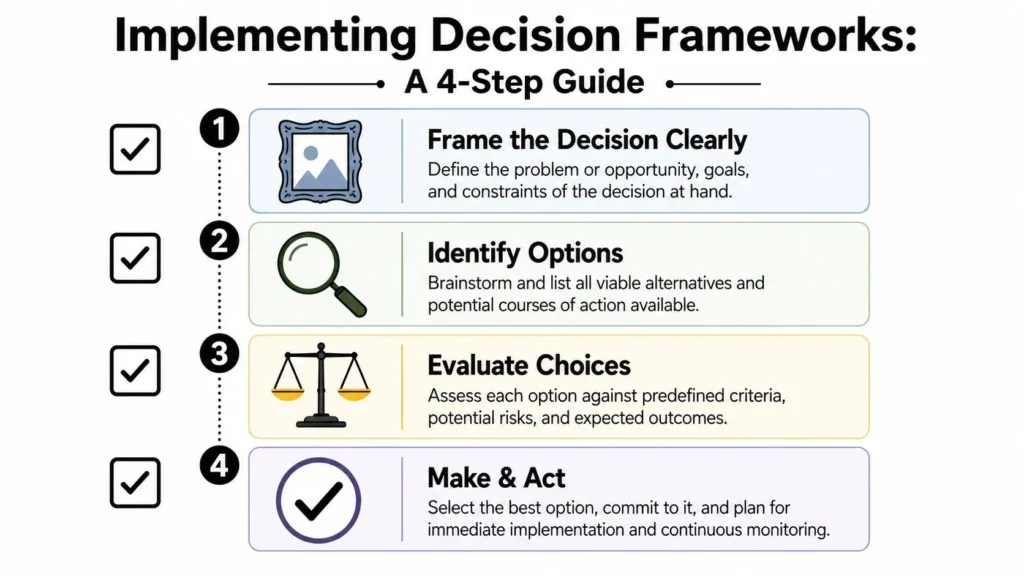
Step 2 identify options and gather information
Now list realistic options. Not fantasy options. Not politically safe placeholders.
For the hiring example, the choices might be:
- Full-time hire for ownership and continuity
- Freelancers for flexibility and specialist skills
- Agency plus internal coordinator for execution speed with lighter internal management
At this stage, gather enough information to compare the options, but don’t wait for perfect certainty. Practical guidance for technical leaders suggests many good decisions can be made once roughly 70% of the desired information is available, especially when the decision is reversible and waiting creates slower cycles with diminishing returns (leadership guidance).
Don’t confuse more information with more insight. A delayed decision often just means the team postponed the hard trade-off.
Step 3 evaluate the trade-offs
The framework is applied. For our example, a decision matrix works well because the options can be compared against visible criteria.
The criteria might include:
- Speed to deploy
- Management overhead
- Skill coverage
- Flexibility
- Long-term capability building
Scoring the options forces the business to confront its actual priorities. If speed and flexibility dominate, freelancers may win. If continuity and brand ownership matter more, a full-time hire may come out ahead. If the matrix result feels wrong, that’s often useful. It may reveal that the criteria or weights were poorly chosen.
Step 4 decide act and communicate
A decision isn’t finished when the spreadsheet names a winner. It’s finished when someone commits, explains the reasoning, and sets review points.
For the hiring example, the business might choose freelancers for the next planning cycle because the work is still variable and specialist needs are changing. That’s a reasonable decision if the owner also states what would trigger a shift to a full-time role later.
Communication matters here. Tell people:
- What was decided
- Why it was decided
- What trade-offs were accepted
- When the decision will be reviewed
That final step is what turns a framework into organizational trust.
Beyond Spreadsheets Ethical and AI Driven Decisions
A clean scoring model can still produce a bad decision.
That’s the uncomfortable truth many teams miss. Traditional frameworks are strong at comparing options, but weaker at surfacing who absorbs the downside. A matrix may show the most efficient answer while hiding unequal effects on customers, employees, or communities.
Ethical context changes the standard
Recent academic work argues that systems-oriented ethical decision-making has to account for context, stakeholder effects, and downstream inequities rather than treating every choice as a neutral analytical trade-off (ethical analysis).
That matters in healthcare, education, housing, hiring systems, and AI governance, but the principle applies broadly. Even a routine operational decision can distribute burden unevenly. A “best” answer on paper may create practical unfairness when implemented.
Questions worth adding to any serious decision review:
- Who benefits first
- Who carries hidden costs
- Which stakeholders were not in the room
- What happens if the process is objective but the outcome is not
When leading people, judgment and management maturity matter more than the spreadsheet. Skills like communication, accountability, and situational awareness become part of the decision method itself, which is why work on leadership skills for managers connects directly to better governance.
AI changes the decision architecture
AI adds another layer. The question is no longer just which option ranks highest. It’s also who defines the model inputs, who validates the outputs, and who overrides the system when context changes.
A model can rank options. It can’t own the consequences.
That’s why role-based frameworks remain relevant. In hybrid human-AI workflows, teams still need clear decision rights, clear accountability, and a visible line between recommendation and final authority.
Making Better Decisions Not Perfect Ones
The best use of decision making frameworks is modest and powerful at the same time. They help teams make better decisions, not flawless ones.
That difference matters. Perfection is a trap. It creates delay, encourages false certainty, and makes people afraid to commit. A framework gives you something more useful: a repeatable way to think clearly, expose trade-offs, and act with discipline.
Start small. Use a pros and cons list on the next reversible choice. Build a decision matrix for the next vendor review. Use RAPID when too many people have opinions and nobody has authority. And keep sharpening the judgment behind the tool by working on how to improve critical thinking skills.
Frameworks don’t think for you. They make your thinking visible, testable, and easier to trust.
If you enjoy practical writing on business, technology, leadership, and everyday decision-making, explore more articles on maxijournal.com. If you’re a reader who likes approachable insights or a writer looking for a place to publish fresh ideas, it’s worth a look.
Discover more from Maxi Journal
Subscribe to get the latest posts sent to your email.