What would it mean to find a world like Earth, a planet with the right size, the right orbit, and conditions that could keep water stable long enough for life to get started? That question sounds simple, but most headlines blur together two very different ideas, Earth-like and habitable. A rocky planet in the right zone is a promising candidate, yet that alone doesn’t make it a true twin of our world.
Astronomers have spent the last few decades turning that vague question into a measurable search. The result is a much richer picture, one that starts with size and orbit, then moves into composition, atmosphere, surface chemistry, and long-term stability. If you keep those filters in mind, you can read almost any future exoplanet headline with more confidence and less hype. For a useful companion to the bigger story of Earth’s origins, this overview of Earth in the beginning gives valuable context for how a rocky planet becomes a planet worth studying.
Why the Hunt for Earth-Like Worlds Matters
The search for planets like Earth is really a search for evidence. If astronomers find a world that is rocky, roughly Earth-sized, and able to keep liquid water on its surface, they’re not just adding another dot to a catalog. They’re testing whether the kind of planet we live on is rare, ordinary, or somewhere in between.
That’s why the field matters so much. A single confirmed Earth twin would change how scientists think about the Galaxy, not because it would prove life exists elsewhere, but because it would show that the ingredients for life-supporting planets can appear more than once in the cosmos. The historical shift from zero confirmed exoplanets before 1995 to a mature science with more than 4,000 confirmed exoplanets in later NASA summaries shows how fast this question moved from speculation to evidence-based astronomy (NASA exoplanet resources).
Four filters shape the search
A useful way to read the topic is to treat it like a sequence of filters, not a single yes-or-no test.
- Size and mass tell astronomers whether a planet is plausibly rocky rather than gas-rich.
- Composition helps them separate a terrestrial world from a mini-Neptune wrapped in volatile gases.
- Orbit shows whether the planet sits in the star’s habitable zone, where surface liquid water could exist.
- Atmosphere and long-term stability decide whether that world can stay temperate over time.
Practical rule: A planet can pass one filter and still fail the next. That’s why “found in the habitable zone” is promising, but never the same thing as “Earth found.”
The deeper appeal of this hunt is that it teaches scientific humility. Astronomers are not trying to force every new candidate into an Earth mold. They’re learning how to compare unfamiliar worlds using a careful framework, one clue at a time. That’s the only way to separate a headline from a planet that might resemble home.
What Astronomers Actually Mean by Earth-Like
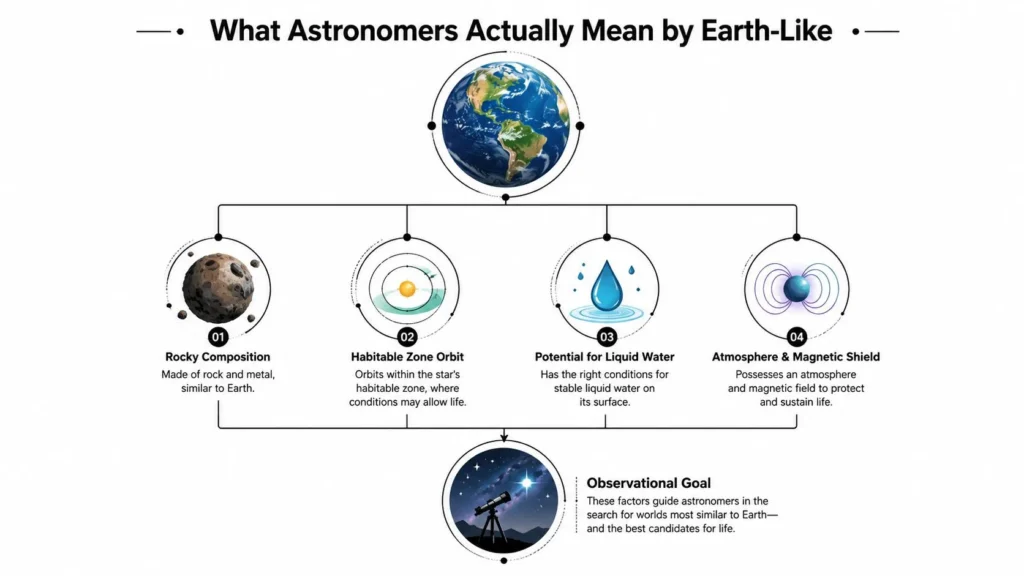
The phrase Earth-like sounds straightforward until you unpack it. Astronomers use it more like a job description than a single exam score, because a planet has to meet several conditions before it can be called meaningfully similar to Earth. Size matters, but so does composition, temperature, and the type of star it orbits.
The basic checklist starts with rock
A defensible baseline is a rocky, terrestrial planet with a radius close to Earth’s and an orbit inside the star’s habitable zone, where surface liquid water could exist (NOAA SOS Earth-like exoplanet dataset). That definition is narrow on purpose. It keeps astronomers from calling every warm or slightly small planet “Earth-like” when its actual interior might be very different from our planet’s.
Size and mass are the first screening tools because they’re measurable. Transit photometry can show how much a star dims when a planet crosses in front of it, which gives a radius estimate. Radial velocity follow-up can then constrain mass, and together the two measurements help scientists estimate density. If the density suggests a rock and iron interior, the planet stays in the Earth-like conversation. If it looks inflated and volatile-rich, it doesn’t.
Similar isn’t identical
A planet can be Earth-sized and still not behave like Earth. That’s the key distinction many headlines miss. The Earth Similarity Index is one formal attempt to compare planets across several variables at once, but even that is only a ranking tool, not a final verdict on habitability. The difference matters because readers often treat “near Earth in size” as if it means “safe for humans,” and that leap isn’t justified.
A more careful frame comes from Carnegie scientists, who emphasize that long-term habitability depends on surface temperature, plate tectonics, and atmospheric retention as well as size and orbit (Carnegie Science on defining an Earth planet). That’s a much stronger test than radius alone. It asks whether the planet can keep its surface environment stable enough for life to gain a foothold and persist.
For a tactile way to think about planetary history, a specimen like this Mars meteorite in a display case is a reminder that rocks from other worlds can be studied directly, even when the worlds themselves remain far away. That contrast helps explain why exoplanets have to be inferred from light and motion, not held in a hand.
How Scientists Actually Find These Distant Worlds
Finding a planet around another star is a little like trying to notice a moth passing a lighthouse from many miles away. The light changes are tiny, and the star usually overwhelms everything else. That’s why astronomers rely on several methods, each with its own strengths and blind spots.
Transit and wobble methods do different jobs
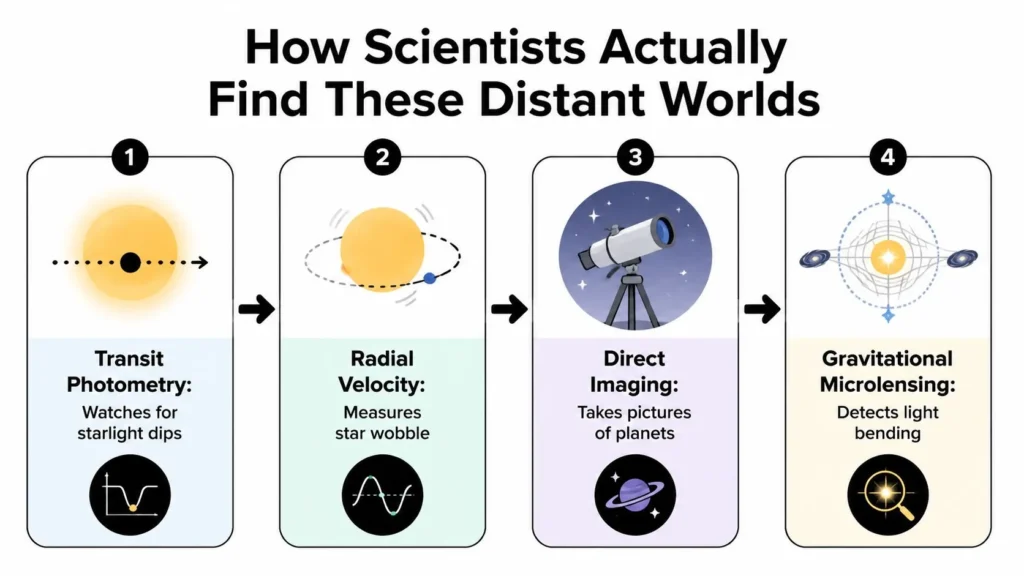
Transit photometry watches for a star to dim slightly when a planet passes in front of it. The planet is blocking a small fraction of the starlight, so astronomers can infer the planet’s size from the dip. This method is powerful, but it only works when the orbit is aligned just right from our point of view.
Radial velocity measures the star’s tiny wobble as the planet’s gravity tugs on it. The star moves toward and away from us by a minuscule amount, and that motion shifts the star’s spectrum. This method is especially useful after a transit detection, because it helps estimate mass.
The other two methods fill in the gaps
Gravitational microlensing takes advantage of a foreground star bending light from a background star. If a planet orbits the foreground star, it can create an extra blip in the brightening pattern. The method is rare in practice, but it can detect planets far from their stars and at great distances from Earth.
Direct imaging is the hardest method for Earth-sized worlds, because the planet is faint and sits extremely close to the glare of its star. Astronomers are improving their techniques, but for now this path is most useful for large, young, or widely separated planets rather than true Earth analogs.
A good shortcut is this. Transit tells you size, radial velocity tells you mass, microlensing tells you what surveys can catch at long distances, and direct imaging is the method you want most, but the one current technology struggles with most.
That’s why detection biases matter so much. Methods that are good at finding giant planets close to their stars can make Earth-sized worlds look unusually rare, even when they aren’t. For readers who want a technical companion to the telescope side of that story, this explainer on how the James Webb Space Telescope works is a helpful next stop.
Beyond the Habitable Zone, What Else Matters
The habitable zone gets a planet into the conversation, but it doesn’t finish the argument. Think of it as the interview stage. A planet still needs to show that it can keep an atmosphere, regulate climate, and avoid becoming too extreme for life as we know it.
Atmosphere and geology do the long work
Carnegie scientists point out that plate tectonics matters because it recycles nutrients and helps maintain long-term geochemical stability (Carnegie Science). Without that recycling, a planet can drift into chemical imbalance over time. That doesn’t make life impossible, but it makes the environment harder to keep steady.
An atmosphere is just as important. A planet’s mass, radius, and host-star environment affect whether it can hold onto its gases. If the atmosphere is too thin, surface temperatures can crash. If it’s too thick or chemically hostile, the surface may become inhospitable in the opposite direction. NASA and The Planetary Society both stress that habitability depends on much more than orbital distance alone (The Planetary Society on exoplanets).
Water, shielding, and stability
Liquid water is the central clue because it gives life a workable chemical medium. A magnetic field can help protect the surface from stellar radiation, while a large moon may help stabilize axial tilt, which matters for climate consistency over long periods. Expert syntheses also suggest that a rocky planet up to about 1.5 Earth masses, about 10% larger than Earth, with a moist atmosphere, 25 to 30% oxygen, shallow-water geography, a large moon, and a strong geomagnetic field may be especially favorable for long-term habitability (Carnegie Science).
Those numbers are not a recipe for life, and they’re not a guarantee. They are a way of saying that Earth itself may not be the only stable arrangement, and perhaps not even the best one. That idea is useful because it pushes readers away from a narrow copy-paste model of habitability.
Bottom line: The habitable zone is necessary context, not a final answer. A world can sit in the right place and still lack the atmosphere, shielding, or geology needed to stay livable.
The Mars terraforming question also highlights the same logic, because people often talk about changing a planet’s surface while forgetting the deeper climate and atmospheric constraints. This look at how long Mars terraforming would take helps show why “planetary environment” is a much bigger problem than “planetary location.”
From Zero to Thousands, the Story So Far
The modern search for planets like Earth starts with a milestone that sounds almost modest now. The first confirmed exoplanet around a Sun-like star was announced in 1995. Before that, astronomers had no confirmed planets outside the Solar System at all, which makes the growth of the field in just a few decades remarkable (NASA exoplanet resources).
Kepler turned a few detections into population science
The transformation came when NASA-era Kepler analyses began to ask not just, “Can we find one?” but, “How common are they?” In 2013, researchers reported that 22% of Sun-like stars may host an Earth-size planet in the habitable zone, with a narrower estimate of 11 ± 4% for planets receiving about 1 to 4 times Earth’s stellar intensity (PNAS study). Using the Milky Way’s roughly 100 billion stars as a reference, co-authors translated that into about 20 billion Earth-sized planets in our galaxy, while other summaries from the same research line ranged from at least 8.8 billion to 40 billion depending on the stellar sample and definition used (PNAS study).
That range is not a flaw. It reflects a real scientific issue, namely that “Earth-like” is not one fixed category. Some studies count only Earth-size planets near Earth-like sunlight. Others include different star types or broader habitable-zone definitions. The statistics change because the definition changes.
The catalog keeps growing, but the rarest cases still stand out
NASA later summarized the field as having more than 4,000 confirmed exoplanets, with about one-fifth in Earth’s size range (NASA exoplanet resources). That matters because the search is no longer a hunt for a single oddball object. It’s a statistical science with enough discoveries to compare radii, masses, and orbital temperatures across many systems.
At the same time, the most Earth-like candidates remain uncommon relative to the full catalog. That’s normal in a field where the easiest planets to find are not the ones most like our own. The timeline tells a clean story, from a single detection in 1995 to a population-level picture in the 2010s and beyond, but the hardest work is still ahead.
The Most Famous Candidate Worlds Compared
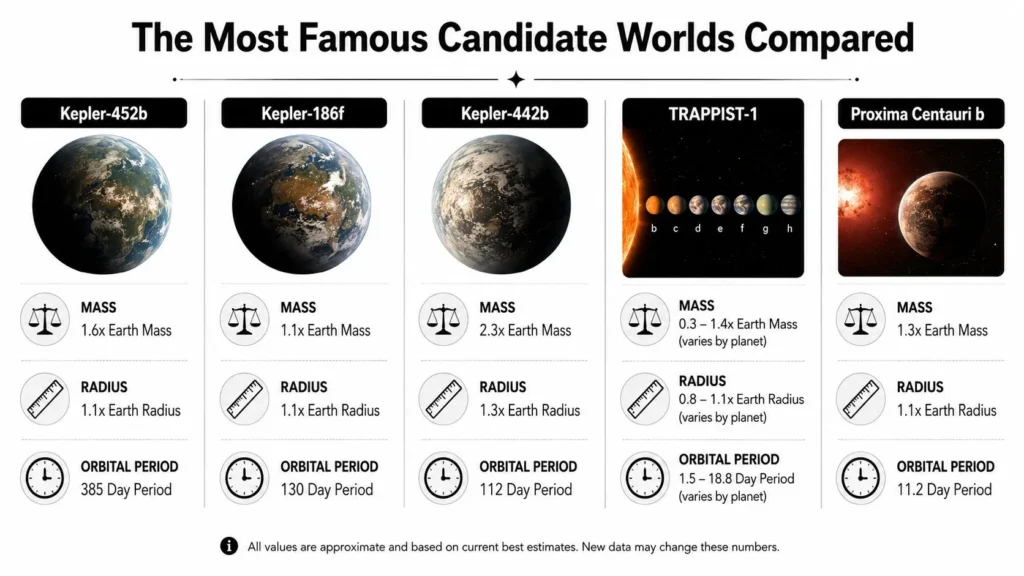
The best way to judge headline candidates is to use the same yardstick on all of them. A good candidate isn’t just famous. It’s a world whose star, orbit, size, and atmospheric unknowns can be weighed against the same basic criteria.
The shortlist is exciting for different reasons
Kepler-452b drew attention because it sits in a sun-like system and was presented as one of the early “Earth cousin” candidates. Its appeal is mostly conceptual, a reminder that planets somewhat larger than Earth can still sit in a region worth studying. Kepler-186f became famous because it was one of the first Earth-size planets identified in the habitable zone of another star, which made it a landmark for the field rather than just a candidate.
Kepler-442b is often discussed because it falls into the same family of temperate, rocky-world possibilities. Proxima Centauri b matters because it is the closest possible target, which makes it the obvious object to watch for follow-up studies. TRAPPIST-1 is different again, because the system contains seven planets, and multiple members sit in or near the habitable zone, giving scientists a compact laboratory for comparing small worlds under one stellar umbrella.
What’s still missing from every case
None of these worlds is a confirmed Earth twin. That sentence matters more than the names themselves. The key missing piece is usually the atmosphere, because without it scientists can’t tell whether the surface is frozen, temperate, dry, cloudy, or chemically unstable.
A second gap is composition. A planet can be in the right orbit and still have a density or internal structure that makes it less Earth-like than it appears in artist renderings. A third gap is stellar environment, especially for active small stars where flares and radiation can change the odds for long-term surface habitability.
The exciting part isn’t the list of names. It’s the fact that each one shows how much can be inferred from light, and how much still has to be measured directly.
For a broader technical discussion of upcoming instrumentation and the logic behind these comparisons, the embedded video below is worth watching after you’ve read the names with the framework in mind.
Why Earth-Like Planets Look Rarer Than They Are
A lot of people assume Earth-like planets are scarce because the headlines make them sound scarce. The reason is simpler, and more interesting. Our detection methods miss huge parts of the planetary population, especially the smaller and more distant ones we most want to find.
The census is incomplete by design
Transit surveys are strongest for planets that happen to pass directly in front of their stars from our viewpoint. That means long-orbit planets, including Earth-like ones with longer years, are easier to miss. Direct imaging, meanwhile, still struggles to separate a dim planet from a blinding star. So even when a planet exists, current methods may not show it to us.
That bias shapes the public story. One Kepler-era line of work suggested Earth-size planets may orbit about 1 in 6 Sun-like stars, while narrower calculations in earlier work produced figures of 1.4% to 2.7% of Sun-like stars under stricter assumptions (Discover Magazine summary of Kepler-era findings). Those numbers aren’t contradictions. They reflect different definitions and incomplete sampling.
Earth-sized and Earth-like are not the same question
That distinction is the heart of the problem. One question asks, “How many planets are about Earth’s size?” The other asks, “How many are Earth-like in the life-supporting sense?” The first is about physical scale. The second is about atmosphere, climate, water, and long-term stability.
That’s why a recent 2024 report noting 45 Earth-like planets in habitable zones should be read carefully, not lazily. It signals progress in the catalog, but it doesn’t mean we’ve found 45 confirmed Earth twins. It means the search is widening and the definitions are still doing a lot of work.
When a headline says “Earth 2.0,” ask which definition of Earth-like it’s using. If the article only gives size and orbit, it’s leaving out most of the habitability story.
In other words, the planets are probably less rare than our methods make them appear. The uncertainty is not only how many exist, but how many we’ve had the sensitivity to notice.
Future Missions and How to Read the Next Headline
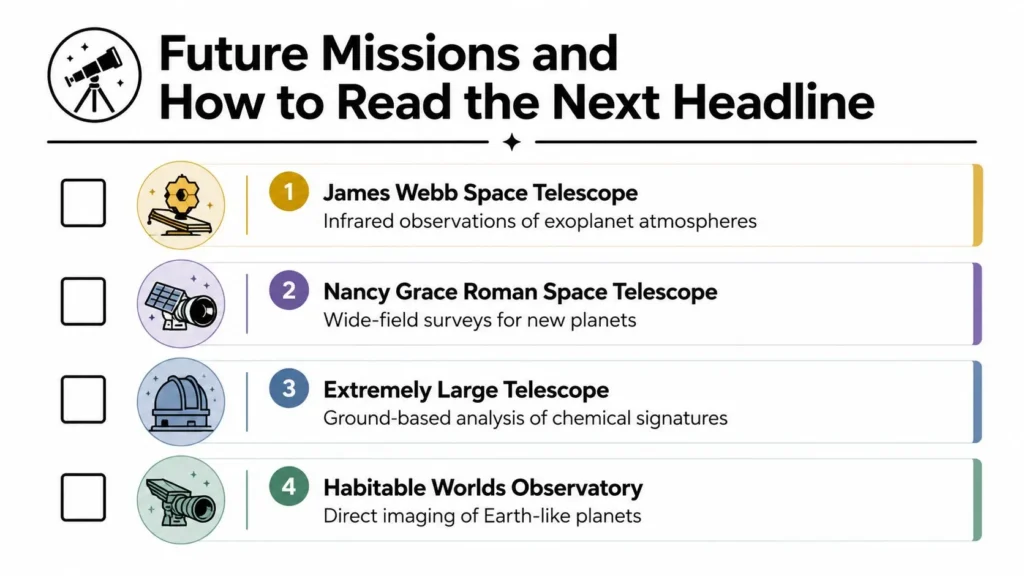
The next chapter in this field belongs to instruments built for finer atmospheric work and better planet characterization. The James Webb Space Telescope, the Nancy Grace Roman Space Telescope, the Extremely Large Telescope, and the proposed Habitable Worlds Observatory are all part of that future. JWST is already central to atmospheric studies, Roman is designed for wide-field discovery, ELT-class telescopes will help with detailed ground-based chemistry, and HWO is aimed at directly characterizing Earth-like planets.
A simple checklist for future headlines
When you see a new “Earth 2.0 found” story, ask four things.
- Is it rocky or just small? A small planet can still be volatile-rich.
- Is it in the habitable zone, or only near it? The boundary matters.
- Do we know anything about the atmosphere? Without that, habitability is still unknown.
- Is the claim about Earth-like size or Earth-like life support? Those are not the same statement.
A news story gets much stronger when it separates those categories cleanly. A weak one mixes them together and assumes the reader won’t notice.
The best exoplanet headlines don’t promise certainty. They tell you what was measured, what was inferred, and what remains unknown.
If you want more clear-eyed science writing that separates evidence from hype, maxijournal.com offers approachable coverage that respects curious readers and keeps the details straight. Visit maxijournal.com for more science stories, plain-language explanations, and thoughtful writing that helps you read the next discovery with a sharper eye.
Discover more from Maxi Journal
Subscribe to get the latest posts sent to your email.