12% of U.S. adults said they were currently taking a GLP-1 drug for weight loss or another condition, and that’s a striking sign of how quickly these medicines have moved from specialist care into everyday conversation. The bigger story, though, isn’t just that glp-1 drugs for weight loss are popular. It’s that they’ve created a new divide between what medicine can do in a trial and what patients can reach in the everyday world.
That divide matters because people don’t just want to know whether the drugs work. They want to know how the drugs change hunger, which version might fit their situation, what side effects can show up, and whether insurance or price will block access before the first dose. A practical guide to using the medications safely also needs a place to start, and a step-by-step resource like how_to_use_proplan can help readers organize the basics before a clinician visit.
Why GLP-1 Drugs for Weight Loss Are Everywhere Now
The rise of GLP-1s looks sudden because the shift has been sudden. These drugs were first developed for diabetes care, then obesity treatment moved to the center of the conversation as trials kept showing meaningful weight loss, especially with semaglutide and tirzepatide. A systematic review of 16 placebo-controlled trials found that 78.54% of people on GLP-1-based agents lost weight, compared with 26.53% on placebo, and the pooled odds of weight loss were 11.37 times higher with treatment.
That is why the conversation around these medicines changed so fast. People who once thought of obesity treatment as a matter of willpower now see a class of drugs that changes appetite biology directly, and health systems are adjusting to the ripple effects. The same review reported typical weight loss of about 8% to 21% with GLP-1 pharmacotherapy, which helps explain why doctors, employers, and payers are paying close attention.
What readers usually need to decide
The more useful question is whether these drugs make sense for you and whether you can access them. That second question is where many glossy explainers stop too early. If you are sorting through options, side effects, and access barriers, the useful information is rarely a slogan. It is the full picture of results, trade-offs, and the practical path to treatment.
Practical rule: if a weight-loss drug sounds simple, check the fine print on cost, coverage, and follow-up care before assuming it is available.
That matters because the medical story and the access story do not move at the same speed. The science can be solid while the pharmacy counter, the insurance plan, or the clinic policy says something different. That gap between clinical promise and real-world access is where this guide focuses.
How GLP-1 Drugs Change Appetite and Eating Behavior
GLP-1 drugs change appetite by turning down the brain’s hunger signals and slowing the pace at which the stomach empties. They do not erase appetite, but they make eating feel less urgent and make fullness last longer. Expert reviews describe a dual mechanism, central appetite regulation in the brain plus slower gastric emptying, which prolongs satiety and lowers energy intake (mechanism review).
A simple way to picture the biology
The brain-side effect matters because GLP-1 receptors affect appetite-regulation circuits. At the cellular level, GLP-1 receptor agonists stimulate POMC/CART neurons, which support satiety, while indirectly inhibiting NPY/AgRP signaling, which is tied to hunger (cellular review). That helps explain why many people describe less “food noise,” fewer cravings, and smaller meals without having to rely only on willpower.
The stomach-side effect matters too. Slower gastric emptying means food sits longer before moving onward, so fullness lasts longer after a meal. You can think of it as the body sending the brain a longer meal-finished signal, which gives satiety more time to register (mechanism review).
Why the effect goes beyond appetite
These drugs also change metabolic signaling. The cellular review notes improved insulin secretion, glucagon suppression, and reduced ectopic fat deposition, which helps explain why the clinical effect is not only lower intake but also broader metabolic improvement (cellular review). That is one reason clinicians pay attention to GLP-1s in patients whose weight is tied to blood sugar problems, lipid handling, or inflammatory fat distribution.
GLP-1 treatment changes the biological signals behind hunger, and the person still has to choose what to eat inside that new signal environment.
Some medications are GLP-1-only drugs, while others add a second pathway. Tirzepatide, for example, is a dual GLP-1 and GIP agonist, which is why it often gets grouped with GLP-1s in everyday conversation even though its biology is broader (mechanism and obesity medicine overview).
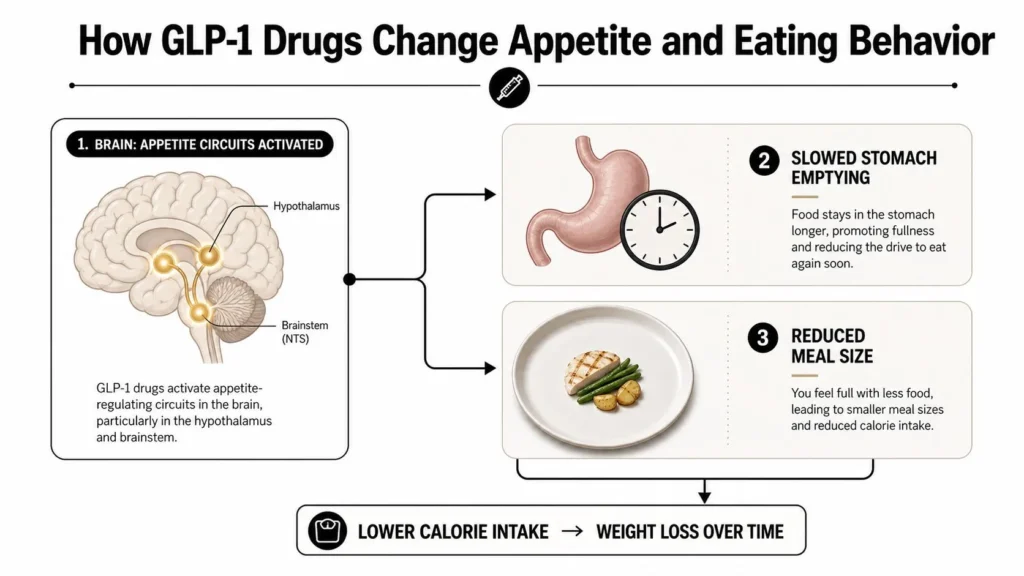
A fuller breakdown of the biology appears in understanding GLP-1 for weight loss, but the practical point is straightforward. These drugs can make eating feel less driven, yet access, cost, follow-up, and long-term use still shape who benefits in real life.
Which GLP-1 Drugs Are Used for Weight Loss and What Results to Expect
Among the GLP-1 medicines used for weight loss, semaglutide and tirzepatide draw the most attention because they anchor current obesity treatment. The more useful comparison is how much weight people lose and how steadily they can stay on treatment. A fuller explanation of the biology appears in understanding GLP-1 for weight loss, but the practical point is straightforward. These medicines can help, and the size of that help depends on the drug, the person, and the setting.
A comparison that keeps the claims grounded
| Drug Type | Typical Weight Loss Range | Patients Losing Weight in Trials |
|---|---|---|
| GLP-1-based agents overall | About 8% to 21% | 78.54% in a pooled review of placebo-controlled trials (systematic review) |
| Semaglutide trials | Within the broader 8% to 21% range | 79.90% lost weight, versus 30.30% on placebo |
| Tirzepatide trials | Within the broader 8% to 21% range | 79.38% lost weight, versus 24.72% on placebo |
That table shows the basic pattern. Trial participants generally lost weight, but the amount varied, and placebo groups still saw some weight loss. For readers, that matters because headlines often flatten a range of outcomes into a single promise.
How trial results compare with real-world outcomes
The same review also reported real-world semaglutide weight reduction over 6 to 12 months ranging from 4.4% to 19.5%, while tirzepatide ranged from 4.8% to 21.2% (systematic review). That spread is the part many guides skip. Outside tightly controlled studies, missed doses, side effects, insurance interruptions, and day-to-day life all shape what the scale shows.
The comparison is a useful reminder that drug class alone does not determine outcome. Some people see a strong response, some see a smaller one, and some do not lose enough weight to justify staying on the same plan. Clinicians usually care less about whether a medication is popular and more about whether it produces a change that is worth the cost, the follow-up, and the effort of staying on it.
Realistic expectation: the best medication is the one a patient can take consistently, tolerate safely, and afford long enough to judge whether it is helping.
Side Effects, Safety Signals, and Long-Term Trade-Offs
The most common side effects are the ones people expect first, nausea, vomiting, constipation, diarrhea, and a sharp drop in appetite. Those effects are part of how GLP-1 drugs work, but they can also be the reason some people stop treatment or never start it. If symptoms become severe, medical review is a good idea, and a general guide on when to see a doctor is available.
The less obvious concern is eating behavior
A 2024 cautionary review warned that GLP-1 drugs can strongly reduce appetite and may trigger or worsen restrictive eating behaviors in people with a history or risk of disordered eating. That does not mean these drugs are unsafe for everyone. It does mean appetite suppression is not automatically a win if it starts pushing someone toward under-eating, guilt around food, or an unhealthy fixation on control.
The long-term question is what happens after stopping. Broader obesity-medicine guidance notes that weight regain is common after discontinuation, which is why long-term use is often discussed as maintenance rather than a short course. That can be frustrating, but it reflects the chronic nature of obesity rather than a failure of the medicine itself.
Unregulated products change the risk calculation
There is also a safety problem outside standard prescribing. The FDA has warned that unapproved GLP-1 products marketed for weight loss can pose quality and safety risks, especially when people buy from unlicensed sources or use compounded versions without appropriate oversight. On top of that, the FDA received reports of adverse events associated with compounded semaglutide and tirzepatide, which is one more reason to treat online offers cautiously.
If you want to preserve function while losing weight, support matters. A resource like keep lean mass with GLP-1s is useful because it reinforces a point many readers miss, weight loss should not come at the expense of strength, nutrition, or basic day-to-day energy.
Watch for a mismatch: if the drug is helping the scale but harming eating behavior, mood, hydration, or strength, that is a clinical conversation, not a private failure.
Who Can Actually Get GLP-1 Drugs for Weight Loss
Access is where the story gets uncomfortable. Clinical benefit does not guarantee a prescription, and a prescription does not guarantee a filled prescription. Evidence from the underserved-access brief shows that GLP-1 use is uneven across income, race and ethnicity, geography, and insurance status, and that use was especially low among younger adults, men, rural residents, and people without a diabetes diagnosis, with only about 3.89% of eligible patients receiving therapy in that sample (access brief).
Eligibility is one thing, access is another
The usual clinical entry point is straightforward. Patients generally qualify with BMI ≥ 30 or BMI ≥ 27 with weight-related conditions, but those criteria do not mean a plan will pay, a local clinic will prescribe, or a pharmacy will stock the drug. That gap explains why many readers hear the same advice repeatedly, then hit a wall when they try to act on it.
Coverage rules shape the bottleneck too. The access brief notes that direct consumer cost, insurance coverage, inconsistent obesity-treatment standards, and a Medicare restriction on anti-obesity coverage remain major barriers (access brief). In practical terms, the drugs may be clinically available but financially out of reach.
A label can say a treatment is appropriate, while the world says something different. That is why eligibility and access cannot be treated as the same question.
What the demand spike means
U.S. use has climbed sharply. Analysts at KFF found that 12% of U.S. adults said they were currently taking a GLP-1 drug for weight loss or another condition, and CDC data showed 26.5% of adults with diagnosed diabetes used GLP-1 injectables in 2024 (KFF and CDC summary). Forbes also reported obesity prescriptions rising nearly 587% between 2019 and 2024, and Medicaid spending increasing from about $1 billion in 2019 to $8.6 billion in 2024 (KFF and CDC summary).
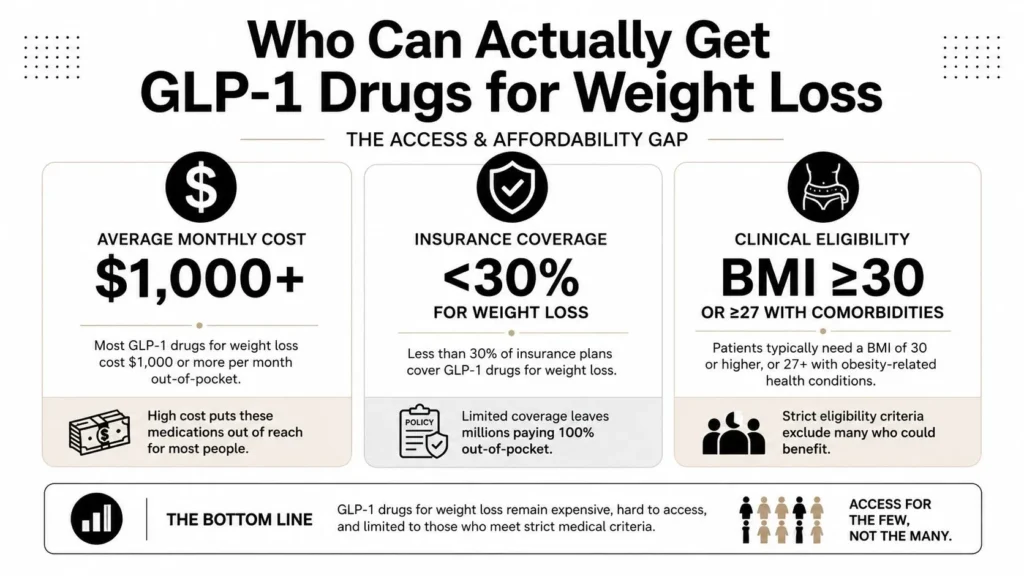
The access lesson is blunt. A drug can be clinically effective, widely discussed, and still unavailable to the people who need it most. Price, coverage, and geography sit beside physiology in the decision, which is why any honest guide to these medications must address all three. A practical next step is to build healthy habits alongside treatment, because medication access and day-to-day support often rise and fall together.
How to Decide If a GLP-1 Drug Fits Your Situation
A more useful first question is whether your medical history, budget, and eating pattern make this a reasonable choice. People who have already tried lifestyle changes, and who meet the usual clinical criteria for weight treatment, are often the ones clinicians consider first. But eligibility on paper is only the starting point. The harder question is whether the drug fits your life well enough to use safely and consistently.
A practical checklist
- You’ve already tried lifestyle changes. If diet, movement, sleep, and behavior changes haven’t been enough on their own, medication may be a logical next tool.
- You’ve discussed your health history with a physician. That matters for pregnancy risk, GI issues, family history, other medications, and mental-health context.
- Your plan includes follow-up. GLP-1s work best when someone checks whether appetite suppression is helping, overdoing it, or causing side effects.
- You have a cost plan. If coverage is uncertain, you need to know the price before you start.
- You’re thinking long term. Weight management usually isn’t a short sprint, so maintenance matters from day one.
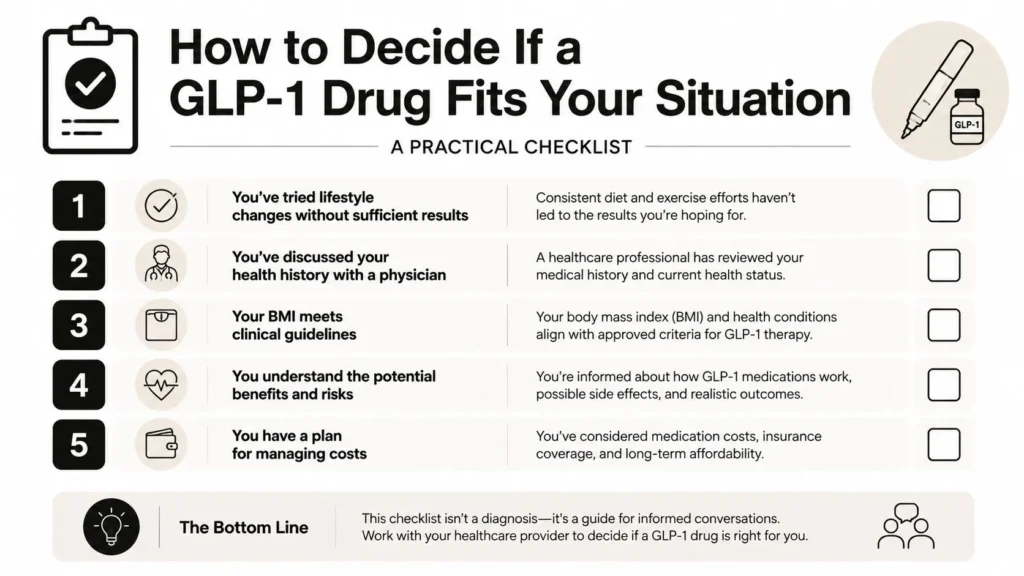
Simple rule: if the medication might help but the follow-up plan is weak, the odds of disappointment go up.
Preparation helps the appointment go better. Bring a list of current medications, a brief weight history, any prior attempts at weight loss, and a note about whether you’ve had nausea, binge eating, restrictive eating, or other food-related concerns. A practical habits guide such as this healthy-habits guide can also help you separate a medication decision from the broader work of changing daily routines.
If you’re talking to a clinician, ask how success will be measured, what side effects should trigger a call, and what the plan is if the first medication doesn’t suit you. That keeps the decision grounded in follow-up, not hype.
What Comes Next for GLP-1 Drugs and Weight Management
GLP-1s have changed the obesity conversation because they’re powerful enough to move weight and metabolic markers, but they haven’t solved the harder problems around access, adherence, and long-term maintenance. The next phase will likely be less about whether these drugs work and more about how they fit with broader care, including behavior support, nutrition, and exercise. A good overview of broader care trends in medicine and care delivery is available at https://maxijournal.com/healthcare-technology-innovations/.
The field is also moving toward more options, not fewer. As newer hormone-based therapies arrive, clinicians may be able to match treatment more closely to a patient’s needs, but that won’t remove the need to watch safety, affordability, and follow-up. For now, the honest conclusion is straightforward. GLP-1 drugs can be highly effective tools, but they’re not a standalone fix, and they’re not equally available to everyone.
If you want more clear, evidence-led health and science coverage like this, visit maxijournal.com for fresh explainers, practical FAQs, and stories that connect medical research to everyday decisions. Maxijournal.com publishes approachable writing across health, science, and technology, so it’s a useful place to keep following topics like GLP-1 drugs, weight management, and the world systems that shape access.
Discover more from Maxi Journal
Subscribe to get the latest posts sent to your email.