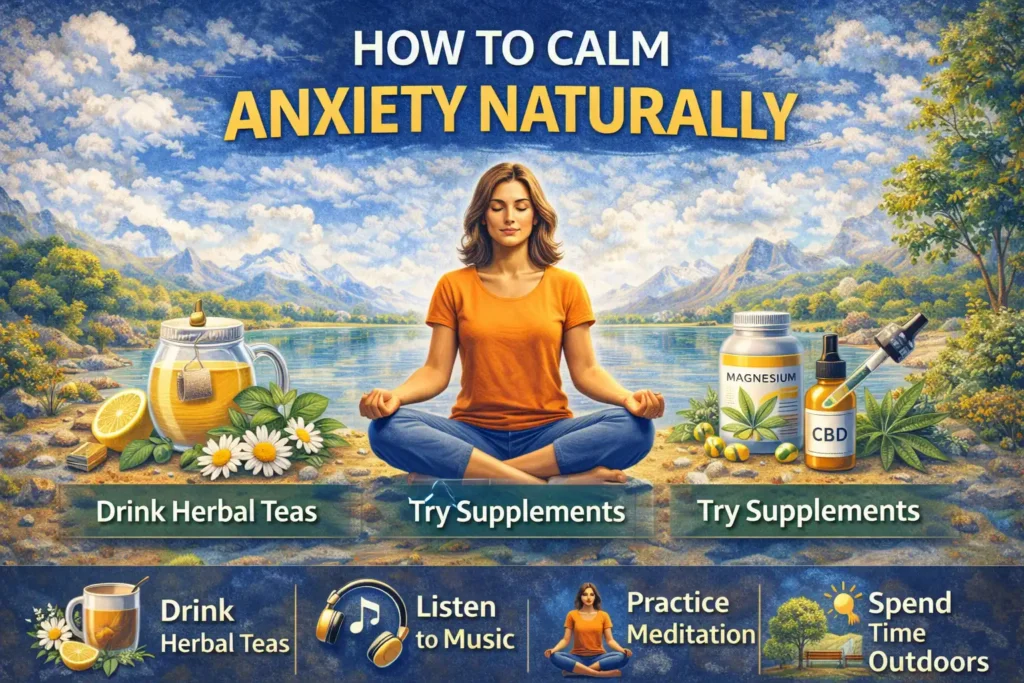
You’re standing in a pharmacy aisle, holding two supplement bottles that promise the same thing. One says “natural,” the other has a shiny seal, and both look harmless enough to toss in the cart. That’s where dietary supplement safety gets real, because the question isn’t just whether a product sounds healthy, it’s whether the bottle, the dose, and your own situation fit together safely.
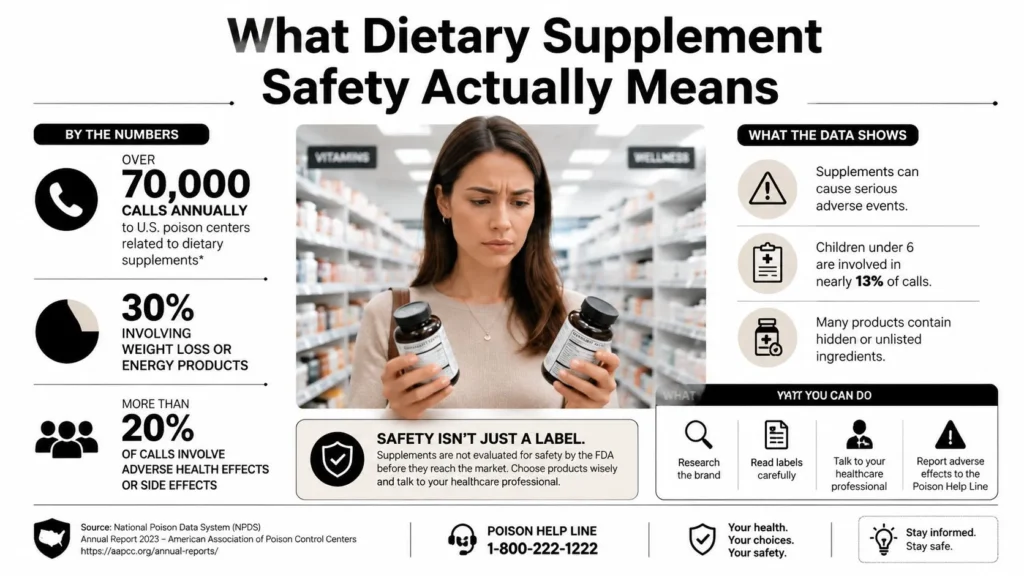
A large U.S. poison-center analysis found 274,998 supplement exposure cases from 2000 through 2012, averaging 21,154 exposures per year or 7.05 exposures per 100,000 population PMC supplement exposure surveillance study. The same analysis showed the annual exposure rate rose, fell, and rose again over time, which is a good reminder that supplement-related harms don’t disappear just because the headline moves on. Safety here isn’t a yes-or-no stamp. It’s a layered judgment about product quality, dose, interactions, and the person taking it.
What Dietary Supplement Safety Actually Means
A supplement can look ordinary on the shelf and still carry very different levels of risk. The poison-center data make that clear, because 70.0% of reported exposures occurred in children younger than 6 years, and 4.5% led to serious medical outcomes PMC supplement exposure surveillance study. That means the danger isn’t limited to dramatic misuse by adults. Accidental ingestion, bad labeling, and poor storage all matter, especially in homes where children can reach a bottle faster than a parent expects.
Safety is a three-part question
Think of supplement safety as a three-part check. First, is the ingredient what the label says it is. Second, is the dose reasonable for the intended user. Third, does the product fit the person’s age, medications, medical conditions, and pregnancy or surgery status. If any one of those parts is off, the product can shift from helpful to risky.
A useful way to read the bottle is this:
Practical rule: a supplement is not “safe” just because it’s sold legally or marketed as natural. Safety depends on the exact product, the dose, and who’s taking it.
That’s why the same aisle can contain products with very different risk profiles. A child’s gummy multivitamin, an iron tablet, a weight-loss capsule, and a herbal sleep aid don’t belong in the same mental category. They may all be supplements, but the safety questions are not the same.
The takeaway is simple. Dietary supplement safety is not a label claim, it’s an evidence question. You’re asking whether the product is correctly made, transparently labeled, appropriate for the intended use, and unlikely to interact with something else you’re taking. Once you see safety that way, the rest of the decisions become much easier to sort.
How the FDA and FTC Oversee Supplements
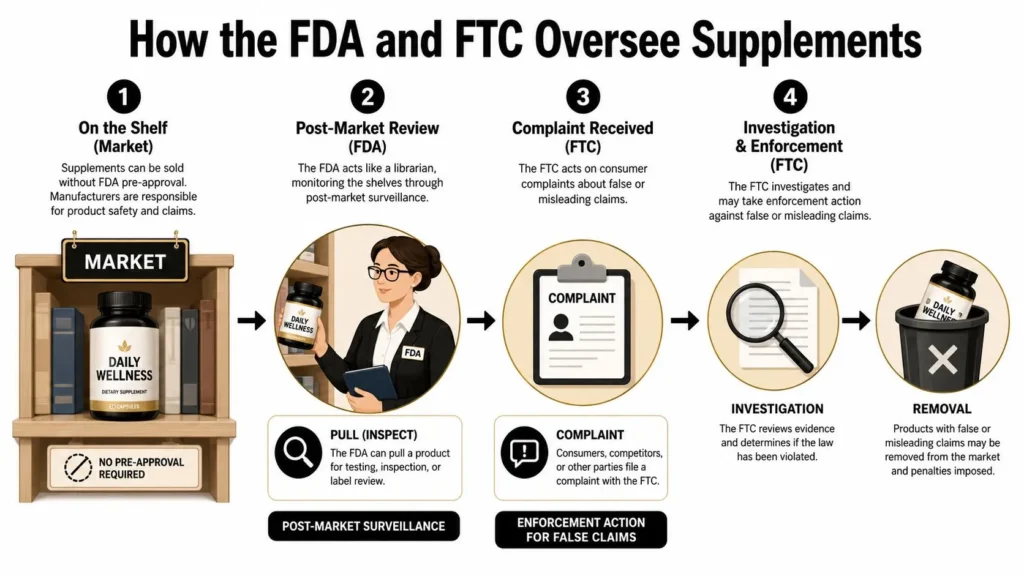
A lot of people assume supplements go through the same front-door review as prescription drugs. They don’t. In the U.S., supplements are mostly handled through postmarket surveillance, which means the product can reach the shelf before problems are fully known, and regulators step in later if warning signs appear. That’s the practical difference between a prescription medicine and a supplement bottle sitting in a store.
The library-shelf analogy
Think of the market as a library shelf. A supplement doesn’t need a pre-approval stamp before it gets placed there, but the librarian can still pull it if complaints, inspection results, or adverse-event reports show a problem. That’s the FDA’s role in plain English. The agency also uses tools like the Dietary Supplement Ingredient Advisory List and the New Dietary Ingredient notification pathway to flag ingredients that need more scrutiny before they’re widely sold FDA legal and regulatory discussion.
The FTC sits beside that system and focuses on marketing claims. If a company says a product will melt fat, cure fatigue, or rebuild immunity without solid support, the FTC can challenge those claims. The split matters because one agency is looking at whether the product is allowed and safe enough to stay on the market, while the other is looking at whether the advertising is misleading.
What this means for buyers
The consumer consequence is blunt. Regulators are mostly reactive, so your own screening matters more than people think. If a bottle appears suspicious, if claims sound extreme, or if an ingredient is new and oddly fashionable, don’t assume the system has already vetted it for you. It probably hasn’t.
That’s also why the same ingredient can move through the market under different levels of scrutiny depending on how it’s introduced. A product that looks familiar isn’t automatically low-risk, and a new formulation can raise different concerns from an old one even when the headline ingredient sounds unchanged. The library shelf is open, but that doesn’t mean every title deserves the same trust.
How Safety Is Actually Assessed for an Ingredient
Safety assessments are more like a file folder than a single test result. Regulators and safety reviewers look at the identity and characterization of the source, the manufacturing process, stability hazards, intended uses, exposure, toxicology, and bioavailability before deciding whether a nutrient source is acceptable under its intended conditions of use stepwise safety assessment framework. That sequence matters because “same nutrient” doesn’t mean “same risk.”
The form of the ingredient changes the risk
A vitamin’s safety profile can change with its chemical form, the surrounding matrix, impurities, and how the body absorbs it. A new salt, extract, or fermentation-derived ingredient may need more evidence if older data don’t clearly cover that exact source. In other words, the label name is only the starting point. What matters is the source, the form, and what ends up in the bloodstream.
Here’s the worked example people often miss. Two products can both say “vitamin” on the front, yet one can behave differently because of manufacturing residues, different breakdown products, or a different absorption pattern. That’s why safety reviewers don’t stop at the nutrient name. They move from identity to quality, then to toxicology, then to human relevance.
Why dose and population stay in the frame
Safety conclusions are always conditional. They depend on the intended dose and the intended user. A formulation that looks acceptable for a general adult population may not be appropriate for pregnancy, childhood, or people with chronic disease. That’s not a loophole, it’s how risk assessment works.
A product can be well made and still be the wrong choice for a specific person.
Once you understand that, the rest of supplement evaluation becomes more concrete. You’re not asking whether a nutrient is “good” in the abstract. You’re asking whether this source, this dose, and this use case have enough evidence behind them to justify taking it.
Adulteration, Mislabeling, and Contamination Risks
A clean label doesn’t prove clean contents. That’s the hardest lesson for many shoppers, because the bottle can look professional even when the powder, capsule, or tablet inside doesn’t match the promise on the front. Supplement safety problems can come from deliberate spiking, accidental cross-contamination, or raw-material impurities, and the risk is especially serious in weight-loss, bodybuilding, and sexual-enhancement products.
What goes wrong in the supply chain
Manufacturers can accidentally mix batches, source contaminated raw materials, or fail to control the production environment well enough. In other cases, a product is intentionally adulterated because a stimulant, steroid, or other pharmaceutical ingredient makes the product seem more powerful than the label suggests. The consumer only sees the finished bottle, not the shortcuts that may have happened upstream.
That’s why ingredient categories matter so much. Products sold for rapid weight loss or sports performance are more likely to attract aggressive marketing and risky formulation choices. If the promise sounds like a shortcut, the product deserves extra skepticism.
The problem isn’t limited to one kind of contaminant either. Surveillance and review work have repeatedly flagged undeclared pharmaceuticals, heavy metals, pesticides, and incorrect dosages in some supplement categories pregnancy supplement safety and quality review. That doesn’t mean every bottle is bad. It means the label alone can’t be your quality guarantee.
For readers who also think about storage and microbial contamination, this kind of environmental control is part of the same logic used in mitigating environmental risk factors for bacteria. If a product was handled badly before it reached you, the absence of visible damage doesn’t tell you much.
Why the marketing language can mislead
Words like “clean,” “natural,” and “clinically inspired” don’t tell you whether the contents were verified. They’re persuasive words, not safety data. When the product category is already high-risk, those words should make you slow down rather than speed up.
Dose, Interactions, and Hidden Cumulative Risk
Most supplement harm doesn’t come from one dramatic mistake. It comes from too much total intake, or from one product colliding with another product or medicine. The NIH notes that adverse effects are more likely when supplements are taken at high doses, used instead of prescribed medicines, or combined across multiple products, and it specifically flags vitamin A excess and iron excess as clear examples of dose-related toxicity NIH supplement safety guidance.
Total daily intake is what counts
A single bottle may look reasonable on its own. The problem starts when a multivitamin, a hair-and-nails formula, a joint product, and a separate omega blend all contribute overlapping nutrients. That cumulative stack can push total intake beyond a sensible range even when each label looks fine by itself.
Vitamin A is the classic example because excess can lead to headache, liver damage, reduced bone strength, and birth defects NIH supplement safety guidance. Iron is another because excess can cause nausea, vomiting, and potential liver or organ injury NIH supplement safety guidance. The pattern is simple. A nutrient can be essential at the right dose and harmful at the wrong one.
If you’re thinking about performance products, it’s worth reading a practical overview like performance enhancer safe use with a skeptical eye. The core question is never just whether something is “natural.” It’s whether the dose is controlled, the ingredients are known, and the stack is safe with your medications and health history.
Interactions can matter as much as dose
Some botanicals raise bleeding concerns, especially ginkgo, garlic, and ginger. Others can complicate anesthesia, including kava and valerian. St. John’s wort can create serotonin-related concerns and can interfere with how other medicines behave in the body NIH supplement safety guidance. Those interactions are exactly why medication reconciliation matters before surgery or when someone is on multiple prescriptions.
Bottom line: if you take several products, your true daily exposure is the sum of all of them, not the number printed on one bottle.
For readers comparing nearby timing advice around gut health products, an operational guide like best time to take probiotics can help organize routine supplements, but it doesn’t replace interaction screening. Timing matters less than knowing whether the combination is appropriate in the first place.
Reading Labels and Verifying Product Quality
The fastest way to shop smarter is to build a simple chain of trust. Start with the Supplement Facts panel, then look for signs that someone outside the manufacturer checked the product, and finally decide whether the product’s claims sound realistic. A seal can’t prove perfect safety, but it can help you separate basic label verification from pure marketing.
Five questions to ask before you buy
- What exactly is in it. Check the active ingredients, serving size, and any added blends.
- Does it hide doses inside a proprietary blend. If it does, you can’t tell how much of each ingredient you’re getting.
- Is there a third-party seal. Look for USP, NSF, or ConsumerLab when you want some assurance about label accuracy and contamination screening.
- Is the claim realistic. If the label promises a cure, a fast fix, or a dramatic effect, walk away.
- Does the product match your situation. Age, pregnancy, surgery plans, and medication use all change the answer.
| Signal | What It Means | Trust Level |
|---|---|---|
| Supplement Facts panel | Lists ingredients and serving size in a standardized format | Moderate |
| Proprietary blend | Hides the amount of each ingredient inside a mixed formula | Low |
| USP, NSF, or ConsumerLab seal | Suggests third-party review of label accuracy and certain quality checks | Higher |
| “Natural” on the front | Marketing language, not proof of safety or purity | Low |
| Specific dose and ingredient list | Lets you compare total intake against other products | Higher |
Third-party verification is not the same as full safety testing
This distinction matters. Third-party verification can help with cleanliness and label accuracy, but it does not mean the product was proven safe for every person or every use case. That’s why a bottle with a familiar seal is better than one without it, but still not a free pass.
A product that’s easy to decode usually deserves more trust than one that leans on vague promises. If the label is hard to read, the benefits sound inflated, and the ingredient list hides behind a blend, the product is asking you to trust too much without showing enough.
Who Should Be Most Cautious
Some people need a much higher bar before they take any supplement at all. Pregnant and nursing people are one group, because many supplements haven’t been tested well in those populations, and prenatal products can still carry contamination or dosing problems pregnancy supplement safety review. Children are another group, especially because accidental ingestion has been a major part of reported exposure cases poison-center surveillance study.
High-caution groups
- Pregnancy and nursing: Ask whether the product has been tested in pregnancy, whether the dose is appropriate, and whether the ingredient is even needed.
- Children: Keep products out of reach and avoid adult formulas unless a clinician says otherwise.
- Older adults on multiple medicines: Ask about pill burden, duplicate ingredients, and interactions.
- People scheduled for surgery: Bring a full list to the pre-op team, because bleeding and anesthesia issues matter.
- Chronic liver or kidney disease: Ask whether the body can clear the ingredient safely.
The counterintuitive point is that “natural” does not mean low-risk. High-dose fat-soluble vitamins, weight-loss and bodybuilding products, and adulterated supplements can be the most dangerous items on the shelf. At the same time, many routine vitamin and mineral products do not improve major chronic-disease outcomes in otherwise healthy people, so taking more isn’t automatically better.
If you’re unsure where you fit, a clear medical disclaimer can help frame the conversation, and read our health disclaimer is the kind of page that reminds readers to treat supplements as real health decisions, not casual purchases. The right questions for a clinician are straightforward. What is the goal, what’s already in my medicine list, and what’s the risk if I skip it?
Ask before you start: “Does this supplement fit my age, diagnosis, medications, pregnancy status, or surgery plan?”
Reporting Adverse Events and Where to Get Help
If a new symptom starts after a supplement, treat it as reportable. The FDA’s MedWatch system and the Safety Reporting Portal let healthcare providers and consumers file reports directly, and the report should include the product name, ingredients if available, dose, lot number, purchase source, symptoms, timing, and any medicines taken at the same time. Healthcare providers are encouraged to report, but you don’t have to wait for one to do it.
For practical guidance on when symptoms deserve medical attention, a consumer-focused page like when to see a doctor can help you decide when to escalate rather than monitor at home. A report doesn’t prove the supplement caused the event, but it adds data that can help regulators see patterns.
Keep a current product list in your phone, bring it to appointments, and store bottles where children can’t reach them. If something feels off after starting a supplement, stop the product and contact a clinician or poison center promptly. That small habit can prevent a minor reaction from becoming a bigger problem.
If you want more clear, science-grounded health writing that explains what labels mean, what the evidence says, and how to make safer choices at home, visit maxijournal.com. You’ll find practical articles that connect research to real decisions, so you can judge products with more confidence and less guesswork.
Discover more from Maxi Journal
Subscribe to get the latest posts sent to your email.