You’ve chosen a topic, opened a blank document, and started writing. The idea feels useful, but a quiet question keeps returning: will anyone search for this, and will they use the words you’ve chosen? If the answer isn’t clear, publishing can feel like placing a carefully written book on a shelf no one visits.
Keyword research basics gives you a practical way to close that gap. It connects your subject expertise with the language people use to find information, products, answers, and trusted sources. Modern research also needs to account for searches that end directly on the results page, conversational questions, and AI-generated summaries. The objective isn’t to force phrases into an article. It’s to understand demand well enough to create a page that naturally fits the query.
Why Guessing Keywords Fails
Writers often begin with what they want to say. That’s natural, but personal interest isn’t the same as search demand. A phrase may sound perfectly clear to you while readers use a different expression, ask a narrower question, or expect an entirely different kind of page.
Suppose you want to write about starting a website. You might choose “website creation” because it describes the subject. A beginner, however, may search for “how to start a blog,” “blog setup for beginners,” or a question about choosing a platform. Each phrase points toward a different need. If your page ignores that language, even useful advice may remain difficult to discover.

Search is a meeting point
The search box is where a reader’s problem meets your knowledge. Keyword research helps you identify that meeting point before you invest time in an article, product page, or video.
Guessing usually creates one of two problems:
- The phrase is too broad: A term such as “marketing” covers many possible goals, from studying theory to hiring an agency.
- The phrase is misaligned: A product page may target a query where searchers expect a comparison guide.
- The topic lacks a clear audience: A clever headline can attract attention from nobody if it doesn’t reflect a real question.
Search volume became foundational because it lets marketers compare demand across terms, locations, and periods. Modern tools normally show an average monthly estimate, not a live counter of individual searches, and they often normalize results by country or market, as explained in Semrush’s keyword search volume guide.
Practical rule: Start with the problem your reader wants to solve, then investigate the words attached to that problem.
Research isn’t a vote against creativity. It gives creativity a destination. You can still use an original angle, a distinctive voice, and a strong point of view. The difference is that your page begins with evidence of what people are trying to understand, rather than relying entirely on what sounds interesting in isolation.
The Core Pillars of Keyword Research
Think of keyword research as a map. Search intent tells you where the reader wants to go, search volume indicates how much activity exists around the route, and competition shows how difficult the terrain may be. A useful decision requires all three.
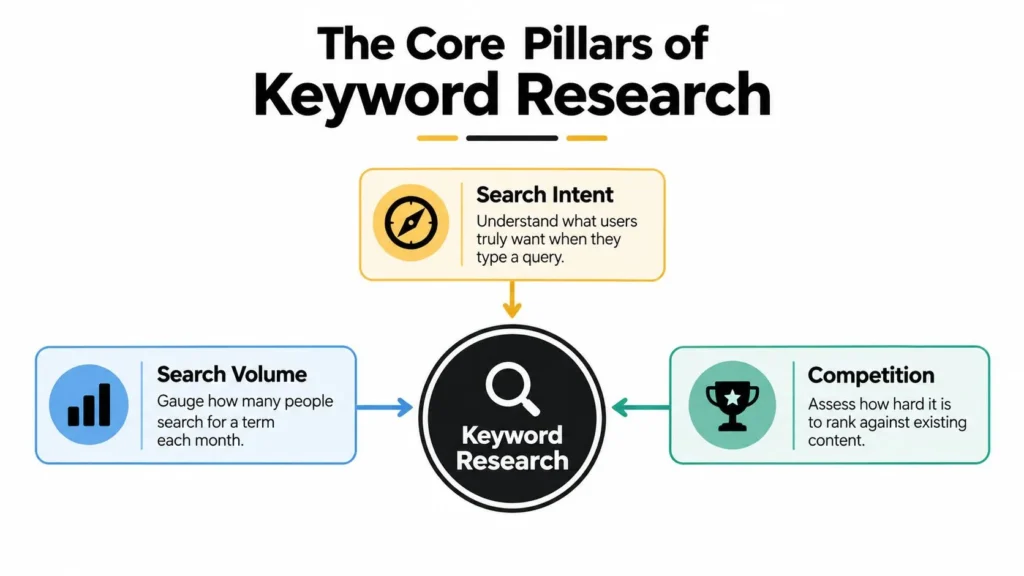
1. Search intent is the destination
Intent means the reason behind a query. A person searching for a brand name has a navigational goal. Someone asking “how does keyword research work” has an informational goal. A search for a specific product may be transactional, while “best email marketing tools” often signals commercial investigation.
Look at the results page before choosing a keyword. If the leading pages are tutorials, a sales page may struggle to satisfy the query. If the results are product listings and comparison pages, a general definition probably won’t match what searchers expect.
2. Search volume estimates activity
Volume helps you compare the potential audience for related topics. It shouldn’t be treated as a promise of visits. Seasonality, location, search features, ranking position, and the wording of the results page can all affect what happens after someone searches.
3. Competition describes pressure
Competition, often represented by a difficulty score, estimates the strength of the pages already ranking. It can reflect authority, links, relevance, and other query characteristics. A lower-volume phrase isn’t automatically easy, but it may offer a more realistic entry point when the current results are closely matched to the question.
For a specialist workflow, keyword research for SaaS teams offers useful context on connecting keyword choices with audience needs and business goals. The same principle applies to publishers, ecommerce teams, and independent creators: don’t select a phrase until you understand both the reader and the page you need to create.
A good keyword is therefore not popular. It is a phrase with a clear purpose, enough relevant demand to matter, and a competitive environment that fits your resources.
Understanding Volume and Difficulty
Search volume looks precise because tools display it as a number. In reality, it is a planning estimate, and different platforms can produce different results for the same query.
Google Keyword Planner uses advertising data, while third-party platforms may combine clickstream samples, volume ranges, and statistical models. Moz has described a methodology based on anonymized clickstream data from about 1 million real U.S. searchers, with forecasting that reached about 95% accuracy against Google Ads impression counts for a keyword over a full month, as detailed in Moz’s explanation of Keyword Explorer. That level of validation can make a tool useful, but it doesn’t turn an estimate into a universal count.
Read volume as a comparison signal
Use volume to compare related opportunities, not to predict your exact traffic. A monthly average can hide seasonal behavior. A term may have strong annual demand while most activity occurs during a particular period, so a calendar and trend view can be as important as the headline metric.
Location matters too. Demand in one country may differ from demand in another, and a global estimate can conceal those differences. Before recording a value in your research sheet, set the target country, language, and search engine market that match your audience.
The useful question isn’t “How many visits will I get?” It’s “Which relevant topic has stronger demand than its alternatives?”
Difficulty deserves similar caution. It isn’t a universal ranking law. A difficulty score is a multi-factor estimate of ranking pressure, and it may consider the authority of competing pages, referring domains, query characteristics, and other signals. Semrush’s analysis of 120,000 keywords across four regions connected difficulty with search volume, word count, authority score, and referring domains, supporting the view that competition involves more than popularity alone. See Semrush’s keyword difficulty validation for the methodology.
Inspect the actual results
Open the search results for a candidate phrase and ask:
- Relevance: Do the current pages answer the same question?
- Format: Are searchers shown guides, reviews, category pages, videos, or definitions?
- Page strength: Do the results come from established sites with substantial link support?
- Opportunity: Is there a missing explanation, audience angle, or practical detail?
A phrase with modest volume can be strategically valuable if it closely matches your expertise and the existing results leave a genuine need unsatisfied. Conversely, a popular term may waste time if the SERP is dominated by pages with much stronger authority and a format you can’t reproduce.
Short-Tail Versus Long-Tail Strategies
“Marketing” and “content marketing strategy for independent shops” may describe the same broad subject, but they don’t represent the same search opportunity. The first is short-tail, broad, and ambiguous. The second is long-tail, specific, and easier to interpret.
Short-tail keywords often attract wider attention, but their intent is unclear. A person searching “shoes” could want styles, retailers, care advice, or a definition. A person searching “best running shoes for flat feet” has already supplied a use case and a need for comparison.
Long-tail phrases aren’t automatically low competition, and they aren’t always better. Their advantage is clarity. Specific wording helps you decide what the page should contain, who it serves, and what action a satisfied reader may take.
| Keyword Type | Example | Intent | Competition Level |
|---|---|---|---|
| Broad short-tail | marketing | Ambiguous, often informational | Usually broad and competitive |
| Focused short-tail | content marketing | Informational or commercial investigation | Competitive, with mixed expectations |
| Long-tail question | how to build a content marketing plan | Informational | More specific, but must be checked in the SERP |
| Long-tail commercial | best content marketing tools for small teams | Commercial investigation | Specific, with comparison-focused competition |
Match length with purpose
Search intent usually falls into four practical groups:
- Informational: The reader wants an explanation, answer, tutorial, or definition.
- Navigational: The reader wants a particular website, brand, or page.
- Transactional: The reader is ready to complete an action, such as buying or signing up.
- Commercial investigation: The reader is comparing options before deciding.
Longer queries often reveal more of that purpose. “Email software” leaves many possibilities open. “Email software for a small nonprofit” gives you a clearer audience and a more focused content brief.
For a newer site, a sensible approach is to build topical relevance with specific phrases while keeping broader terms in view. A detailed guide can naturally address related searches without creating a separate page for every tiny wording variation. The page should serve the topic, not repeat a phrase mechanically.
Choose the narrowest phrase that still represents a meaningful audience and a useful page.
Start by writing a seed topic in your own words. Expand it with audience, problem, format, location, or use case. Then compare those variants in a keyword tool and in the live SERP. The final decision should balance relevance, intent, estimated demand, and ranking pressure, not word count alone.
Mapping Keywords to Content
Keyword research becomes useful when it changes what you publish. A spreadsheet full of phrases isn’t a strategy until each phrase has a destination on your site.
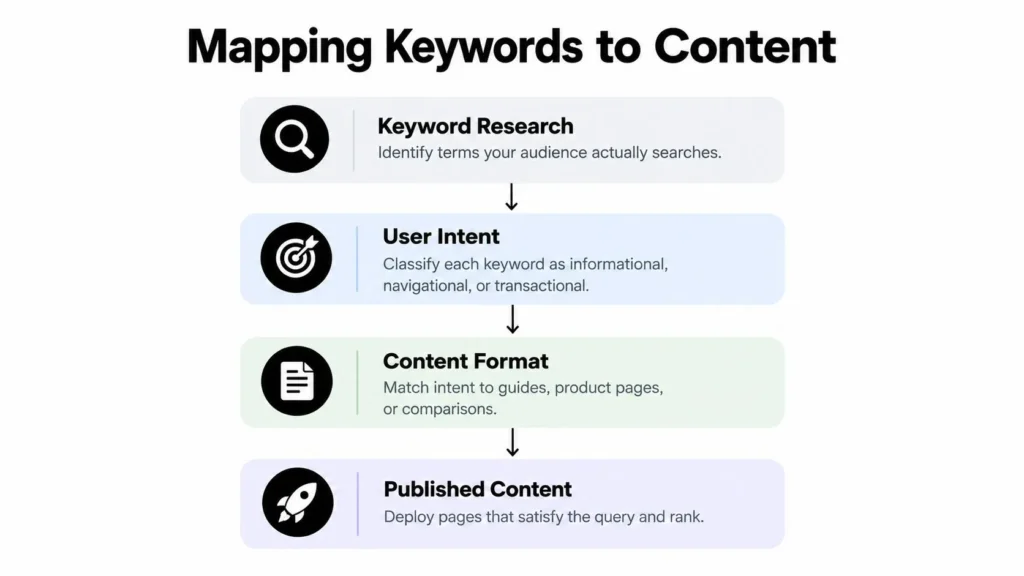
Give each intent the right format
A “how to” query normally needs a clear guide. A comparison query may need a review or evaluation page. A request for a specific product or service usually belongs on a focused landing page rather than an introductory article.
Build a simple research sheet with columns for:
- Primary query: The phrase that best represents the page.
- Related questions: Subtopics and natural variations to answer.
- Intent: Informational, navigational, transactional, or commercial.
- Format: Guide, review, category page, landing page, video, or FAQ.
- SERP notes: What the current results include and what they omit.
- Next action: The internal page or conversion step the reader should see.
This structure prevents keyword cannibalization, where several pages compete for the same purpose. If two phrases share the same intent and audience, one strong page may serve them better than two thin articles.
Build a topic cluster
A pillar page covers a broad subject, while supporting cluster pages answer narrower questions. For example, a pillar page about starting a blog could connect to articles about choosing a topic, planning content, improving visibility, and maintaining a publishing workflow.
Use internal links to show how those pages relate. The links should help readers move from a general explanation to a specific answer, and then toward a relevant next step. If you’re developing a publishing project, how to start a blog can serve as an example of the kind of foundational page that may anchor related beginner topics.
A practical editorial workflow looks like this:
- Collect: Gather phrases from tools, search suggestions, customer questions, and existing site data.
- Group: Combine variants that express the same need.
- Prioritize: Consider relevance, estimated demand, difficulty, timeliness, and business value.
- Assign: Give each group one page and one clear purpose.
- Publish and connect: Add internal links between the pillar and supporting pages.
- Review: Use impressions, rankings, clicks, conversions, and reader behavior to refine the plan.
Don’t force the primary phrase into every sentence. Put it where it clarifies the page, then cover the subject naturally with accurate language and useful detail.
Common Mistakes and New Realities
Many beginners still define success as getting the largest possible number of clicks. That measure matters, but it isn’t complete. A searcher may find your explanation in a featured snippet, knowledge panel, or AI-generated summary and never open a result.
Recent Semrush reporting says 58.5% of U.S. searches and 59.7% of searches in the EU were zero-click searches, while 40.3% of U.S. Google searches led to an organic click in March 2025, as reported in Semrush’s SEO trends analysis. These figures shouldn’t make you abandon traffic goals. They should make you measure visibility more intelligently.
Track more than visits
A useful modern keyword strategy asks whether your content:
- Appears for the query: Does your page earn impressions or visibility?
- Answers the question: Could a summary accurately represent your content?
- Builds recognition: Does the result associate your brand with a useful topic?
- Supports a journey: Can readers continue to another relevant page?
- Creates assisted value: Does visibility contribute to later research or action?
Conversational search creates another challenge. People increasingly phrase requests as complete questions, adding context, constraints, and personal circumstances. A page that covers related subquestions clearly can remain useful even when the exact sentence never appears as a keyword.
Historical data also has limits for new subjects. A Ranktracker source projects that 15% of daily searches in 2026 may be brand-new queries with no historical data, and reports that searches containing “tell me about” rose 70% from 2024 to 2025, as described in its keyword research statistics overview. Treat those as source-reported figures and projections, not guarantees for every market.
For emerging topics, combine tool data with audience questions, news momentum, expert knowledge, and close observation of language. AI tools for content creation may help organize ideas, but human review must determine whether a topic is timely, accurate, and genuinely useful.
Your Roadmap to Keyword Mastery
A beginner named Maya might start with a broad idea such as “healthy travel.” Instead of publishing immediately, she could ask what readers need: planning meals on the road, finding suitable restaurants, managing routines, or preparing for a particular destination. Each answer creates a different intent and a different page.
She would then record candidate phrases, inspect the current results, and choose one focused topic for the first article. A useful page might answer a specific planning question, link to a broader travel guide, and lead readers toward related destination content. Later, search impressions and reader behavior would show whether the article needs clearer headings, more direct answers, or a better-matched title.
Use a repeatable research loop
Your process can stay simple:
- Listen: Collect questions from readers, clients, comments, sales conversations, and community discussions.
- Expand: Turn each problem into natural phrases and conversational questions.
- Evaluate: Compare intent, estimated volume, difficulty, current results, and relevance.
- Map: Assign one primary purpose and format to each page.
- Create: Write for the reader first, using the target language naturally.
- Measure: Review visibility, clicks, engagement, and meaningful actions.
- Refresh: Update pages when the audience, SERP, or topic changes.
For ecommerce publishers, the distinction between a product page and a collection page can change the entire keyword map. Shopify product vs collection SEO is a useful resource for thinking through that relationship before assigning commercial phrases to URLs.
Keyword research isn’t a one-time hunt for a perfect term. It’s an ongoing conversation with your audience, supported by imperfect but useful data. For more practical foundations, explore SEO tips for beginners and apply one small improvement to your next page.
Maxi Journal publishes approachable guides and commentary across education, science, technology, business, health, travel, arts, and other everyday interests. Visit maxijournal.com to find practical ideas for building clearer content and understanding the questions readers bring to search.
Discover more from Maxi Journal
Subscribe to get the latest posts sent to your email.