You’re standing in front of the refrigerator, comparing a yogurt labeled “gut health,” a fiber-fortified bar, and a kombucha covered in words such as “adaptogens” and “wellness.” Each product promises more than calories and nutrients, but the label rarely tells you which ingredient matters, how much you need, or whether the research used the same food.
That confusion is understandable. Functional foods for health include ordinary foods with bioactive components that may support body functions beyond basic nutrition, but the evidence varies sharply by ingredient, dose, strain, food matrix, and health outcome. A practical approach is to treat every claim as a question: what is the active component, what amount was studied, and what benefit was measured?
Why Functional Foods Are Suddenly Everywhere
The shift often begins with a familiar shopping decision. You want a convenient breakfast, but the yogurt promises digestive support, the cereal advertises added fiber, and the drink claims to support immunity or focus. The products look similar to conventional foods, yet their packaging turns ordinary eating into a health intervention.
Three changes helped create this environment. Public interest in immune resilience, mental wellbeing, and digestive health pushed ideas such as the gut-brain connection into mainstream food marketing. Microbiome research also gave shoppers a new vocabulary, including probiotics, prebiotics, and postbiotics. Manufacturers then adapted familiar products, from dairy and cereals to beverages and snacks, so consumers could pursue health goals without adding a separate supplement routine.
The commercial opportunity is substantial. Industry estimates place the global functional food and beverage market at about USD 398.81 billion in 2025, with projections ranging from roughly USD 634 billion to nearly USD 983 billion by the early 2030s or 2034, depending on methodology, as reported by Fortune Business Insights’ functional foods market analysis. Asia-Pacific is identified as the largest regional market, with a share near 39.67% in 2025 in that analysis, while other market assessments identify Europe as a leading revenue-generating region.
From specialist products to everyday formats
The scale matters because it shows that functional foods aren’t confined to health-food shops. Protein-enriched products, gut-health foods, healthy-aging formulas, and fortified everyday staples now compete for space in ordinary grocery aisles. The food itself does much of the delivery work, so consumers can choose an oat cereal, yogurt, fortified plant drink, or snack rather than swallowing a capsule.
Beverages illustrate the change especially well. Drinks can carry fiber, live cultures, minerals, botanical compounds, or protein in a convenient format, but the same convenience can make vague claims harder to evaluate. A useful overview of how product developers are approaching this crowded category is Pep Tea’s guide to functional beverage trends 2026.
Practical rule: A growing market tells you that a category is popular, not that every product in it works.
The rest of the label still needs scrutiny. “Gut-friendly,” “immune support,” and “natural energy” describe marketing territory unless the product identifies a plausible active component, a meaningful amount, and a health outcome supported by appropriate evidence. Functional foods are now easy to find. The harder task is separating useful formulation from attractive wording.
What Makes a Food Functional
The simplest definition starts with the food’s job. A conventional food supplies energy and nutrients. A functional food is a conventional food, or a food based on a conventional format, that contains a bioactive component associated with a benefit beyond basic nourishment.
International scientific and policy discussions commonly describe these products as foods containing compounds that may support one or more body functions and help prevent or manage chronic non-communicable diseases. A recent review of the field describes how bodies such as EFSA, FDA, WHO, and FAO have shaped this understanding, while also noting that functional foods are foods rather than pill-based supplements. The peer-reviewed review of functional food definitions and development also describes the move toward evidence-based definitions, including a 2014 Functional Food Center formulation requiring a clinically proven benefit from biologically active compounds in defined, non-toxic amounts.
One food, several categories
The distinctions become clearer with examples:
- Conventional food: An apple eaten as an ordinary fruit, supplying fiber, water, carbohydrate, and micronutrients.
- Fortified food: A plant drink with added vitamin D or calcium, where nutrients are added to address a nutritional purpose.
- Dietary supplement: A capsule containing concentrated fish oil or a powdered probiotic, separated from the ordinary food format.
- Functional food: Yogurt containing identified live cultures, or oats whose beta-glucan content is relevant to a specific cardiometabolic outcome.
These categories can overlap. Fortification may make a food functional, but the label alone doesn’t establish a health benefit. A product becomes scientifically meaningful when researchers can connect its active component with a measured outcome, such as a change in LDL cholesterol, bowel symptoms, or another clinically relevant endpoint.
Think of food as the delivery vehicle
A useful analogy is a delivery truck. The food is the truck, the bioactive is the cargo, and the health outcome is the package reaching its destination. The truck’s design matters because processing, storage, digestion, and the surrounding meal can affect whether the cargo survives and becomes available.
Bioactives include polyphenols, carotenoids, omega-3 fatty acids, peptides, and live microbial cultures. Their effects aren’t interchangeable. A probiotic requires an identified organism and adequate viable amounts. A fiber ingredient requires the right type and dose. A carotenoid may behave differently in a cooked food than in a raw one.
This is why a label-reading habit matters more than a “superfood” list. Look for the named ingredient, its amount, the claimed outcome, and the form in which it appears. For a practical way to inspect bars and similar packaged products, compare ingredient order and nutrition facts using this clean nutrition bar breakdown. You can apply the same discipline to concentrated drinks, including the ingredient questions raised by ginger shots.
The Four Categories That Dominate the Science
Not all functional foods have the same evidence profile. The most reliable way to compare them is to identify the active component, then ask whether researchers studied a defined amount, strain, or preparation.
| Category | Key bioactive or strain | Dose or strength that works | Best-supported health claim |
|---|---|---|---|
| Probiotic and fermented foods | Named live microorganisms | Adequate viable amounts, with effects depending on strain and food matrix | Support for selected bowel disorders |
| Prebiotic and fiber-rich foods | Beta-glucan and other soluble fibers | At least 3 g/day of beta-glucan is associated with an LDL-cholesterol reduction of 7% to 24% | Cardiometabolic and intestinal support |
| Phytochemical-rich plant foods | Polyphenols, carotenoids, and other plant compounds | Depends on the compound, preparation, and food matrix | Potential support for specific physiological processes |
| Fortified and enriched foods | Added vitamins, minerals, or other nutrients | Depends on the nutrient and the population need | Filling documented nutritional gaps |
Probiotic and fermented foods
The word “probiotic” isn’t enough. Probiotics are live microorganisms that confer a benefit when administered in adequate amounts, and the strongest documented effects concern selected bowel disorders, including lactose intolerance, antibiotic-associated diarrhea, and infectious diarrhea. Reviews emphasize that efficacy depends on strain identity, viable dose, and food matrix, not merely the presence of a named species. The evidence boundary is discussed in this review of probiotics and fermented functional foods.
A yogurt may therefore be a sensible food, but its label should identify the cultures and provide a meaningful amount through the end of shelf life. A generic “supports gut health” statement is weaker than evidence tied to a specific strain and outcome. Consumers comparing products can also use this guide to find vet-approved probiotic supplements, while remembering that supplement evidence doesn’t automatically transfer to a fermented food.
Fiber and beta-glucan
Soluble fiber offers a clearer dose-response example. Reviews report that at least 3 g/day of beta-glucan is associated with a 7% to 24% reduction in LDL cholesterol, while total dietary fiber intake in the 25 to 38 g/day range is linked to lower diabetes risk and improved intestinal function, according to this review of beta-glucan and dietary fiber. Beta-glucan increases intestinal viscosity, which can reduce cholesterol absorption and influence post-meal glucose handling.
The practical lesson is that “contains fiber” doesn’t reveal enough. The type and amount matter, as does whether a person can consume the product consistently.
Plant compounds and fortified foods
Phytochemical-rich foods may be valuable, but their evidence often depends on preparation and absorption. Cooked tomato products, cocoa, legumes, vegetables, and other plant foods deliver complex mixtures rather than one universal active ingredient. Fortified foods solve a different problem by adding nutrients such as iodine, vitamin D, or B12 where dietary intake may be inadequate.
These products can be useful tools, but they shouldn’t be treated as proof that a food prevents disease. The best-supported choice usually combines a plausible bioactive with a familiar food that fits the person’s diet.
A Practical Day of Functional Eating
A useful day doesn’t require a refrigerator full of novelty products. It starts with familiar foods and adds attention to the component that has been studied.
Breakfast could be oats topped with berries, alongside live-culture yogurt. Oats provide beta-glucan, and the evidence discussed above points to at least 3 g/day as the relevant threshold for the LDL-cholesterol association. If the yogurt identifies live cultures and supplies at least 1 billion CFU, that gives you more information than a front-label claim alone, although the health effect still depends on the strain and matrix.
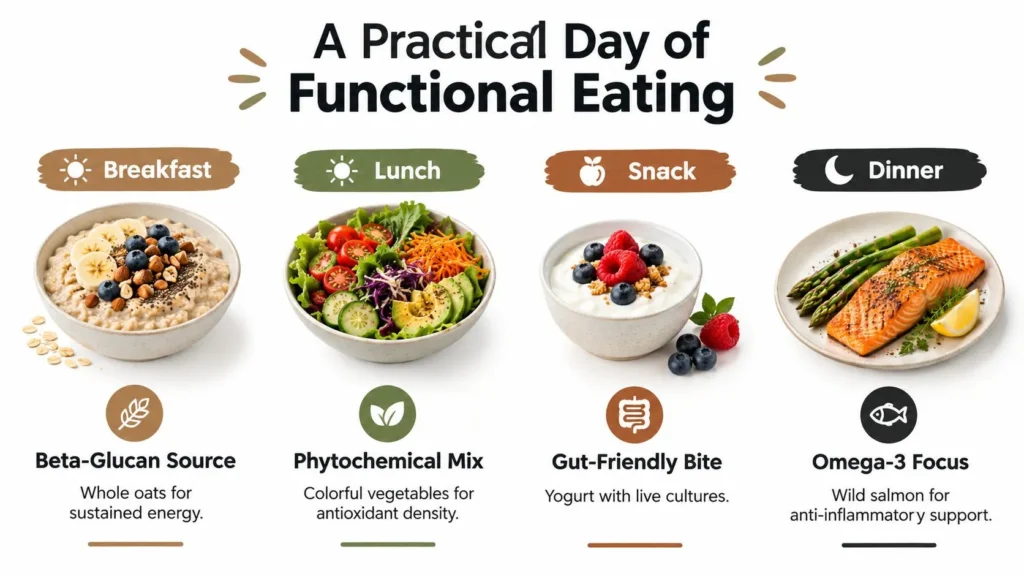
Lunch might be a lentil bowl with vegetables, olive oil, and fermented cabbage such as kimchi or sauerkraut. Lentils contribute fiber and plant compounds, while the fermented vegetables add flavor and may contain live organisms. Don’t assume that every fermented food delivers a clinically established probiotic effect, especially after processing or pasteurization.
For a snack, dark chocolate can be paired with nuts. If you’re choosing cocoa for a specific flavanol target, look for a product that reports the amount rather than relying on “dark” as a proxy. Nuts provide plant-based fats, but their presence doesn’t turn a snack into a treatment.
Dinner can center on oily fish, vegetables, and a whole-grain side. Fish supplies EPA and DHA, while cruciferous vegetables provide compounds such as sulforaphane precursors. The strongest practical principle is variety, not perfection.
On rushed or expensive days, use the fallback that preserves the basics: plain oats, beans or lentils, frozen berries, seasonal vegetables, and a modest portion of fish when available. Meal planning can make these choices easier, and these healthy meal prep ideas can help turn evidence-based ingredients into repeatable meals.
Where the Evidence Gets Thin
A promising mechanism isn’t the same as a reliable result at the dinner table. Laboratory studies may show that a compound affects a pathway, but digestion, cooking, storage, genetics, gut microbes, and medicines can change what reaches the body.
Bioavailability is one major weak point. Tomatoes illustrate the issue because preparation can affect lycopene absorption, while compounds such as curcumin may require the right meal context for better availability. A product can contain a named compound and still deliver less usable material than its marketing suggests.
Strain specificity creates a second problem. Evidence linked to Lactobacillus rhamnosus GG can’t automatically be transferred to every Lactobacillus product. The same organism may also behave differently in yogurt, fermented milk, cereal, or a supplement because processing and storage affect survival.
| Weak spot | Example | What to check |
|---|---|---|
| Bioavailability | Cooking and meal composition can alter absorption of plant compounds | Preparation, fat content, and measured human outcomes |
| Strain specificity | A result for one probiotic strain may not apply to another | Full species-and-strain name, not just “probiotic” |
| Dose translation | Trials may use concentrated extracts rather than ordinary portions | The tested dose and the food amount needed to reach it |
| Individual response | Genetics and gut microbiota can influence results | Trial population, baseline health, and consistency of findings |
How to read a functional food study
Start with the name of the active component. “Probiotic” identifies a category, not a complete intervention. “Fiber” also covers many different materials with different physical properties and outcomes.
Next, find the dose and duration. A study that uses a concentrated extract may not justify a claim about a normal serving of the whole food. Finally, ask whether researchers measured a clinically meaningful endpoint or only a short-term biomarker.
Read beyond the headline: A biological change may be interesting, but it doesn’t automatically translate into a benefit you can feel or a disease outcome you can prevent.
Recent reviews identify broader barriers, including food-matrix effects, processing conditions, interindividual genetics, gut microbiota differences, bioavailability, and food-drug interactions. They also highlight inconsistent standards for functional claims across the US, EU, Japan, and China. That uncertainty doesn’t make functional foods useless. It means the honest claim is often narrower than the label implies.
Cost Access and the Trust Gap
Functional foods can turn a basic grocery purchase into a premium one. A probiotic yogurt, enriched egg, fortified snack, or specialty beverage may cost substantially more than a conventional alternative, even when the underlying food is similar. A 2025 review reports that functional foods can cost three to five times more than conventional alternatives, creating a barrier for households already managing tight food budgets, as discussed in this review of functional foods, access, and affordability.
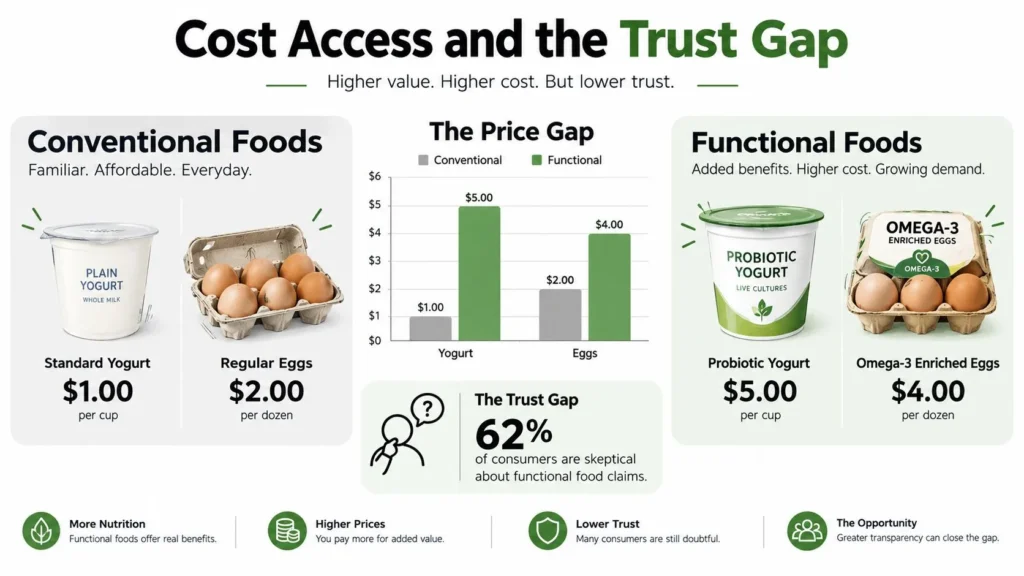
The price premium doesn’t always buy a stronger outcome. Sometimes it pays for packaging, convenience, branding, or a formulation that hasn’t been tested in the form you’re buying. A costly bar with several loosely defined benefits may be a weaker choice than inexpensive oats, beans, frozen vegetables, or plain yogurt.
Lower-cost ways to reach the same principles
- Choose ordinary fiber foods: Oats, lentils, beans, and vegetables can support fiber intake without requiring a premium “functional” label.
- Use frozen produce: Frozen berries and vegetables can make phytochemical-rich foods more accessible when fresh options are expensive or unavailable.
- Compare the active ingredient: Generic psyllium husk may offer a simpler route to soluble fiber than a heavily marketed bar, but follow the product directions and consider individual medical needs.
- Buy practical fish options: Canned sardines can be a convenient alternative when fresh oily fish is difficult to afford.
- Prioritize fortified staples selectively: A fortified food is most useful when it addresses a real dietary gap rather than adding another claim to an already adequate diet.
Access also depends on geography. Rural and lower-income neighborhoods may have fewer choices for fresh fish, fermented vegetables, or specialized fortified products. School food programs, nutrition assistance policies, and clearer standards could help direct resources toward foods with established nutritional value instead of shifting the burden entirely onto individual shoppers.
The trust gap grows when snack bars, drinks, and cereals use functional language without clearly stating the active amount or evidence level. Consumers don’t need to reject all packaged foods. They need labels that make comparison possible, and products whose claims match what researchers tested.
Regulation Research and What Comes Next
Functional food regulation differs because countries classify and authorize health claims through different systems. The United States generally separates disease claims from structure or function statements, while the European Union applies a formal scientific assessment process for authorized health claims. Japan’s FOSHU framework is associated with approved foods carrying specified health uses, which creates a different path for communicating benefits.
That means the same type of yogurt may carry a more specific authorized message in Japan than a comparable product can use in the United States. The difference isn’t necessarily a disagreement about biology. It reflects different legal categories, evidence standards, wording rules, and enforcement systems.
| Region | Regulator or framework | Claim type allowed | Evidence requirement | Example approved product |
|---|---|---|---|---|
| US | FDA | Nutrient content, health, or structure/function claims within applicable rules | Depends on claim type and regulatory pathway | Fortified or cultured food making a permitted claim |
| EU | EFSA and European Commission framework | Authorized nutrition and health claims | Scientific substantiation and authorized wording | Food using an approved nutrient or health claim |
| Japan | FOSHU framework | Specified health-use claims for approved products | Review and approval under the national system | Approved food carrying a specified health-use indication |
Consumers should also separate functional foods from concentrated products marketed as supplements. A clear discussion of dietary supplement safety can help with that distinction, especially when a product combines botanicals, nutrients, and pharmacologically active ingredients.
What stronger research should report
The next useful studies will make comparison easier. Look for:
- Registered trials: Researchers should define outcomes and methods before results are known.
- Reported doses: A label claim is easier to judge when the study states the exact amount and form used.
- Relevant endpoints: Changes in symptoms, disease risk, or validated clinical measures generally matter more than an isolated biomarker.
- Representative participants: Results are more useful when the trial population resembles the people who will buy the product.
- Food-specific testing: Evidence from a capsule or extract shouldn’t automatically be presented as evidence for a yogurt, bar, or beverage.
The future of functional foods may include more personalized nutrition, microbiome-targeted fibers, plant-based omega-3 products, and upcycled ingredients. Those areas are promising, but personalization also raises unanswered questions about testing, privacy, affordability, label accuracy, and post-market monitoring.
The most trustworthy product won’t necessarily have the longest ingredient list. It will identify the active component, explain the intended benefit, provide a meaningful amount, and avoid claiming more than the evidence supports.
maxijournal.com offers approachable writing across health, science, technology, and everyday life, with articles designed to make complex subjects easier to understand. Visit maxijournal.com for more practical explanations and independent perspectives on topics that affect your daily choices.
Discover more from Maxi Journal
Subscribe to get the latest posts sent to your email.