You’ve got friends arriving, someone has already asked what you’re playing, and the shelf offers far too many plausible answers. A highly rated strategy game may leave casual players staring at the rulebook, while a party classic can feel shallow to a group that wants meaningful decisions. The problem usually isn’t a lack of good games. It’s choosing a game that doesn’t match the people, time, and mood around the table.
Strong board game recommendations begin with the occasion, not the bestseller list. Player count, experience level, session length, cognitive load, and tolerance for competition all shape whether a title succeeds. Once those filters are clear, choosing becomes less like gambling on a popular box and more like matching the right tool to the job.
Why Board Game Selection Is Harder Than It Looks
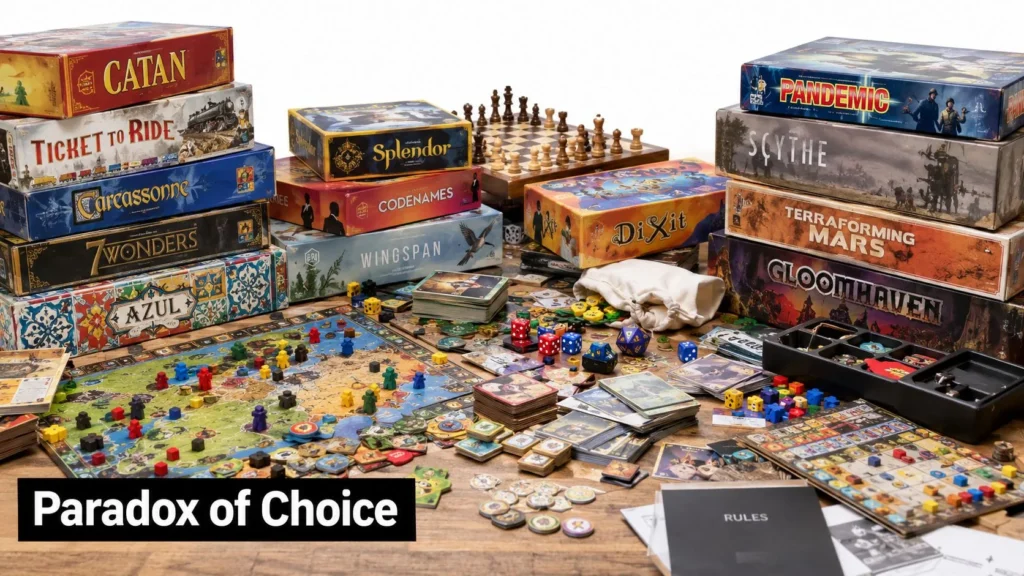
A typical game night can produce a familiar argument. One person wants a quick laugh, another wants a clever strategy challenge, and a third has never played anything more demanding than a mass-market family game. Someone suggests a famous title because “everyone loves it,” but popularity doesn’t tell you whether it works for this particular group.
The modern hobby offers an enormous range of themes, mechanisms, session styles, and learning curves. The market itself reflects that scale. One market analysis of modern board games valued the global market at USD 15.83 billion in 2025 and projected it to reach USD 39.52 billion by 2034, implying a 10.70% CAGR from 2026 through 2034. More choice gives players better options, but it also makes casual selection less reliable.
Popularity is not compatibility
A dedicated strategist may enjoy planning several turns ahead, comparing efficiency, and accepting a long explanation before the first move. A family group may prefer visible progress, simple choices, and rules that can be learned while playing. Neither group is wrong, but they’re asking the game to perform different social functions.
The same mismatch appears with competition. Direct conflict can create memorable tension for one group and uncomfortable pressure for another. Cooperative play can welcome new players, but experienced gamers may find a fully cooperative design less satisfying if one person naturally takes control of every decision.
Practical rule: Don’t ask which game is best. Ask which game is best for these people, on this evening, with this amount of time.
A useful first step is to write down the group’s actual circumstances before searching for titles. If you’re exploring the hobby for the first time, a practical gaming guide for beginners can help with basic vocabulary, but the central filter remains personal context. A title’s reputation matters less than whether its interaction, pace, and rules fit the table.
Four Pillars of Choosing the Right Game
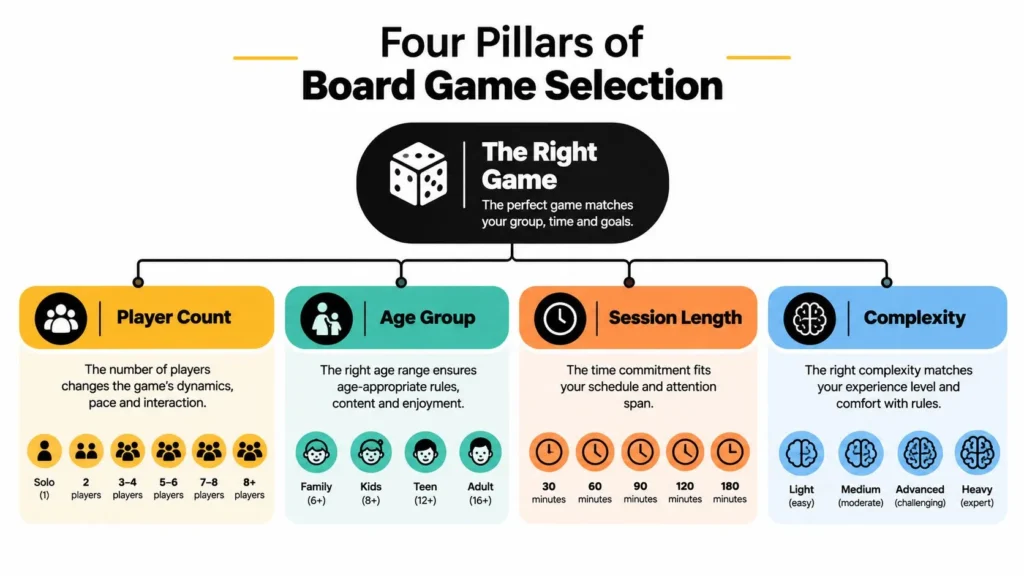
A reliable choice usually rests on four questions: Who is playing? How old and experienced are they? How long can they play? How much complexity do they want? Treat these as filters rather than optional preferences. A game that fails one major constraint can derail the evening even if it excels in every other area.
Player count sets the shape of the experience
Start with the number of people who will sit down, not the range printed on the box. A game that supports a broad range may feel sharp with a small group and sluggish with a larger one. More players can increase negotiation and laughter, but they can also create downtime, diluted decisions, or weaker interaction.
A practical guide to adult board games makes the important distinction that player-count fit can predict satisfaction better than the printed range. A game marked for 2–6 players may have a much narrower sweet spot, so choose for the count you expect to use most often and check how the game performs at that specific count.
Age means more than reading ability
Age recommendations help, but they don’t capture attention span, confidence, or tolerance for delayed rewards. A child who reads well may still dislike a game that asks them to hold several rules in mind. An older adult may enjoy strategic depth but prefer larger components, clear iconography, and fewer fiddly procedures.
Look for the group’s practical comfort level. Can players follow a multi-step turn without repeated reminders? Will anyone struggle with small text or visual clutter? Does the theme invite participation, or does it create distance?
Session length should match the occasion
A weeknight gathering often benefits from a game that reaches its conclusion before attention fades. A relaxed weekend can support a longer arc, especially if the group enjoys developing an engine, building a campaign, or revisiting a decision over several rounds.
Don’t treat the listed play time as a promise. Teaching, setup, player discussion, and unfamiliarity can all extend a session. If time is tight, choose something with a clean stopping point or a short core loop rather than a game that only feels satisfying after a long build-up.
Complexity controls the learning burden
Complexity isn’t the same as quality. It describes how much information players must absorb, remember, and evaluate. A light game can deliver suspense and clever choices, while a demanding game can collapse if the group isn’t ready to invest in learning it.
Use the group’s desired mental effort as the final filter. Some nights call for easy decisions and social energy. Others call for concentration and a slower pace. The right recommendation respects that difference instead of treating heavier rules as automatically more impressive.
The following video offers another visual way to think about selecting a game for the people around the table.
Curated Picks for Every Gaming Scenario
A useful recommendation should explain why a game fits, not just name a title. The picks below are starting points for common situations. Check the current edition, player requirements, and teaching burden before buying, especially when your group has a narrow schedule or a mixed level of experience.
| Scenario | Ideal Player Count | Target Complexity | Key Requirement |
|---|---|---|---|
| Two-player evening | 2 players | Light to medium | Strong decisions without excessive downtime |
| Mixed-age family night | Small group | Light | Clear turns and accessible rules |
| Party with unfamiliar guests | Larger group | Light | Fast onboarding and social interaction |
| Dedicated strategy session | Small group | Medium to heavy | Meaningful planning and patience for a teach |
For a focused two-player evening
Jaipur is a strong choice when you want a compact contest built around timing, risk, and set collection. Its decisions are easy to explain, but players still create tension by deciding when to sell, when to wait, and how much to expose to the opponent.
Patchwork works for couples who prefer a quieter puzzle. Each player builds a personal quilt, and the competition comes from taking valuable pieces before the other player can claim them. It has little direct confrontation, making it a better fit than an aggressive duel for players who want competition without constant attack.
For a more expansive session, 7 Wonders Duel rewards players who enjoy several paths to victory and a denser set of tactical choices. It asks more of the group than Jaipur or Patchwork, so it’s better when both players are comfortable reading a board state and planning ahead.
For a family with mixed experience
Ticket to Ride remains useful because its central action is immediately understandable. Players collect cards, claim routes, and pursue destination goals. The strategic layer grows as people learn when to commit, but a newcomer can participate without mastering a large system first.
Kingdomino is a good alternative for a shorter, more spatial experience. Each player builds a small terrain, and the scoring creates decisions without burying the table in rules. It’s particularly useful when the group wants a game that feels thoughtful but doesn’t demand a long explanation.
A cooperative option such as Forbidden Island can reduce the pressure on a player who dislikes losing publicly. Cooperation doesn’t guarantee a smooth game, though. Experienced players should avoid directing every move, or the newer participants may become passengers rather than decision-makers.
For a party with unfamiliar guests
Codenames suits groups that enjoy language, association, and conversation. It lets players contribute in different ways, and the team format can help strangers interact without requiring personal disclosure.
Just One is even easier to bring to a mixed gathering because players can understand the basic task quickly. Its appeal depends on the group enjoying wordplay and accepting that imperfect answers are part of the fun.
For more options beyond tabletop staples, this curated list of 10 best indoor group games is useful when you’re planning a broader indoor social event rather than a dedicated hobby night.
For a dedicated strategy session
Concordia rewards long-term planning without relying on direct combat. Players manage cards, trade, expand, and adapt their plans as the board changes. It’s a good fit for a group that wants depth but prefers restrained interaction.
Wingspan offers engine building with an inviting theme and a steadily developing personal tableau. Players still need to plan carefully, but the game gives them visible progress, which makes the learning process feel rewarding.
For a group looking to move from board games into a shared story, learning how to play Dungeons and Dragons may be a better direction than buying another competitive strategy box. Roleplaying demands a different kind of preparation, but it can provide the longer-form experience that some groups are really seeking.
Navigating Complexity and Weight Ratings
BoardGameGeek’s weight scale gives players a practical shorthand for cognitive demand. It runs from 1.0 to 5.0, with light games around 1.0–1.99, medium-light games at 2.0–2.49, medium games at 2.5–3.49, medium-heavy games at 3.5–3.99, and heavy games at 4.0–5.0, as described by a board game strategy and review resource.
These figures aren’t grades. A higher weight doesn’t mean a game is better, and a lighter weight doesn’t make a game disposable. The scale helps you predict how much teaching, planning, and mental stamina the table may need.

Read the weight as a warning about effort
A light title generally gives players a faster route from opening the box to making meaningful choices. That doesn’t mean the choices are empty. Games such as Azul and Kingdomino can feel approachable while still rewarding observation and timing.
Medium games often occupy the most useful middle ground for established groups. They can provide a sense of progression and strategic identity without requiring players to study the system before the first session. Wingspan and Cascadia are examples of games that offer more texture than a party game while remaining teachable in a social setting.
Heavy games demand more commitment. Players may need to understand multiple interacting systems, evaluate long-term consequences, and accept that early mistakes can affect the rest of the session. That can be exactly what experienced hobbyists want, but it’s a poor match for a group that has limited time or low patience for rules.
Use a three-question screening method
Before buying, ask what players need to know before their first meaningful turn. If the answer requires a long explanation, identify whether the group will enjoy that teaching process or merely tolerate it.
Then check whether the game’s depth comes from decisions your group likes. Some people enjoy economic planning, others prefer deduction, spatial puzzles, negotiation, or narrative choices. Finally, compare the estimated session length with the group’s available energy. A review source that focuses on strategic games commonly frames the experience around decision-making and sessions lasting 45 minutes to two hours, a useful illustration of the trade-off between depth, teachability, and time.
Better filter: Choose the heaviest game your group will happily learn, not the heaviest game you can technically finish.
The Rise of Accessibility and Modern Trends
A game can be strategically elegant and still fail at the table if the first play feels like homework. Accessibility now deserves the same attention as theme, mechanics, and replay value. Groups often need readable components, clear iconography, manageable setup, and rules that reveal themselves through action rather than a long lecture.
A recent guide to new board games in 2026 describes growing attention around accessibility and designs that teach rules through play. That approach matters for mixed-experience groups because it gives newcomers context at the moment they need it. Instead of memorizing every possibility before acting, players can learn from a controlled first round.
Campaigns change the buying question
Cooperative and legacy formats are also shifting what people expect from a purchase. Rather than asking whether a box is entertaining for one evening, players may ask whether it creates a continuing experience, develops a shared story, or gives the group a reason to return.
Market coverage from Mordor Intelligence on global board game formats identifies cooperative and legacy formats as forecast to grow fastest, while strategy and euro titles hold the largest share in its estimate. The practical lesson isn’t that every collection needs a campaign game. It’s that recommendations should account for players who want progression and immersion rather than a self-contained session.
Low friction does not mean low depth
A self-teaching game can still contain meaningful decisions. The best designs separate the rules players need immediately from the possibilities they can discover later. That structure lets a new group start confidently without removing the satisfaction of improving over repeated plays.
When comparing modern titles, look for learning aids, modular introductions, clear player aids, and setup that doesn’t require excessive sorting. These features are especially valuable for families, older adults, and hobby newcomers who may enjoy strategic thinking but dislike rulebook-heavy onboarding.
Your Checklist for a Successful Game Night
The final choice should take less time than the game itself. Before you open a box, confirm the group’s practical limits and emotional expectations. A title can be excellent in isolation and still be wrong for a tired weeknight, a noisy party, or a gathering where half the players are new.
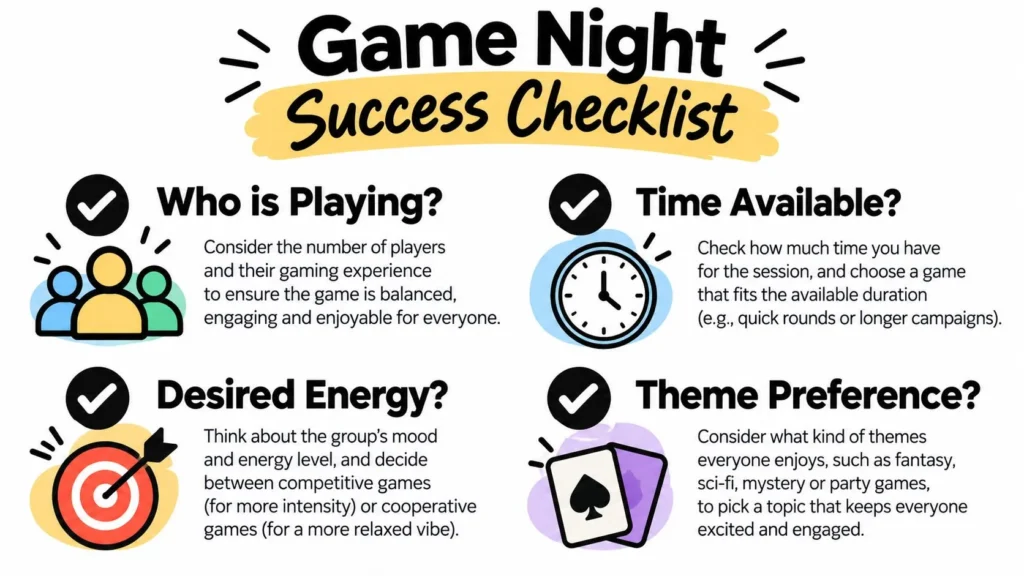
Run the table check
- Who is playing: Match the game to the actual number of participants and their experience, not the most flattering description on the box.
- How much time is available: Include setup, explanation, and the possibility that new players will need extra time.
- What energy does the group want: Choose competition for a spirited contest, cooperation for shared problem-solving, or a quieter puzzle when conversation matters more than confrontation.
- What theme will attract attention: A familiar subject can make learning easier, but don’t force a theme that leaves the group cold.
- What happens after the first play: Decide whether you want a complete one-evening experience or a campaign that asks everyone to return.
A quick pre-game conversation can prevent most mismatches. Ask whether people want something silly or serious, competitive or collaborative, quick or involved. If the answers conflict, choose the option with the lowest onboarding burden and the clearest stopping point.
For groups that specifically want a two-person roleplaying experience, these two-player RPG games offer another way to create a shared evening without relying on a conventional competitive board game.
The best game is the one your group wants to play again, not the one with the most impressive description.
Keep a short record after each session. Note the actual player count, how long setup and teaching took, which players stayed engaged, and whether the game felt too light or too demanding. Those observations will produce better board game recommendations for your household than any universal ranking.
maxijournal.com publishes approachable writing across gaming, entertainment, education, technology, and other everyday interests. Visit maxijournal.com to find fresh articles and practical ideas for your next game night.
Discover more from Maxi Journal
Subscribe to get the latest posts sent to your email.