A reader opens a poetry book, chooses one strip of paper for each line, and discovers that the poem changes with every arrangement. The author wrote the materials, but the reader completes the experience.
What Interactive Storytelling Really Means
Interactive storytelling gives an audience a role in shaping how a narrative unfolds, appears, or acquires meaning. In a conventional novel, the author fixes the sequence and the reader follows it. In an interactive story, the author still designs characters, settings, language, rules, and possible outcomes, but the reader or player also makes decisions, explores spaces, combines elements, or triggers events.
That doesn’t mean every story with a button is interactive storytelling. A video that pauses when someone clicks play has an interactive control, but the click doesn’t change the narrative. A game can also have rules without offering a meaningful story. The important question is: does the audience’s action affect the path, information, consequence, interpretation, or rhythm of the story?
Raymond Queneau’s Cent mille milliards de poèmes, published in 1961, offered readers ten options for each of fourteen lines, allowing them to generate one trillion different sonnets. Around the same period, Spacewar! became an early precursor of interactive video-game play. These works came from different traditions, yet both demonstrate the same principle: the audience does not just receive a finished sequence. The audience helps assemble the experience. The American Academy of Arts and Sciences discusses these literary and game roots.
Control moves from sequence to system
A useful working definition is this:
Interactive storytelling is narrative designed as a system of possible actions, relationships, and consequences that lets an audience participate in shaping the experience.
The word system matters. An author may write every branch in a choice-based drama, or may create rules that produce situations the author couldn’t predict in detail. In both cases, the creator establishes boundaries. The audience then explores those boundaries.
This creates a productive tension. The author controls the available materials and rules. The audience controls a pathway, combination, interpretation, or outcome. A branching novel distributes control through choices. An open-world game distributes it through movement and behaviour. An interactive theatre piece may distribute it through audience voting or physical movement. A web documentary may let readers decide which evidence to inspect first.
The result is recursive. The audience responds to the story, and the story responds to the audience. That response can be dramatic, such as a character dying because of a decision, or subtle, such as revealing information only after a reader investigates a location. Good design makes the response legible, so people understand that their actions mattered.
From Print Experiments to Digital Networks
A reader opening Julio Cortázar’s Hopscotch in 1963 could follow the chapters in a non-linear order. Six years later, B. S. Johnson’s The Unfortunates placed twenty-seven sections in a box, leaving the middle twenty-five available in different sequences. These books turned reading order into part of interpretation. The reader chose not only what to read next, but also how one event would frame another.
The same principle appears in Raymond Queneau’s experiments with interchangeable narrative units. Print made the reader’s hand part of the structure. Early computer stories shifted that participation into commands, movement, rules, and feedback. A reader became a player who learned the story by acting inside a designed environment.
A short historical sequence
Literary combination: Queneau made narrative variation a physical reading activity, while Cortázar and Johnson used sequence and arrangement to challenge the fixed path of the novel.
Computational experimentation: Early games translated participation into typed commands, movement through connected spaces, rules, and responses. The player discovered the story through actions rather than through a fixed sequence alone.
Commercial interactive fiction: The commercial era is often divided into university and precursor experiments from 1972 to 1981, a boom from 1982 to 1986, a nostalgia and transition period from 1987 to 1991, and an Internet-centered community phase from 1992 to 1999. A historical overview of interactive fiction outlines these phases.
During the 1982 to 1986 golden age of text adventures, approximately 1,000 adventure games were published. Around two-thirds combined text with graphics, often showing a picture beside each room description. The format already extended beyond a parser responding to typed instructions. Players explored connected spaces, solved puzzles, and uncovered consequences through action.
Why the form survived
Graphical games later became the centre of the commercial market, yet interactive fiction continued through online communities and competitions. Its survival showed that interactive storytelling is not tied to one device. A story can operate in a printed book, a command-line interface, a browser, a game console, or a shared community platform.
Its conventions still guide creators. Exploration controls the pace at which information appears. Commands give the audience a way to express intention. Consequences make discovery feel earned rather than handed over.
Web stories, role-playing games, location-based narratives, and immersive installations adapt these older ideas to newer interfaces. For creators, the practical questions remain stable: What actions are available? What changes after each action? Which story elements should remain fixed, and which should respond? Those answers connect literary experimentation with game design, while also shaping later decisions about access, automation, and evaluation.
The Main Forms of Interactive Storytelling
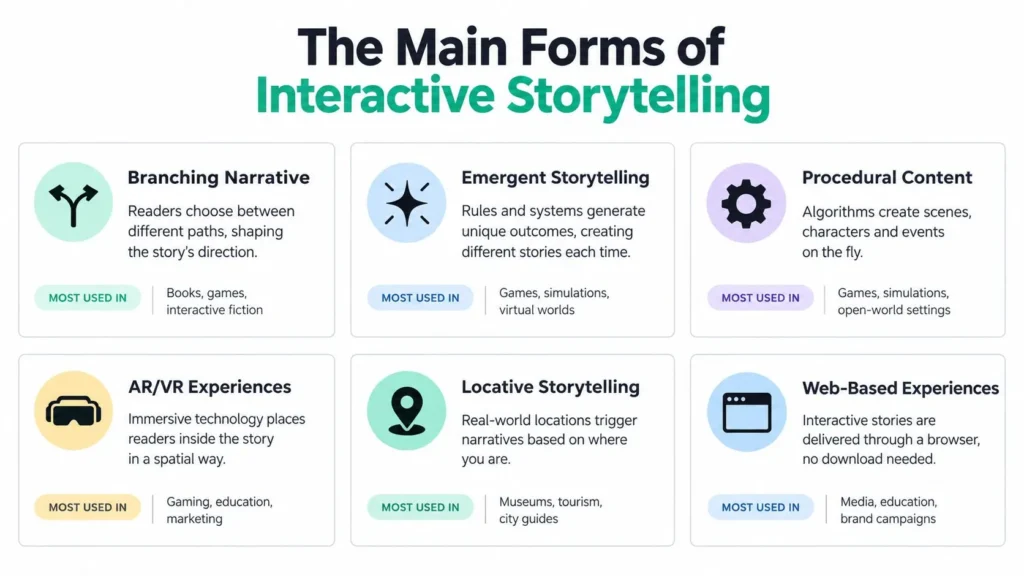
A clear taxonomy helps creators choose a structure before they choose software. The six forms below overlap, but each gives the audience a different kind of control.
Branching narrative presents authored paths. The audience chooses between options, and the story follows a selected route. This suits interactive fiction, narrative games, educational scenarios, and decision-based films. Its strength is dramatic consequence. Its challenge is managing branches without making every path feel shallow.
Emergent storytelling comes from interactions among systems, characters, rules, and player behaviour. The creator designs the conditions, but the exact sequence develops during play. Simulation games and role-playing sandboxes often use this model. The audience controls behaviour more than a menu of prewritten decisions.
Procedural content uses algorithms to generate scenes, environments, dialogue, or events. It can provide variety and replayability, but generated variation isn’t automatically meaningful. A procedural system needs constraints that protect tone, continuity, and purpose.
AR and VR experiences place narrative information in an embodied or spatial environment. The audience may look around, move, manipulate objects, or follow a virtual guide. These forms can make perspective and presence central to the story, but they require careful attention to comfort and access.
Locative storytelling connects narrative events to physical places. A phone might reveal a character’s message near a building, or a walking route might become the structure of a historical account. Location becomes both setting and interface.
Web-based experiences deliver interactive narratives through browsers. They can combine text, animation, maps, audio, video, data, and user choices without requiring a dedicated game installation. They’re especially useful for journalism, education, archives, and public-facing campaigns.
| Form | Reader Control | Best Platforms |
|---|---|---|
| Branching narrative | Selects authored paths and consequences | Interactive fiction, games, web |
| Emergent storytelling | Acts within systems that produce outcomes | Simulation and role-playing games |
| Procedural content | Explores algorithmically generated material | Games, generative installations |
| AR and VR | Moves through spatial narrative environments | Headsets, phones, immersive exhibits |
| Locative storytelling | Encounters narrative through place | Mobile apps, walking tours |
| Web-based experiences | Chooses what to open, watch, read, or investigate | Browsers, news sites, education |
Match the form to the promise
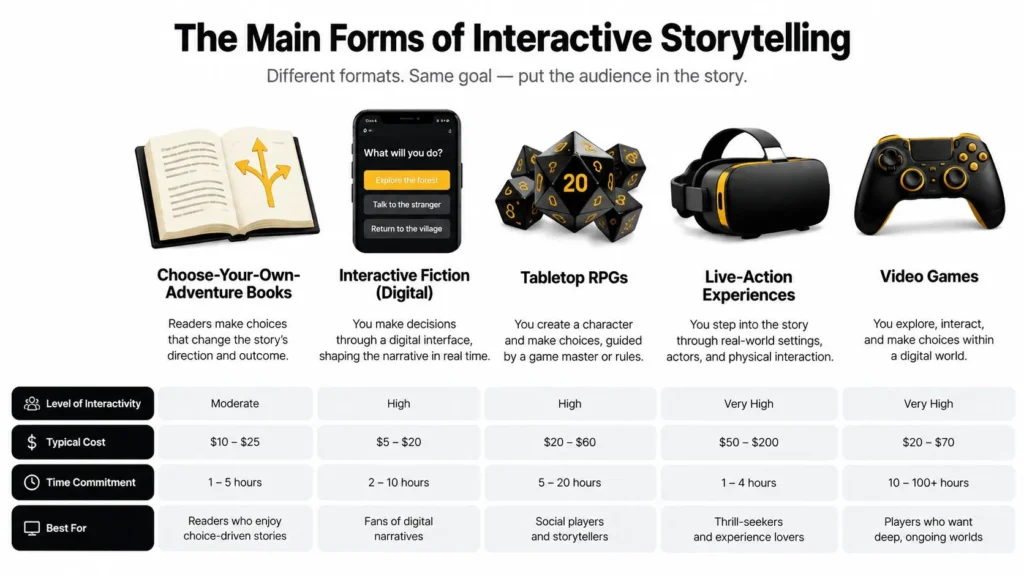
If your story depends on a difficult moral decision, branching narrative may be the clearest choice. If it depends on the audience creating a unique chain of events, emergent systems may fit better. If place is inseparable from memory or history, locative design can make geography meaningful rather than decorative.
Creators working with games can also study branching narrative techniques that work to compare choice structures, consequence design, and pacing. For educators and game groups, interactive decision-making can also be explored through activities such as how to play Dungeons & Dragons, where participants build narrative outcomes through shared rules and improvisation.
The distinction isn’t rigid. A browser documentary can include branching paths and procedural visualisation. An AR experience can use authored choices while also responding to location. Start by identifying the audience’s main action, then select the form that makes that action narratively valuable.
Core Mechanics and Narrative Design Patterns
A story becomes interactive through mechanics that connect action, response, and meaning. The interface may be simple, but the design underneath must answer several practical questions: What can the audience do? What does the system remember? How soon does it respond? Does the response alter the story or only decorate it?

Cosmetic and structural choices
A cosmetic choice changes presentation without changing the underlying situation. The player chooses a friendly or sarcastic line, but the conversation reaches the same conclusion. Cosmetic choices can establish personality and rhythm, so they aren’t useless. They become disappointing when the interface promises a consequence that never arrives.
A structural choice changes a relationship, resource, piece of knowledge, route, or future possibility. Suppose a character asks whether the protagonist will share a secret. A cosmetic version changes the next line of dialogue. A structural version changes whether that character provides help later, appears in a later scene, or trusts the protagonist during a crisis.
Good branching usually follows a pattern:
- Offer a legible decision: The audience should understand what kind of action they’re taking, even if the result remains uncertain.
- Record the consequence: The system should track a relationship, fact, location, object, or unresolved promise.
- Return the consequence later: The story should make the earlier decision visible through dialogue, access, conflict, or changed context.
- Preserve interpretation: The creator can show an outcome without telling the audience exactly how to judge it.
State tracking is the hidden craft behind this pattern. A writer might maintain a relationship state, an evidence state, and a location state. A developer might represent those conditions as variables. The medium differs, but the authoring question is the same: what does the story need to remember?
Testing reversibility
Rewind systems offer a useful design lesson. A controlled mixed-methods study tested three interactive-story versions with 60 participants, one without rewind and two with different rewind mechanics. It found no significant differences among the versions in perceived game engagement, narrative engagement, or narrative transportation, while both rewind implementations received positive feedback. The study’s abstract reports the comparison and its findings.
That result doesn’t prove that rewind always improves an experience. It suggests that reversibility can support experimentation without automatically destroying immersion. Designers should still ask what rewind means inside the fiction. Is it a convenient player tool, a time-travel ability, or a private rehearsal that the character never remembers?
Pacing and feedback
Interactive pacing differs from page-turning because the audience may pause, investigate, repeat, or ignore content. Give each action a useful response. A sound, changed line of dialogue, newly available route, or visible consequence can confirm that the system understood the user.
Practical rule: If an action matters, show its effect. If it doesn’t matter, don’t frame it as a major choice.
Transportation also needs careful handling. A story can pull someone into a character’s situation while still reminding them that they’re operating a system. That awareness isn’t necessarily a flaw. The goal is not to hide every mechanism. The goal is to make the mechanism support attention, curiosity, and emotional understanding.
Case Studies Across Books, Games, Web, and AR
A useful way to study interactive storytelling is to ask what each project makes the audience do. Different works may use the same label while offering very different forms of participation.
A branching book turns reading order into a narrative action. The reader may choose a route through numbered sections, return to an earlier decision, or discover that a seemingly minor choice changes the ending. The design challenge is consequence without confusion. Readers need enough orientation to act deliberately, but not so much explanation that uncertainty disappears.
A narrative game can make choice more physical. The player may explore a room, decide whom to protect, or spend a limited resource. The story then communicates through the world, not only through dialogue. A locked door can be a plot condition, a moral reminder, or evidence that the player overlooked something.

Web and location as narrative interfaces
An interactive documentary may let readers choose which testimony, map layer, timeline, or piece of evidence to open. The audience becomes an investigator. That structure works best when each choice answers one question and creates another, rather than scattering unrelated media across a page.
A locative or AR piece changes the meaning of movement. A street, museum, classroom, or park can become a sequence of narrative triggers. Creators should make the physical route safe and understandable, while offering a non-location alternative for people who can’t visit the site. Readers new to the medium can review what augmented reality is before planning a location-based project.
Brands also use interactive narrative to turn passive attention into exploration. A useful collection of interactive narrative examples for brands can help teams compare guided journeys, product discovery, and audience participation without assuming that every campaign needs a game.
What data stories reveal
An experimental comparison examined an interactive, game-based data story alongside a non-interactive video version. Participants in the interactive condition reported higher emotional-engagement scores across all seven measured dimensions, with the largest differences associated with discovery, perceived control, captivation, and exploration. The published study describes the interactive and video conditions.
The finding supports a practical principle: structured choices and visible feedback can make information feel like something the audience investigates. It doesn’t mean that interaction automatically makes evidence more trustworthy. The same research found that perceived trustworthiness improved more unevenly, so transparent sourcing and clear editorial framing remain essential.
Authoring Tools and Tips for Creators and Educators
Choose an authoring tool according to the story’s main verb. If the audience will read and choose, start with a text-first engine. If they’ll explore nodes, use a visual branching tool. If they’ll move through space or media, choose a web, game, or AR platform that supports the required inputs.
Text-first tools such as Twine suit writers, teachers, and beginners who want to prototype passages, variables, and links quickly. Ink supports more complex interactive fiction with a strong writing workflow. Visual tools such as Ink-based integrations, Yarn Spinner, or game engines with dialogue systems suit teams that need to connect narrative states to characters, objects, and scenes. Web tools and AR platforms work better when the experience depends on maps, media layers, responsive layouts, or physical context.
A creator’s small prototype
- Write one dramatic question: For example, “Will the witness share what they know?”
- Create two meaningful options: Make each choice reveal a different value or risk.
- Track one state: Use trust, evidence, access, or time. Don’t begin with a complicated matrix.
- Show the result: Return to the earlier decision through a later line, route, or changed relationship.
- Test with a small group: Ask users what they thought their choice would do, what they expected afterward, and where they felt lost.
The education technology tools guide can help teachers compare digital options, but the learning goal should come first. A tool can make branching easy while still producing a weak lesson.
Classroom applications
Teachers can ask students to map a linear scene into two possible routes, then defend which consequences feel fair. In literature classes, students can compare how a changed reading order affects interpretation. In history or science, learners can make a source-based scenario where each decision must refer to evidence.
Use reflection as part of the activity. Students should explain not only what they chose, but what information they used, what the system remembered, and how revision could improve the experience. That turns interactive storytelling into a lesson in structure, empathy, systems thinking, and audience design.
Where Interactive Storytelling Falls Short
More immersion doesn’t automatically produce better storytelling. It can produce a richer experience for one audience while making the story harder or impossible to use for another.
Recent research identifies screen-reader incompatibility, complex interfaces, motion-heavy controls, hardware cost, and motion sickness as barriers to interactive experiences. It also reports that only about 63% of the world’s population was online in 2024, which means immersive digital storytelling remains structurally unavailable to billions of people. The research discusses access, disability barriers, and global connectivity.
Design for equivalent agency
Accessibility isn’t a final compatibility check. It changes the interaction model from the beginning.
- Keyboard access: Every important action should work without a mouse or complex gesture.
- Audio and text alternatives: Provide captions, transcripts, audio description, and meaningful labels.
- Reduced motion: Let users disable camera movement, visual effects, and motion-heavy transitions.
- Alternative input: Support touch, keyboard, switch access, or other suitable controls where possible.
- Low-bandwidth delivery: Keep the core narrative usable when large media files or fast connections aren’t available.
- Mobile-first layouts: Make text, controls, and feedback readable on smaller screens.
The strongest accessibility solution preserves agency rather than merely providing a summary. If one audience gets to investigate, choose, and discover while another receives a static transcript, the experiences aren’t equivalent. Offer different routes to the same meaningful narrative actions.
Generative AI needs boundaries
Generative AI can produce novelty, but novelty isn’t the same as narrative quality. A long story needs continuity, authorial intent, cultural sensitivity, and choices that feel consequential. Without those constraints, an AI system may improvise a surprising scene while contradicting an earlier fact or weakening the user’s control.
Creators should distinguish cosmetic personalization from structural agency. Changing a character’s name or descriptive details is personalization. Letting the audience choose a value that changes relationships, evidence, or outcomes is agency.
Practical safeguards include human review, explicit state tracking, consent around personal data, cultural review, and clear disclosure when audiences interact with generated material. Use AI where variation serves the story, not where the creator has avoided making a necessary design decision.
Measuring Impact and Looking Ahead
A successful interactive story needs more than completion data. Measure the experience in separate parts:
- System engagement: Can users operate the interface and understand available actions?
- Story engagement: Do they care about characters, questions, and consequences?
- Narrative transportation: Do they feel absorbed in the situation while still navigating the system?
- Trust: Do they understand what is factual, generated, simulated, or authored?
Use a short post-experience survey, then conduct think-aloud sessions with people from the intended audience. Ask where they expected a consequence, which choice felt meaningful, and what they believed the system had remembered. Compare those answers with observed behaviour instead of treating one general “immersion” score as the whole evaluation.
AI storytelling research is moving across literature, education, games, film, and multimodal systems. A 2025 scoping review of 44 peer-reviewed publications from 2020 to 2025 identified recurring concerns including narrative inconsistency, limited user control, and unresolved authorship and agency questions. The review examines these research areas and limitations.
The medium’s future will depend less on adding interaction everywhere and more on choosing interaction carefully. Build stories that remember responsibly, include different bodies and devices, and make audience actions matter for reasons the audience can understand.
maxijournal.com offers approachable writing across technology, games, education, arts, and related subjects, making it a useful place to continue exploring how stories and digital experiences shape one another. Visit maxijournal.com to discover fresh articles and practical commentary for curious readers and creators.
Discover more from Maxi Journal
Subscribe to get the latest posts sent to your email.