You open a streaming app looking for something loud, new, and slightly unpredictable. Instead, you get the same familiar recommendations, separated into broad genre labels that tell you very little about the actual music. Current punk has split into comedy, political post-punk, math-punk, synth-led experimentation, bedroom introspection, and polished pop-punk. That variety is useful, but it makes the starting point less obvious.
This guide takes a direct route through eight new rock punk bands and adjacent artists, with one entry track, one deeper cut, and one suggested first album for each. Some are genuinely punk in their attack. Others borrow punk’s refusal to stay inside a fixed format. That distinction matters. Punk has always developed through local scenes adapting a shared language, rather than following one centralized model, a pattern visible from its international emergence in the United States, the United Kingdom, Australia, France, Switzerland, the Netherlands, and Scandinavia during the late 1970s (Britannica’s history of The Clash).
If you make music yourself, visual presentation is part of that discovery process. You can browse AI rock video generators for ideas before releasing your own clips. For listeners, the simplest approach is to start with one track and follow the route that feels most natural.
1. Wet Leg and Post-Punk Humor

Wet Leg understand that a joke can carry a song further than a slogan. Rhian Teasdale and Hester Chambers built their sound around clipped guitar lines, blunt observations, and an intentionally awkward sense of timing. The music feels casual on the surface. Underneath, the band writes about boredom, desire, social performance, and the strange rituals of modern life.
Start with “Chaise Longue.” It gives you the full entry point: a repetitive post-punk groove, a vocal delivery that refuses to oversell the punchlines, and a chorus that stays in your head because it sounds almost too simple. The track works as comedy, but it also captures the band’s main skill. Wet Leg can make discomfort danceable without turning every lyric into a thesis.
The listening route
- Entry track: “Chaise Longue,” for the deadpan hook and immediate rhythm.
- Deeper cut: “Too Late Now,” where the humor gives way to sharper emotional detail.
- First album: Wet Leg, a concise introduction to their balance of wit, guitar pop, and post-punk repetition.
Their limitation is also part of their appeal. The conversational style can feel slight if you expect every song to build toward a dramatic emotional release. Wet Leg often prefer the sideways glance to the grand statement. That works best when you listen for the tension between an apparently silly line and the anxious situation around it.
For readers tracking newer artists beyond the obvious playlist cycle, Maxi Journal’s guide to up-and-coming music artists offers a useful place to continue. Wet Leg are a good first stop because they show how comedy can be a serious punk technique, not a break from seriousness.
Practical rule: If the joke lands before the beat does, listen again. Wet Leg often hide the sharper observation inside the laugh.
2. IDLES and Political Post-Punk

IDLES make music that wants physical space. The Bristol band’s songs are built from pounding drums, heavy bass, rough guitar textures, and Joe Talbot’s forceful delivery. Their politics are direct, but the best tracks don’t depend on knowing every reference. They work because the band turns solidarity into a rhythmic experience.
Begin with “Danny Nedelko.” It’s an accessible introduction to the group’s belief that an anthem can be both confrontational and generous. The track’s momentum comes from repetition, collective vocals, and a chorus designed for a crowded room. It’s less interested in subtlety than in making participation unavoidable.
What works, and what doesn’t
IDLES are strongest when the message and the arrangement push in the same direction. “Never Fight a Man with a Perm” uses blunt satire and a hard-driving structure to make its target easy to recognize. The band’s live attack also gives the songs a purpose beyond private listening. They’re made to be shouted back.
The weaker moments arrive when the rhetoric becomes more predictable than the music. A listener who wants ambiguity may find some lyrics too plainly stated. That isn’t a flaw in every context, but it means the records reward physical engagement more than detached analysis.
- Entry track: “Danny Nedelko,” for the communal, politically charged chorus.
- Deeper cut: “June,” for a more vulnerable and spacious side of the band.
- First album: Joy as an Act of Resistance., the clearest starting point for their combination of aggression and social purpose.
Rock’s commercial scale doesn’t guarantee exposure for individual artists. U.S. rock generated approximately 260.5 billion streams in 2025, ranking second among broad genres in the cited year-end analysis, while rock was also identified as the fastest-growing major streaming genre in that analysis (year-end streaming report from A Journal of Musical Things). For a band like IDLES, the lesson is practical. Broad genre demand helps, but a distinct live identity gives listeners a reason to move from a stream to a room.
More recommendations are available in this selection of the best new rock bands, but IDLES remain the useful reference point for listeners who want punk with an explicit public argument.
3. Purity Ring and Dream Punk Synth-Rock
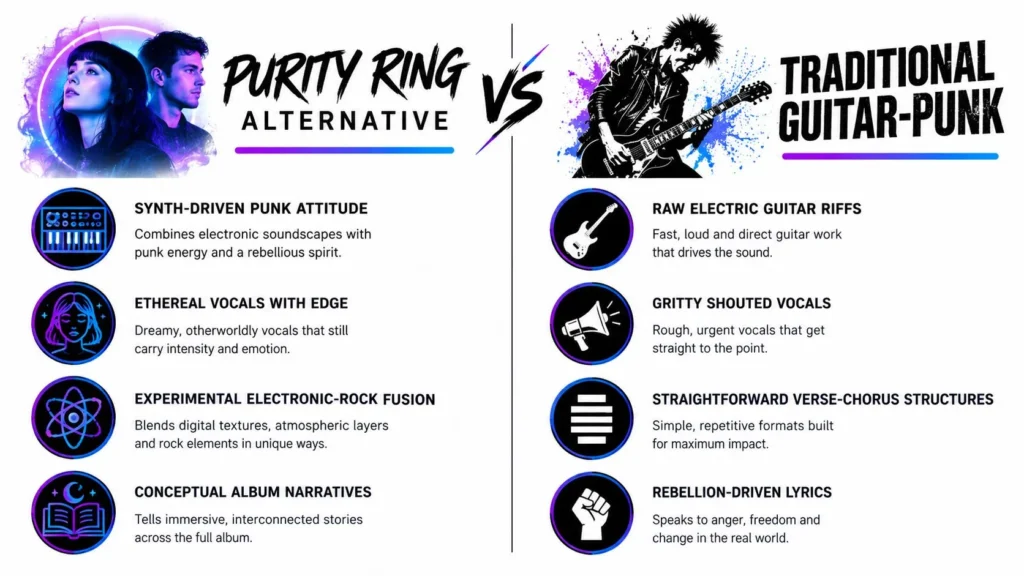
Late at night, after a run of wiry post-punk records, Purity Ring make immediate sense. They keep the tension and abrasion, but shift it into synths, sub-bass, and percussion that hits with the force of punk without borrowing its usual guitar shape. Megan James sings in a voice that can sound intimate, removed, or suddenly threatened. Corin Roddick builds around that with sharp electronic detail and distortion used in short, exact bursts.
The easiest way in is “Fineshrine.” It gives you the core idea fast. The drums feel physical. The vocal floats above them rather than locking into the beat. That split is what makes the song work. You hear dream-pop softness on the surface, but the track keeps pressing underneath.
For a deeper cut, go to “Lofticries.” It is less immediate and more revealing. The percussion sounds pieced together from hard edges and gaps. Vocal fragments drift in and out of focus. I keep returning to it because the arrangement never settles. The instability carries the emotion more than any big chorus could.
Start with Shrines. It remains the clearest first album because it establishes the project’s language in a compact form. The low end is synthetic and heavy. The melodies are memorable, but never too neat. The phrasing can feel strange on first listen, then natural once your ear adjusts. If comedy post-punk and math-punk get their force from attack and disruption, Purity Ring reach a similar end through control, atmosphere, and pressure.
That also explains the trade-off. Purity Ring rarely offer the group-release feeling you get from a shouted refrain in guitar-punk. The songs draw you inward instead. Some listeners will hear distance there. Others will hear precision. Both reactions are fair.
Use this route if you want punk attitude expressed through sound design rather than band-room impact.
- Entry track: “Fineshrine,” for the cleanest introduction to their synth-punk atmosphere.
- Deeper cut: “Lofticries,” for more fractured production and darker momentum.
- First album: Shrines, the strongest starting point for their electronic framework.
A visual comparison between Purity Ring’s electronic approach and traditional guitar punk can help clarify why the project belongs in this route.
4. Squid and Angular Math-Punk
Put Squid on when you can give them the room. A walk helps. So does a train ride with headphones on. Their records reward active listening because the tension sits in the arrangement itself. The drums keep shifting the center of gravity, the guitars grind against the groove, and the songs stretch without losing their pulse.
Start with “Narrator.” It is still the clearest entry point, but not because it sums up every side of the band in a neat package. It works because it teaches you how to hear them. The track begins with repetition, then keeps tightening the screws. By the time the vocal starts to fray, the whole song feels like an argument about control and point of view. Squid do this well. They make structure feel emotional.
If you want the more physical side of the band, go to “G.S.K.” first on your second pass. It drives harder and gets to the point faster, yet the band keep disturbing that momentum with clipped guitar lines and sudden turns. Their math-punk streak matters here. The complexity has a job. It stops the rhythm from settling into comfort and keeps your ear on the interaction between parts.
Bright Green Field is the first album to choose. It gives the best sense of how Squid balance movement, repetition, and scale. Some tracks feel almost cinematic in how they open up, but the playing stays wiry and tense. That friction is the appeal.
The trade-off is easy to hear. Squid do not always give you a chorus or vocal line to hold onto right away. A few passages ask for patience, and not every listener will want to work for the payoff. I think that is fair. When the band are locked in, the songs feel less like singles and more like living systems.
Use this route if comedy post-punk feels too loose and synth-punk feels too controlled.
- Entry track: “Narrator,” for escalation, repetition, and unstable perspective.
- Deeper cut: “G.S.K.,” for sharper rhythmic attack and interruption.
- First album: Bright Green Field, for the strongest introduction to Squid’s angular design.
5. Black Midi and Chaotic Noise-Rock
A Black Midi song can feel like the room has tilted a few degrees and nobody in the band wants to fix it. That tension is the point. For listeners who want punk to stay abrasive, unstable, and a little hostile, they offer a clear route in.
If you want the band at their most confrontational, queue up “Bmbmbm” first. It works through repetition, clipped bass movement, and a vocal that gets stranger each time it returns. The hook is less a melody than a pressure tactic. Black Midi understand how far a simple idea can go when the rhythm section refuses to relax around it.
Then switch to “John L.” That track opens the frame. The playing is denser, the vocal is more theatrical, and the song keeps threatening to split apart without ever losing control. What stands out is how the band use technical skill. They do not present it as clean precision or easy flash. They make it feel dangerous, which is much harder.
For a first full record, pick Schlagenheim. It is the most direct entry because the aggression stays close to the surface, even when the arrangements turn jagged. Cavalcade is the next move if you want more composition, more character voices, and more dramatic shape, but Schlagenheim gives the sharper introduction to what makes them distinct in this field.
There is a trade-off. Black Midi can push so hard toward disruption that the songs register as exercises in tension before they register as songs you want to replay. Some listeners will hear the wordless stretches and rhythmic feints as thrilling. Others will hear distance. I get both reactions.
That friction is also why they belong here. Comedy post-punk, math-punk, and synth-punk each give you a different entry into current guitar music. Black Midi cover the end of the spectrum where noise-rock turns technical and technique turns unnerving.
- Entry track: “Bmbmbm,” for repetition, provocation, and controlled discomfort.
- Deeper cut: “John L.,” for theatrical chaos and unstable ensemble movement.
- First album: Schlagenheim, for the rawest first contact with Black Midi’s attack.
A difficult record can still feel immediate. Black Midi make difficulty part of the impact.
6. The Japanese House and Indie-Punk Introspection
The Japanese House fits this list if you care less about volume and more about exposure. Amber Bain works with electronic indie pop, layered vocals, and careful production, yet the core impulse still connects with punk. The songs stay close to doubt. They do not rush to resolve it.
The gentlest way in is “Saw You in a Dream.” It moves in slow circles, with soft synths and stacked vocals that keep feeling just out of reach. That distance is the point. Instead of pushing toward release, the song lets repetition build tension, and the tension comes from what Bain will not over-explain.
That makes The Japanese House useful as a side route in this article, not a strict genre match. If IDLES turn conflict outward and Squid make anxiety sound jagged, Bain keeps the pressure internal. I hear the appeal most clearly when the arrangement leaves room for hesitation, a pause in the vocal, a slight shift in texture, a line that lands because it sounds half-certain.
For the next step, play “Maybe You’re the Reason.” It is brighter and more immediate, but it does not abandon the uncertainty that gives the project its weight. Bain writes about relationships and self-perception with enough detail to feel personal, while the production avoids clutter. Small changes matter here. A vocal layer entering late or a synth line thinning out can change the emotional temperature of the whole song.
Good at Falling is the right first album. It gives the clearest picture of the project’s strengths: intimate writing, electronic detail, and a guitar-rooted sense of atmosphere. It also shows the trade-off. The record rarely delivers the bodily jolt that a loud punk band gets from impact alone.
That is not a flaw unless you want a different function from the music. These songs gather force gradually. Put the album on after a difficult conversation, when you can hear the restraint in it. If you need speed, distortion, and a room-moving chorus, start elsewhere. If you want to hear how bedroom introspection can carry punk’s honesty into modern indie production, start here.
- Entry track: “Saw You in a Dream,” for suspended feeling and emotional distance.
- Deeper cut: “Maybe You’re the Reason,” for a clearer hook with the same uncertainty underneath.
- First album: Good at Falling, for the most accessible entry into The Japanese House’s sound.
7. Fontaines D.C. and Literary Post-Punk

A Fontaines D.C. song usually hits in two ways at once. First, the band locks into a hard, repetitive pulse. Then Grian Chatten starts singing like he is reciting something half-remembered, half-defended. That combination gives them their own lane. They sound literary, but they still sound like a band that understands what a riff is supposed to do in a room.
If you want the cleanest way in, play “Boys in the Better Land.” It gives you the band’s basic method without making you work too hard for it. The groove is direct, the guitar pattern keeps pushing forward, and the chorus opens just enough to suggest escape while the lyric keeps its doubts intact. You get movement first. Then the unease starts to register.
After that, switch to “I Love You.” Do it when you can follow the words. The tempo is slower, the phrasing is heavier, and the tension comes from how long the band is willing to sit inside the weight of the song. Fontaines D.C. are strongest when the political writing stays attached to lived detail. National identity, family pressure, housing, memory. They handle those subjects well because they write them as pressure on a person, not as slogans.
Start with Dogrel. It is still the best first album because it lays out the early version of the band in the clearest terms: clipped guitars, local detail, strong spoken-sung cadences, and a constant sense that the songs are observing the city from inside it. Later records widen the sound and soften some edges. Dogrel is more useful as a first encounter because the intent is plain.
There is a trade-off. Fontaines D.C. can get heavy in a way that narrows the emotional range, and Chatten’s delivery can feel withholding if you want warmth right away. I would still start here, because that distance is part of the design. Listen for how the voice works against the drums and guitars, not above them.
For readers who want more bands in a related lane, this indie music bands list is a reasonable next stop. Fontaines D.C. matter because they prove post-punk can function as both a live physical language and a serious literary form.
8. Pale Waves and Pop-Punk Visibility
Pale Waves sit at the most openly melodic end of this list. Put them on after Fontaines D.C. and the shift is immediate. The hooks arrive faster, the feelings are stated plainly, and Heather Baron-Gracie leads the band with a style built for connection rather than distance. That change in tone matters. It shows how a newer punk-adjacent band can use pop structure without giving up identity, relationships, or the search for community as core subjects.
For the fastest way into the band, play “There’s a Honey.” first. It still captures an early strength better than almost anything else they released. The song keeps one foot in atmosphere and one in pop urgency, so you hear the tension that made the band stand out early on. Baron-Gracie’s vocal stays intimate. The chorus opens the track up without flattening the mood.
Then try “She’s My Religion.” That is the better deeper cut because it shows what Pale Waves do best when the writing stays concrete. The song is romantic, clear, and centered on a strong image instead of a vague mood. I keep coming back to it because it proves the band does not need to complicate the language to make the feeling land.
Start with My Mind Makes Noises. It remains the cleanest entry point because it lays out the first version of the band in full. Glossy production, vulnerable lyrics, sharp melodic instincts, and queer experience treated as the center of the songs rather than background detail. If that record works for you, Who Am I? makes sense next. It pushes harder toward pop-punk and makes the shift plain.
The trade-off is easy to hear. Pale Waves can sound too polished for listeners who want abrasion, mess, or the sense of physical risk that older punk records often carry. Some of the production choices also pull the songs toward familiar pop-rock habits, which can blur what makes them distinct. Even so, the band has a clear value. They brought self-expression and inclusion into a mainstream pop-punk form and made that choice sound natural, not defensive.
A simple route works best here: “There’s a Honey” first, “She’s My Religion” next, then My Mind Makes Noises front to back.
8-Band New Punk Rock Comparison
| Artist | Style | Implementation complexity | Resource requirements | Ideal use cases | Expected outcomes & key advantages |
|---|---|---|---|---|---|
| Wet Leg | Witty post-punk with minimalist instrumentation and deadpan humor | Low–Medium, straightforward rhythms, sparse production | Duo setup, DIY recording, modest live rig | Viral singles, indie radio, Gen Z-oriented playlists, social commentary features | Highly memorable lyrics, mainstream accessibility, quick virality and cultural relevance |
| IDLES | Aggressive, politically charged post-punk with pounding rhythms | Medium, energetic performance and punchy production | Full band, robust live sound system, higher production needs | High-energy live shows, activist events, political playlists | Strong live impact, authentic political engagement, scene influence |
| Purity Ring | Dreamy synth-punk / electronic-rock hybrid with ethereal vocals | Medium–High, layered synths and detailed electronic production | Producers, synth rigs, polished studio time, visual production | Experimental indie/electronic playlists, artful visuals, crossover audiences | Innovative sonic fusion, polished production, broad indie/electronic appeal |
| Squid | Angular math-punk with complex time signatures and cinematic scope | High, intricate arrangements and compositional complexity | Multi-instrumental band, skilled musicians, extended studio work | Concept albums, attentive listening sessions, college radio, critics | Distinct sonic identity, critical acclaim, musicianship-forward innovation |
| Black Midi | Chaotic noise-rock experimentalism with virtuosic passages | Very High, unconventional structures and technical demands | Highly skilled players, experimental production, niche promotion | Avant-garde venues, experimental festivals, art-music audiences | Radical artistic innovation, critical respect, pushes genre boundaries (limited mainstream reach) |
| The Japanese House | Indie/bedroom-pop with punk attitude and intimate lyricism | Low–Medium, lo-fi production, intimate arrangements | Solo/project-based setup, modest recording gear, social media promotion | Personal listening, mental-health themed programming, intimate shows | Strong emotional relatability, accessible songwriting, close fan connection |
| Fontaines D.C. | Literary post-punk with stream-of-consciousness lyricism and groove | Medium, emphasis on tight grooves and vocal delivery | Full band, focused vocal/lyric work, festival/tour support | Literary-minded festivals, critical playlists, urban/identity themes | Exceptional lyricism, critical and commercial crossover, memorable thematic depth |
| Pale Waves | Pop-punk with polished melodies and explicit LGBTQ+ representation | Low–Medium, pop structures with polished production | Full band, major-label marketing, streaming/TikTok promotion | Mainstream radio, LGBTQ+ community events, pop-punk playlists | Broad demographic appeal, strong representation, high streaming and fan engagement |
Start Listening, Then Keep the Bands Alive
The most useful way to approach new rock punk bands is to stop treating discovery as a finished task. A playlist can introduce you to a voice, a riff, or a production style. It can’t tell you whether the band has a durable live identity, whether the deeper album holds up, or whether the group is building a real relationship with its audience.
Start with one entry track from this list. Don’t queue all eight at once. Pick the song that matches your current mood, then listen to the suggested album without skipping after the first unfamiliar turn. Wet Leg and Pale Waves offer immediate hooks. Squid and Black Midi need more patience. The Japanese House rewards quiet attention. IDLES and Fontaines D.C. make more sense when you hear how their lyrics behave inside a live arrangement.
The streaming environment makes this focused approach necessary. Services received more than 106,000 new tracks per day in 2025, and 96.2% of those uploads came from independent artists or non-major sources. At the same time, 88% of all tracks received 1,000 or fewer streams, while approximately 120.5 million tracks received between zero and ten streams, according to Unchained Music’s report on the discovery crisis. Those figures describe the scale of the problem for artists, but they also change what responsible listening looks like. A single passive play is weak support. A follow, save, direct purchase, ticket, or shared recommendation is more useful.
A practical support sequence
- Follow official channels: Use the band’s website, Bandcamp page, mailing list, or verified social profile rather than relying only on an algorithmic feed.
- Buy the release directly: Purchase a digital album, cassette, vinyl record, or other format when the band offers one that suits your budget.
- Attend a local show: A ticket helps the artist and the venue, while a live performance tells you whether the music has grown beyond its recording.
- Share a specific song: Name the track and explain what works. “You’ll like this” is less useful than pointing to a particular drum pattern, lyric, or vocal performance.
- Watch for merch drops: A shirt, poster, or limited release can support the band in a way that a casual stream rarely does.
Live discovery deserves special attention. Rock was the most-engaged genre on Bandsintown in 2025, while shoegaze grew 37% year over year, and independent venues generated 38 million ticket clicks and 2 million RSVPs on the platform, according to reporting on Bandsintown’s 2025 activity. The figures don’t prove that every new band can fill a room. They do show why local venues, support slots, and small tours remain important parts of the discovery system.
The best next move is to find a show rather than another playlist. Check which acts are playing near you, then compare the ticket price with what you’d spend on a casual night out. A small room can reveal more about a band than a polished video. You’ll hear how the singer manages difficult passages, how the drummer controls momentum, and whether the audience responds to the songs or only to the band’s online profile.
Touring internationally also requires evidence, not wishful thinking. Fans are increasingly willing to travel for concerts, but dispersed online listeners don’t automatically create a viable route. A band should look at city-level listeners, ticket conversion, venue size, promoter relationships, and travel costs before treating a distant stream as touring demand. For fans, the equivalent is simple. If an artist you love announces a show nearby, buying early helps create the evidence that brings similar artists to the same room.
Support doesn’t require becoming a superfan of every act. It means choosing deliberately. Listen to one entry track, follow the band, explore one deeper cut, and act when there’s a release or show you really want. That sequence gives new artists a better chance of turning attention into a career.
Maxi Journal can also be relevant for musicians who need a place to introduce an upcoming album or explain the story behind a release. For listeners, it offers independent writing across music and other subjects, which makes it a useful companion to streaming platforms that tend to flatten context.
Choose one route tonight. Start with the track, play the album, and check the band’s official channels before you move on. If the music stays with you, buy something, attend a show, or send the song to someone who will listen closely.
Maxi Journal publishes independent writing and approachable commentary across music, arts, entertainment, technology, health, business, and other subjects. Visit maxijournal.com to discover fresh coverage of artists and ideas, or to explore how an upcoming rock-punk release could be introduced to readers.
Discover more from Maxi Journal
Subscribe to get the latest posts sent to your email.