Learning to draw a portrait is really about following a solid process. You aren’t born with some magic ability; you just need to know the steps: gather your tools, pick a good reference photo, lock in the proportions, and then slowly build up the details and shading. Think of it as a series of small, manageable stages that anyone can follow to capture a likeness.
Setting Up for Portrait Drawing Success
Before you even think about putting pencil to paper, the best portraits start with thoughtful preparation. This is your foundation. Getting this part right ensures you have the right materials and mindset to tackle the drawing with confidence. It’s not just about what you draw, but what you draw with.
Trying to jump in with the wrong gear is just asking for frustration. A single school pencil isn’t going to give you the range you need for realistic depth and shadow. Instead, what you really want is a small but versatile toolkit that can create everything from the faintest guidelines to deep, rich shadows.
Your Essential Portrait Drawing Toolkit
Having just a few key items on hand makes a world of difference. Each tool has a specific job, and knowing what it’s for is the first step toward controlling your final artwork. Here’s a simple breakdown of what you need to get started.
| Tool | Recommended Type | Primary Use in Portrait Drawing |
|---|---|---|
| Graphite Pencils | A small set ranging from 2H to 6B | A 2H is perfect for light initial sketches, while a 6B is essential for creating the darkest shadows that make a portrait pop. |
| Drawing Paper | Smooth bristol or a 90 lb. drawing pad | A smooth surface allows for easy blending and crisp details without the paper’s texture interfering with your work. |
| Erasers | Kneaded eraser and a detail eraser (like a Tombow Mono Zero) | The kneaded eraser lifts graphite without damaging the paper, ideal for highlights, while a detail eraser cleans up precise areas. |
| Blending Tools | Blending stumps or tortillons | These paper tools help you smoothly blend graphite to create soft transitions, especially for realistic skin textures. |
This basic setup gives you everything required to start creating portraits with genuine depth and realism.
Selecting the Perfect Reference Photo
Your reference photo is your roadmap. If you start with a blurry, poorly lit photo, you’re setting yourself up for a confusing and frustrating drawing session.
Look for an image with a clear, strong light source. This creates distinct areas of light and shadow, which is crucial for helping you understand the 3D form of the face. High-resolution images are also non-negotiable; you absolutely need to be able to zoom in on details like the eyes and mouth without it all turning into a pixelated mess. A great photo does half the work for you.
“The principles of modern portraiture are deeply rooted in classical techniques. The methods taught today—establishing proportions, blocking in shapes, and using light and shadow—echo the practices of Renaissance masters.”
It’s fascinating how strong that connection remains. Today, over 70% of art students globally still cite Renaissance methods in their training, proving these foundational steps are truly timeless. Learning portraiture is like taking part in a tradition passed down through centuries.
Finally, don’t underestimate your workspace. A quiet, well-lit area free from distractions is key. It helps you get into that state of flow that is so crucial for the intense observation that drawing requires. To help create a peaceful environment, you might find our guide on how to calm anxiety naturally useful.
Building a Foundation with the Loomis Method
Let’s be honest: tackling facial proportions is probably the most intimidating part of learning to draw a portrait. So many beginners get completely hung up right here. But there’s a classic, time-tested technique that makes it all manageable: the Loomis Method.
Developed by the legendary artist Andrew Loomis, this approach is brilliant in its simplicity. It breaks down the incredibly complex shapes of the human head into simple, geometric forms. This gives you a reliable, solid foundation to build upon for any portrait you want to draw.
It all starts with a simple sphere. Think of this ball as the main part of the cranium—the part of the skull that holds the brain. It’s such a powerful starting point because it works for a head at any angle. Once you have your sphere, the next move is to imagine slicing a flat, oval shape off each side.
This is a critical step. Those flattened sides represent the temporal areas of the skull, which keeps the head from looking like a perfectly round, unnatural cartoon. The circle created where you “sliced” the sphere becomes a key landmark for placing features later on, especially the ear.
The whole process, from grabbing your pencils to picking a good reference photo, really sets the stage for success. This infographic breaks down what that initial setup looks like.
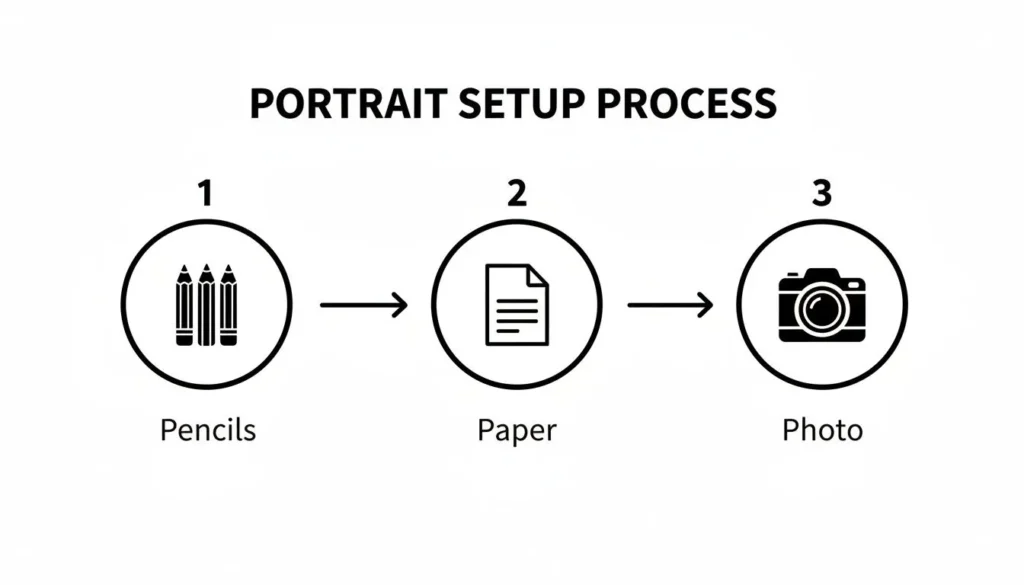
As you can see, a great portrait starts long before you sketch the first line of the face. It begins with the right tools and a quality photo to work from.
Establishing Key Proportional Lines
With the basic mass of the cranium defined, it’s time to draw the guidelines that will tell you exactly where every feature belongs. First, wrap a line around the center of the sphere, both vertically and horizontally. You’re essentially creating an equator and a prime meridian, just like on a globe.
That horizontal line running right through the middle? That’s your brow line, where the eyebrows will eventually sit. It’s a super common mistake to place the eyes on this line, but they actually belong just a little bit below it.
Now, you have the top of the head (the top of the sphere) and the bottom of the nose (the bottom of the sphere). To find the chin, you need to add the jaw. Just take the distance from the brow line down to the bottom of the sphere and repeat that same measurement downward. This new point marks your chin line.
The real magic of the Loomis Method is how it turns a complex, organic form into a predictable, measurable structure. It completely removes the guesswork. You get a logical system to follow, which is incredibly liberating for any artist, especially when you’re just starting out.
This framework of brow, nose, and chin lines creates the basic vertical rhythm of the face.
Placing the Core Features
Once your main guidelines are in place, you can start mapping out the features with a lot more confidence. The most important rule of thumb to burn into your memory is that the eyes sit halfway down the entire head—from the very top of the cranium to the bottom of the chin. So many beginners draw them way too high, which is a dead giveaway of an inexperienced artist.
Here are the standard proportional rules to follow within your Loomis structure:
- The Eyes: Position them on that halfway mark of the head. The space between the two eyes should be roughly the same width as one eye.
- The Nose: The bottom of the nose rests on the bottom of your initial sphere. The width of the nostrils usually lines up perfectly with the inside corners of the eyes.
- The Mouth: The line where the lips meet is typically about one-third of the way down from the bottom of the nose to the chin. The corners of the mouth often align vertically with the pupils of the eyes.
- The Ears: The ears fit neatly between the brow line and the nose line. When you’re looking at the face straight-on, they sit just behind the jawline.
This method gives you a structural mannequin of a head. It’s not meant to be a finished drawing right away. Instead, it’s a robust under-sketch that guarantees everything is in the right spot before you even think about committing to details. For more foundational advice, feel free to check out our collection of beginner art tips.
Think of this initial construction as your best defense against the frustration of a portrait that “just looks wrong.” It gives you a logical and, most importantly, repeatable system for success.
Drawing Lifelike Eyes, Noses, and Mouths
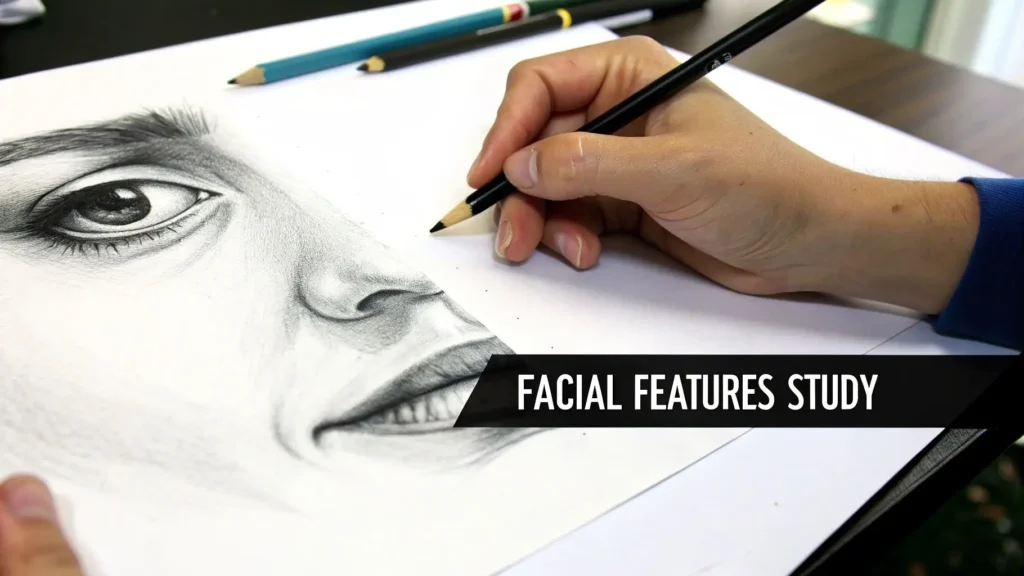
Okay, you’ve mapped out the basic structure of the head. Now for the fun part—bringing the portrait to life by rendering the features. This is where a drawing stops being a generic mannequin and starts showing real personality.
We’re going to move beyond drawing symbols for eyes, a nose, and a mouth. Instead, we’ll focus on observing and capturing their unique three-dimensional forms. Each feature tells a story, and getting them right is a huge leap forward. Let’s tackle them one by one.
Capturing Emotion in the Eyes
The eyes are almost always the focal point of a portrait. They’re called the “windows to the soul” for a reason. A classic beginner mistake is to just draw an almond shape with a circle in it. To get that lifelike quality, you have to think of the eye as a sphere sitting inside the skull.
The eyelids aren’t just lines; they’re pieces of skin that wrap around this sphere, giving them a noticeable thickness and curve. Look closely at a real person: the upper eyelid usually covers a bit of the iris, while the lower lid might just kiss the bottom edge. Nailing that little overlap makes a world of difference.
“The most important thing to remember when drawing eyes is that they are wet, spherical objects. This means you must account for highlights, the subtle shadow of the upper lid on the eyeball, and the soft transitions of light across its curved surface.”
To get that spark of life, you absolutely must pay attention to the catchlight—that tiny, bright reflection of a light source. This should be one of the absolute brightest spots in your entire drawing. Place it accurately and keep its edges sharp. It’s the single best trick for making an eye look glossy and alive.
Here’s a practical way to approach drawing an eye:
- Sketch the socket: Lightly block in the almond shape of the eye socket, using your construction lines as a guide.
- Draw the eyeball: Place the circle for the iris inside. You almost never see the full circle, so let the lids cut it off.
- Define the eyelids: Draw the upper and lower lids, making sure to give them some thickness. Don’t forget the tear duct in the inner corner.
- Place the pupil and highlight: Draw the pupil dead center in the iris and carefully mark out where the catchlight will go. Whatever you do, do not shade this area.
- Shade the iris: Start shading the iris, often with subtle lines radiating out from the pupil. Leave that catchlight pure white.
- Add final shadows: Gently shade the “whites” of the eyes (they’re never pure white) and add the soft shadow cast by the upper eyelid onto the eyeball itself.
Constructing the Nose with Simple Planes
The nose can feel intimidating because it doesn’t have a lot of hard edges. The secret is to stop seeing it as a complex blob and start thinking of it as a simple, blocky form. Imagine it’s made of a few flat planes: a front plane, two side planes, and a bottom plane.
The bridge of the nose is that top plane, and it’s usually where the light hits strongest. The side planes angle away and will almost always be in shadow. The bottom is where you’ll find the nostrils and the fleshy tip, which often catches its own little secondary highlight.
Thinking in planes tells you exactly where your shadows need to go. That soft shadow where the front plane turns into the side plane is what gives the nose its entire structure. The nostrils will be your darkest accents, creating a vital point of contrast.
A common pitfall is drawing heavy, dark outlines around the nostrils. They aren’t circles; they’re openings. Their appearance comes from the shadow inside them and the cast shadow from the nose onto the upper lip. Shade these value masses instead of drawing lines.
Shaping Realistic Lips and a Natural Mouth
The mouth is incredibly expressive, but its soft curves are tricky. The number one mistake beginners make is drawing a single, harsh line between the lips. This makes the mouth look flat and pasted on.
Instead, think of the lips as three distinct fleshy forms: the two lobes of the upper lip and the single, larger form of the bottom lip. The line where they meet isn’t straight—it dips and curves around these shapes. It’s usually darkest at the corners and in the very center.
Keep these key points in mind for a more natural look:
- The Upper Lip: It’s almost always darker than the bottom lip because it angles downward, away from the light source.
- The Bottom Lip: This part curves outward, so it catches the light. It will usually have a soft highlight right on its fullest part.
- The Cupid’s Bow: That little dip in the center of the upper lip is a crucial landmark. Don’t ignore it.
- The Corners: Avoid making the corners sharp and dark. Let them fade softly into the skin, maybe with a small shadow underneath to suggest depth.
And if you have to draw teeth? Less is more. Don’t draw an outline around every single tooth. Just lightly suggest the divisions with subtle shading, and remember that teeth follow the curve of the jaw. Often, you only need to really define a few of the front teeth and let the brain fill in the rest. Focus on the overall value of the teeth as a group, and you’ll get a much more believable result. This completes the core elements in your journey of how to draw portraits step by step.
Creating Depth with Shading and Value
So you’ve got your line drawing sorted. It’s the map of the face, but shading is what makes that map come to life. This is where we stop drawing outlines and start sculpting with graphite, turning a flat sketch into something that feels like it has real weight and volume. It’s all about light, shadow, and everything in between.
The key concept here is value—the technical term for the lightness or darkness of a tone. Get a handle on value, and you can trick the eye into seeing depth on a completely flat piece of paper. This is the real magic behind a portrait that pops off the page.
Understanding Your Value Scale
Before you even think about touching your portrait, you need to get familiar with your tools. Your pencils aren’t just one shade of gray; they’re a whole orchestra of tones waiting to be conducted. A simple value scale is the best way to see this in action.
Just draw a long rectangle and split it into about seven sections. Start with your hardest pencil (like a 2H) and work your way down to your softest (a 6B or darker), filling each box with a progressively darker tone.
- Lightest Value: This is just the white of your paper. Save it for the absolute brightest highlights, like the glint in an eye.
- Mid-Tones: Most of the skin will fall into this range. Your H, HB, and 2B pencils are your workhorses here.
- Darkest Value: This is your blackest black. Use a soft pencil like a 6B for the deepest shadows in places like the nostrils or the corners of the mouth.
Doing this little exercise builds crucial muscle memory and gives you way more control when you start shading for real.
The big breakthrough in shading happens when you stop thinking about “coloring in” and start thinking about “building up form.” Every layer of graphite you add is like a sculptor’s touch, slowly carving the features out of the paper.
This mental shift changes everything. You’re not just filling in shapes anymore; you’re describing how light falls across the surfaces of the face. For artists who want to see how these principles translate to color, checking out different painting techniques for beginners can be a huge help.
Core Shading Techniques for Portraits
Okay, with a better feel for value, let’s look at how to apply it. You’ll want to use controlled, deliberate strokes to avoid that smudgy, undefined look that plagues so many beginner portraits.
Here are the techniques you’ll come back to again and again:
- Hatching: Simply drawing fine, parallel lines close to one another. The closer the lines, the darker the value.
- Cross-Hatching: This is just layering hatching in different directions, usually perpendicular. It’s an awesome way to build up dark values quickly and add a bit of texture.
- Blending: Using a blending stump or a tortillon, you can smooth out your graphite to create soft, seamless transitions. This is your go-to for soft skin, but don’t overdo it! Too much blending can make a drawing look flat and lifeless.
Mix and match these, and you’ll have everything you need to render anything from the smooth curve of a cheek to the subtle pores of the skin.
Mapping Shadows on the Face
Time to bring it all back to your drawing. The most important skill here is learning to see where the light isn’t. Shadows aren’t random smudges; they’re created by the structure of the face blocking your light source.
Try to see the major planes of the head. Think of the forehead, cheeks, and chin not as outlines, but as broad surfaces. Light hits these planes at different angles, creating clear zones of light and shadow that define the entire structure of the portrait.
The idea of breaking down a complex image isn’t new. The photorealist painter Chuck Close famously gridded his canvases to build his hyper-detailed portraits, a method that influenced an estimated 40% of contemporary portrait techniques. The modern step-by-step approach of gridding a photo and building up at least seven distinct tonal values mirrors this concept, and studies show it can improve accuracy by over 50%.
Rendering Realistic Hair and Finishing Touches
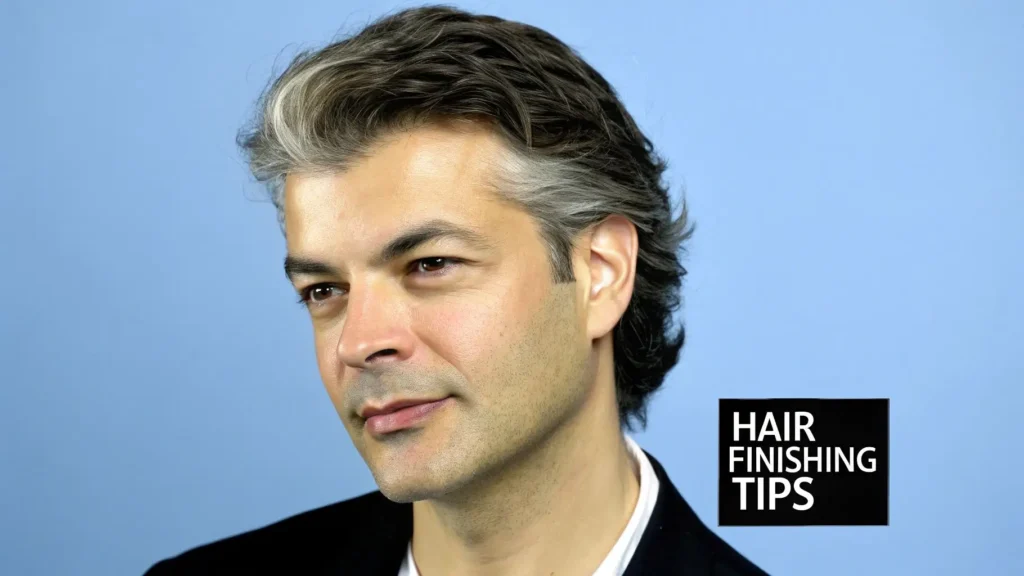
The final details are what take a decent sketch and turn it into a portrait that feels like it could breathe. This is where you add the textures and subtle touches that truly sell the illusion of reality. Hair, in particular, can feel like an impossible task. Thousands of individual strands? No, thank you.
But here’s the secret: you don’t draw every strand. The key to believable hair is to simplify it way down. Forget the individual hairs and start seeing the bigger picture: large, flowing shapes, clumps, and ribbons of value. When you think of hair in terms of its overall form and how light hits it, any style becomes much less intimidating.
Seeing Hair as Major Shapes and Forms
Before you even think about detail, squint your eyes at your reference photo. Seriously, try it. This simple trick blurs out all the distracting little strands and forces you to see the big, fundamental shapes. Notice how the hair clumps together into larger, ribbon-like sections or chunky curls. These are your starting blocks.
First, lightly sketch the overall silhouette of the hair. Pay close attention to its volume—how it sits on and around the head. Next, start blocking in those major clumps you just identified. Don’t worry about texture yet; just focus on the general direction and flow of these sections. This is often called the “rhythm” of the hair.
This step is all about structure. It’s the equivalent of the Loomis head for the rest of the hair. You’re building a solid foundation that will guide every stroke you make from here on out.
Rendering Different Hair Textures
With your large forms mapped out, you can finally start building up the texture. Your technique is going to change quite a bit depending on the kind of hair you’re drawing.
- For Straight Hair: Use long, confident strokes that follow the direction of the hair’s growth. Let your pencil pressure do the work to create depth. Highlights will usually look like sleek, well-defined bands of light.
- For Wavy Hair: Think in “S” shapes. Your strokes should be curved and follow the rhythm of the waves. The highlights and shadows here are softer, falling on the crests and inside the troughs of each wave.
- For Curly Hair: This is less about lines and more about shapes. Think of curls as a series of cylinders and coils. Shade these coiled forms just like you would any 3D object, with bright highlights on the parts that bulge toward the light and deep shadows on the inside of the curls. You don’t need to draw every single curl—just suggest them in key areas and let the viewer’s brain do the rest.
A kneaded eraser is your secret weapon for hair. Stop thinking of it as a mistake-fixer and start using it as a drawing tool. You can pinch it into a sharp edge or a fine point to lift out incredibly delicate highlights. This is how you create the illusion of individual, light-catching strands.
This “subtractive” drawing technique is a game-changer. It creates highlights that are far more natural and soft-edged than if you simply tried to draw around them.
Applying the Final Polishing Touches
Alright, the hair is looking good. Now it’s time for those final details that pull the entire portrait together. These are the subtle cues that kick the realism up a notch and make the drawing feel truly finished. Don’t rush this part; this is where the magic really happens.
Here are a few things I always do to finish a piece:
- Reinforce Your Darks: Go back one last time and push your darkest values. The pupils, the inside of the nostrils, the corners of the mouth, the deepest cast shadows—make them as dark as your softest pencil allows. This single step instantly boosts the contrast and makes the portrait pop off the page.
- Add Subtle Skin Texture: A perfectly smooth face can look a little fake, like it’s been airbrushed. You can suggest subtle skin texture by lightly stippling with a sharp 2H pencil or by using a piece of paper towel to gently press down on a shaded area. A tiny bit goes a very long way.
- Refine Edges: Not every edge on a face is sharp. Use a blending stump to soften the edges of shadows on curved surfaces, like the cheeks. Keep the harder edges for places like the jawline or the bridge of the nose. This mix of soft and sharp focus is crucial for creating depth.
- Check Your Highlights: Make sure your brightest highlights are clean and crisp. The catchlight in the eyes, the glint on a lower lip, or a highlight on the tip of the nose should be tiny points of pure white. They act as focal points and give the portrait a sense of moisture and life.
By focusing on these last elements, you’re moving beyond just copying a photo. You’re making deliberate artistic choices to guide the viewer’s eye and enhance the three-dimensional feel of your work. These final moments of refinement are what bring all your hard work together.
Got Questions? Let’s Talk Portrait Drawing
Even with the best step-by-step guide in front of you, a few questions are bound to bubble up. That’s perfectly normal. Let’s tackle some of the most common hurdles I see artists run into when they’re just starting out. Here’s some quick advice to clear things up and get you back to the drawing board.
What Are the Biggest Beginner Mistakes?
The most frequent tripwires I see almost always come down to two things: proportion and value. It’s almost a rite of passage to place the eyes way too high on the head, which throws off the entire face instantly. Another classic mistake is drawing what you think you see—like a generic football shape for an eye—instead of carefully observing the unique, specific shapes on your reference.
New artists also tend to lean on harsh, dark outlines for everything, which completely flattens the portrait. And then there’s the fear of the dark—being too timid with shadows. This leads to a low-contrast drawing that just feels… well, flat. It never achieves that pop of a three-dimensional form.
Here’s a little secret: the fastest way to improve is to stop being afraid of your eraser and your dark pencils. Your eraser isn’t just for mistakes; it’s a drawing tool for pulling out brilliant highlights. And those darks? They’re what create form. Treat them like your two most powerful assets.
How Long Does It Take to Get Good?
Ah, the ultimate “how long is a piece of string” question. There’s no magic number of hours, but I can tell you this: progress is tied directly to consistent practice, not the occasional marathon session. Drawing is a skill built on mileage and muscle memory, just like learning an instrument.
Putting in 20–30 minutes every single day is far more effective than trying to cram in a five-hour session once a week. That daily consistency builds neural pathways and makes observation feel like second nature. Try focusing on one skill at a time—maybe spend a week just sketching noses from different angles. This targeted approach speeds up learning and keeps you from feeling overwhelmed. And remember to be patient with yourself; every artist you admire started right where you are now.
Which Pencil Should I Start With?
Always, always begin your initial sketch and structural lines with a hard, light pencil. Think of a 2H or an H pencil as your best friend in these early stages. They lay down faint, crisp lines that are incredibly easy to erase without leaving a single groove in your paper.
Using these light lines means your foundational grid and proportional mapping can be tweaked and adjusted without a trace. Only when you are completely confident that the proportions are nailed down and the features are in the right spot should you even think about reaching for your softer pencils like HB, 2B, and 6B for shading. Starting light is the key to preventing a messy, overworked drawing later on.
At maxijournal.com, we’re all about breaking down complex skills into simple, manageable steps. For more guides on art, creativity, and countless other subjects, check out our daily content. Dive into your next passion with us at https://maxijournal.com.
Discover more from Maxi Journal
Subscribe to get the latest posts sent to your email.