
You bought a notebook, wrote nothing, and now the blank page feels like a test you already failed. Or you wrote “my family” once and never opened it again. That stall is common, and it isn’t a character flaw.
A better way to learn how to start a gratitude journal is to treat the first month as a small experiment. You choose one format, keep a few timed sessions, write specific lines, and compare a mood score with the number you wrote on night one. Hard days get a neutral detail instead of forced cheer. Missed days do not get catch-up essays.
Start with where the journal lives. A plan you can’t open at the same hour will not produce a score you can trust.
Choosing a Format and a Daily Time
Consistency beats the notebook brand. Use this comparison, then commit.
| Format | Main advantage | Main risk |
|---|---|---|
| Paper notebook | Reduces screen distraction | Gets forgotten in a bag or drawer |
| Notes app | Reminders, search and quick entry on the phone | Notifications and scrolling pull attention away |
| Dated template with prompts | Removes the blank-page problem | Can become a chore if the prompts feel fixed |
Paper cuts screen distraction and gets left in a bag. A notes app offers reminders and search, then pulls you into scrolling. A dated template, including a guided book such as The Five Minute Journal, clears the blank page and feels like a chore when the prompts stay fixed.
The Greater Good Science Center gratitude journal practice recommends about 15 minutes, up to five things, and journaling at least three times a week for two weeks. A 2016 randomized experiment among 119 young women found higher hedonic well-being, optimism, and sleep quality, lower diastolic blood pressure, and no cortisol link. Read those results as possible benefits, not treatment or a guarantee.
Practical rule: Pick the format you will open at the same time each day, and write that choice on the first line so day two doesn’t reopen it.
Tie the reminder to coffee or the commute home. Life Calendar’s how to start your first journal covers the blank-notebook hurdle, and our daily writing journal guide shows a short page beside a habit you already keep.
Your Two-Week Gratitude Journal Schedule
Someone buys a notebook, writes one thin line, and stops. Willpower was never the missing piece. A schedule is.
| Stage | Sessions | Entries and time | Check-in |
|---|---|---|---|
| Week 1 | 3 sessions (for example Mon, Wed, Fri) | 3 specific entries, about 15 minutes | Baseline mood score from 0 to 10 before the first entry |
| Week 2 | 3 sessions | 3 to 5 entries, each with a reason | Note one change in mood or sleep |
| Weeks 3-4 | 1 session per week | 3 to 5 entries with reasons | Compare current score with baseline at end of week 4 |
Week 1
Use three fixed days, such as Monday, Wednesday, and Friday. Write three specific entries. Before the first word, record a baseline mood score from 0 to 10. That single number is what makes the later comparison real. Without it, you will only remember the mood you are in on the night you happen to reread the book.
Week 2
Keep the same three days. Stretch to three to five entries, and add one plain reason for each. Then note one change in mood or sleep, including “no change.” A null note is still data. It stops you from inventing a success story just because you showed up.
Weeks 3 and 4
Drop to one session a week with three to five entries and their reasons. At the end of week four, write the current mood score beside the baseline. You are looking for a difference you can point to, not a new identity.
A 2019 randomized clinical trial divided 1,337 participants into three groups: 446 completed a gratitude exercise, 444 recorded daily hassles, and 447 described neutral events. The gratitude group listed grateful moments each day for 14 days. Researchers measured positive and negative affect, depressive symptoms, subjective happiness, and life satisfaction before the exercise, immediately afterward, and again 14 days later. That group improved on positive affect, subjective happiness, and life satisfaction, and showed reductions in negative affect and depressive symptoms. The increase in positive affect was larger than in the comparison groups. The trial tested one defined exercise. It does not prove every person, or every journaling style, will match those results.
Three sessions a week are enough to start, and daily writing is optional. The week-four check-in only needs the sessions in the table. If you want the cue to stick without a second job, our healthy habits guide shows how to attach a small action to an hour you already keep.
How to Write an Entry That Counts
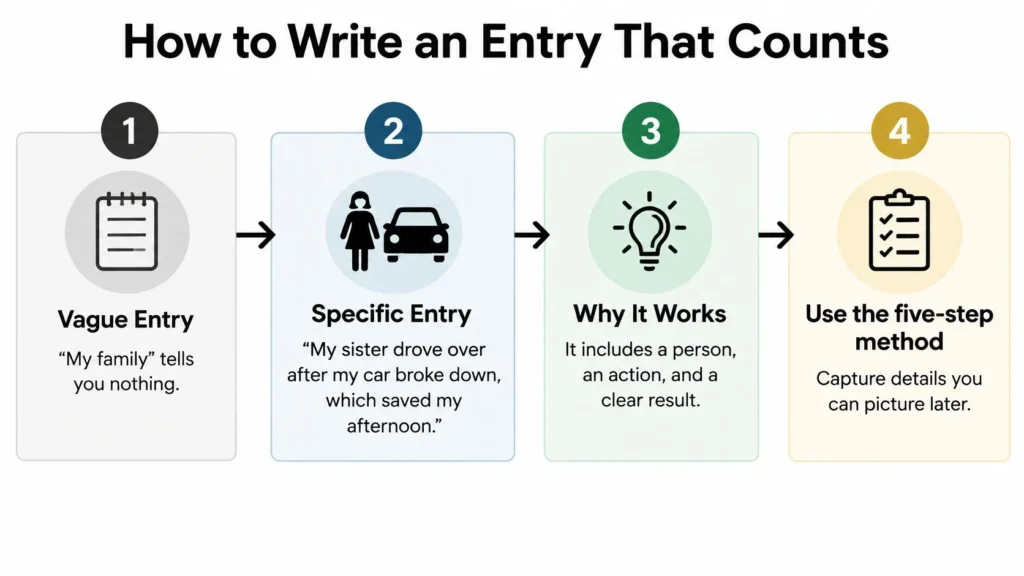
“My family” tells you nothing a week later. “My sister drove over after my car broke down, which saved my afternoon” gives you a person, an action, a benefit, and a feeling you can picture.
Five moves for one line
- Pick one moment from the last few days. A single scene is easier to recall than a category. If you can’t see it, it is too broad.
- Name the person or the concrete detail. “The 7:12 train” beats “transport.” “My sister” beats “family.”
- Say what it gave you, in one plain sentence. This step often collapses into “I’m so grateful.” Write the benefit instead: time, quiet, a finished report, a meal you didn’t have to cook.
- Imagine the week without it. This counterfactual feels odd, and people skip it. One sentence is enough: “Without that ride, I would have missed the school pickup.”
- Note the feeling in one line. Calm, relief, amusement, or “less rushed” all count. You are labeling, not performing joy.
A systematic review in the Journal of Occupational Health found that gratitude-list interventions conducted four times or fewer generally did not produce significant changes, while weekly journaling commonly used the 3–5 items plus reasons format. The same protocol asks you to say why each item mattered and to picture how the week would have differed without it. Concrete experiences beat repeated abstract labels such as “family” or “health.” Keep the same prompt for four or more weeks if you want a clean comparison, and mark each session done so you are not trusting memory.
A bad-week example
Say the day was mostly a mess, and the only workable moment was a train that left on time.
The 7:12 left on time after a morning of delays at home. I got to the desk before the meeting, which kept the rest of the day from starting already late. Without that train, I would have walked in mid-sentence. I felt a small bit of relief, not happiness.
That entry still names a detail, an action, a result, and a feeling. Aim for three to five entries like it, each with its reason, in one short sitting. Judge the month with a 0–10 mood or stress score at the start and again after four weeks. Expect a modest shift, not a new personality.
Prompts to Rotate Through the First Month
The same question every night produces autopilot. Rotate three entry types across the month: a specific person or event, a small everyday benefit, and a counterfactual. Week 1 can stay with people. Week 2 can stay with ordinary benefits. Week 3 can ask what would have been harder without one detail. If you would rather measure one question cleanly, keep a single prompt for four weeks and don’t apologize for the repetition.
| Prompt | Entry type | Sample entry |
|---|---|---|
| Who made a small difference to me this week? | Specific person | My neighbour held the lift door when my hands were full, and I got to work without rushing. |
| What made the commute easier today? | Everyday benefit | The bus came the moment I reached the stop, so I finished a chapter before work. |
| Which ordinary object did I rely on today? | Everyday benefit | My reading lamp still works after years, and it kept the evening calm. |
| What would this week have been like without one person? | Counterfactual | Without my manager’s quick reply, the report would have sat unfinished all weekend. |
| What tasted better than I expected? | Everyday benefit | The soup was warm at lunch, which felt like a pause in a busy day. |
| What did I receive today that I didn’t ask for? | Specific event | A friend sent a photo of the dog I had missed, which turned a long meeting into a good afternoon. |
The samples show structure, not lines to copy. Swap in your own bus stop, your own lamp, your own person. If a prompt starts producing the same sentence, move to the next type even if the week isn’t over.
Short, repeatable cues help when you don’t want to invent a question at 10 p.m. Mr. Pen’s notes on simple steps toward daily thankfulness are one more set of plain cues you can borrow, then put back into your own words.
Handling Hard Days Without Forcing Positivity
You sit down after a bad day and cannot find three good things. Forcing a smile onto the page can make the hour worse, not better. The useful move is a true, small, neutral detail written next to the hard feeling, not instead of it.
These lines count:
- Quiet: “The room was quiet for ten minutes after everyone left.”
- A reply: “Someone answered my message.”
- Heat: “The coffee was hot.”
You are not denying the argument, the grief, or the bill. You are recording one fact that was also true. If the only honest sentence is neutral, stop there. One true line beats three fake ones.
A systematic review of 64 randomized clinical trials found improvements in gratitude, mental health, anxiety, and depression, and still rated that evidence cautiously. The trials varied a lot, many people dropped out, blinding was limited, and risk of bias was common. Personal and cultural meanings of gratitude also differ, so a script that feels natural to one reader can feel hollow to another.
Journaling is not a substitute for clinical care when symptoms are severe, persistent, or frightening. If the page increases guilt or distress, pause and talk with a professional. Our journaling for mental health page is a place to read about writing as support, not as a stand-in for care. Let the hard feeling stay in the entry beside one neutral detail.
Fixing a Journal That Has Stalled
You missed two weeks, and the gap now feels like proof you “aren’t a journal person.” Frequency and format matter more than a perfect streak. A 2025 synthesis in PNAS found gratitude interventions produced only a small overall well-being increase, Hedges’ g = 0.19, across 24,804 participants in 28 countries. Effects were stronger for positive affect, for randomized designs, and when studies combined more than one kind of practice. Short notes, a look at someone’s contribution, savoring one event, or a thank-you message can do more than the same list copied every night.
| Symptom | Likely cause | Fix |
|---|---|---|
| Skipping whole weeks | Sessions feel like a chore | Cut to three entries at the same time, and restart at the next session without catch-up |
| Same wording every day | Autopilot prompts | Rotate prompt type each week using the prompts above |
| Entries feel fake | Forced optimism | Write one true, neutral detail next to any hard feeling |
| Entries become vague | Abstract categories such as family or health | Name a person, an action and the benefit it gave |
| Stopped after two weeks | No measure of progress | Set a 0-10 check-in and compare with baseline at week four |
What the rows are telling you
A chore is a size problem. Three short lines at the usual hour are easier to face than a performance. Repeated wording is a prompt problem, so change the type of question, not your personality. Fake entries usually mean you tried to outrun a bad mood. Vague entries mean you named a category instead of a scene. Stopping with no score means the experiment had no endpoint, so the missed weeks felt like failure instead of missing data.
Pick up at the next scheduled session. Do not write catch-up entries for the days you skipped. Backfilling invents memories and turns the notebook into debt. If the lists feel mechanical, switch the form for one week: a two-line note, a paragraph on one person’s action, or a thank-you message you may or may not send. Keep the 0–10 score so the page stays an experiment, not another productivity target.
Start Your First Entry Tonight
Tonight needs one action, not a reread of the whole month. Open the journal, write the baseline mood score from 0 to 10, and complete one specific entry with the five moves: a moment, a name, a benefit, a counterfactual, and a feeling.

Use this checklist before you close the notebook:
- Choose the format. Paper, a notes app, or a dated template, written on line one.
- Set the first week’s reminders. Three times you already have, such as coffee or the ride home.
- Write the first entry. One specific scene is enough for tonight. The later sessions can hold three to five.
At the week-four check-in, compare the new score with the baseline and decide whether to keep the same prompt or rotate. Effects in this kind of practice tend to be modest. The journal is a personal experiment, not treatment. A short, specific first entry beats a long plan that never starts.
If you want a short walk-through of the same idea in another voice, this video is a calm place to start before you pick up the pen.
Maxi Journal publishes approachable writing on health and daily practice, including ways to notice a small win, a kindness, or something simple to look forward to. If you want that kind of clear context beside the two-week experiment you just started, visit maxijournal.com. Bring tonight’s baseline score with you and read at the same measured pace you used in the notebook.
Discover more from Maxi Journal
Subscribe to get the latest posts sent to your email.