Some nights the problem isn’t one big crisis. It’s the pileup. An unfinished email, a tense conversation replaying in your head, the sense that you’re behind on everything, and the odd guilt of knowing you “should” be coping better than this. By the time you sit down, your mind is noisy enough that even resting feels hard.
That’s usually when people start looking for something simple. Not a dramatic life overhaul. Just one practice that helps them slow their thoughts down and feel less internally crowded.
Journaling can be that practice. Not because it turns life neat and easy, and not because every form of writing is automatically therapeutic. It helps because it gives your mind somewhere to put what it’s carrying. Thoughts that feel overwhelming in your head often become clearer once they’re on paper or on a screen.
If you’ve dismissed journaling as “keeping a diary,” I’d challenge that idea. Used well, it’s a mental health tool. Used poorly, it can become repetitive venting that leaves you feeling worse. That distinction matters more than most advice admits.
If you want a second practical perspective, this therapeutic journaling guide offers a grounded overview of how writing can support emotional wellbeing. For broader everyday habits that pair well with journaling, these mental health self-care tips are also useful.
Your Path to a Calmer Mind Starts Here
A journal works best when you stop treating it as a performance. It isn’t a place to sound wise, positive, or organized. It’s a place to notice what’s true.
That might mean writing, “I’m angry and I don’t know why.” It might mean listing what happened today in plain language. It might mean admitting that your body feels tense before your mind has caught up. Those are not small observations. They’re often the beginning of regulation.
What journaling is actually good for
People often come to journaling with one of two expectations. Either they expect instant relief, or they assume it won’t do much at all. Both views miss the point.
Journaling is usually most helpful for:
- Slowing mental spirals by moving fast, repetitive thoughts into a visible form
- Spotting patterns in triggers, moods, habits, and relationships
- Creating emotional distance so you can respond instead of just react
- Supporting therapy or coaching by helping you arrive with clearer material
Practical rule: Your journal doesn’t need to be insightful. It needs to be honest enough to show you what’s happening.
What this practice is not
Journaling isn’t a test of discipline, and it isn’t proof that you’re handling everything alone. If writing helps, use it. If writing feels activating or confusing, adjust the method.
That’s why the safest starting point matters. Many people assume the “deepest” journaling is writing freely about pain, trauma, or every dark thought in detail. Sometimes that’s too much, too soon. A steadier approach often works better at the beginning.
The goal isn’t to squeeze meaning out of suffering every time you open a notebook. The goal is to create a repeatable habit that leaves you more settled, more aware, and a little less tangled than before you started.
The Science Behind a Pen and Paper
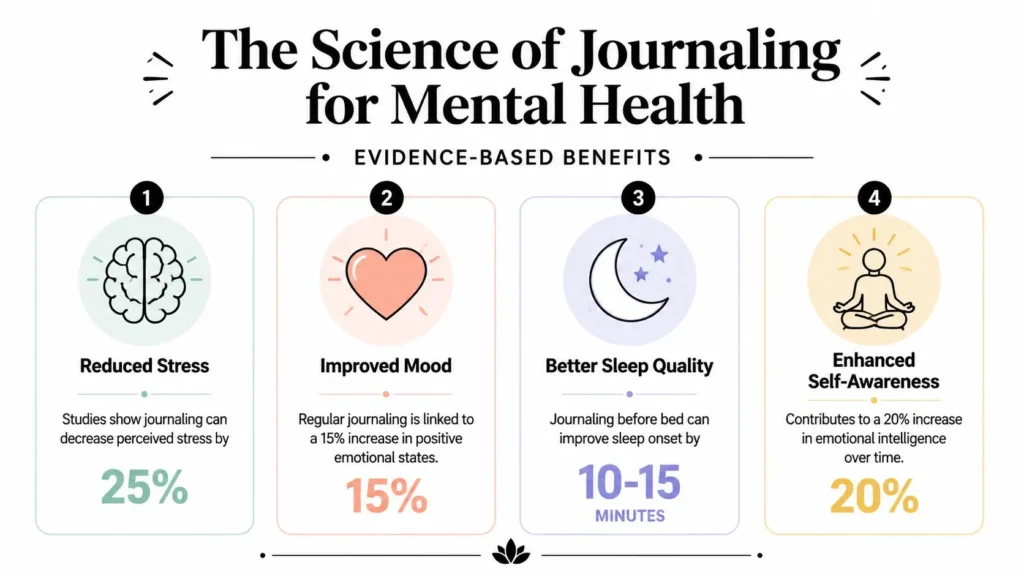
Journaling for mental health has real evidence behind it, but the evidence is more nuanced than “writing always helps.” The strongest reading of the research is that journaling can be useful, especially when the method fits the person and the problem.
A 2022 meta-analysis found that journaling interventions produced an average 5% reduction in patient scores on mental health measures compared to control groups, with stronger effects for anxiety at 9% and PTSD at 6%, while depression showed a smaller 2% benefit according to this meta-analysis on journaling as a mental health intervention. That’s not a miracle result. It is meaningful, especially for a low-risk practice that many people can begin at home.
Why the condition matters
This is one place where generic self-help advice often goes wrong. It talks about journaling as if it works the same way for every mental health concern.
It doesn’t. The condition-specific breakdown matters. As noted in this discussion of journaling and condition-specific symptom change, journaling appears more helpful for anxiety and PTSD symptoms than for depression. That doesn’t mean people with depression shouldn’t journal. It means expectations should be realistic. A journal may help with clarity, tracking, and emotional expression, but it may not be the main lever for depressive symptoms.
What consistency seems to change
Other clinical summaries report that regular journaling can reduce anxiety and depression symptoms by 20% to 45%, that expressive writing reduced depression scores by an average of 30% over 8 weeks, and that journaling can reduce cortisol by up to 23% in regular practitioners, with useful practice parameters of 3 to 4 times per week, 15 to 20 minutes, over 4 to 6 weeks, according to this overview of the benefits of journaling. Those figures should be read as support for structured, repeated practice, not as a guarantee of the same outcome for every reader.
For anxiety specifically, structured journaling has also been reported to reduce symptoms by up to 42% over six weeks, and consistency matters more than occasional long sessions. The same review notes that brief writing done three times a week for 5 to 10 minutes can produce more sustained benefits than infrequent longer sessions, and that flexible adherence goals improve follow-through. It also suggests using tools like the PSS or GAD-7 to track change over time in this article on journaling for managing stress and anxiety.
If you enjoy learning how the brain supports habits, reflection, and emotional processing, this overview of recent discoveries in neuroscience is worth reading.
A journal is not powerful because it is expressive. It becomes powerful when it is specific, repeatable, and matched to what you actually need.
How to Set Up Your Journaling Practice
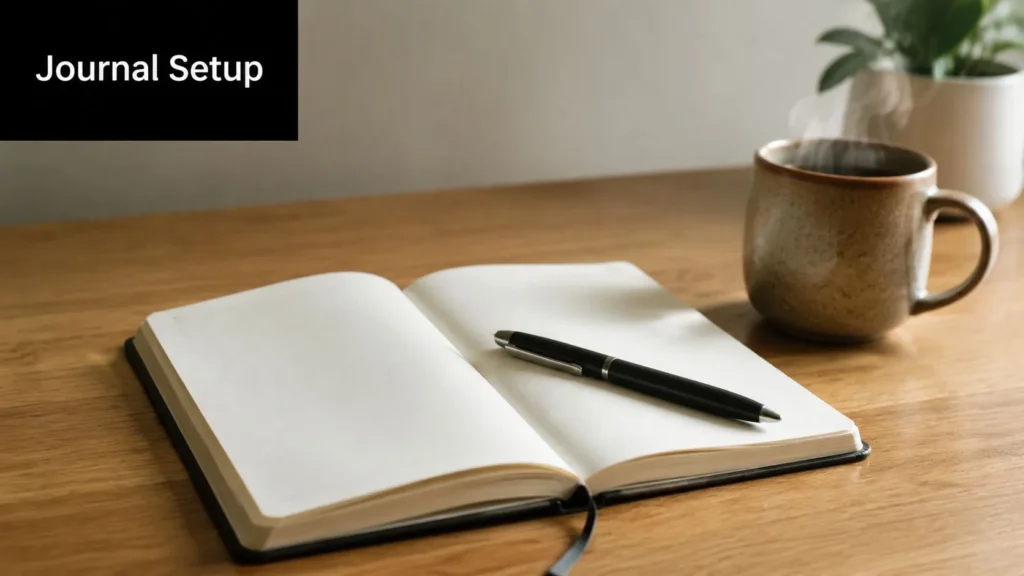
A good journaling setup removes friction. If your notebook is hard to find, your app feels cluttered, or your routine asks too much of you, you probably won’t keep going. Start with convenience, not perfection.
Choose the format you’ll actually use
Some people think pen and paper is automatically better. It isn’t. The best tool is the one that fits your life, your privacy needs, and your attention span.
| Feature | Digital Journaling (App/Software) | Analog Journaling (Pen & Paper) |
|---|---|---|
| Speed | Fast to type, easy to capture thoughts quickly | Slower pace, often better for reflection |
| Privacy | Passwords and device security can help | Feels private if stored safely, but physical |
| Searchability | Easy to search old entries | Harder to review patterns quickly |
| Sensory feel | Efficient, portable, low mess | More tactile and grounding |
| Distraction risk | Higher if your phone pulls you elsewhere | Lower if you stay off devices |
| Emotional tone | Useful for quick check-ins and structured prompts | Often feels more personal and immersive |
If you like handwriting, the physical object matters more than people admit. A notebook that opens flat, paper you enjoy touching, and a pen that writes smoothly can make the habit feel easier. If aesthetics help you show up, you might want to explore handcrafted leather journals and choose one that feels durable enough to keep near you.
If digital is more realistic, don’t apologize for that. The habit matters more than the romance of paper.
Build a ritual, not a grand plan
Many quit because they start too intensely. They decide to write every morning for half an hour, miss two days, and assume the practice has failed.
A steadier approach works better:
Pick one cue
Tie journaling to something you already do, like coffee, shutting your laptop, or getting into bed.Keep the entry small
Start with a few lines. If you want to continue, continue. If not, stop.Use one location
A chair, desk corner, kitchen table, or notes app. Repetition helps your brain treat the act as familiar.End with one grounding question
Try “What do I need next?” or “What mattered today?”
Make the space emotionally usable
A journaling space doesn’t need candles and a perfect morning routine. It needs to feel safe enough for honesty.
That usually means:
- Low pressure by choosing a time when you won’t be interrupted
- Easy access by keeping your notebook visible or your app pinned
- Private storage so you don’t censor yourself out of fear
- A simple fallback such as a one-line entry on difficult days
For fresh ideas on keeping writing sustainable, this collection on the daily writing journal can help you refine your routine.
If your setup feels precious, you may protect it too much to use it. Aim for inviting, not perfect.
What to Write When the Page Is Blank
The blank page bothers people because it asks a question without words. What’s going on with me right now? When you’re tired, anxious, or emotionally shut down, that can feel impossible to answer.
The easiest fix is structure. Not rigid structure. Just enough to get your mind moving.
Start with the safer form of writing
One of the most important distinctions in journaling for mental health is the difference between positive-affect journaling and free-form distress journaling.
Research suggests that positive-affect journaling focuses on steady, meaningful aspects of life and can be a safer starting point for people with mild-to-moderate anxiety, while unstructured trauma-focused writing can increase distress for some people. That distinction is discussed in this study on positive-affect journaling as a feasible intervention.
This doesn’t mean you must only write cheerful things. It means your first practice should help your nervous system settle, not flood it.
Write toward steadiness before you write toward excavation.
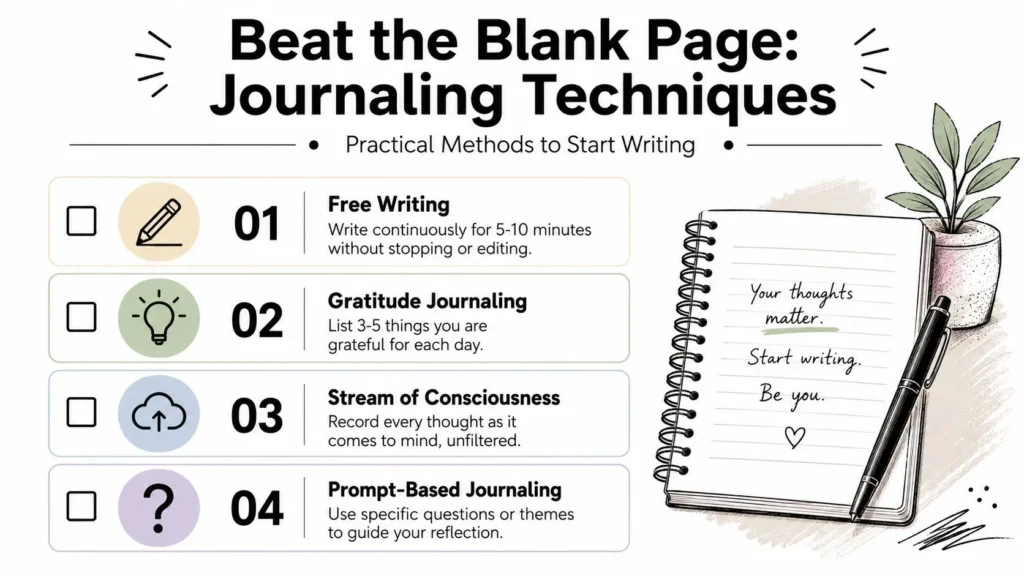
Four approaches that work for different days
Here’s a more useful question than “What should I journal about?” Ask, “What kind of support do I need today?”
Positive-affect journaling
Use this when you feel tense, overloaded, or emotionally thin.
Prompts:
- What felt stable today even if the day was messy?
- Who or what supported me
- What small thing did I appreciate
- What helped me cope better than usual
This style helps direct attention toward meaning, connection, and steadiness. It doesn’t deny pain. It broadens the frame around it.
Before trying a prompt, some people find it helpful to watch someone model a calm writing process.
Thought record style writing
This is useful when a specific thought keeps looping.
Write in four short lines:
- Situation
What happened? - Thought
What did I tell myself? - Feeling
What emotion came up? - Response
What would be a more balanced view?
Example:
“I didn’t get a reply.”
“They’re upset with me.”
“Anxious.”
“I don’t know that yet. There are several possible reasons.”
Future-self journaling
Use this when you feel stuck or scattered.
Prompts:
- What would a steadier version of me notice here?
- What matters most by the end of this week?
- What’s one action tomorrow would-me will thank me for?
This shifts journaling away from endless processing and toward direction.
Free writing with guardrails
Free writing can help, but it needs limits. Set a timer. Stay with one topic. End by naming one need, one lesson, or one next step.
If you’re writing about trauma or highly activating material, be careful. Unstructured distress writing isn’t always therapeutic just because it feels intense. If your entries leave you dysregulated, numb, panicky, or unable to reorient, that’s information. Change the method.
Three good first lines
When nothing comes, start with one of these:
- Right now, I notice…
- The thought I keep circling is…
- What I need but haven’t admitted is…
Those lines are simple enough to begin and revealing enough to matter.
Navigating Common Journaling Pitfalls
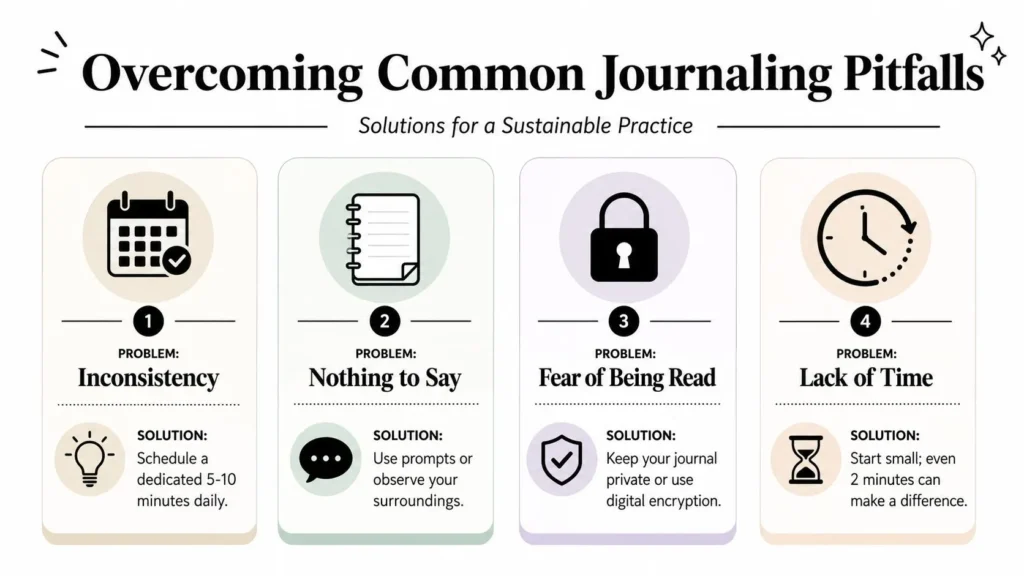
A lot of journaling advice says “just write.” That sounds freeing, but for many people it’s too vague to be helpful. When the method has no boundaries, the journal can become a storage unit for stress instead of a tool for processing it.
The rumination trap
One of the clearest pitfalls is rumination. That’s when you write the same fear, frustration, or self-criticism in slightly different language without moving toward understanding or relief.
As noted earlier in the evidence, a common pitfall in journaling is dwelling only on negative emotion. The practical recommendation is to shift toward gratitude or other positive topics when writing starts to feel overwhelming, because that reframing can interrupt spiraling. In plain terms, if your journal is making you more stuck, don’t keep digging in the same spot.
Signs you’re ruminating:
- You repeat the same story without discovering anything new
- You leave feeling more activated than when you started
- Your entries get harsher but not clearer
- You use writing to avoid action such as setting a boundary or asking for help
Why inconsistency isn’t always the real problem
People often blame themselves for not journaling “enough.” Sometimes the issue isn’t motivation. It’s that the practice is too demanding.
Try adjusting the target instead:
- Shrink the entry to a few lines
- Use a recurring prompt so you don’t reinvent the wheel
- Attach it to a cue like lunch, bedtime, or the end of work
- Let boring entries count because repetition beats intensity
A sustainable journal practice is often plain. That’s why it survives real life.
Privacy, perfection, and self-censorship
Another quiet obstacle is fear. If you think someone might read your journal, or if you feel embarrassed by your own thoughts, you’ll write around the truth. That usually produces flat entries and little benefit.
You can reduce that friction by:
- Choosing a protected format that fits your privacy concerns
- Writing in fragments if full sentences feel too exposing
- Using initials or shorthand for sensitive people or events
- Destroying pages after writing, if the release matters more than the record
What a useful entry tends to include
A productive entry usually has at least one of these elements:
| If the entry has this | It usually helps by doing this |
|---|---|
| A named feeling | Reduces vagueness |
| A specific event | Grounds the emotion in context |
| A balanced question | Opens reflection instead of looping |
| A next step | Moves you from insight to action |
The journal doesn’t need to solve your whole life. It only needs to help you move one inch from chaos toward clarity.
When Your Journal Is Not Enough
Journaling can be powerful, but it has limits. If writing becomes the only place where you admit you’re struggling, it can accidentally become a way to manage alone for too long.
That matters because the best evidence doesn’t describe journaling as a replacement for care. It describes it as an adjunct. In other words, something that supports a broader treatment plan. The 2022 meta-analysis described journaling as an efficacious adjunct to standard therapy when prescribed and implemented properly, and as a low-risk option whose value is strongest when integrated into wider care. That distinction is central to responsible use.
Signs you may need more support
Consider reaching out to a therapist, counselor, or mental health professional if:
- Your distress keeps interfering with work, sleep, relationships, or daily functioning
- Your writing leaves you overwhelmed and you can’t settle afterward
- You feel persistently hopeless, numb, or shut down
- You use journaling instead of taking necessary action
- Trauma material keeps surfacing and you don’t feel equipped to contain it
This is not failure. It’s good judgment.
What journaling can still do in treatment
When someone is already in therapy, journaling can help them notice patterns between sessions, remember what they wanted to discuss, and track how they respond to stress over time. It can also help them bring in material that’s hard to say aloud at first.
If you’re trying to find support locally and want an example of what that search can look like, this guide to Vernon mental health shows the kind of practical starting point that can make reaching out feel more manageable.
Sometimes the healthiest use of a journal is letting it show you that you need company, not more solitude.
A journal can hold a lot. It just shouldn’t have to hold everything.
If you want more thoughtful, accessible writing on health, science, and everyday reflection, visit maxijournal.com. It’s a good place to keep reading, keep thinking, and keep building a writing practice that fits real life.
Discover more from Maxi Journal
Subscribe to get the latest posts sent to your email.