A great tennis forehand is built on three pillars: the right grip, a balanced stance, and a fluid swing. Once you lock these in, you’ll have a consistent, powerful shot that lets you take charge of rallies and boss your opponent around from the baseline.
Building Your Forehand From the Ground Up
The forehand is the cornerstone of the modern game, but building a reliable one can feel like an impossible task. So many players get bogged down trying to hit with massive power and topspin way too early. The real secret? You have to start with the fundamentals. Nail these, and the rest of your game will start to click into place.
You wouldn’t build a house on a shaky foundation, and the same goes for your forehand. Before you start dreaming of hitting highlight-reel winners, you need a repeatable motion that reliably gets the ball over the net and deep into the court.
Finding Your Ideal Forehand Grip
Your grip is your only connection to the racquet, and it single-handedly determines the angle of the racquet face when you make contact. The way you hold the handle has a massive impact on the spin, power, and control you can generate. While there are tons of slight variations, three main grips are used by almost every player on tour.
- Eastern Grip: This is what we call the “shake hands” grip, and it’s the most natural place for beginners to start. It encourages a flatter swing path, which makes it easier to drive through the ball and build consistency. It’s also a really versatile grip that makes switching to volleys or hitting a slice feel much more intuitive.
- Semi-Western Grip: This is by far the most popular grip in modern tennis, favored by pros like Rafael Nadal and Carlos Alcaraz. By shifting your hand slightly more underneath the handle, your swing path naturally brushes up the back of the ball, creating heavy topspin. This is the grip for players who want the ball to dip hard at their opponent’s feet and kick up high after the bounce.
- Full Western Grip: This is the most extreme of the three, placing your hand almost completely under the racquet. It’s a pure topspin machine, perfect for players who want to hit with a huge margin over the net. The tradeoff is that it can make hitting low balls and flatter shots much more difficult.
Coach’s Tip: Don’t stress about finding the one “perfect” grip right away. I always have new players start with the Eastern to build a solid, consistent base. Once your timing and confidence are there, you can start playing around with a Semi-Western to add more spin. The right grip is ultimately the one that feels comfortable and works with your natural swing.
Comparing the Most Common Forehand Grips
Here’s a quick look at the three primary forehand grips, their core characteristics, and the type of player they benefit most.
| Grip Type | Key Characteristics | Best Suited For |
|---|---|---|
| Eastern | Neutral racquet face, promotes flatter shots, easy to learn. | Beginners, all-court players who value control and versatility. |
| Semi-Western | Slightly closed face, excellent for generating topspin and power. | Intermediate to advanced players, aggressive baseliners. |
| Full Western | Extremely closed face, maximizes topspin for high-bouncing shots. | Advanced clay-court specialists and players with powerful groundstrokes. |
Choosing a grip sets the stage, but the next step is learning how to use your body to support it.
The Footwork and Stance That Create Power
Effortless power has very little to do with your arm; it comes from the ground. The right footwork gets you into a balanced position to fire the kinetic chain—that’s the transfer of energy from your legs, up through your core, and exploding out into the racquet.
It all begins with a unit turn. The moment you see the ball coming to your forehand, your first move should be to turn your hips and shoulders together as one solid unit. This early preparation is like coiling a spring, storing up all that potential energy you’re about to release into the ball.
From that initial turn, you’ll set up in one of three stances, depending on the situation:
- Open Stance: This is your go-to when you’re stretched wide or don’t have much time. You stay mostly facing the net and load your outside leg to create rotational power.
- Semi-Open Stance: A fantastic hybrid stance that gives you a great mix of balance and power, plus it helps you recover to the middle of the court quickly.
- Neutral Stance: The classic, textbook stance where you get your body completely sideways to the net. It’s perfect when you have plenty of time to set your feet and really drive the ball, especially down the line.
Mastering these movements will make your forehand feel less like you’re just swinging your arm and more like a connected, athletic motion. To improve your overall movement, check out our guide on fitness tips for beginners to build a stronger athletic base for the court.
The Mechanics of a Modern Forehand Swing
Once you’ve settled on a grip and stance, it’s time to get into the swing itself. A killer forehand isn’t a checklist of stiff, separate movements. It’s a fluid, connected motion where every part flows into the next, building up to an explosive impact with the ball. We’re going to break down that entire chain, from the initial preparation all the way to a balanced finish.
Everything starts with a solid base. The visual below shows the three non-negotiable steps—Grip, Stance, and Unit Turn—that your swing is built on.
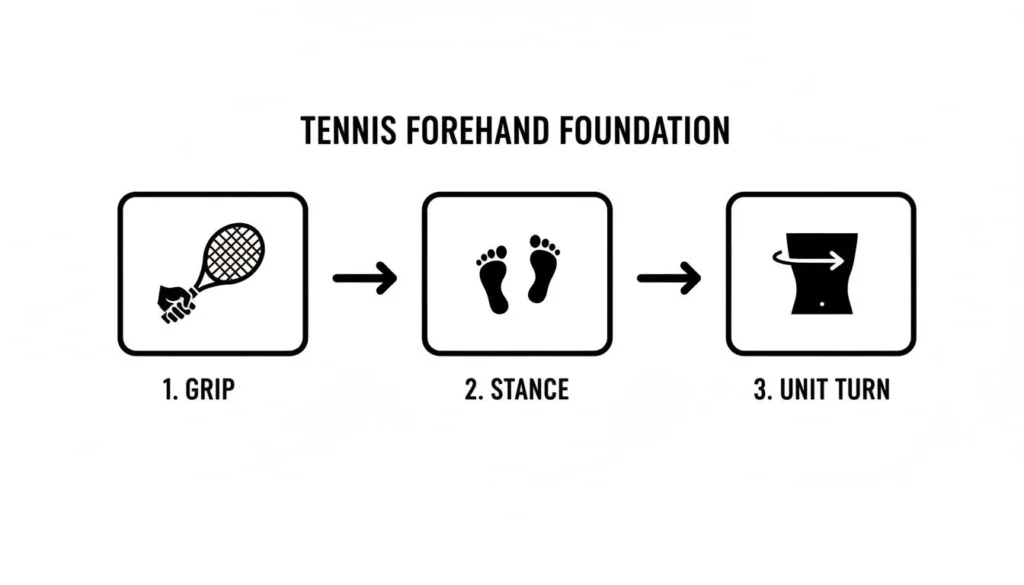
Nailing this sequence is absolutely critical. The right grip enables the proper swing path, and a balanced stance combined with a quick unit turn lets you generate power from the ground up.
The Take-Back: Setting Up for Power
The second you read that a forehand is coming your way, the prep work starts. Your very first move should be a unit turn—your feet, hips, and shoulders rotate as one solid unit to the side. As you turn, the racquet begins its take-back.
A huge mistake I see all the time is players yanking the racquet straight back like they’re trying to start a lawnmower. The modern forehand is all about a more compact, circular, or “C-shaped” path. The racquet head often comes up a bit before dropping down below the height of the incoming ball. This loop isn’t for show; it builds momentum and puts you in the perfect slot.
One of my biggest coaching takeaways is that players who can’t find their power usually have a take-back that’s way too long or straight. A tighter loop is just more efficient. It gives you incredible racquet head speed without having to muscle the ball.
Think of this circular path as building a longer runway for your racquet to accelerate. It’s pure physics, and it gets your swing started on the right track.
The Secret Sauce: Racquet Lag and Snap
This is it. This is the key to the effortless power you see from the pros. As your body starts to uncoil and rotate forward into the ball, the racquet head naturally “lags” behind your hand and wrist. For a split second, it drops down so the butt cap of your racquet is almost pointing at the ball.
This isn’t a conscious wrist flick. It’s the natural outcome of keeping your arm relaxed while your hips and torso explode through the rotation. Your arm is just coming along for the ride.
- Loading Phase: This lag stretches your forearm muscles just like a rubber band.
- Release Phase: As you swing through to contact, all that stored energy is unleashed in a “snap,” whipping the racquet head through the ball at insane speeds.
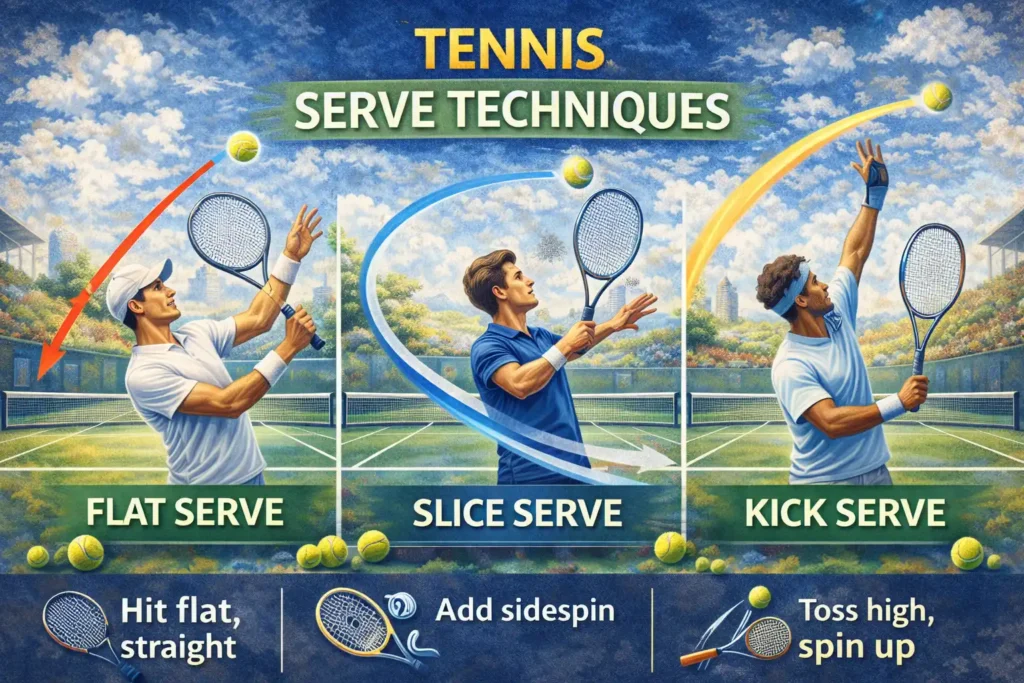
If you try to consciously “snap” your wrist, you’ll mess up your timing and risk injury. Instead, focus on a smooth, explosive uncoiling of your body. The lag and snap will happen on their own. Getting a feel for this is a massive breakthrough for any player. If you’re looking to bring this kind of pop to other shots, check out our guide on tennis serve techniques.
Finding Your Ideal Contact Point
Where you meet the ball changes everything. For the forehand, the perfect contact point is out in front of your body and at a comfortable distance to your side. Hitting the ball here is what allows you to transfer all your weight and power into the shot.
Here’s why that spot is so important:
- Too Late: If you hit the ball beside or behind your body, you’re all arm. You lose all your power, your racquet face opens up, and the ball sails long.
- Too Close: Jamming yourself means you can’t extend your arm or rotate properly. The result is a weak, pushed, and uncontrolled shot.
- Just Right: Contacting the ball out front allows for full arm extension, complete body rotation, and the feeling of hitting through the ball toward your target.
A great little mental trick is to pretend you’re going to “catch” the ball with your non-hitting hand. Then, swing to hit it right in that spot. This almost guarantees you make contact in that ideal power zone.
The Follow-Through: A Balanced Finish
The swing isn’t over when you hit the ball. The follow-through is a crucial part of the motion that does three things: it ensures you accelerated completely through the ball, it slows your arm down safely to prevent injury, and it gets you ready for the next shot.
After contact, let your arm continue extending toward your target before it naturally comes across your body. A classic finish spot is having the racquet wrap around your opposite shoulder or bicep.
Never, ever stop your swing abruptly after impact. A full, relaxed follow-through is the sign of a well-timed shot where you used your whole body and stayed balanced. It’s the perfect ending to a powerful forehand.
Actionable Drills to Ingrain Your Technique
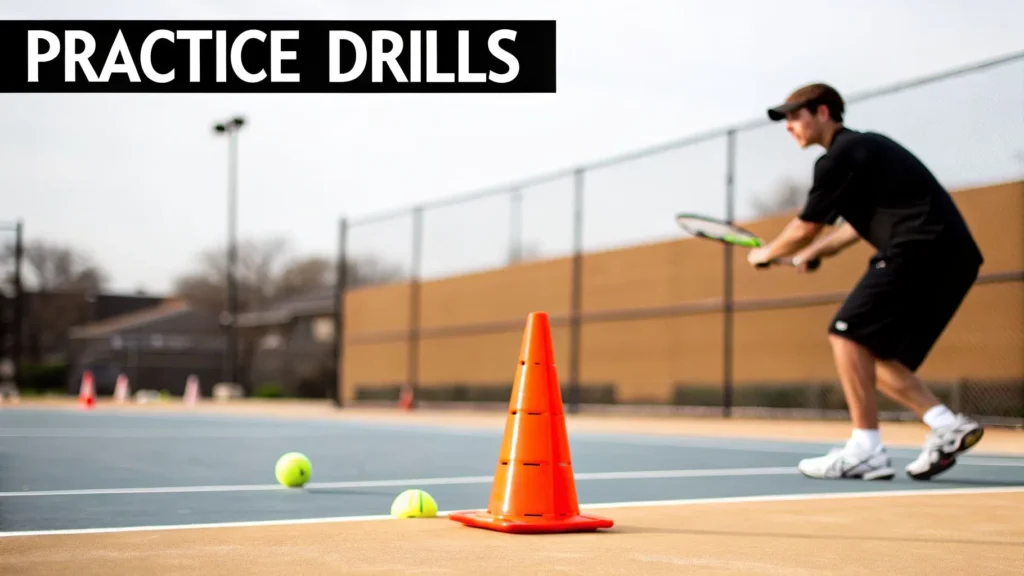
Knowing the theory behind a great forehand is just the start. The real work is turning that knowledge into a reliable shot you can hit under pressure without thinking. That only comes from one place: focused, repetitive practice. Drills are how you burn those correct movement patterns into your muscle memory.
We’ll start with the absolute basics to build a solid foundation and then gradually layer in movement and tactical pressure, just like you’d experience in a match.
Building Foundational Consistency
If you’re new to the game or trying to fix a major flaw, your first goal is simple: make clean contact, over and over again. We’re not worried about power yet. These drills are all about feeling the swing and finding that sweet spot.
Drill 1: Self-Feed Forehands
This is the most fundamental drill there is, and it’s non-negotiable for building good habits. All you need is a basket of balls.
- Stand near the service line. Drop a ball out in front and to your side.
- Let it bounce to a comfortable waist height.
- Focus on a simple unit turn and a smooth, low-to-high swing.
- Your only objective is to hit the ball over the net and land it deep in the other court.
Aim to hit 50-100 of these. This drill takes timing and footwork out of the equation, letting you focus 100% on the swing itself.
I see it all the time: players try to muscle the ball way too early. You have to resist that urge. Concentrate on keeping your arm relaxed and finishing your swing completely. A loose, full follow-through will give you much more depth and pace than a tense, jerky motion ever will.
Once you’re grooving on the self-feed, have a partner or coach toss balls to you from the other side. This adds a little bit of timing but still keeps your feet stationary.
Integrating Movement and Timing
Hitting a great shot while standing still is one thing. Doing it after moving to the ball is what tennis is all about. Now it’s time to get your feet involved.
Drill 2: The Figure-8 Forehand
This drill is a classic for a reason—it’s incredible for grooving your footwork and recovery. Put a cone on the center hash mark of the baseline.
- Your partner feeds a ball to your forehand.
- Move out, hit your forehand (aiming crosscourt is a good target), and immediately shuffle back around the cone to your starting spot.
- As soon as you’re back, your partner feeds the next ball. Repeat.
Pay attention to your footwork. Use small, quick adjustment steps to get into position, and then a strong crossover step to start your recovery. This drill builds the essential rhythm of a baseline rally. A study on player movement shows that efficient recovery can cut a player’s energy use by up to 15% in a long match. That’s a huge advantage.
Developing an Aggressive Weapon
With a consistent forehand now in your arsenal, it’s time to learn how to use it to control points. These drills add pressure, targets, and tactics to the mix.
Drill 3: The 2-on-1 Forehand Pressure Drill
This is a high-intensity drill that needs three players. One player (the feeder) is on one side, and two players are on the other.
- The feeder hits alternating balls to the two players across the net.
- The job of the two players is to hit every ball back to the single feeder, forcing them to run side-to-side.
- The feeder’s job is to try and force an error from the duo.
- Rotate positions after a set time (like 2 minutes) or a specific number of points.
This drill is a killer. It forces you to hit solid forehands when you’re tired and under constant pressure. You’ll quickly learn when to hit with depth to reset the point and when to go for an angle to end it. It’s the perfect way to practice hitting your best shot when your legs are burning and your heart is pounding.
How to Fix Common Forehand Problems
We’ve all been there. One day your forehand is your biggest weapon, and the next, you can barely keep it in the court. It’s one of the most frustrating parts of tennis.
But getting angry at a missed shot doesn’t fix it. Understanding why it happened does. This guide is your personal troubleshooter. Instead of just getting frustrated, you can start diagnosing the root cause on the fly and make an adjustment on the very next ball.
Let’s break down the most common forehand issues and give you some clear, actionable ways to get your best shot back on track.
Dumping Forehands Into the Net
There’s no feeling more deflating than setting up for a big forehand, only to watch it dive straight into the net. You feel like you did everything right, but the result was completely wrong. This almost always comes down to one of two simple mechanical flaws.
The first, and most common, culprit is making contact with the ball too late. When you let the ball get beside or even slightly behind your body, your racquet face will naturally close through the hitting zone, directing the shot straight down.
The second cause is dropping your racquet head too much in your backswing. A “low-to-high” swing path is crucial for topspin, but dipping the racquet too far can make you scoop the ball or hit the bottom half, which again, kills its trajectory.
- Fix Your Contact Point: Try some self-feed drills where your only goal is to meet the ball well out in front of your lead foot. A great trick is to use your non-hitting hand to point at the incoming ball, creating a visual target for where you need to make contact.
- Check Your Swing Path: Practice shadow swings in front of a mirror or have a friend film you. Watch your racquet path. Make sure it drops below the ball’s path but then rises to meet it squarely, not from underneath.
Sailing Forehands Long
Just as frustrating as netting the ball is spraying it long. You feel the power, but it’s completely uncontrolled, sailing past the baseline again and again. This almost always points to a problem with your racquet face angle or your overall swing path.
An open racquet face at impact acts like a ramp, launching the ball high with very little topspin to bring it back down into the court. This can be caused by a grip that’s not quite right for a topspin shot or, again, a late contact point.
The other big reason for hitting long is a flat swing. If your swing travels straight through the ball without much of an upward angle, you’re hitting a line drive. Without topspin—the force that makes the ball dip—you have almost no margin for error to land the shot in.
To get your shots back inside the lines, you need to focus on creating shape and spin.
- Brush the Ball: This is a powerful mental cue. Instead of thinking about hitting through the ball, imagine you’re brushing up the back of it. This simple thought encourages the low-to-high motion needed for heavy topspin.
- Aim Higher Over the Net: Set up a visual target about 5-6 feet above the net strap (a cone on a stick works perfectly). Your goal is to make your forehand clear this higher target. This forces you to create an arc on the shot, which will naturally bring it down deep inside the court.
A Frustrating Lack of Power
Do you feel like you’re swinging with all your might, but the ball just seems to float over the net? This lack of pace is rarely about raw arm strength. Real power in the tennis forehand technique comes from efficient kinetic energy transfer, starting from the ground up.
If you’re just arming the ball, you’re leaving about 70% of your potential power on the table. The force needs to come from your legs loading, your hips and torso rotating, and all that energy flowing up through your core into a relaxed arm and racquet.
Tension is the ultimate power killer. A death grip on the racquet and a tense arm will choke your swing speed. To unlock that effortless power, you have to think about being fluid and using your entire body.
Focus on a connected motion. Start by loading your outside leg, then uncoil your hips and shoulders explosively. Let your arm be the whip at the end of the chain, not the engine trying to do all the work.
Forehand Fault Finder: A Troubleshooting Guide
Every player has those days where the forehand just won’t cooperate. Instead of guessing, use this table to quickly diagnose what might be going wrong and find a concrete drill to fix it.
| Common Mistake | Likely Cause | Corrective Action or Drill |
|---|---|---|
| Ball goes into the net | Contact point is too late; Racquet face is closed at impact; Dropping racquet head too low. | Contact Point Drill: Self-feed and focus on meeting the ball in front of your body. Use your non-hitting hand to point to the contact zone. |
| Ball sails long | Racquet face is too open at impact; Swing path is too flat (not enough low-to-high); Grip may be too “open” (like Continental). | High Target Drill: Aim to hit the ball 5-6 feet over the net. This forces you to add shape and topspin to bring the ball down. |
| Shots lack power | “Arming” the ball instead of using your body; Too much tension in the arm and grip; Not loading the legs or rotating the hips/torso. | Medicine Ball Throws: Practice rotational throws to feel the power from your core and hips. Shadow swing focusing on a loose arm. |
| Shots are inconsistent/off-center | Watching the opponent or the target, not the ball; Pulling your head up too early; Unstable footwork. | “Read the Label” Drill: Exaggerate watching the ball onto your strings. Try to read the brand name on the ball as you hit it. |
| Ball shanks off the frame | Late preparation; Eyes not tracking the ball all the way to the strings; Incorrect spacing from the ball. | Footwork Focus: Hit mini-tennis, focusing only on taking small, precise adjustment steps to get in the perfect position for every shot. |
Think of this chart as your go-to reference on the practice court. By identifying the symptom (the mistake) and understanding the cause, you can apply the right solution and get your forehand back to being a reliable weapon.
Boosting Your Forehand With the Right Gear and Fitness
You can drill your tennis forehand technique for hours on end, but if your body and gear aren’t up to the task, you’ll eventually hit a frustrating plateau. A truly great forehand—the kind that’s both powerful and repeatable under pressure—is built just as much in the gym and during your equipment selection as it is on the court.
Think of it this way: your body is the engine that produces the power, and your racquet is the transmission that delivers it to the ball. A weak engine can’t generate speed, no matter how fancy the transmission. Let’s make sure both are working in perfect harmony.
Building a Tennis-Specific Engine
The modern forehand is all about explosive, rotational power. All that pace comes from the ground up, flowing through your body in what we call the kinetic chain. Your fitness routine needs to mirror that movement.
- Rotational Core Power: This is your pace generator. The explosive uncoiling of your hips and torso is what creates serious racquet-head speed. Medicine ball throws are the gold standard here. Stand sideways to a solid wall and throw the ball against it, mimicking the exact rotation of your forehand swing.
- Explosive Leg Strength: Your legs are the foundation. They load up your energy before you unleash it into the shot. Incorporate box jumps, squats, and lunges to build the raw power needed to drive through the ball.
- Shoulder Stability and Health: The shoulder is the most vulnerable joint in tennis. To protect it, you need to strengthen the small stabilizer muscles. Resistance band exercises, like external and internal rotations, are non-negotiable for long-term shoulder health.
A strong core and stable shoulders not only add miles per hour to your forehand but also significantly reduce your risk of injury. A consistent fitness regimen is your best defense against common tennis ailments.
Focusing on these key areas will make your swing feel more connected, athletic, and powerful. Taking the time to understand how to prevent sports injuries will also give you a great framework for staying on the court for the long haul.
Choosing a Racquet That Helps Your Forehand
Your racquet should feel like an extension of your arm, but the wrong specs can make it feel like you’re fighting your own equipment. The wall of racquets at a tennis shop can be intimidating, so let’s cut through the noise and focus on what really matters for your forehand.
Racquet Specs and Their Impact on Your Forehand
| Racquet Spec | How It Affects Your Forehand | Who It’s For |
|---|---|---|
| Head Size | A larger head size (100-110 sq. in.) provides a bigger sweet spot and more “free” power. A smaller head (95-98 sq. in.) offers pinpoint control and feel for those who find the middle. | Big sweet spots are perfect for beginners and intermediates. Advanced players who consistently strike the ball cleanly often prefer smaller heads. |
| Weight | A heavier racquet (11+ oz) plows through the ball, adding power and stability. A lighter racquet is easier to swing fast and offers great maneuverability, but can get pushed around by heavy shots. | Beginners usually start with lighter frames. Advanced players gravitate toward heavier frames for stability and power. |
| String Pattern | An open pattern (like 16×19) lets the strings bite the ball, generating massive topspin. A dense pattern (like 18×20) gives you more control and is better suited for flatter shots. | Open patterns are the go-to for most modern baseliners who live on topspin. Dense patterns are for players who prioritize precision over spin. |
Never just buy the racquet your favorite pro uses. Their frame is customized for their world-class mechanics and physique. The single best thing you can do is demo a few different racquets with varying specs to feel the difference for yourself. That hands-on experience is the only way to find the frame that will turn your forehand into a true weapon.
Your Questions About Forehand Technique Answered
After covering the fundamentals, drills, and common issues, players always have more specific questions about the tennis forehand technique. This section is designed to give you direct answers to clear up any lingering confusion about this critical stroke. Let’s get right into the most common queries.
Many players struggle with the finer points, like how much wrist to use, which stance is best, and the root cause of their shots sailing long. Nailing these details is often the final piece of the puzzle.
How Much Wrist Should I Use in My Forehand?
This is a major source of confusion for developing players. The wrist should be relaxed and fluid, but never floppy or consciously “snapped.” The explosive wrist action seen from professional players is almost always a natural result of the entire kinetic chain working correctly.
As you rotate your body and keep your arm loose, the racquet head naturally lags behind your hand. When you accelerate through the contact zone, this lag unwinds, creating a whip-like effect that generates immense racquet head speed.
A common mistake is to actively flick or snap the wrist. This is one of the fastest ways to develop timing problems and can even lead to injury. Instead, focus on a relaxed grip and powerful rotation from your hips and torso. Your arm should be the whip, not the engine.
The wrist’s job is to stay supple and allow this transfer of energy, not to be the primary source of power itself.
Should I Use an Open or Closed Stance?
The correct stance is entirely situational. Modern tennis heavily favors the open and semi-open stances, and for good reason. They enable faster recovery and more powerful rotation, particularly when you’re short on time or pulled wide by your opponent.
- Open Stance: This is your primary stance for returning serves, playing defense, and hitting on the run. It allows for effective loading of the outside leg and explosive rotation without a full step-in.
- Neutral (Closed) Stance: Still very important when you have time to set up. Getting sideways to the net lets you transfer your weight linearly into the ball, which is ideal for driving shots down the line or hitting an approach shot.
- Semi-Open Stance: A versatile hybrid offering a great mix of rotational power and linear weight transfer.
Top players don’t commit to a single stance. The key to versatility is learning which one to use for the ball you’re given.
Why Do My Forehands Keep Going Long?
Hitting forehands beyond the baseline is a frequent problem that usually points to one of two main causes: an incorrect contact point or an improper swing path. If your shots consistently fly long, you are not generating enough topspin to bring the ball down into the court.
You may be making contact too late (behind your body), which causes your racquet face to open at impact. This turns your racquet into a ramp, launching the ball on a high, flat trajectory with little margin for error.
Another possibility is that your swing path is too horizontal or “flat.” A swing that just drives straight through the ball produces a line drive, which requires perfect height over the net to land in.
Actionable Tip: Instead of thinking about hitting through the ball, a better mental cue is to focus on brushing up the back of it. This encourages a low-to-high swing path, which is essential for creating the heavy topspin that makes the ball dive down well inside the baseline.
What Is the Best Way to Get More Power?
This is the question every tennis player eventually asks. The answer is rarely “swing harder with your arm.” Real power comes from using your entire body as a unit, starting from the ground up. If you feel like you are muscling the ball, you are not tapping into your body’s full potential.
The proper power sequence is as follows:
- Load the Legs: Begin by bending your knees and loading your weight onto your outside leg.
- Explode with the Core: The swing should be initiated by a forceful rotation of your hips and torso toward your target.
- Transfer the Energy: This rotational energy flows from your core, into your shoulder, down a relaxed arm, and finally into the racquet head.
Tension is the enemy of power. A tight grip and a stiff arm will actively slow your swing speed. Concentrate on staying loose and fluid, letting the large muscles in your legs and core do the work.
We hope these answers help you fine-tune your forehand and build more confidence on the court. For more deep dives into sports, health, technology, and more, explore the daily articles at maxijournal.com. Discover fresh perspectives and practical guides at https://maxijournal.com.
Discover more from Maxi Journal
Subscribe to get the latest posts sent to your email.