A truly great serve is more than just the first move of a rally—it’s your first attack. Mastering the different serves, from the fundamental underhand serve and tricky float serve to the aggressive topspin jump serve, turns the service line into a weapon. Each one gives you a different way to put pressure on the other team and score points before the rally even gets going.
To give you a quick overview, here’s a breakdown of the main serves you’ll see on the court. This table summarizes their unique traits and where they fit best.
Quick Guide To Volleyball Serving Techniques
| Serve Type | Key Characteristic | Difficulty Level | Best For |
|---|---|---|---|
| Underhand Serve | High arc, easy to learn | Beginner | Young players and beginners learning control |
| Float Serve | No spin, unpredictable movement | Intermediate | Disrupting passers and forcing errors |
| Standing Topspin | Aggressive forward spin | Intermediate | Applying pressure with pace and a sharp drop |
| Jump Serve | Maximum power and topspin | Advanced | Overpowering the defense for aces |
Each serve has its place, but they all start with a solid foundation. Let’s dig into the core mechanics that every server needs to master.
Building Your Serve From The Ground Up
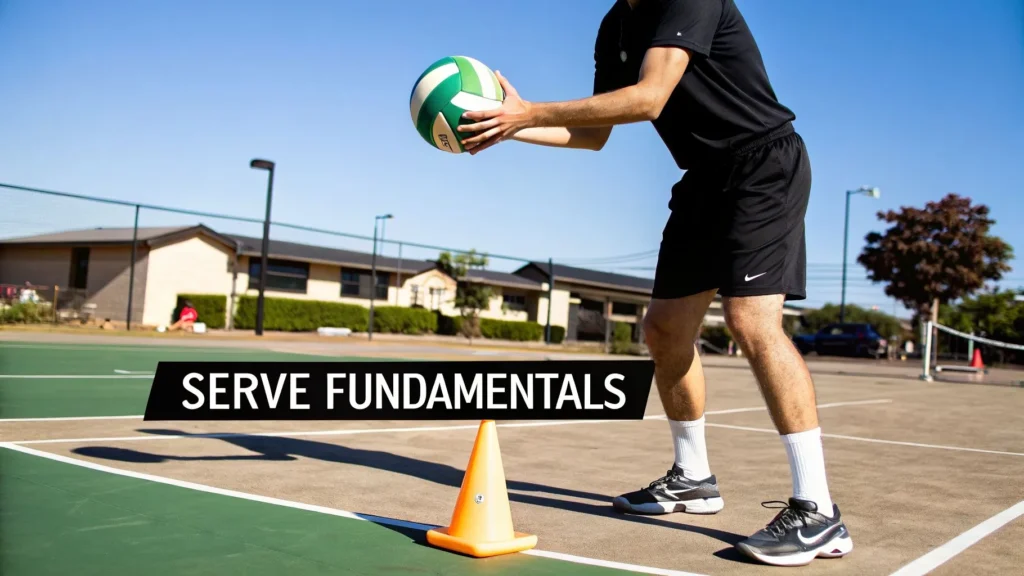
Before you can drop a nasty float serve or pound a jump serve, you have to lock in the fundamentals. We’re going to build the universal habits that make a server consistent and dangerous. This is your blueprint for turning a simple serve into a point-scoring weapon.
Craft a Pre-Serve Routine
Every top-tier server has a pre-serve routine. It’s not just a ritual; it’s a critical tool for resetting your mind and body, ensuring consistency when the pressure is on.
Your routine doesn’t need to be complicated, but it must be the same every time.
- Deep Breathing: Take a slow, deep breath to bring your heart rate down. A popular technique is box breathing: inhale for four seconds, hold for four, exhale for four, and hold for four. It’s incredibly effective for focus.
- Visualization: Close your eyes for a split second and see the ball flying exactly where you want it. Picture it dropping into that perfect open spot.
- Physical Cues: Bounce the ball 3 times. Spin it in your hands. These small, repeatable actions tell your body and brain it’s time to execute.
A consistent pre-serve routine is your secret weapon against pressure. It creates a bubble of focus, allowing you to execute the skill you’ve practiced thousands of times, regardless of the score.
Perfect Your Toss
The toss is everything. I can’t say it enough: an inconsistent toss is the number one reason for serving errors. The goal is simple but difficult—a perfect, repeatable toss that puts the ball in your hitting zone every single time.
For a float serve or standing topspin, you want a low, precise toss. Think just a foot or two above your head and slightly in front of your hitting shoulder. This lets you make quick, direct contact.
For a jump serve, the toss needs more air. It should be higher and farther in front of you, giving you enough time to execute your approach steps and jump into the ball with full power.
Understand the Biomechanics of Power
Real serving power doesn’t come from your arm; it comes from the ground. It’s a full-body kinetic chain. Your stance, core engagement, and footwork are what generate true velocity.
Start with a balanced stance, your weight loaded on your back foot. This sets you up for an explosive transfer of energy forward as you contact the ball. Your core is the bridge that moves that power from your legs to your shoulder and arm.
As you start your arm swing, a powerful core rotation adds serious heat to the serve. To truly grasp how your body creates force, it’s worth exploring the core principles of biomechanics in sports. This knowledge helps you unlock effortless power instead of just trying to muscle the ball over the net.
Mastering The Deceptive Float Serve
If a powerful jump serve is a sledgehammer, the float serve is a scalpel. It’s the ultimate weapon for creating chaos and forcing easy points. While other serves rely on sheer speed, the float’s magic comes from its wild, unpredictable movement. It dances, dips, and swerves, making life an absolute nightmare for the other team’s passers.
The entire secret is to serve the ball with zero spin. Without rotation to stabilize it, the ball gets pushed around by air currents, creating that signature “float.” This isn’t about hitting it hard; it’s about hitting it clean. Let’s break down how you can add this deceptive serve to your arsenal.
Creating a No-Spin Contact
Everything starts and ends with the moment your hand meets the ball. To kill the spin, your hand has to be a firm, flat surface making a perfect connection.
First, get your hand position right. Press your fingers together, tucking your thumb against the side of your hand to create a solid paddle. You absolutely cannot have spread fingers or a cupped palm—that’s a recipe for unwanted spin. Think of your hand as a rigid board, not a soft glove.
The secret to a killer float serve isn’t power—it’s precision. A clean, flat contact on the center of the ball is what creates the unpredictable movement that gives passers nightmares.
The Low Toss and Punch
With your hand set, the next pieces of the puzzle are the toss and the hitting motion. These two have to work in perfect harmony.
For a float serve, you want a low, consistent toss. A high toss just adds more variables and makes you swing instead of punch, which almost always adds topspin. Aim for a simple toss just a foot or two above your head, placed right in front of your hitting shoulder. Nailing this consistency is a cornerstone of any effective volleyball serving technique.
Your arm motion is less of a swing and more of a quick, firm “punch” straight through the ball.
- Mental Cue: Imagine you’re trying to push a button on a wall directly in front of you. It’s a direct, forward motion, not a looping swing.
- Arm Action: Drive your arm in a straight line toward the ball. The follow-through should be extremely short—or better yet, non-existent. Stop your hand the instant you make contact. A long, wrapping follow-through is the number one cause of spin.
- Contact Point: You want to connect with the dead center of the ball using the heel of your palm. That solid, bony part of your hand is perfect for transferring force cleanly without making the ball rotate.
Common Errors and Simple Fixes
Even with the right idea, it’s easy for small mistakes to creep in and ruin your float. Here’s a quick guide to diagnosing and fixing the most common problems I see.
| Problem | Likely Cause | Correction |
|---|---|---|
| Ball has topspin | You’re following through and snapping your wrist over the ball. | Focus on “freezing” your arm at the point of contact. Really commit to the punch motion and stop your hand immediately. |
| Ball has sidespin | Your contact is off-center, or your hand isn’t perfectly flat. | Get a few feet from a wall and practice punching the ball. Your goal is to see it rebound straight back with zero spin. |
| Serve is inconsistent | The toss is all over the place—too high, too far left or right. | Just practice the toss. Seriously. Toss the ball 10 times in a row and let it land in the exact same spot before you even think about hitting it. |
Drills to Master the Float
You can’t just think your way to a great float serve; you need to build muscle memory through repetition. These drills are my go-to for developing a nasty float.
The Wall Serve drill is fantastic for instant feedback. Stand about 10-15 feet from a solid wall and perform your float serve. Focus completely on that flat, punchy contact. If the ball comes straight back to you with no spin, you nailed it. If it spins off to the side, you know your contact wasn’t clean.
Another great one is Partner Distance Serving. Start close to the net and serve floats back and forth with a partner. Once you can consistently deliver a no-spin ball, each of you takes a step back. Keep increasing the distance until you’re behind the service line, all while maintaining that perfect, clean contact. This drill teaches you to add power gradually without letting your technique fall apart.
Executing The Aggressive Topspin Jump Serve
When you’re ready to score points directly from the service line, the topspin jump serve is your go-to. This is the serve that brings the heat, combining raw power with a heavy, diving trajectory that’s designed to handcuff passers and rack up aces. It’s definitely an advanced skill, but mastering it makes you an immediate threat every time you step back to serve.
Unlike the unpredictable float serve, the topspin has a much more stable and predictable flight path. Its power comes from pure speed and a dramatic, sharp drop as it clears the net. This gives passers a fraction of a second to react with almost zero room for error. Let’s break down how to build this serve from the ground up.
Building The Rhythmic Approach
All the power in a jump serve comes from a well-timed, explosive approach. It’s not just about running fast and jumping high; it’s a fluid rhythm that builds momentum from start to finish. For a right-handed server, the standard approach is a three-step sequence: left, right, left.
You can think of it just like a spike approach, but you’re starting further back and have to generate all the momentum yourself.
- First Step (Left): This is your timing and directional step. As you toss the ball, you’ll take a slow, controlled step with your left foot to get your body moving toward the court.
- Second Step (Right): Now it’s time to accelerate. This step should be longer and more explosive, starting to lower your center of gravity so you can load up for the jump.
- Final Step (Left): This is the “plant” or “close” step. You bring your left foot forward to meet your right, planting both feet firmly to transfer all that forward momentum into a powerful vertical jump.
Keeping this motion smooth is absolutely crucial. If your approach is choppy or you hesitate, you’ll lose a ton of power before your feet even leave the floor.
A great topspin jump serve feels like an attack from behind the end line. The goal is to contact the ball at the absolute peak of your jump, hitting down into the opponent’s court.
The Art of The High Toss
The toss is, without a doubt, the make-or-break element of a great jump serve. If your toss is inconsistent, your serve will be, too. For this serve, you need to toss the ball high enough and far enough in front of you to allow for a full approach and jump into the ball.
As you take your first approach step, toss the ball up with your non-hitting hand. A good benchmark is to aim for about 8-10 feet high and a few feet inside the court. This placement is key because it forces you to move forward and be aggressive. If your toss is too low or too close to your body, you’ll end up jumping straight up and down, which almost always results in hitting the ball into the net.
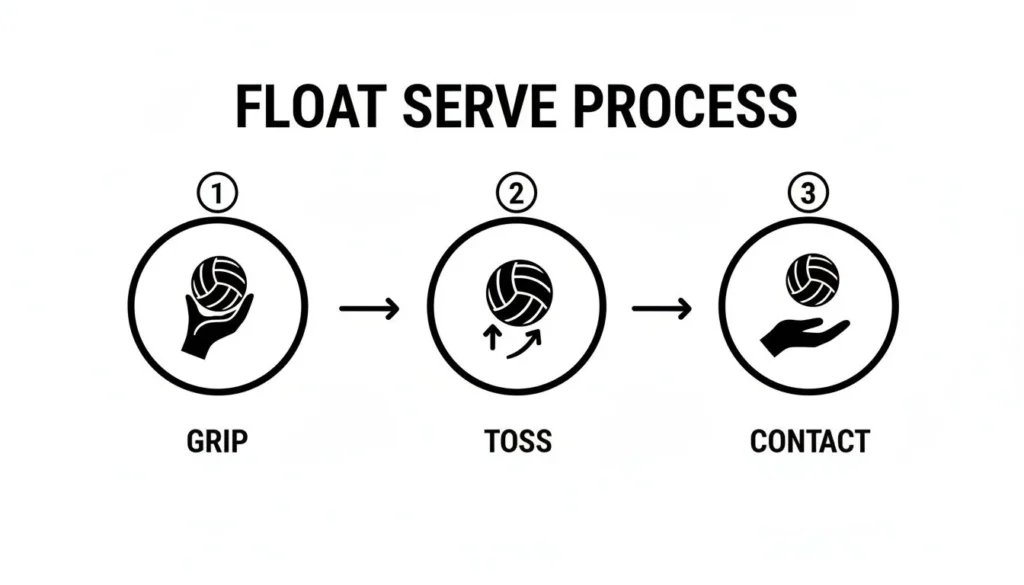
While the image above shows the float serve, which is built on entirely different principles, it’s a good visual reminder of the basic components. Where the float serve demands flat, no-spin contact, the topspin requires the exact opposite motion to create that signature dive.
Generating Spin With The Arm Swing and Wrist Snap
As you explode upward into your jump, your body should be coiling like a spring. Draw your hitting arm back into a “bow-and-arrow” position, keeping your elbow high. Your non-hitting arm should point toward the ball to help with balance and aiming.
The real power comes from your whole body rotating through the hit. Your core and shoulder open up during the jump, then violently snap forward as you swing to meet the ball. The final piece of the puzzle is the wrist snap.
- Open Hand Contact: You’ll strike the ball with a firm, open hand, making contact on the upper half of the ball.
- Aggressive Wrist Snap: Right at the moment of contact, you have to forcefully snap your wrist over the top of the ball. This is what generates all that heavy topspin. A good cue is to think about making the ball roll forward off your fingertips.
- Full Follow-Through: Unlike a float serve where you stop your hand, a topspin serve requires a complete, powerful follow-through. Let your arm swing naturally down and across your body after contact.
It’s the combination of a fast arm swing and that aggressive wrist snap that creates a serve that drops like a rock. The mechanics are different, but the core concept of generating spin through contact is central to other sports, too. If you’re curious about how these principles apply elsewhere, our guide on advanced tennis serve techniques offers some interesting parallels.
Progression Plan For The Jump Serve
Trying to go from zero to a full jump serve is a quick way to get frustrated. The key is to build the skill piece by piece using a smart progression.
- Start with Standing Topspin Serves: Before you even worry about jumping, just stand at the service line. Practice the high toss, arm swing, and wrist snap. Your only goal is to consistently create heavy topspin that makes the ball drop sharply over the net.
- Introduce the Approach: Once you can reliably hit a standing topspin, start adding the footwork without the jump. Just walk through your three steps, toss the ball, and hit it while keeping your feet on the ground. This drill is all about syncing your toss with your approach steps.
- Combine and Conquer: Finally, you can put it all together. Start with a more controlled approach and a smaller jump. The focus here should be on good timing and clean contact, not on hitting it as hard as you can. As your timing and confidence improve, you can slowly ramp up the speed of your approach and the power of your swing to build a truly intimidating serve.
How The Modern Serve Became An Offensive Weapon
Gone are the days when a serve was just a way to get the point started. In modern volleyball, the serve is the first attack. This massive strategic shift has turned the service line into a prime scoring area, completely changing how the game is played and coached. A serve is no longer about just getting the ball over the net; it’s about ending the rally before it even gets going.
You can see this evolution clearly in the rise of highly specialized serves, like the brutal jump serve and the tricky jump float. These aren’t just minor variations in technique—they represent a fundamental change in volleyball philosophy. Today, entire team strategies are built around how to handle an opponent’s tough serve or how to score with your own.
The Rise Of The Offensive Serve
This shift isn’t just something coaches feel in their gut; the data backs it up. A massive analysis of 15,347 serves in top-tier competition showed just how much the game has tilted towards aggression. In that study, a staggering 69.9% of all serves were power jump serves, with another 26.9% being jump floats. The days of the simple “get it in” serve are long gone. You can dig into more of these fascinating stats on the effectiveness of different serves in volleyball.
This tells a story that every player and coach knows all too well: a nasty serve is one of your best weapons. The objective has moved far beyond just avoiding a service error. Now, the goal is to create an immediate advantage, either by scoring a clean ace or, just as importantly, forcing the other team into a sloppy, out-of-system pass.
Contrasting Styles: Men’s vs Women’s Volleyball
While every team wants an aggressive serve, how they achieve it often looks different in the men’s and women’s games. These differences come down to distinct strategic approaches that play to different physical strengths and game dynamics.
In the elite men’s game, the power jump serve is king. It’s pretty common to see serves screaming over the net at speeds of over 120 km/h (75 mph). At that velocity, the strategy is simple: brute force. The server is trying to overpower the passers with sheer speed, giving them only a split second to react.
- Men’s Game Focus: Overwhelming power, extreme velocity, and heavy topspin that drives passers back on their heels.
- Common Outcome: More aces and outright reception errors, but this high-risk approach also leads to more service errors.
The women’s game, on the other hand, often showcases a more tactical and varied serving arsenal. Power jump serves are definitely a factor, but the jump float is a much more prevalent weapon. The strategy here isn’t about raw speed, but about creating total chaos with unpredictable ball flight.
- Women’s Game Focus: Deception, pinpoint targeting, and generating that “no-spin” movement that makes the ball wiggle and drop unexpectedly.
- Common Outcome: Fewer clean aces, but a much higher rate of forcing “out-of-system” plays where the other team can’t run their preferred offense.
Remember, the goal of an offensive serve isn’t always an ace. Forcing the opponent into a predictable, high-ball attack that your blockers can easily read is a huge win. That’s the tactical genius of a well-placed float serve.
Reading The Court And Exploiting Weaknesses
Beyond just having a good serve, elite servers play a mental game. The best in the world don’t just blast the ball; they read the court and make smart, calculated decisions. Before every single serve, they’re running through a quick mental checklist to find the best target.
They’re actively hunting for weaknesses in the other team’s passing formation. Is a front-row hitter who’s known for shaky passing in the rotation? Is there a big gap (a “seam”) between two passers? Does one player have a history of shanking float serves or overpassing hard-driven balls?
This is where serving turns into a game of chess. A server might see a passer creeping in a few steps, trying to anticipate a short serve. The server’s adjustment? A deep, driving ball to the corner that forces a last-second, off-balance play. Once you start thinking in these strategic layers, your serve transforms from a repetitive motion into a calculated weapon that can dismantle an opponent’s entire system.
Troubleshooting Common Serving Mistakes
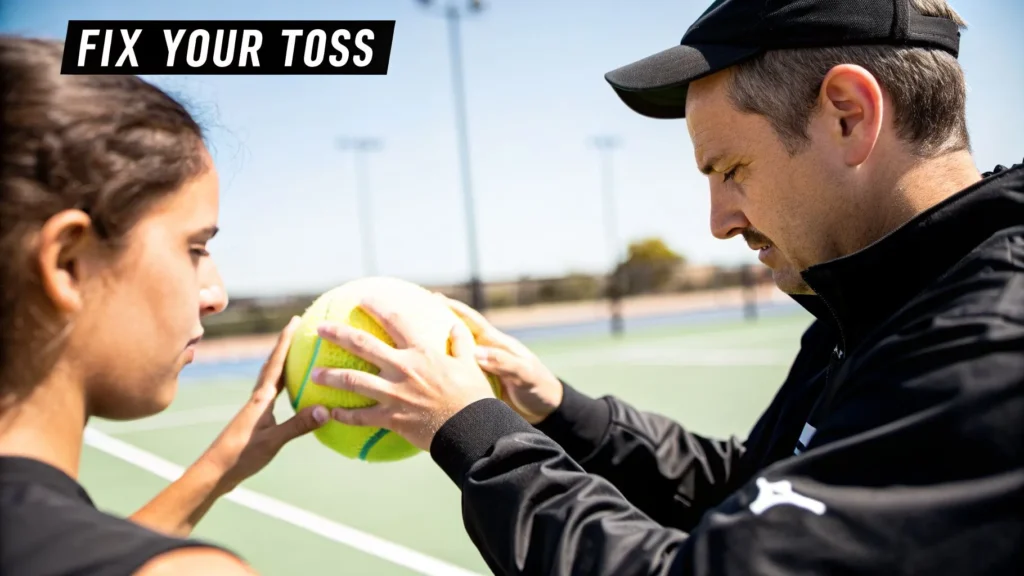
Even the best servers fall into bad habits. A tiny change in your toss or a lazy follow-through on a float serve can be the difference between an ace and a frustrating error. This is your guide to diagnosing and fixing the most common issues that sneak into every player’s game.
We’ll break down why these mistakes happen and give you some simple, effective drills to get your serve back on track. Think of it as a quick coaching session you can take to the court.
The Inconsistent Toss
Let’s be blunt: an erratic toss is the root of over 80% of serving errors. If the ball isn’t in the right spot, your body has to make a split-second adjustment, killing any chance you have of making consistent, powerful contact.
So what’s going wrong? Often, it’s tossing the ball from your palm instead of your fingertips. This causes the ball to roll, adding unwanted spin and making its path unpredictable. Another common culprit is flicking your wrist, which sends the ball too high or, even worse, behind you.
The solution is to strip it all back. Practice your toss without even hitting the ball.
- Toss and Catch: Stand at the service line and simply toss the ball up as if you were about to serve. Let it fall to the ground. Your goal is for it to land in the same small area every single time, just slightly in front of your hitting-side foot.
- Use a Flat Hand: Hold the ball on a platform of your spread fingers, not cupped in your palm. The tossing motion should be a smooth lift of your entire arm from the shoulder, not a flick of the wrist or elbow.
My Float Serve Keeps Spinning
The whole point of a float serve is to have zero spin. That’s what creates the unpredictable, dancing movement that gives passers so much trouble. If your “floater” is spinning, you’ve lost the magic, and the problem is almost always your contact and follow-through.
When players try to muscle up for more power, they often slip back into a full arm swing and instinctively snap their wrist over the top of the ball. That’s a topspin motion, and it’s the number one killer of a good float serve.
A true float serve is a “push” or a “punch,” not a swing. The key is to stop all motion the instant you make contact. A long follow-through will always create spin.
The Fix: Stand about 5-10 feet from a wall. Using your float serve motion, punch the ball into the wall. Does it come straight back to you with no rotation? Perfect. If it careens off to the side with spin, your contact wasn’t clean, and you probably followed through.
My Jump Serves Always Hit The Net
There’s nothing more deflating than building up for a massive jump serve only to have it slam into the net. This error almost always points to an issue with your toss placement or timing.
If your toss is too low or not far enough out in front of you, you’re forced to jump straight up, not forward and up. This vertical-only leap robs you of your forward momentum. To get the ball over, you have to swing down sharply, but there’s no power carrying it deep into the court. The result? The ball dies right at the net.
The Fix: First, get your standing topspin serve perfect. This ingrains the feeling of snapping your wrist over the ball to create that downward arc. Once that’s solid, progress to a one-step approach. Focus on tossing the ball higher and further in front of you, forcing you to take an explosive step and jump forward to meet it.
| Common Problem | Diagnostic Question | Corrective Action |
|---|---|---|
| Serve goes long | Are you contacting the ball too far underneath? | Make contact slightly higher on the ball’s equator and snap your wrist more aggressively over the top to create a sharper downward angle. |
| Serve is weak | Is your approach slow or hesitant? | Focus on accelerating through your last two steps. A faster approach directly translates to a more powerful jump and a faster arm swing. |
| Inconsistent contact | Are you jumping under the ball? | Your toss is likely too far behind you. Focus on tossing the ball further into the court, forcing you to stay behind it. |
Fixing these flaws takes patience and a willingness to break the serve down into its smallest parts. Remember, persisting with bad mechanics not only leads to errors but can also put unnecessary strain on your shoulder and back. For more on staying healthy on the court, read our guide on how to prevent sports injuries.
Your Questions On Serving Answered
Alright, let’s get into the questions I hear all the time from players and even other coaches about serving. Perfecting your form is one thing, but a lot of the battle is mental, and specific little issues can pop up along the way.
From what actually makes a serve “tough” to just how long it takes to get that killer jump serve, these are the real-world answers you need to get past those plateaus at the service line.
What Is The Hardest Serve To Return In Volleyball
You’d think it’s the blazing, high-speed jump serve that tops the list, but it’s not. The serve that gives even the most elite passers consistent nightmares is a well-executed jump float. The reason is one simple word: unpredictability.
A power topspin serve, while incredibly fast, flies on a pretty predictable arc. A good passer can read the server’s body, anticipate the trajectory, and get into position. A great jump float, on the other hand, is pure chaos. It has high velocity but zero spin.
This lack of rotation lets the ball get grabbed by air currents, causing it to “dance,” dip, or swerve violently at the last possible second. A passer can be in the perfect spot, only to have the ball suddenly drop a foot or dart sideways, resulting in a shanked pass or a clean ace. It’s the ultimate weapon for forcing errors and getting easy points.
How Can I Make My Volleyball Serve More Powerful
Generating real power on your serve is a full-body job—it’s not about just having a strong arm. If you’re just trying to muscle the ball over the net with your shoulder, you are leaving so much speed on the table. Power is a chain reaction that starts the moment your feet move.
To add some serious heat to your serve, you have to connect these three pieces:
- Use The Ground: Your power starts in your legs. For any serve type, you need a strong, explosive drive from the ground up, channeling that energy into your hip and core rotation. For a jump serve, this is non-negotiable; a faster approach and a higher jump translate directly into a harder-hit ball.
- Whip Your Arm: Don’t think of it as a push; think of your arm as a whip. It should be loose and fluid, building speed throughout the swing and culminating in a violent, fast snap right at contact. A slow, hesitant arm swing will kill your power every time.
- Find The Sweet Spot: Clean contact is everything. You have to hit the ball squarely to transfer all that energy you’ve built up. For a topspin, that means an open-hand smack on the upper-middle half of the ball. For a float, it’s a firm, flat palm strike right in the center. Any off-center hit just bleeds power away.
So many players get obsessed with just swinging their arm faster. Remember this: your legs and core build the power; your arm just delivers it. Without that foundation, a fast arm swing means nothing.
How Long Does It Take To Master A Jump Serve
This is the big one, and the only honest answer is: it’s a long road. There’s no magic number, but we can map out a realistic timeline for what it takes to build one of the most complex skills in volleyball.
Just learning the basic mechanics—getting the toss, approach, jump, and contact to sync up—and serving with some consistency can take a few months of dedicated work, practicing 3-4 times per week. In this initial phase, you’re just trying to make it all happen in the right order without looking like a mess.
But true mastery? That’s a multi-year journey. Mastery means the serve is a reliable weapon you can pull out in the tightest moments of a match, not just something you can hit in practice. It’s about power, precision, and confidence under pressure.
A Realistic Progression Timeline
You can’t just start jumping and swinging. The process is layered. You have to master the topspin contact from a standing position first to get the feel for the wrist snap. From there, you add the footwork of the approach, but without the jump. Only then do you start putting it all together—the toss, the approach, the jump, and the swing.
Progress is never a straight line. You’ll have incredible days where your timing feels perfect, followed by days where you can barely keep the ball in the court. The only way forward is consistent, deliberate practice. Focus on one small piece of the motion at a time. That’s how you build a masterful jump serve over seasons, not just weeks.
At maxijournal.com, we are dedicated to bringing you clear, expert insights on everything from sports science to the latest trends. Explore our diverse collection of articles to satisfy your curiosity and stay informed. Discover more on maxijournal.com.
Discover more from Maxi Journal
Subscribe to get the latest posts sent to your email.