Ever watched a top-tier player and wondered how the ball seems glued to their feet? It’s no accident. It’s the result of mastering fundamental soccer dribbling techniques, turning them from just another player into a constant threat on the pitch.
This guide is built from real on-field experience to help you become that dynamic, confident player, no matter your current skill level.
The Art of Keeping the Ball on a String
Dribbling isn’t just about running fast with a soccer ball. It’s a constant dialogue between you and the ball, a skill that blends soft touch, sharp instincts, and a real understanding of the game.
When you get it right, you control the match’s tempo, create scoring chances from nothing, and weave through tight defenses.
I’ve seen it time and time again on the field: the best dribblers aren’t necessarily the ones with the flashiest moves. They’re the ones who have an almost intuitive feel for the ball, knowing exactly how to make it do what they want, when they want.
More Than Just Fancy Footwork
Every dribble needs a purpose. You have to ask yourself why you’re taking a player on. Are you trying to open up a lane for a shot? Pull a defender out of their position to create space for a teammate? Or just shield the ball and keep possession under pressure?
Each one of those situations calls for a completely different technique. We’ll get into all of it—from the basic inside-outside touches that form your foundation to the body feints and step-overs that can break ankles. The idea is to give you a full set of tools to use in actual games.
Dribbling isn’t just about beating a player one-on-one; it’s about making the right decision with the ball at your feet. True mastery comes when you know when to dribble, when to pass, and when to shoot.
What We’ll Cover
This guide gives you practical, step-by-step instructions designed for players ready to put in the work. Here’s what we’re going to break down:
- Core Fundamentals: Using the inside and outside of your foot for total control.
- Advanced Deception: The mechanics behind moves like step-overs and body feints.
- Game Intelligence: How to use changes of pace and direction to unbalance defenders.
- Tactical Application: Putting your skills to use in real-match scenarios.
Let’s start by laying the groundwork. The table below provides a quick overview of the essential techniques every player needs. Think of this as your cheat sheet before we dive deep into each one.
Core Dribbling Techniques at a Glance
Here is a quick summary of fundamental soccer dribbling techniques and their primary in-game purpose to get you started.
| Technique | Key Body Part | Primary Purpose |
|---|---|---|
| Inside Touch | Inside of the foot | Close control, shielding, slight direction changes |
| Outside Touch | Outside of the foot (laces) | Pushing the ball into space, quick acceleration |
| Sole Roll | Bottom of the cleat (sole) | Changing direction sharply, manipulating the ball in tight spaces |
| The Cut | Inside or outside of the foot | Abruptly stopping and changing direction to evade a defender |
| The Feint | Hips, shoulders, and eyes | Deceiving an opponent without touching the ball |
These are the building blocks. Once you get comfortable with how and when to use them, you’ll be ready to start combining them into the fluid, effective dribbling you see at the highest levels.
Building Your Foundation With Essential Touches
Every jaw-dropping dribble you’ve ever seen, from ankle-breaking cuts to lightning-fast runs, is built on two simple touches. Forget the complex, highlight-reel stuff for now. True mastery starts here, by making the ball an extension of your foot.
The goal is to get so comfortable that you don’t even have to think about the ball anymore. It all starts with the inside and outside of the foot. These are your bread and butter.
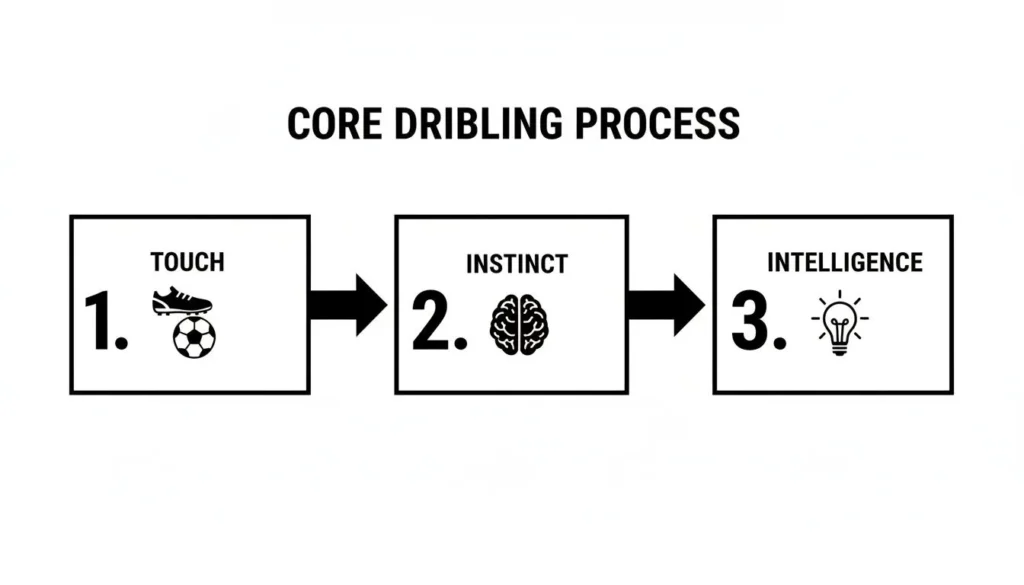
As you can see, a simple physical touch is what eventually leads to smart, instinctive decisions on the field. Once the touch becomes second nature, your brain is free to focus on the game itself.
Mastering the Inside Touch for Control
Think of the inside of your foot as your tool for tight spaces and control. It’s what you use when a defender is breathing down your neck, you need to shield the ball, or you want to make a small, precise change of direction.
Picture a defender lunging at you from your right. A soft touch with the inside of your left foot is all you need. It pulls the ball away from their challenge, uses your body as a shield, and opens up a new lane to your left. It’s not flashy, but it’s incredibly effective for keeping possession.
Using the Outside Touch for Acceleration
If the inside touch is about control, the outside of your foot is your gas pedal. This is how you create space and explode past defenders. A firm push with the outside of your foot—right on the laces—propels the ball forward into open grass.
Imagine you’re in a footrace with a defender on your shoulder. A quick poke forward with the outside of your far foot knocks the ball ahead and away from them. That simple move forces the defender to turn their hips, giving you the split-second advantage needed to break away.
The secret to effective dribbling isn’t just touching the ball; it’s how and when you touch it. A soft inside touch invites a defender in, while a sharp outside touch says goodbye.
Your Dribbling Posture and Vision
Of course, the touches are only part of the equation. Your body position is just as critical. You need to get a low center of gravity by bending your knees and staying light on the balls of your feet. This keeps you balanced, ready to absorb contact, or change direction in an instant.
And just as important—keep your head up. Every coach yells it for a reason. When your eyes are up, you stop being a ball-watcher and start being a playmaker. You can see everything:
- Defensive Gaps: The open lanes to attack.
- Teammate Runs: The perfect time to make a killer pass.
- Goalkeeper Positioning: A surprise chance for a shot from distance.
You’ll naturally glance down at the ball, but your main focus has to be the field ahead. This is how simple control turns into a powerful tactical weapon. Once you feel comfortable, you can start integrating these skills with team play by checking out our guide on football passing drills for youth.
Having the ball at your feet is one thing. Making a defender look silly is another. Once you’ve mastered keeping the ball close, it’s time to learn how to sell a lie with your body. Feints and fakes are how you unlock defenses, creating that crucial yard of space by making an opponent think you’re going one way when you’re really going another.
These aren’t just flashy tricks you see on highlight reels; they are fundamental tactical weapons. The magic isn’t in the move itself, but in the setup. It’s a deceptive dance where you use your eyes, shoulders, and hips to force a defender off-balance, giving you the split second you need to blow past them.

The Art of the Body Feint
The most effective fake in the game often involves not touching the ball at all. The body feint is pure deception, using your body weight and a dropped shoulder to suggest movement in one direction before you explode into another. It’s so effective because it exploits a defender’s core instinct: to mirror their attacker.
Picture it: you’re running straight at a defender. You take a sudden, sharp step to their left and drop your left shoulder hard, as if you’re about to take off down that side. The moment they shift their weight to follow you, you use the outside of your right foot to push the ball past their right and accelerate into the space you just manufactured.
When to Use a Body Feint:
- In a Crowded Midfield: To open a passing lane when there’s no room for extra touches.
- Facing a Defender Head-On: Ideal for 1v1 situations where the defender is squared up and waiting for you to make a move.
- To Create a Shot: A quick feint at the top of the box can move a defender just enough to give you a clear look at goal.
A half-hearted shoulder dip won’t fool anyone. You have to truly sell the fake. Exaggerate the movement with your entire upper body to make them bite.
Executing the Classic Step-Over
The step-over is iconic for a reason. It’s a fantastic way to unbalance a defender, especially out on the wings. The move involves faking a touch by circling your leg around the front of the ball, only to take it away in the opposite direction with your other foot.
As you dribble toward your opponent, swing your right foot over the ball from the outside-in and plant it firmly on the other side. This motion fakes a cut to the left. The defender will hesitate or shift their balance, and in that instant, you use the outside of your left foot to knock the ball to the right and burst past them.
A feint is a question you ask a defender. Their reaction is the answer that tells you where the open space is. Don’t decide which way you’re going until you see them commit.
While you can string together double or even triple step-overs, a single, sharp one is often the most devastating. The goal isn’t to be fancy—it’s to be decisive. Use the fake, create the advantage, and then exploit it with a burst of speed.
The Devastatingly Simple La Croqueta
Made famous by Spanish midfield legends like Andrés Iniesta, “La Croqueta” is the perfect example of how simplicity can be the most effective tool on the pitch. It’s a lightning-fast, two-touch move for navigating tight spaces by quickly shifting the ball from one foot to the other.
As the defender closes in, use the inside of one foot to knock the ball across your body into the path of your other foot. Just as they adjust, you immediately take a second touch with the inside of your other foot to push the ball forward, past your now off-balance opponent. It’s one fluid, inside-to-inside motion.
This move is lethal because of its efficiency. Just look at the numbers behind Lionel Messi, a player who built a career on simple but unstoppable moves. Between August 2012 and June 2023, he completed an incredible 2,586 successful take-ons in Europe’s top leagues—over 500 more than any other player. His mastery of techniques like ‘La Croqueta’ allowed him to maintain a jaw-dropping success rate of 60-70% in crowded areas, turning almost no space into a huge advantage. You can dive deeper into the metrics that define elite dribblers with this statistical guide from The Analyst.
The secret to a perfect “La Croqueta” is timing. You have to execute it at the exact moment the defender commits to a tackle, using their own momentum against them. It’s the ultimate move for a midfielder in a packed penalty box or a winger cutting along the goal line.
Gaining Ground with Explosive Changes of Pace
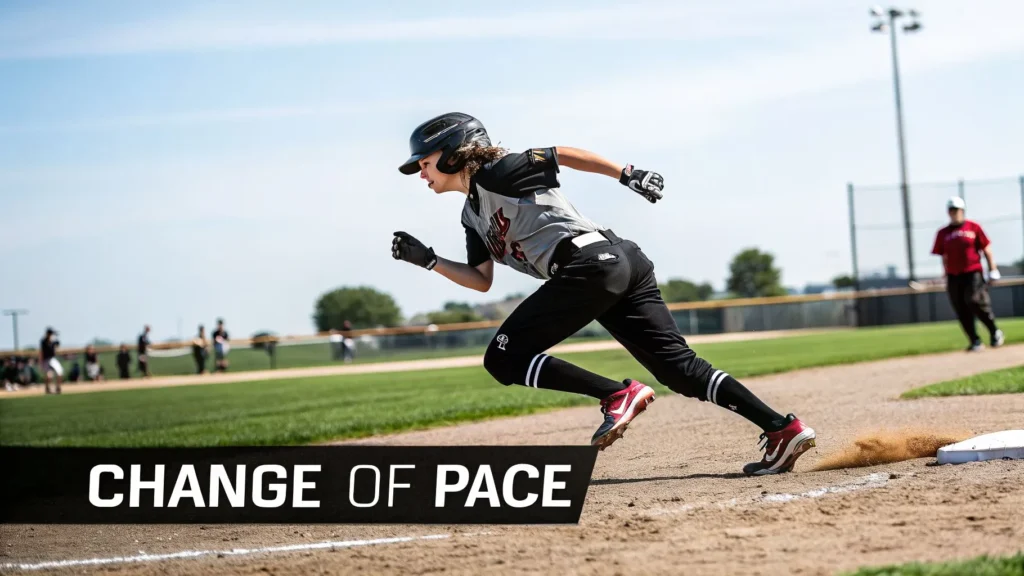
While feints are about trickery, sometimes the best way to beat a defender is with pure, raw acceleration. An explosive change of pace doesn’t just get you past your opponent; it breaks their defensive posture and turns a 50/50 ball into a clear-cut scoring opportunity.
This isn’t about being the fastest player over 100 yards. It’s all about the sudden burst—going from a jog to a full sprint in a split second or slamming on the brakes to make a defender fly right by. Unpredictability is your greatest weapon here.
The Stop and Go
The classic stop-and-go move is devastating because it plays on a defender’s instincts. As you dribble toward them at a controlled speed, they’ll shadow you, getting ready to make a challenge. The real move happens when you suddenly stop, plant your foot, and fake a pass or a sharp turn.
In that moment, the defender is committed to their forward momentum. They either stop awkwardly or lunge in, expecting you to continue. That’s your cue. Push the ball into the space they just vacated and explode forward, leaving them completely flat-footed.
Weaponizing Your First Step
That first step is everything. It’s your launch button. The secret to generating power is dropping your center of gravity—sink your hips, bend your knees, and lean your chest over the ball. Dropping your shoulder in the direction you intend to go helps sell the fake and preps your body for takeoff.
A hard push-off from your back foot creates that initial burst of speed. Combine that with a firm touch that knocks the ball 6-8 feet ahead of you, and you’ve created instant separation. You’re not just running; you’re challenging them to a race you’ve already won.
An explosive change of pace is an invitation. You’re daring the defender to react to your speed, but by the time they do, you’re already gone. The secret isn’t just running fast; it’s going from 0 to 100 while they are still processing the change.
In today’s highly organized defenses, creating your own space is a game-changer. Since 2015, overall dribbling success rates have actually dropped by 10-15% in top European leagues. Yet, elite players who master the change of pace still find success because they manipulate space on their own terms. While top dribbling speed can hit 5.13 m/s in a straight line, it plummets to just 2.44 m/s in tight quarters, making the ability to accelerate out of a turn absolutely vital. You can find more insights on dribbling success rates from Sport Monks and see how metrics are changing the game.
Sharp Cuts to Create Separation
Changing your pace isn’t just about moving forward. It’s also about sudden, sharp changes in direction. Two of the most essential moves for this are the Cruyff Turn and the L-Turn.
The Cruyff Turn: While shielding the ball, you’ll fake a pass or shot. Instead of following through, you use the inside of your foot to drag the ball behind your standing leg, pivoting 180 degrees and accelerating into the new space.
The L-Turn: This is a fantastic move for close control in tight areas. You simply place the sole of your foot on the ball, pull it straight back, and then use the inside of the same foot to tap it behind your standing leg, creating an “L” shape and a new angle of attack.
Both of these techniques rely on abruptly stopping your forward momentum before quickly changing direction. These skills are fundamental to building your athleticism on the ball. If you’re looking to build that core power and agility from the ground up, check out these fitness tips for beginners to establish a solid foundation.
Integrating Dribbling into Your Tactical Game
So, you’ve got your moves down. You can dance around cones all day, but the real test comes when a defender is breathing down your neck in a live match. This is where we stop just practicing **soccer dribbling techniques** and start using them to win games.
The goal is to shift from beating a player to beating them with a purpose. Are you trying to create a pocket of space for a shot? Pulling a defender away to open a passing lane for a teammate? Or maybe you’re driving to the end line to whip in a cross. Every touch has to mean something.
Putting Skills into Practice with Small-Sided Games
The fastest way to build this tactical brain is to throw yourself into game-like situations. Small-sided games—think 1v1s and 2v2s—are the perfect laboratory for this. They force you to react instantly and use your skills with a clear objective.
Here are a couple of ways to structure these games to get the most out of them:
- 1v1 to Goal: Set up a small pitch with two mini-goals. The mission is simple: get past your opponent and score. This forces you to dig into your bag of tricks—feints, cuts, and speed changes—to create that crucial shooting angle.
- 2v2 with a Target: On a slightly bigger field, play 2v2. The attacking pair’s goal is to dribble past the defense and connect with a “target” player waiting on the end line. This drill pushes you to think beyond just beating your man and focus on delivering the final, decisive ball.
These scenarios teach you to read a defender’s body language and punish their mistakes in the moment. It’s no longer about a pre-planned move; it’s about improvising a solution on the fly.
Tactical dribbling is a conversation with the game. You’re not just running with the ball; you’re constantly asking questions. “Is the defender off-balance?” “Is my teammate making a run?” “Where is the space?” The best dribblers find the right answers instantly.
The Critical Art of Scanning While Dribbling
One of the toughest—but most vital—skills is scanning. This is the simple act of lifting your head while you’re on the move to see what’s happening around you. The best players aren’t staring at the ball; they’re taking quick mental snapshots of the entire field.
As you dribble, get into the habit of looking up every few touches. You’re searching for critical information:
- The position of your closest defender.
- Where the open space is.
- The runs your teammates are making.
- Where the goalkeeper is positioned.
This one skill is what separates a good dribbler from a truly great playmaker. A player glued to the ball might beat one defender, but a player who scans can unlock an entire defense with one smart decision.
Knowing When to Dribble and When to Pass
Dribbling is a high-risk, high-reward play. The best players have an instinct for this balance. A successful take-on can completely break down a defense, but a failed one can launch a dangerous counter-attack against your team.
Before you decide to take on a defender, run through this quick mental checklist:
- Am I outnumbered? Trying to dribble through two or three players is usually a losing battle.
- Is a teammate in a better spot? Often, the simple pass is the most brilliant play you can make.
- Where am I on the field? Losing the ball in your own defensive third is a disaster waiting to happen. Losing it near their goal is a risk worth taking.
Effective dribbling can become a team’s calling card. Just look at the Brazilian national team, which has always used dribbling as a tactical weapon. At the 2018 FIFA World Cup, they averaged an incredible 21.71 dribbles per game with a 69.57% success rate. This wasn’t just about individual flair; it was a strategy built on close control and feints to systematically dismantle defenses, a style dating back to the days of Pelé. You can dive deeper into the evolution of these strategies in this detailed analysis of World Cup playing styles.
By mixing in dynamic drills, mastering the art of scanning, and sharpening your game intelligence, you’ll turn your dribbling from a personal skill into a powerful weapon for your whole team.
Progressive Dribbling Practice Plans
Consistent practice is the only way to build muscle memory and make these techniques second nature. The key is progressive overload—gradually increasing the difficulty as you improve. Below is a sample weekly routine you can adapt based on your current skill level.
| Skill Level | Day 1 Focus (20 mins) | Day 2 Focus (20 mins) | Day 3 Focus (20 mins) |
|---|---|---|---|
| Beginner | Stationary Ball Taps & Rolls | Slow Dribble (Inside/Outside Touches) | Basic Cone Weaving (Walking Pace) |
| Intermediate | Dribbling with Speed Changes | Cuts & Turns (L-Turn, Cruyff Turn) | 1v1 Drills vs. Passive Defender |
| Advanced | Dribbling while Scanning & Shielding | Combination Moves (e.g., Stepover into a Cut) | 2v2 Small-Sided Games to Goal |
These 20-minute sessions are designed to be short, intense, and focused. The goal isn’t to exhaust yourself but to get hundreds of quality touches that reinforce good habits and build your confidence on the ball. Stick with it, and you’ll see a real difference in your game.
Your Questions on Mastering Dribbling Answered
Even after learning the drills, plenty of questions and roadblocks pop up. Mastering dribbling is a long-term process, and hitting a plateau is a normal part of the journey. Below are the most common questions I get from players, with direct answers to help you break through those frustrating moments.
How Long Does It Take to Get Good at Dribbling?
There’s no magic number, but you can see real, noticeable improvement in close control and confidence within a couple of months. This assumes you’re putting in consistent, focused practice for 20-30 minutes, at least 3-4 times a week.
The key here is deliberate practice. Don’t just kick the ball around aimlessly. Dedicate each session to a specific weakness. One day, you might focus entirely on your non-dominant foot. The next, you could work on just one new move, like the L-Turn.
The path to mastery is measured in dedicated hours, not just days on a calendar. Beginners will see fast gains in basic control, but mastering the instinctual, split-second decisions of in-game dribbling is a years-long pursuit. Even the pros practice fundamentals every single day.
Progress is never a straight line. You’ll have days where the ball feels like it’s glued to your foot and others where nothing seems to work. Just stay consistent, and the overall trend will be upward.
What Is the Most Effective Dribbling Technique to Learn First?
Before you even think about flashy step-overs or rainbow flicks, the single most important skill to master is close control. This means using both the inside and outside of both feet comfortably. This is the bedrock for every other dribbling technique.
You have to be able to keep the ball within a single step’s distance while jogging. If you’re constantly looking down or the ball is getting away from you, you aren’t ready for more advanced moves.
Start with the simplest drill you can imagine:
- Set up a line of 5-6 cones, about a yard apart.
- Dribble through them at a walking pace, using only the inside of your right foot. Focus on a soft touch with every stride.
- Come back through using only the outside of your right foot.
- Repeat the whole thing with your left foot.
Only when you can do this without staring at the ball should you start adding changes of pace and direction. In a real match, these are far more effective than any complex feint you can learn.
Why Do I Keep Losing the Ball to Defenders?
This is an incredibly common frustration for developing players. The problem usually comes down to one of three things: being predictable, having poor timing, or dribbling at the defender instead of into open space.
1. You’re Predictable: Stop telegraphing your moves. Good defenders read your eyes and body shape. Use body feints and look-aways to disguise what you’re about to do. Look left, drop a shoulder, and explode to the right. The fake is just as important as the touch.
2. Your Timing is Off: Don’t try to take on a defender who is set, balanced, and waiting for you. That’s a low-percentage play. The best time to attack is when they are off-balance, in the middle of turning their hips, or rushing toward you. Use their own momentum against them.
3. You’re Dribbling Through Them: The goal is to move the ball past the defender and into open space, not to force it through their legs. A single, well-timed touch into an open lane, followed by a burst of speed, is often all you need.
Fixing these issues takes a lot of practice and in-game awareness. It also helps to be physically prepared for the demands of shielding the ball and changing direction explosively. For more on that, check out our guide on how to prevent sports injuries, which will help keep you on the field.
Should I Prioritize Speed or Control in My Dribbling Practice?
The answer is simple: always start with control. Speed is totally useless if every touch sends the ball 10 feet away from you. You can’t outrun your own mistakes.
Practice every new technique at a walking pace. The goal is to make the movement so automatic that you can execute it perfectly without thinking. Only when it feels completely natural should you start to ramp up the speed.
A great way to build both precision and power is to use the “3-3-3” rule.
- Perform a drill three times slowly, focusing on perfect technique.
- Then, do it three times at a medium pace, trying to maintain that same technique.
- Finally, perform it three times at full game speed, pushing your limits.
This approach builds the correct muscle memory first, then layers on the explosive power needed to make it work in a real match. Control gives you options; speed without control just gives the ball to the other team.
At maxijournal.com, we are dedicated to providing clear, approachable commentary on a wide range of topics, from sports and health to technology and the arts. Explore more of our daily writing at https://maxijournal.com.
Discover more from Maxi Journal
Subscribe to get the latest posts sent to your email.