So, what really goes into making a documentary? It’s a lot more than just hitting record on a camera and hoping for the best. The real craft lies in the techniques a filmmaker uses to turn raw, unscripted reality into a story that grips an audience. These are the strategic choices you make—how you shoot, who you talk to, and what you leave on the cutting room floor—that ultimately guide how people see the truth.
The Art of Shaping Reality
Making a documentary isn’t a passive act of recording what happens. It’s an active process of observation and, crucially, interpretation. Every decision, from your camera angle to the silence you leave after an interview question, shapes the narrative.
Think of it like this: you start with a massive block of marble—that’s reality in all its chaotic, unedited glory. As the filmmaker, you’re the sculptor, carefully chipping away to find the form hidden within. The finished statue is your documentary. It’s not the single, objective truth, but a version of the truth seen through your eyes and shaped by your hands.
And right now, there’s never been a better time to be in this business. Audiences are hungry for authentic, real-life stories, and streaming giants are paying attention. The global documentary film market hit a staggering USD 12,336.28 million in 2024 and is on track to surpass USD 14.6 billion by 2033. This explosion is powered by everything from breathtaking 4K nature docs to the gritty, fly-on-the-wall style of cinéma vérité. You can dig into the market data yourself to see what’s driving the surge.
Thinking Like a Documentarian
Before you even think about gear, you need to develop the right mindset. It’s a way of seeing the world built on endless curiosity, a deep sense of empathy, and an instinct for the telling detail. It’s about recognizing the story hiding in plain sight and understanding that your point of view is your most powerful tool.
Adopting this mindset really comes down to a few key shifts:
- From Observer to Storyteller: You’re not a fly on the wall; you’re a narrator. Your job is to find the story’s arc—the people, the problems, and the changes—within the real-life events you’re capturing.
- Embracing Both Sides of the Coin: You have to chase the facts and be as accurate as possible. But at the same time, you have to accept that every film is subjective. Being honest about your own perspective is the first step to making an ethical film.
- It’s All About People: At the end of the day, documentaries are about human connection. Your ability to build trust and genuinely listen to your subjects is worth more than the fanciest camera on the market.
The goal is to make a film that feels true, even though you know it’s a construction. You’re building a bridge between your subject and the audience, and your techniques are the materials you use to make that bridge strong and authentic.
This guide is here to pull back the curtain on these essential documentary filmmaking techniques. We’ll walk through the big ideas and turn them into practical steps you can actually use, covering everything from the classic modes of documentary to the hands-on methods for shooting beautiful footage and getting incredible interviews. By the end, you’ll have a clear roadmap for turning what you see into stories that matter.
Understanding the Six Modes of Documentary
Every documentary you’ve ever watched, from a sweeping nature series to a raw, personal video diary, has a specific voice. It’s the way the film speaks to you, the perspective it takes. Film scholar Bill Nichols gave us a framework for understanding this “voice” by defining six modes of documentary.
Think of these modes as the fundamental blueprints a filmmaker chooses from before a single frame is shot. It’s a choice that shapes the entire storytelling strategy.
Getting a handle on these modes is your first big creative decision. Each one gives you a different toolkit for engaging with reality and building your narrative.
To make this easier to grasp, here’s a quick-reference table that breaks down the six modes.
Comparing the Six Documentary Modes
| Documentary Mode | Primary Goal | Key Characteristics | Classic Example |
|---|---|---|---|
| Expository | To inform and persuade | “Voice of God” narrator, logical argument, archival footage, presents a clear case. | The Civil War (1990) |
| Poetic | To create a mood or feeling | Abstract, associative editing, emphasizes visual rhythm and subjective experience over narrative. | Rain (1929) |
| Observational | To observe life as it unfolds | “Fly-on-the-wall” perspective, filmmaker is an invisible observer, captures raw reality. | Gimme Shelter (1970) |
| Participatory | To show the filmmaker’s interaction | Filmmaker is on-screen, asks questions, actively shapes events, director-subject relationship is key. | Supersize Me (2004) |
| Reflexive | To question the filmmaking process | Film about making a film, shows the editing process, challenges its own representation of reality. | Man with a Movie Camera (1929) |
| Performative | To express personal, emotional truth | Focuses on the filmmaker’s subjective experience, often autobiographical and deeply personal. | Tarnation (2003) |
This table gives you a bird’s-eye view, but let’s dive into what makes each mode tick.
The Expository and Poetic Modes
The expository mode is the one most people think of when they hear “documentary.” Its main job is to inform and persuade, often using an authoritative “voice of God” narrator to walk you through a clear, logical argument. Picture a classic history special that pieces together archival footage and expert interviews to explain a complex event. It’s building a case, much like a visual essay.
On the complete other end of the spectrum, the poetic mode couldn’t care less about a traditional narrative. It’s all about creating a mood, a tone, a feeling. It pieces footage together in an associative, almost abstract way, focusing on visual rhythm and subjective experience. It doesn’t tell you what to think; it invites you to feel something.
No matter the mode, you’re always turning raw footage into a story with an impact. The real difference is how you approach that storytelling step.
The Observational and Participatory Modes
The observational mode is the classic “fly-on-the-wall” approach. Here, the filmmaker tries to become invisible, capturing life as it happens with as little interference as possible. The whole point is to give you the sense that you’re witnessing raw, unfiltered reality as it unfolds. Its power comes from that feeling of authenticity and immediacy.
This hunger for authenticity has driven a huge surge in the documentary genre. Audience interest shot up by a remarkable 44% between early 2021 and late 2023, making documentaries the fastest-growing unscripted category. This boom is tied directly to the kind of “real” moments that observational cinema, a style honed since the 1960s, delivers so well. You can see the full breakdown of this trend on Parrot Analytics.
The participatory mode, however, yanks the filmmaker out from behind the camera and puts them right into the story. It’s all about the interaction between the filmmaker and their subjects. Think of any documentary where the director is an on-screen character—asking questions, sharing their own journey, and actively influencing the events being filmed.
“In participatory filmmaking, the director doesn’t pretend to be an objective observer. Instead, their relationship with the subject becomes a central part of the narrative itself.”
This mode is built on the acknowledgment that a filmmaker’s presence always changes things, so it makes that interaction a core part of the story.
The Reflexive and Performative Modes
Finally, we get to the most self-aware modes. The reflexive mode is all about questioning the nature of documentary itself. It’s a film about making a film. By showing you the editing room, discussing ethical dilemmas on camera, or openly challenging its own story, this mode forces the audience to think critically about how “reality” is constructed.
The performative mode pushes subjectivity even further, zeroing in on the filmmaker’s personal experience and emotional truth. It’s less concerned with objective fact and more with conveying a unique, deeply felt perspective. These films are often autobiographical and use the camera to explore identity, memory, and personal history.
By understanding these six modes, you gain a powerful vocabulary for making your first, most important decision: What kind of story do you want to tell, and how do you want to tell it?
Essential Camera and Cinematography Techniques
Alright, we’ve covered the big-picture ideas. Now it’s time to get practical. This is where you translate those documentary modes into actual shots, turning theory into something an audience can see and feel. Your camera work defines the mood, sets the perspective, and drives the emotional core of every single scene.
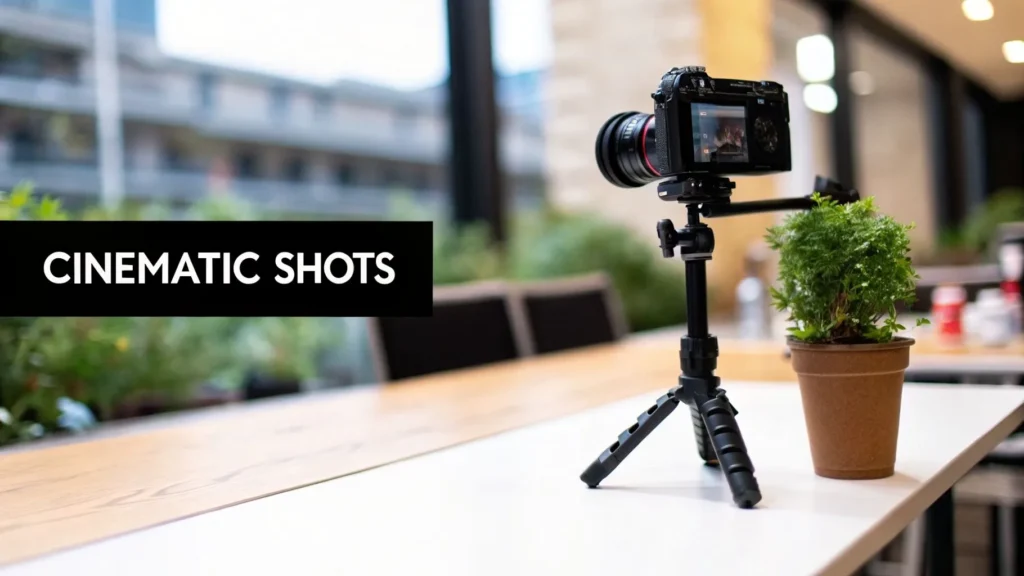
Everything starts with a simple choice: are you locked down or are you moving? Using a tripod gives you those stable, perfectly composed shots. This approach feels intentional and controlled, making it ideal for formal interviews or capturing stunning landscapes. It puts the audience in the position of a calm, steady observer.
On the other hand, handheld shooting throws your viewer directly into the moment. That natural, subtle shake makes it feel like they’re right there in the room, experiencing events as they happen. It’s a signature of observational and participatory docs for a reason—it creates a raw, authentic feeling that’s intensely personal. Neither is “better,” they’re just different tools for creating a different feeling.
Composing Your Story Visually
Once you’ve decided on stability versus movement, you have to think about what’s actually in the frame. Good composition isn’t just about making a shot look pretty; it’s about deliberately guiding the viewer’s eye and adding layers of meaning. A few foundational rules are your best friends here.
The Rule of Thirds is the perfect place to start. Just imagine your screen has a 3×3 grid over it. Instead of sticking your subject smack in the middle, you place them along one of the lines or at an intersection point. This instantly makes the shot feel more balanced and dynamic.
Next, start looking for leading lines. These are lines that already exist in the environment—a road, a fence, a coastline—that naturally guide the viewer’s eye toward your subject. It’s a simple trick that adds a real sense of depth, turning a flat image into an immersive world.
Your visual choices are not just decorative. A low-angle shot can make a subject seem powerful and authoritative, while a high-angle shot can make them appear vulnerable. Every frame is an opportunity to reinforce your narrative.
If you’re just getting your feet wet with visual storytelling, practicing with still photography is a great way to build your eye. Many of the core principles are exactly the same, and you can learn more about how to take better photos to build that fundamental skill.
The Power of Shot Variety and B-Roll
One of the most common mistakes I see from new filmmakers is shooting everything from the same distance and angle. To keep your audience from checking their phones, you need to mix it up. Use wide shots to establish a new location, medium shots for conversations, and tight close-ups to capture those crucial flickers of emotion.
This is where B-roll becomes your absolute secret weapon. Simply put, B-roll is all the footage you capture that isn’t your main interview or action (that’s your “A-roll”). It’s the visual texture of your film.
Think of it this way: if an interview is the plot, B-roll is the descriptive language that builds the world around it. It gives you visuals to cut to, provides context, and can pack a huge emotional punch.
Effective B-roll might include:
- Establishing Shots: Sweeping views of the city, landscape, or building where your story is unfolding.
- Cutaways: Close-ups of your subject’s hands as they talk, shots of meaningful objects in their home, or details from their environment.
- Action Sequences: Footage of your subject actually doing their thing—working at their desk, coaching a team, or interacting with their family.
Without good B-roll, even the most compelling interview can feel static and visually dull. With it, your film becomes a living, breathing world that pulls the audience in and refuses to let go. This is how you transform reality into cinema.
Mastering the Art of the Interview
If there’s a beating heart to your documentary, it’s the interview. This is the moment when facts get a human face, and abstract ideas become deeply personal stories. A great interview is so much more than a Q&A session; it’s a guided conversation, one that unearths genuine emotion and insight. This is a cornerstone of your documentary filmmaking techniques.
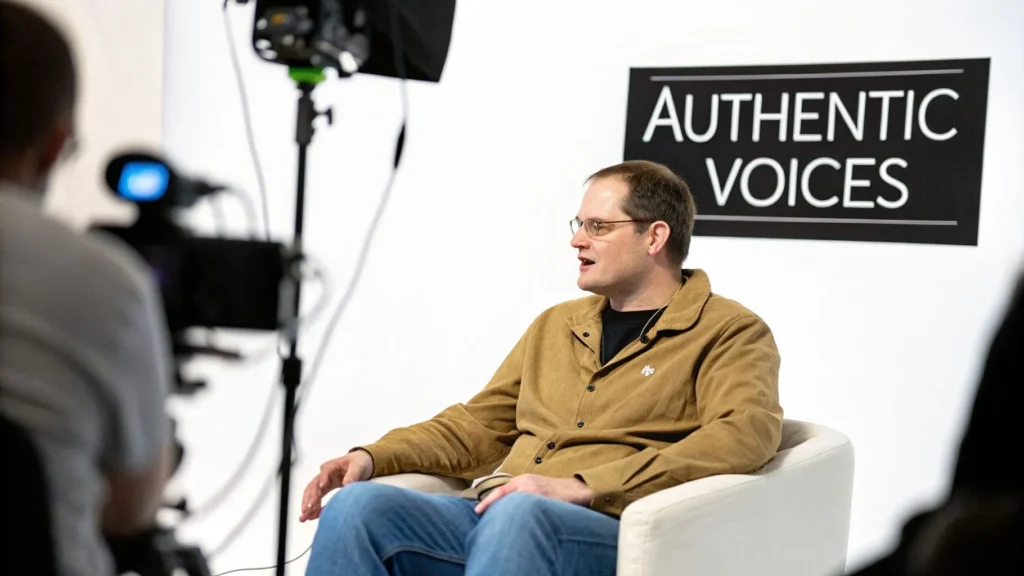
The entire foundation of a powerful interview rests on rapport. Your subject has to feel safe and seen, not like they’re under a microscope. Ease into it. Explain what you’re doing, make some small talk, and show you’re genuinely curious about them as a person, not just a source of information. Your body language says more than you think—hold eye contact, nod, and offer small affirmations to show you’re right there with them.
Once they’re comfortable, you can start digging past the surface-level answers. The key is to avoid questions that get you a simple “yes” or “no.” You need to master open-ended questions.
Asking Questions That Unlock Stories
The quality of your final film often hinges directly on the quality of your questions. See yourself as a guide, helping your subject navigate their own memories and emotions. Your questions are simply the prompts that open new doors.
For instance, instead of asking, “Were you scared?” try something like, “Can you walk me through what was going through your mind in that moment?” The first question gets a single word. The second invites a story.
Here are a few powerful starters to get you going:
- “Tell me about the time when…”
- “How did you feel when…”
- “What was that experience like for you?”
- “Can you describe the moment that…”
Just as critical is what you do after you ask: you listen. I mean really listen. Active listening is about more than just hearing the words; it’s about tuning into the pauses, the shifts in tone, and all the non-verbal cues. Sometimes the most profound truths are found in the silence you give them. If you want to work on this, our guide on how to improve public speaking has some great tips on audience connection that apply here, too.
Capturing Pristine Audio
While the conversation is king, the technical side is what makes it all usable. In documentary, sound is every bit as important as the picture. An audience might forgive a slightly shaky camera, but they will check out immediately if the audio is muffled, noisy, or distorted. Clean sound is non-negotiable.
Your first and most important decision is choosing the right microphone. Different mics serve different purposes, and knowing the right tool for the job is a fundamental filmmaking skill.
The golden rule of documentary sound is simple: get your microphone as close as you can to your subject’s mouth without it being in the shot (unless that’s a deliberate stylistic choice). Proximity is everything.
Here’s a quick rundown of the essential microphone types you’ll encounter:
- Lavalier Mics (LAVs): These are the tiny mics that clip right onto a person’s shirt or collar. They are the workhorse for sit-down interviews because they deliver clear, consistent audio no matter where the subject turns their head.
- Shotgun Mics: These are highly directional, meaning they pick up sound best from wherever they are pointed. You can mount one on your camera or a boom pole to help isolate your subject’s voice from distracting background noise.
- Boom Mics: A shotgun mic on a boom pole is the professional gold standard. A dedicated operator can position the mic perfectly just out of the frame, aimed right at the subject. This gets you rich, natural-sounding audio that’s beautifully isolated from the environment.
Ultimately, a great interview is a careful blend of human connection and technical skill. If you can build trust, ask thoughtful questions, and make clean audio a top priority, you’ll capture the powerful, authentic voices that bring your film to life.
Finding Your Story in the Editing Room
There’s an old saying in documentary filmmaking: the final script is written in the edit. Once the interviews are wrapped and the gear is packed away, you’re left with a mountain of raw material—hours, sometimes hundreds of hours, of footage. The editing process is where you take that mountain and begin to sculpt it into a coherent, moving story.
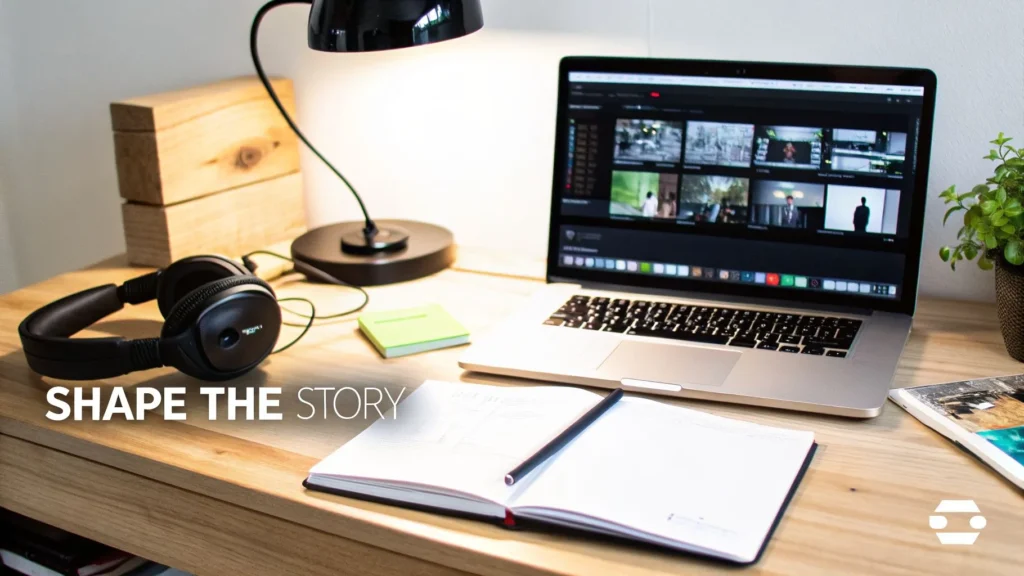
This stage is, without a doubt, the most powerful application of every technique you’ve used so far. It’s a journey of discovery, where you unearth juxtapositions, rhythms, and emotional beats you never could have planned for on set. A good editor doesn’t just assemble clips; they build meaning from the ground up.
This growing appreciation for craft is part of why documentaries are thriving. In 2023, global film production hit a record 9,511 movies, a massive 68% rebound from its 2020 low. Documentaries have carved out a serious niche in this boom, using specialized methods to create deep empathy. You can learn more about the global film production rebound and see where documentaries fit into the bigger picture.
The Power of Juxtaposition and Pacing
One of the most essential ideas in editing is the Kuleshov effect. At its core, it’s the principle that viewers get more meaning from two shots shown back-to-back than they do from a single shot on its own.
Think about it: show a close-up of a person with a neutral expression. If you immediately cut to a shot of a bowl of soup, the audience thinks, “He’s hungry.” If you cut to a child playing, they read affection. The person’s expression never changed, but its meaning did entirely.
As an editor, you’re using this principle constantly. By placing an interview clip next to a specific piece of B-roll, you can create a brand new layer of meaning, introduce irony, or heighten emotional resonance. You are guiding the audience’s interpretation with every single cut.
The editing room is where a film finds its heartbeat. The rhythm of your cuts—fast or slow, jarring or smooth—dictates the emotional energy of a scene and shapes the viewer’s entire experience.
Pacing is your control over that heartbeat. A rapid-fire sequence of cuts can build tension and excitement, making it perfect for a montage showing a character’s quick decline or a protest erupting into chaos. On the other hand, long, lingering takes give the audience time to breathe, think, and feel the emotional weight of a moment. A great documentary is always shifting its pace to keep the audience locked in and to mirror the story’s emotional arc.
Building Your Narrative Arc
Even though you’re working with real life, your final film absolutely needs a clear narrative structure. The most powerful documentaries, just like great fictional films, almost always have a clear beginning, middle, and end. Your job in the edit is to find those story beats hiding in your footage.
This process usually involves a few key steps:
- Logging and Transcribing: Before you can even think about cutting, you have to know what you’ve got. This means meticulously logging all your footage and getting every single interview transcribed. This is your map for the entire journey.
- The “Paper Edit”: Many seasoned editors start by creating a “paper edit.” They literally arrange snippets of transcribed interviews and shot descriptions into a sequence in a document. This lets you build the skeleton of the story without getting bogged down in the editing software.
- Assembling the Rough Cut: This is your first real pass at putting the film together. You’ll lay out all the main story beats in order. It’s going to feel way too long and probably a little clumsy, but it’s the first time you’ll see the film’s skeleton.
- Refining and Polishing: From this point on, it’s all about refinement. You’ll tighten scenes, perfect the timing of your cuts, weave in music and sound design, and color correct the footage to create a consistent, professional look.
Our guide on how to edit videos for YouTube also shares some excellent fundamentals on trimming clips and structuring a narrative that can be a big help for any video project.
The Ethical Responsibility of the Editor
Finally, you can’t talk about documentary editing without touching on its profound ethical weight. As the editor, you hold an incredible amount of power to shape a person’s reality. What you decide to include—and just as importantly, what you decide to leave out—will define the film’s version of the truth and forever shape how the audience sees your subjects.
A single quote taken out of context can completely invert its original meaning. A reaction shot placed at the wrong moment can make someone look foolish, cruel, or dishonest. Every cut is a choice, and every one of those choices has a real-world impact on the people who trusted you with their stories. A great documentary editor isn’t just a technician; they are a storyteller with a deep, unwavering sense of responsibility.
Your Top Questions on Documentary Filmmaking Techniques
Diving into documentary filmmaking means you’re going to have a lot of questions. It’s a world where creative, technical, and deeply human challenges all collide. We’ve gathered some of the most common questions we hear from new filmmakers and provided some straight-up answers to help you get moving.
Think of this as a quick chat with a seasoned pro. We’ll cover where to begin, what gear actually matters, and how to handle the tricky business of telling someone else’s story. Getting these fundamentals down will help you build your confidence and find your voice as a filmmaker.
What Is the Most Important Technique for a Beginner to Learn?
If you’re just starting out, the single most important skill you can develop is active listening during an interview. Yes, beautiful shots are great, but the human story is what drives almost every powerful documentary. Your job is to build enough trust and rapport that your subject feels safe enough to be truly themselves. That’s where the magic happens.
This isn’t just about ticking questions off a list. It’s about being 100% present, listening to what’s not being said, and responding with genuine empathy. A very close second, on the technical side, is capturing clean, clear audio. People will forgive a shaky shot if the story has them hooked, but they will click away in a heartbeat if they can’t understand what’s being said.
The heart of a documentary is authenticity. Your ability to genuinely connect with and listen to your subject will yield more powerful results than any piece of expensive equipment ever could. This human-centered approach is the foundation of impactful storytelling.
How Should I Handle Ethical Dilemmas When Filming?
Navigating the ethics of documentary filmmaking comes down to one core principle: “do no harm.” This isn’t just a friendly suggestion; it’s your primary responsibility as a storyteller. The best way to do this is through transparency, ongoing consent, and treating your subjects like true collaborators.
Before you even hit record, make sure your participants understand exactly what the project is, where it might end up, and what potential impact—good or bad—it could have on their lives. And this isn’t a one-and-done conversation.
Follow these key ethical practices:
- Ongoing Informed Consent: Don’t just get a release form signed and call it a day. Check in with your subjects regularly throughout filming and editing to ensure they’re still comfortable.
- Transparency About Intentions: Be upfront about the story you’re trying to tell and your own perspective. Hiding your angle only leads to mistrust and a weaker film.
- Prioritize Dignity: Always, always put your subject’s well-being and dignity above getting the “perfect shot.” If a situation feels exploitative or you can see it’s causing distress, it’s your duty to stop filming.
In the end, your ethical compass is one of the most vital pieces of gear in your kit. Treat the people in your film as partners in the process, not just characters.
Can I Make a Documentary with Just My Smartphone?
Absolutely. Modern smartphones have become incredibly capable filmmaking devices, and plenty of incredible, award-winning documentaries have been shot on them. The trick isn’t the camera you use, but how you use it. Your documentary filmmaking techniques will always matter more than your gear.
First off, prioritize sound. A simple external microphone that plugs right into your phone is the single best investment you can make. It will instantly elevate the quality of your film. Second, keep it steady. Use a small tripod or a gimbal to avoid that shaky, amateur footage that screams “low-budget.”
Finally, download an app like FiLMiC Pro to unlock manual controls for focus, exposure, and white balance. Taking control of these settings, combined with a solid grasp of composition and storytelling, is all you need to create a film that looks and feels professional.
What Is the Difference Between Cinéma Vérité and Observational Mode?
This is a great question, as it’s easy to get these two mixed up. They’re cousins, but with a key difference in philosophy.
The observational mode is the big-picture category. Think of it as the “fly on the wall” style, where the filmmaker’s goal is to simply observe events as they unfold, with as little interference as possible. The ideal is for the filmmaker and camera to be completely invisible.
Cinéma vérité, which literally means “film truth,” is a specific, more provocative flavor of observational filmmaking. A cinéma vérité filmmaker isn’t afraid to poke the bear. They might ask a confrontational question or even acknowledge the camera’s presence to provoke a reaction, believing this reveals a deeper, more uncomfortable truth.
So, to put it simply: all cinéma vérité is observational, but not all observational film is cinéma vérité. The latter is willing to break the rules to get at something more raw and real.
Discover more from Maxi Journal
Subscribe to get the latest posts sent to your email.