So, you want to get into photography? The great news is it’s not about dropping a ton of cash on a fancy camera. It’s about learning to see the world around you a little differently and understanding a few key ideas to finally switch your camera off “auto” mode for good.
Your First Steps into Digital Photography
If you’ve ever felt a bit lost looking at all the buttons on a camera or confused by all the technical talk online, I get it. But here’s the thing: in 2026, taking great photos is more accessible than it has ever been. That amazing little camera you carry around in your pocket every day? It’s the perfect place to start. We’re going to build your confidence by focusing on the fundamentals that actually make a difference.
And this isn’t just a feeling; photography has absolutely exploded. The whole industry was valued at a massive $55.74 billion in 2025 and is set to climb to $59.04 billion by the end of 2026. What’s driving this? The 6.8 billion people with smartphones, which now account for an incredible 92.5% of all photos taken across the globe. Photography is no longer just for the pros. You can discover more insights about the digital photography market and see just how big this trend is.
Understanding Your First Camera
Before we get into settings and rules, let’s talk about the tools. Whether you’re working with a smartphone, a compact point-and-shoot, or a shiny new mirrorless camera, the core ideas are always the same. Creativity comes from you, not your gear.
The most important part of your camera is the twelve inches behind it. – Ansel Adams
Deciding on your first “real” camera really boils down to your budget and what you hope to achieve. Honestly, plenty of incredible photographers start and stick with their smartphones. Others eventually crave the creative freedom that comes with changing lenses on a mirrorless or DSLR camera.
To make sense of it all, here’s a quick look at the most common camera types for beginners. This should help you figure out the best starting point for your own journey.
Beginner Camera Types At a Glance
| Camera Type | Best For | Pros | Cons |
|---|---|---|---|
| Smartphones | Everyday convenience and learning composition. | Always with you; powerful software makes shooting easy. | Limited zoom; less control over settings; smaller sensor. |
| Point-and-Shoot | Travel, family events, and a step up from a phone. | Better optical zoom and image quality than a phone; still very compact. | Fixed lens; smaller sensor than mirrorless/DSLRs. |
| Mirrorless | Anyone wanting full creative control and high quality. | Excellent image quality; interchangeable lenses; compact and modern. | Can be expensive; lens collection adds to the cost. |
| DSLR | A traditional photography experience with great performance. | Huge lens selection; excellent battery life; great ergonomics. | Bulkier and heavier than mirrorless cameras. |
Ultimately, choosing a camera is a personal decision, and there’s no single “right” answer.
The best advice I can give? Start with what you already have. Get good at spotting a great photo waiting to happen. Once you master the art of seeing, picking up the technical side of things will feel a whole lot more natural. This guide will walk you through it, step-by-step. Let’s get started.
Mastering The Exposure Triangle
Ready to finally move beyond your camera’s “Auto” mode and start making your own creative choices? The key is getting a handle on the Exposure Triangle. This is the fundamental relationship between the three pillars of photography that control how light or dark your photos turn out.
The three elements are aperture, shutter speed, and ISO.
Think of it like filling a bucket with rainwater. Your goal is to get just the right amount of water—not overflowing (overexposed) and not barely a drop (underexposed). The Exposure Triangle gives you three different ways to control the flow.
Aperture: The Faucet Opening
Aperture is the opening inside your lens that lets light hit your camera’s sensor. In our bucket analogy, this is the width of the faucet. A wide-open faucet lets water gush in, while a narrow one just lets it trickle.
We measure aperture in “f-stops,” written as numbers like f/1.8, f/4, or f/11. This is where it gets a little backward for newcomers, so pay close attention:
- A small f-number (like f/1.8) means a wide-open aperture. This lets in a ton of light, which is perfect for darker scenes. It also creates a very shallow depth of field, giving you that beautiful, blurry background (or “bokeh”) you see in professional portraits.
- A large f-number (like f/16) means a narrow aperture. This lets in very little light. It creates a deep depth of field, keeping everything sharp from the flowers in the foreground to the mountains in the back. This is what you want for landscape photography.
Key Takeaway: Use a small f-number (e.g., f/1.8) for blurry backgrounds in portraits. Use a large f-number (e.g., f/11) to keep everything sharp in landscapes.
Shutter Speed: The Faucet Timer
Shutter speed is simply the amount of time your camera’s sensor is exposed to light. Back to our water bucket analogy, this is how long you leave the faucet turned on. A quick flick of the wrist fills the bucket a little; leaving it on for a minute fills it a lot.
Shutter speed is measured in seconds or, more often, fractions of a second (like 1/1000s, 1/60s, or even 2″). It has two major effects on your photo: it controls brightness and it controls motion.
- A fast shutter speed (like 1/1000s) freezes action completely. This is how you capture a speeding car, a bird in flight, or a running child without any motion blur.
- A slow shutter speed (like 1/15s or longer) intentionally creates motion blur. You can use this creatively to make a waterfall look silky smooth, create light trails from cars at night, or show a sense of speed. Just know that for slow shutter speeds, a tripod is non-negotiable to keep the camera itself perfectly still.
ISO: The Water Pressure
ISO is your camera’s sensitivity to light. If aperture is the faucet width and shutter speed is the timer, then ISO is the water pressure. You can crank up the pressure to fill the bucket faster without touching the other two controls.
But this power comes with a trade-off. Increasing your ISO digitally brightens the image, but it also introduces digital “noise,” which looks like a grainy or speckled texture in your photos. Modern cameras are fantastic at handling high ISOs, but the rule of thumb is still the same: always keep your ISO as low as you can for the cleanest possible image.
- Low ISO (100-400): Your go-to for bright, sunny days. This will give you the absolute best image quality.
- Medium ISO (800-1600): Perfect for shooting indoors with good window light or on overcast days when you just need a little boost.
- High ISO (3200+): Reserve this for very low-light situations where you can’t use a flash, like at a concert or a candlelit dinner.
The chart below shows how your camera choice—from a simple smartphone to a mirrorless system—affects your ability to control these settings.
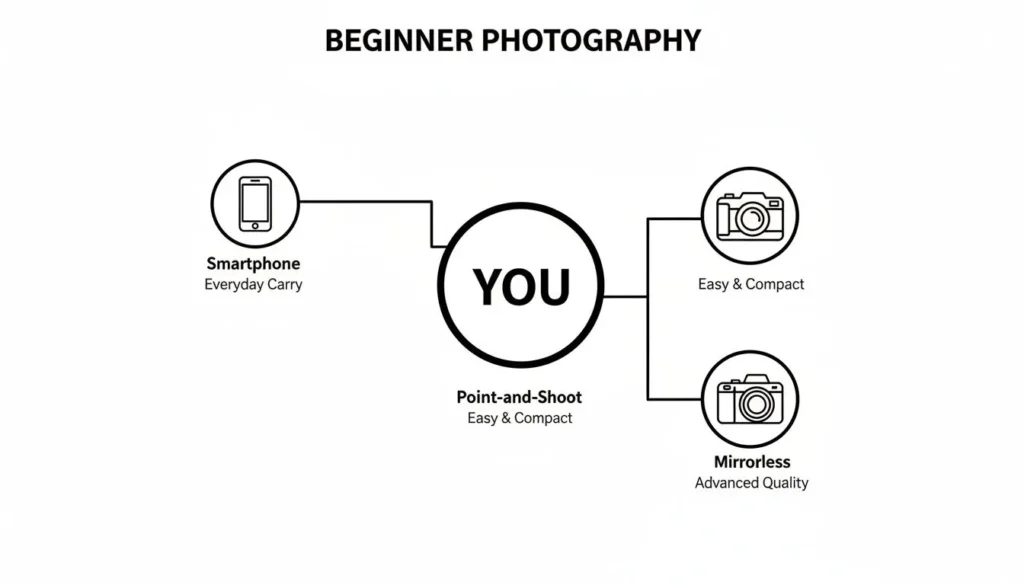
As you can see, while any camera can take a picture, mirrorless and other interchangeable-lens systems give you direct, manual control over the exposure triangle. This is what unlocks true creative potential, far beyond what a smartphone can offer.
Putting It All Together
The real magic happens when you understand that these three elements are in a constant balancing act. If you change one, you have to adjust one of the others to keep the same exposure.
For example, let’s say you want that blurry background for a portrait, so you set your aperture to a wide f/2.8. You’re letting in a flood of light. To keep your photo from being a washed-out white mess, you’ll need to compensate with a much faster shutter speed.
Here are a few common starting points to get you going:
- Portraits: Set your camera to Aperture Priority mode (A/Av). Choose an f-stop between f/1.8-f/4 and an ISO of 100-400.
- Landscapes: Stick with Aperture Priority mode (A/Av). Pick an f-stop of f/8-f/16 and keep your ISO at 100.
- Sports/Action: Switch to Shutter Priority mode (S/Tv). Set your shutter to 1/500s or faster and let the ISO be on Auto.
Mastering the exposure triangle takes practice, but it’s the single most important step in moving from just taking snapshots to actually creating photographs. Don’t be afraid to get out there, twist the dials, and see what happens. This is where your creative journey truly begins.
The Art of Powerful Composition
Alright, so you’re getting the hang of aperture, shutter speed, and all the technical buttons and dials. That’s fantastic. But the real magic, the thing that separates a simple snapshot from a breathtaking photograph, isn’t just about technical skill—it’s about composition.
Think of it this way: the camera settings are your grammar, but composition is your storytelling. It’s how you arrange everything in the frame to lead the viewer’s eye and create a feeling. Honestly, this is the secret sauce. Learning to see the world in terms of lines, shapes, and light will change everything.
The Rule of Thirds
The first “rule” everyone learns is the Rule of Thirds, and for good reason. It’s a game-changer. Just imagine your screen has a tic-tac-toe grid laid over it—two vertical lines and two horizontal lines creating nine equal squares.
The idea is simple: instead of sticking your subject smack in the center, place it along one of those lines or, even better, where two lines intersect. This immediately creates a more balanced and visually interesting image. It gives your subject some breathing room and encourages the viewer’s eye to explore the whole frame.
- Landscapes: Try placing the horizon on the bottom third line to emphasize a dramatic sky, or on the top third line to highlight an interesting foreground.
- Portraits: Align your subject’s eyes with one of the top intersection points. It’s a small change that makes a huge impact.
Using Leading Lines to Guide the Eye
Once you start looking for them, you’ll see leading lines absolutely everywhere. They’re paths, fences, rivers, roads, even the edge of a shadow. You can use these lines to create a visual roadmap that draws the viewer’s eye directly to your main subject.
Leading lines are your best friend for creating a sense of depth and making a flat photo feel like a world you could step into. That classic shot of a winding road disappearing toward a mountain? That’s the power of leading lines in action, pulling you right into the scene.
Create Depth with Framing and Layering
Another trick I use all the time is framing. This is where you use something in the foreground to create a natural frame around your subject. Think shooting through a window, an archway, or even between some tree branches.
Framing adds context and an incredible sense of depth. It makes your photo feel more intimate and three-dimensional, like you’re giving the viewer a private little window into the scene.
You can also build depth by layering your shot with a foreground, a middle ground, and a background. A photo of a mountain range instantly feels more epic if you have some flowers up close in the foreground and maybe a lake in the middle ground. It gives the scene scale and makes it far more immersive. For a deeper dive into composition and other techniques, check out our guide on how to take better photos for more advanced tips.
Know When to Break the Rules
Now for the most important part: these are guidelines, not laws. The Rule of Thirds is a fantastic tool, but sometimes a perfectly centered, symmetrical shot is exactly what an image needs to feel powerful and direct.
The key is to learn the rules first, so you know why you’re breaking them. Don’t just center a subject because it’s easy. Do it because you’re making a deliberate choice to emphasize symmetry or create a feeling of stability. Composition is a toolbox, and the more you practice, the more you’ll start to see these opportunities without even thinking about it.
Understanding Your Lens and Light
Once you’ve got the basics of your camera body down, it’s time to talk about the two things that really make or break a photo: your lens and your light.
Think of it this way: a great camera with a cheap lens is like putting budget tires on a race car—you’re just not going to get the performance you paid for. And even the best gear in the world won’t rescue a picture taken in terrible light.
Getting a handle on your lens and learning to “see” light is where you’ll notice the biggest jump in the quality of your photos. Let’s dig into how to pick the right lens for the job and how to find the light that makes your images sing.
Lenses: The Eyes of Your Camera
If you’ve got a camera that lets you swap lenses, you’ve probably stared at all the options and wondered what the difference is. It really comes down to two main camps: zoom lenses and prime lenses. Each has its own job and gives you different creative perks.
A zoom lens packs a range of focal lengths into a single lens (like the common 18-55mm kit lens). That versatility is a lifesaver for beginners. You can frame a wide landscape one moment and a tight portrait the next without having to move. It’s a fantastic jack-of-all-trades, especially for travel when you have no idea what you’ll run into.
A prime lens, on the other hand, has one fixed focal length (like a 50mm). That might sound like a drawback, but primes have two massive advantages. First, they’re typically much sharper and have wider maximum apertures (like f/1.8), which makes them absolute beasts in low light. It’s how photographers get that gorgeous, creamy, blurred-out background. Second, they make you “zoom with your feet,” which is one of the best ways to get better at composition.
Beginner’s Tip: A “nifty fifty”—an affordable 50mm f/1.8 prime lens—is almost always the first lens new photographers buy. The image quality and its knack for beautiful portraits make it a huge step up from the standard kit lens. It’s an incredible value.
Understanding Focal Length
Focal length, measured in millimeters (mm), is just a way of describing how “zoomed in” your lens is and how much of the scene it can see.
- Wide-Angle (e.g., 16-35mm): These lenses capture a huge field of view. They’re perfect for sweeping landscapes, big architectural shots, and cramming a lot into the frame when you’re in a tight space. Be careful with portraits, though—they can distort features when you get too close.
- Standard (e.g., 35-70mm): This range is the closest to what our own eyes see. The classic 50mm lens falls right in this zone, making it a go-to for street photography, environmental portraits, and everyday shooting.
- Telephoto (e.g., 70-200mm and up): These are the lenses that bring far-away things right to you. You’ll see them everywhere in sports and wildlife photography. They’re also brilliant for portraits when you want to blur the background into oblivion and make your subject pop.
The Magic of Natural Light
Photography literally means “drawing with light.” Honestly, learning how to find and use good light is more important than any gear you could ever buy. The best part? The best light is almost always free. You just need to know when and where to look.
The most famous light is the Golden Hour. This is that magical window of time just after sunrise and right before sunset. The sun is low, casting a soft, warm, and incredibly flattering glow over everything. Shadows get long and gentle, and the light just seems to wrap around your subject perfectly.
Contrast that with midday sun, which creates hard, unforgiving light. When the sun is directly overhead, it casts nasty shadows, especially on people’s faces (hello, “raccoon eyes”). If you absolutely have to shoot at noon, your best bet is to find open shade under a tree or next to a building. This diffuses the sunlight and softens it up beautifully.
Here’s a quick breakdown of the different kinds of light you’ll encounter:
| Light Type | Time of Day | Characteristics | Best For |
|---|---|---|---|
| Hard Light | Midday | Strong, defined shadows; high contrast | Architectural details, dramatic black & white |
| Soft Light | Golden Hour, Overcast | Diffused, gentle shadows; low contrast | Flattering portraits, landscapes, anything |
| Blue Hour | Just before sunrise/after sunset | Cool, blue tones; serene mood | Cityscapes with lights, moody landscapes |
Start paying attention to the quality of light around you—its direction, its color, its softness. It’s a skill that will take your photos from simple snapshots to something truly special. This is the most powerful tool you have as a photographer.
Simple Editing to Make Your Images Pop
Taking the shot is really just the beginning. The magic of post-processing is where you get to polish your image and inject your own personal style. Don’t let the idea of editing intimidate you; you don’t need to dive into complex and expensive software to see a massive difference.
Many incredible edits are done on free, user-friendly apps like Snapseed or the mobile version of Lightroom. The goal isn’t to create something fake or unrecognizable. Think of it more like guiding the viewer’s attention and enhancing the mood you already worked so hard to capture in-camera. This basic workflow covers the five most important adjustments you’ll need.
Your Five-Step Editing Workflow
Forget about learning every single slider and tool right away. Focusing on these five core adjustments will give you the most bang for your buck and can be applied to almost any photo for a clean, professional look.
Cropping and Straightening: Before you touch anything else, fix your composition. Is the horizon a little wonky? Straighten it. Are there distracting branches or people at the edge of the frame? Crop them out. This one simple step instantly makes a photo feel more polished and intentional.
Exposure: This is your master brightness control. If your photo feels a bit too dark or washed out, a small nudge of the exposure slider can bring back lost details and make the entire scene feel properly lit.
Contrast: Contrast manages the difference between the darkest and brightest parts of your shot. Bumping it up makes your blacks deeper and your whites brighter, giving the image a satisfying “punch.” Be careful not to go overboard, as too much contrast can crush details.
Saturation: This slider controls the intensity of your colors. A little boost can make a dull landscape feel lush and vibrant. But be warned: a heavy hand here is the fastest way to make a photo look cheap and unnatural. Subtle is almost always better.
Sharpening: Think of this as the final touch of crispness. Sharpening enhances the fine edges and details, making your subject look tack-sharp. This should always be the very last thing you do, and you only need a small amount to make an impact.
RAW vs. JPEG: The Real Game-Changer
Once you get comfortable, you’ll start hearing photographers talk about shooting in RAW versus JPEG. A JPEG is what most people are used to—it’s a compressed file your camera has already processed for you. It’s small and ready to share immediately. A RAW file, on the other hand, is the digital equivalent of a film negative; it holds all the unprocessed data straight from the camera’s sensor.
Shooting in RAW gives you far more flexibility in post-processing. You have much more room to recover details from shadows that are too dark or highlights that are too bright without losing image quality.
This flexibility is a complete game-changer. As you start to hone your editing skills, you’ll find that shooting in RAW unlocks a whole new level of creative control over the final look of your images. For a deeper dive into software that handles both file types, check out our guide on graphic design software for beginners.
Developing strong editing skills is more than just a hobby, too. With the U.S. photography market reaching $15.8 billion in 2025, there are real opportunities. Product photography, a niche that relies heavily on editing, is expected to hit $1.78 billion by 2033, especially since 75% of online shoppers rely on product photos. Discover more insights about photography niches on Fstoppers.com.
Common Beginner Mistakes and How to Fix Them
Look, every photographer—even the pros—makes mistakes. It’s just part of the learning curve. Knowing the most common slip-ups can help you bypass them and get better, faster. Think of this as your personal cheat sheet for building good habits from your very first shot.
The journey starts with figuring out what’s going wrong. Are your photos constantly blurry? Poorly lit? Or do they just feel… off? Let’s break down these classic beginner issues and give you simple, actionable ways to fix them.
Fixing Blurry and Out-of-Focus Images
There’s nothing more frustrating than thinking you nailed the shot, only to find it’s a blurry mess. This usually boils down to two culprits: motion blur from a slow shutter speed, or just plain missing your focus.
To tackle motion blur, you need a faster shutter speed. Think of it like this: a quick blink freezes a moment in time. A good rule of thumb is to keep your shutter speed at 1/125s or faster for still subjects. If you’re shooting something that’s moving, like a kid running around or a dog playing, you’ll want to go much faster—start with 1/500s and adjust from there.
If your photo is sharp, but in the wrong spot, then the issue is missed focus. Instead of letting the camera guess what’s important, you need to take charge. Most modern cameras let you tap the screen or use a small joystick to choose your focus point. Always aim that little box right for your subject’s eye in a portrait, or on the key element you want sharp in the scene.
Your camera has no idea what’s important in your photo—but you do. Learning to manually select your focus point is one of the quickest ways to start taking pictures that look truly professional.
Decluttering Your Backgrounds
A classic beginner mistake is getting so fixated on the subject that you completely ignore everything happening behind them. A distracting background—whether it’s random clutter, clashing colors, or a lamppost growing out of someone’s head—can kill an otherwise great photo.
The fix is usually surprisingly simple: move your feet. Before you even think about pressing that shutter button, take a half-second to scan the entire frame from corner to corner.
- Can you take two steps to your left to get that ugly trash can out of the shot?
- Could you crouch down a bit to use the clean, blue sky as a backdrop instead of a busy street?
- Can you use a wider aperture (like f/2.8) to turn that distracting background into a soft, beautiful blur?
This one small habit—being mindful of the entire composition—will dramatically improve your photos. It guides the viewer’s eye exactly where you want it: right to your subject. Your goal is to tell a clear story, and a cluttered background is just static.
Common Photography Questions Answered
It’s completely normal to have a ton of questions when you’re just starting out. Honestly, we all did. Let’s walk through some of the most common ones we hear from new photographers to clear things up and get you shooting with more confidence.
This journey is all about building your skills one step at a time. The good news is, you’re not alone. Research shows that 80% of beginners actually get their start using mobile apps. With over 500 million downloads of photography apps each year and AI that can boost low-light shots by up to 400%, the tools are more accessible than ever. You can read the full research on the growth of digital photography tools to see just how much technology is helping new photographers.
Should I Shoot in RAW or JPEG?
This is the classic debate, and there’s a simple way to think about it. A JPEG is like a finished print from a photo lab. The camera has already made all the decisions about color, contrast, and sharpening, then compressed it into a small, shareable file. It’s convenient and ready to go.
A RAW file, on the other hand, is the digital equivalent of a film negative. It holds every bit of unprocessed data the sensor captured. The files are much bigger, but they give you incredible power in the editing room to recover details from shadows and highlights that a JPEG would have discarded.
Beginner’s Tip: Start with JPEG. It’s simple, and you won’t have to worry about editing. Once you start getting curious about post-processing and want more creative say over the final look, switch to RAW. It’s a total game-changer for creative control.
What Is the Most Important Setting to Learn First?
If you want to take a meaningful step away from Auto mode, get to know Aperture Priority mode. On most cameras, it’s labeled ‘A’ or ‘Av’ on the dial, and it’s the perfect stepping stone.
This mode lets you control the single most creative setting: the aperture. You get to decide if your background is beautifully blurred for a portrait or sharp from front to back for a landscape. While you’re making that one key decision, the camera takes care of the shutter speed to ensure the photo is properly exposed. It’s the best way to start making intentional choices without getting bogged down by all the settings at once.
And once you start creating images you’re proud of, you might want a place to show them off. You can learn more about how to start a blog to create your own online gallery.
How Do I Get Sharp Photos Instead of Blurry Ones?
Blurry photos almost always come down to two culprits: a shutter speed that’s too slow, or missed focus.
First, check your shutter speed. To get a crisp, handheld shot of a still subject, a good rule of thumb is to use a speed of 1/125s or faster. Anything slower and the tiny movements of your hands will start to cause blur.
Second, tell your camera exactly what to focus on. Don’t let it guess. Use your camera’s joystick or touchscreen to move the little focus box directly over your subject’s eye or the most important part of the scene. Making this a habit is the secret to consistently sharp images.
At maxijournal.com, we’re dedicated to bringing you clear, approachable guides on everything from technology and arts to business and sports. Explore our daily content for fresh perspectives and in-depth articles. Find your next great read at https://maxijournal.com.
Discover more from Maxi Journal
Subscribe to get the latest posts sent to your email.