When you hear the word “robotics,” your mind probably jumps to humanoid robots from sci-fi movies. But the truth is, robotics is far more practical and is already woven into the fabric of our daily lives. At its core, robotics is the science of creating machines that can sense their surroundings, think about what to do, and then physically act to get a job done.
Essentially, it’s a field of technology that designs, builds, and operates machines—robots—that bridge the gap between the digital and physical worlds.
Beyond Gears: A Simple Guide to What Robotics Means
Think of any robot, from a simple vacuum cleaner to a sophisticated Mars rover. They all operate on a fundamental principle known as the “sense, think, act” cycle. This simple loop is the heartbeat of all robotics.
It’s a process that combines several disciplines. Robotics borrows from mechanical engineering to build the physical body, electrical engineering for the circuits and power, and computer science for the software that acts as the brain.
The Four Core Elements of Any Robot
To really get what makes a robot tick, it helps to break it down into four fundamental building blocks. Think of them like the body parts of a living creature—each has a specific and vital role.
| Component | Analogy | Technical Term | Function |
|---|---|---|---|
| Body | The Skeleton | Mechanics | Provides the physical structure and allows movement. |
| Senses | The Eyes & Ears | Sensors | Gathers information from the environment (e.g., light, sound, touch). |
| Muscles | The Muscles | Actuators | Converts energy into physical motion (e.g., motors, grippers). |
| Brain | The Brain | Control System | Processes sensor data and tells the actuators what to do. |
These four elements work together in that “sense, think, act” cycle. For example, your robot vacuum’s bumper (sensor) hits a wall. The control system processes this and decides to turn. Then, the actuators (wheel motors) change direction, moving the robot’s body.
A common misconception is that all robots are powered by advanced artificial intelligence. While AI is becoming a huge part of complex robotics, many useful robots still run on simple, pre-programmed instructions. You can learn more about the latest developments in our artificial intelligence news today section.
Ultimately, the goal of robotics is to build autonomous systems that can handle tasks that are too dangerous, dull, or difficult for people. Whether it’s assembling a car with flawless precision or assisting in delicate surgery, robotics is all about extending human capabilities through smart machines.
The Evolution of Robots From Fiction to Factory Floor
To really get a handle on robotics, you have to look back at where it all started. The dream of a mechanical servant is as old as storytelling itself, popping up in ancient myths and legends long before the first circuit was ever designed. These old tales about automata and thinking machines were the first sparks of an idea that would eventually capture the minds of inventors and engineers.
For a long time, that’s all they were—stories and clever clockwork toys. The leap from fiction to a functional machine was slow, driven by a simple desire to solve real problems. The Industrial Revolution brought automation to the forefront, but those machines weren’t robots. They were single-minded tools, great at one job but completely unable to learn another.
The Dawn of the Industrial Robot
The real beginning of modern robotics kicked off in the 1950s, thanks to inventors George Devol and Joseph Engelberger. They looked at the manufacturing world and saw a clear problem: jobs that were too dangerous, boring, and physically demanding for people. Their answer was a programmable mechanical arm, a machine that could move through a series of steps with perfect precision, over and over again.
In 1961, their creation, Unimate, made history as the first industrial robot ever put to work on a factory floor. It landed a job at a General Motors plant, where its task was to lift and move scorching hot pieces of die-cast metal. It was a brutal, hazardous job that Unimate did perfectly, 24/7. That one robot proved that this technology wasn’t just a gimmick—it could make factories safer and far more efficient.
Unimate wasn’t “smart” in the way we think of AI today. It was a powerful, obedient workhorse that did exactly what its programming told it to do. It was the perfect solution for a specific set of industrial pains, and its success lit the fuse for an automation boom in the auto industry and far beyond.
From Heavy Lifters to Collaborative Partners
For the next few decades, giant, powerful robots like Unimate were the public face of robotics. They were kept behind heavy safety cages, completely separate from human workers for obvious safety reasons. Their whole purpose was to take over jobs that needed brute force and endless repetition.
But the story didn’t end there. As the technology got smaller, smarter, and cheaper, a new idea began to take shape: what if robots could work with people instead of just replacing them? This shift gave birth to collaborative robots, or “cobots,” which started showing up around the early 2000s.
These modern robots are built from the ground up with advanced sensors and safety protocols that let them work right next to their human colleagues. They’re also worlds easier to program and adapt than their hulking ancestors. It marks a fundamental change in philosophy—from just automating away dangerous work to actually augmenting human skill, creating a true partnership between person and machine.
Understanding the Anatomy of a Modern Robot
So, what actually makes a robot a robot? To get a real feel for robotics, you have to pop the hood and see what’s inside. While they come in every shape and size imaginable—from giant factory arms to tiny surgical tools—they all share the same basic building blocks.
Once you get a handle on these core components, even the most intimidating machine starts to make sense. It all boils down to a simple loop: sense, think, and act. Let’s break down the parts that make this happen. A great way to think about it is to compare it to the human body: a robot needs a skeleton, senses, muscles, and a brain to get anything done.
The Mechanical Structure: Its Skeleton
The first thing you’ll notice is the robot’s mechanical structure. This is its physical frame, body, or chassis—basically, its skeleton. The design of this skeleton is completely driven by the robot’s job.
An industrial robot that lifts heavy car parts? It might be a single, brawny arm made of steel, built purely for strength and reach. A rover exploring Mars, on the other hand, will have a rugged chassis with wheels or legs designed to crawl over rocky, unforgiving terrain.
This physical body is the foundation. It determines the robot’s size, shape, and how it can physically touch, move, and manipulate things in the world around it. The evolution of these structures tells a story all on its own, charting a course from purely functional designs to the more sophisticated and collaborative forms we see today.
This graphic really captures that conceptual journey, from ancient myths to modern machines.
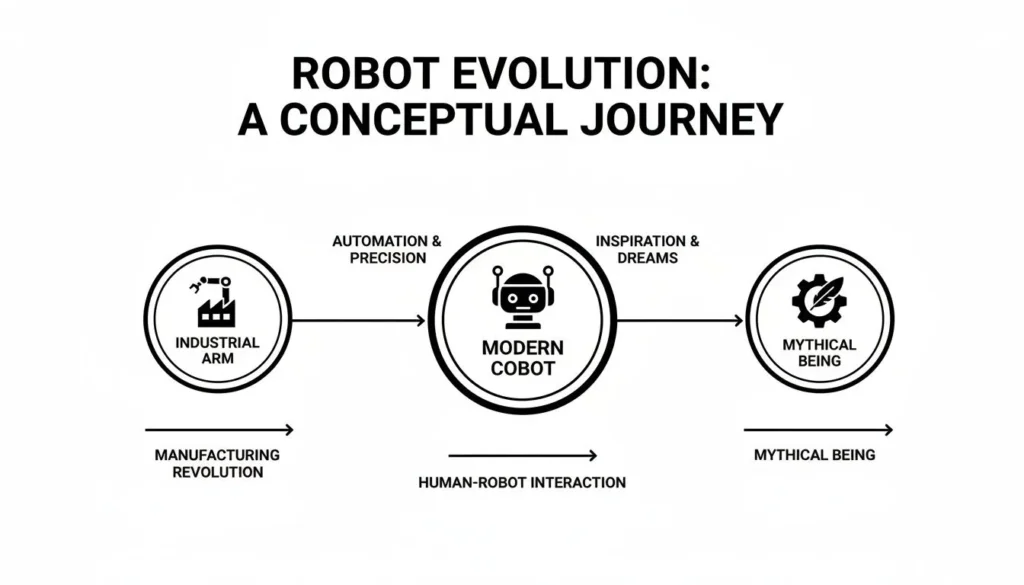
You can see a clear shift away from raw industrial power toward smarter, more human-centric designs, which perfectly mirrors the evolving goals of the robotics field.
Sensors: Its Senses
A robot’s frame is just dead weight if it can’t perceive the world. That’s where sensors come in. They are the robot’s eyes, ears, and sense of touch, collecting data from the environment and translating it into a digital language the robot’s brain can process.
Just like our own senses, a robot’s sensors are incredibly varied:
- Vision Sensors: Cameras act as the robot’s eyes, letting it “see” objects, find its way around a room, and tell the difference between colors and shapes.
- Proximity Sensors: Think of a bat’s echolocation. These sensors use sound waves or infrared light to figure out how close things are without ever making contact. Your car’s backup beeper is a perfect example.
- Force Sensors: These give a robot a sense of touch. It’s what allows a gripper to know exactly how much pressure to apply when picking up a delicate glass versus a heavy box.
- Light Sensors: Simple but effective, these sensors detect the presence and brightness of light. They’re often used to tell a robot whether it’s day or night.
This constant stream of information is what gives the robot situational awareness, preventing it from just bumping into things blindly.
Actuators: Its Muscles
If sensors are the senses, then actuators are the robot’s muscles. An actuator is any part that takes an electrical command from the control system and turns it into physical motion. Without them, a robot is just an expensive paperweight—all perception and zero action.
You’ll see them in a few common forms:
- Electric Motors: By far the most common, these are used to spin wheels, rotate joints, and move limbs.
- Linear Actuators: These create motion in a straight line, perfect for pushing or pulling parts.
- Grippers: These act as the robot’s hands. They can be simple two-fingered pincers or complex, multi-jointed hands that mimic our own.
The interplay between sensors and actuators is so fundamental that it forms the financial bedrock of the entire industry. The global robotics technology market, valued at USD 124.37 billion in 2026, is on track to hit USD 416.26 billion by 2035. Hardware like sensors and actuators makes up a whopping 72% of that market, proving that a robot’s physical ability to see and act is what drives value. You can dig into the full market projections on robotics technology to see where the growth is headed.
The Control System: Its Brain
Finally, at the heart of everything, is the control system—the robot’s brain. This is where the “think” part of the “sense, think, act” cycle unfolds. The control system is usually a computer loaded with specialized software that chews on sensor data, makes decisions, and shoots out commands to the actuators.
A robot’s control system can be anything from a simple microprocessor running a fixed script to a supercomputer using artificial intelligence. A robot on an assembly line might just repeat the same three motions forever, while a humanoid robot could use AI to learn a new task just by watching a person do it.
This “brain” is the coordinator, the central command. It takes an input—”My camera sees an obstacle 2 feet ahead”—and produces an output: “Tell the wheel motors to stop and turn left.” This constant, looping process is what allows a robot to operate on its own and actually get its job done.
A Guide to the Different Types of Robots
The word ‘robot’ probably brings a specific image to mind, but the reality is a whole family of different machines doing wildly different jobs. To really get a handle on robotics, you have to meet the different members of the family.
Each type is built from the ground up to tackle a specific set of problems in a very particular place. From a sprawling factory floor to your own living room, these machines are far more specialized than most people think.
Industrial Robots: The Powerhouses of Production
Think ‘robot,’ and you’re probably picturing an industrial robot. These are the massive, powerful mechanical arms you see bolted to a factory floor. They are the original workhorses of the robotics world, built for one thing: smashing through repetitive, high-precision tasks with a speed and strength humans just can’t match.
You’ll find them on assembly lines doing the heavy lifting, like:
- Welding: Fusing car body parts together with perfect accuracy, 24/7.
- Painting: Applying flawless coats of paint in environments thick with hazardous fumes.
- Assembly: Placing microscopic chips onto circuit boards without a single mistake.
- Material Handling: Lifting and shifting heavy loads all day, every day, without getting tired.
A classic example is a KUKA robotic arm on a car assembly line—a common sight in any modern manufacturing plant. These robots are almost always kept inside safety cages for a good reason. They move with incredible force and speed, making them a serious hazard for any person who gets too close while they’re working.
The appetite for these machines is only growing. Fueled by the need for absolute precision in sectors like automotive and electronics, the industrial robotics market is set to explode from USD 65.1 billion in 2026 to USD 343.8 billion by 2036. You can dig into the full industrial robotics market forecast to see what’s driving this incredible growth.
Service Robots: The Everyday Helpers
While industrial robots are busy behind the scenes, service robots are made to work right alongside people, giving us a hand with our daily tasks. This is a huge and incredibly varied category, basically covering any robot that does something useful for a person outside of a factory.
You’ve got professional service robots, like the da Vinci Surgical System, which gives surgeons superhuman control to perform minimally invasive operations. You’ll also spot them in hotels delivering room service or in hospitals disinfecting rooms to zap dangerous germs.
Then there are the personal service robots, which are becoming incredibly common. Your robot vacuum is a perfect example, quietly taking care of a household chore all on its own. Robotic lawnmowers and pool cleaners fall into this group, too. The key difference is the world they live in—they have to navigate our messy, unpredictable spaces like homes, hospitals, and busy public areas.
To help clear things up, let’s compare some of the major robot families and where you’ll find them.
Comparing Major Types of Robots
This table offers a quick look at the different robot families, their natural habitats, and what they’re built to do.
| Robot Type | Primary Environment | Key Function | Real-World Example |
|---|---|---|---|
| Industrial | Factories, manufacturing plants | Repetitive, high-precision tasks (welding, assembly) | KUKA robotic arm |
| Service (Professional) | Hospitals, hotels, public spaces | Assisting humans with professional tasks | da Vinci Surgical System |
| Service (Personal) | Homes, yards | Automating domestic chores | iRobot Roomba |
| Mobile (AMR) | Warehouses, construction sites | Navigation and transportation | Amazon warehouse robots |
| Collaborative (Cobot) | Shared human-robot workspaces | Assisting and augmenting human workers | Universal Robots’ UR5e |
| Humanoid | Research labs, public interaction | Mimicking human form and movement for research | Boston Dynamics’ Atlas |
As you can see, a robot’s design is dictated entirely by its job and its workplace.
Mobile Robots and Collaborative Robots
Two of the most exciting and fastest-growing areas in robotics right now are mobile robots and collaborative robots, and they often overlap.
Autonomous Mobile Robots (AMRs) are exactly what they sound like: robots designed to move around their environment without being stuck in one place. They’re the new backbone of modern logistics, zipping around giant warehouses to grab items for online orders. Those little orange bots you see in an Amazon fulfillment center? Prime example. Other mobile robots, like Boston Dynamics’ Spot, can trek across tricky terrain like construction sites to carry out inspections.
Collaborative robots, or “cobots,” are a complete game-changer. Unlike traditional industrial robots sealed away in cages, cobots are packed with advanced sensors and safety features that let them work safely right next to people. They are usually smaller, lighter, and way easier to program, designed to help people with their jobs, not just replace them.
A cobot might hand a worker the exact part they need, hold a heavy component steady while a person tinkers with it, or take over a boring, repetitive task right beside them on a shared workbench. This approach is bringing automation to smaller businesses that could never afford it before, sometimes cutting down the complex setup process by as much as 50%.
How Robotics Is Changing Industries Today
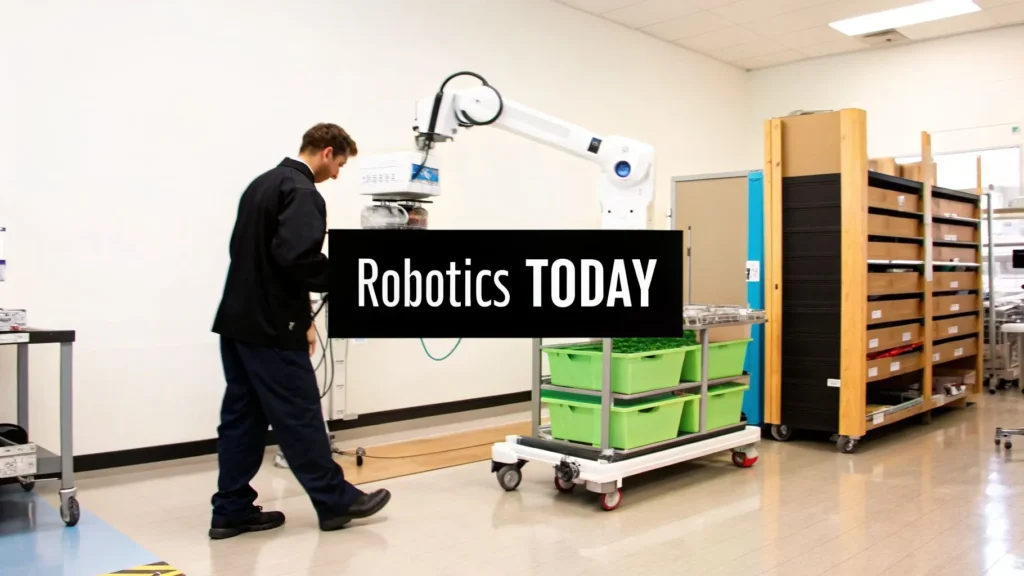
The theory is cool, but robotics really shines when it gets out of the lab and starts solving real-world problems. From hospital operating theaters to sprawling warehouses, robots aren’t just a future fantasy anymore. They’re a practical force that’s actively reshaping entire industries, one task at a time.
The numbers back this up. The global robotics market is set to explode, growing an incredible 2.5X from nearly US$50 billion in 2025 to over US$110.7 billion by 2030. A huge chunk of that growth, somewhere between 50-60%, is expected to come from mobile robots zipping around warehouses. You can get a deeper look at the global robotics market outlook to see just how big this shift is.
Revolutionizing Healthcare With Precision
One of the most powerful applications of robotics is in healthcare, especially inside the operating room. Surgical robots, like the well-known da Vinci Surgical System, aren’t there to replace surgeons. They’re there to give them superhuman abilities.
Picture a surgeon at a console, using controls to guide incredibly precise robotic arms. These arms, holding miniature instruments, can make incisions and perform procedures with a level of steadiness and a range of motion a human hand could never match. The result? Smaller incisions, less blood loss, and much faster recovery times for patients. It’s a perfect example of robotics working with human experts to get better results.
Speeding Up the World of E-Commerce
Ever wonder how that package you ordered shows up on your doorstep in a day or two? A huge part of the credit goes to autonomous mobile robots (AMRs). These machines are the unsung heroes of modern e-commerce, running a perfectly choreographed dance inside massive fulfillment centers.
These smart, wheeled bots navigate the warehouse floor, locate the right shelf, and bring an entire rack of products straight to a human worker. This “goods-to-person” model solves a massive bottleneck by cutting out all the time employees used to spend walking miles up and down endless aisles.
By automating the movement of goods, AMRs allow warehouses to process thousands of orders with incredible speed and accuracy. They are a core component of the logistics infrastructure that underpins the convenience of modern online shopping.
This shows how robotics is perfect for tackling tasks that are repetitive, physically draining, and time-consuming. It frees up human workers to handle more valuable work like quality checks and packing. This space is also a hotbed for combining technologies; check out our guide on what is augmented reality to see how visual overlays are also changing the game in warehouses.
Creating New Frontiers in Entertainment
Robots aren’t just about work; they’re also about play. While theme parks have used animatronics for decades to make characters move, modern robotics has taken entertainment to a completely different level.
Today’s robotic systems are creating mind-bendingly dynamic and immersive rides. Forget a simple car on a fixed track. Imagine being strapped into a powerful robotic arm that can twist, turn, and move in perfect sync with what’s happening on a giant screen. These KUKA-style robot arms create a feeling of motion and freedom that was impossible before, making attractions more thrilling than ever.
It’s a great showcase of the technology’s versatility. The same type of robotic arm that spot-welds a car frame in a factory can be programmed to be the star of a storytelling experience.
Making Education More Hands-On
Robotics is also making a huge impact in the classroom, changing how students learn about science, technology, engineering, and math (STEM). Instead of just reading about abstract concepts, students are now building and programming their own robots.
Platforms like LEGO Mindstorms and VEX Robotics give students of all ages toolkits to get their hands dirty with core engineering principles. They get to learn about:
- Mechanical Design: Figuring out how to build a robot that is sturdy and can actually move.
- Programming Logic: Writing the code that tells the robot what to do and how to react to its surroundings.
- Problem-Solving: Debugging their code and tweaking their design when the robot inevitably does something unexpected.
This approach makes complex ideas tangible and encourages critical thinking, creativity, and teamwork. It proves that robotics isn’t just something to study—it’s a tool for active learning.
The Future of Robotics and Its Ethical Questions
As robots break free from the predictable confines of factory floors and venture into our messy, real world, we’re not just watching a tech demo. We’re staring down a whole new set of social and ethical puzzles.
The conversation is shifting. It’s no longer just about what machines can do, but what they should do. The real challenge is figuring out how to weave them into the fabric of our lives responsibly. At the heart of it all is the growing bond between robotics and artificial intelligence. AI is giving robots the ability to think on their feet, learn from experience, and make their own decisions—a development that brings both incredible opportunities and serious concerns.
The New Workforce: Human-Robot Collaboration
Let’s start with the most common question: will a robot take my job? It’s a valid fear, but the reality is a lot more interesting than a simple replacement. While robots will certainly take over many of the repetitive, physically draining, or dangerous tasks, they’re also set to create entirely new job categories.
Think of it less as a replacement and more of a reshuffling of roles. We’re going to need a lot more people who specialize in:
- Robot Supervision and Management: Someone has to oversee the fleets of autonomous systems and make sure they’re playing nicely.
- Maintenance and Repair: These complex machines won’t fix themselves. Skilled technicians will be in high demand.
- Human-Robot Interaction Design: The best technology feels intuitive. We’ll need designers to build the bridge between human workers and their robotic colleagues.
The future is all about collaboration. The goal is to let robots handle the dull, dirty, and dangerous work. This frees up people to focus on what we do best: creativity, critical thinking, and emotional intelligence—things machines just can’t touch right now.
The core question isn’t whether robots will displace jobs, but how we can retrain and adapt our workforce to succeed in a world with more automation. It’s a challenge that requires foresight from governments, educators, and businesses to make sure nobody gets left behind.
Navigating Ethical Dilemmas and Regulation
The smarter robots get, the higher the ethical stakes become. When a self-driving car has an accident, who’s at fault? How should a medical robot decide which patient to help first in a crisis? These aren’t just technical glitches to be patched; they’re deep moral questions that society has to answer.
This brings us to the urgent need for solid safety standards and regulation. Without clear rules of the road, we risk deploying systems that are biased or just plain unsafe. Crafting these regulations is tricky—it’s a balancing act between encouraging innovation and protecting the public. We have to establish clear lines of accountability for the people who make and operate these robots.
As technology races ahead, our legal and ethical frameworks have to sprint to keep up. Developing these advanced systems hinges on massive computing power, and some think the next big breakthrough will come from a totally new direction. For those interested, you can learn more about how quantum computing could change the game in our guide.
The point isn’t to put the brakes on progress. It’s to steer it in a direction that benefits everyone. Building a future where humans and robots work together effectively means having these tough conversations now, before the tech gets too far ahead of us.
Even after diving into the world of robotics, you probably still have a few questions buzzing around. That’s perfectly normal. Let’s clear up some of the most common points of confusion that I hear all the time.
What’s the Real Difference Between Robotics, AI, and Automation?
People often use these terms interchangeably, but they’re not the same thing. It’s best to think of them as distinct, but related, concepts.
Automation is the big-picture goal. It’s simply about making a process happen with less human effort. Think of a simple sprinkler system on a timer—that’s automation.
Robotics is a physical way to achieve that goal. It means using an actual machine, a robot, to carry out the automated task. A robotic arm on a car assembly line is a classic example of robotic automation.
Artificial Intelligence (AI) is the smarts. It’s the brain that allows a robot to do more than just repeat a pre-programmed motion. AI gives a robot the power to perceive, learn, and make decisions on its own.
A basic factory arm that welds the same spot over and over is robotics and automation, but with very little AI. A self-driving car, on the other hand, needs all three: the physical robot (the car), the goal of automation (driving itself), and a seriously advanced AI to navigate traffic and make split-second decisions.
Are Robots Going to Take All Our Jobs?
This is probably the number one question I get, and it’s a valid concern. The reality is much more nuanced—it’s less of a job takeover and more of a job transformation.
Sure, robots are exceptionally good at handling tasks that are dangerous, mind-numbingly dull, or require a level of precision we humans just can’t match. But as those jobs change, completely new roles are created.
For every task a robot takes over, new jobs pop up in robot design, programming, maintenance, and data analysis. The future of work won’t make humans obsolete; it will make our uniquely human skills—creativity, complex problem-solving, strategic thinking, and emotional intelligence—more valuable than ever.
It’s not about humans versus machines. It’s about humans with machines. The most successful workplaces will be the ones where people and robots work together, each playing to their strengths.
How Can I Get Started in Robotics?
Jumping into robotics is easier today than you might imagine. You definitely don’t need a fancy, high-tech lab to get your hands dirty.
DIY kits are a fantastic way to start. Platforms like Arduino or LEGO Mindstorms are relatively affordable and provide a fun, hands-on way to build and program your very first robot.
If you’re more drawn to the software side of things, I’d recommend exploring the Robot Operating System (ROS). It’s an open-source framework that has become a standard in the industry, and learning it will give you a major leg up.
You can also find a ton of great introductory courses from top universities on platforms like Coursera and edX. And don’t forget to join a few online forums or communities—they’re full of hobbyists and experts who are usually more than happy to help you along the way.
Discover more from Maxi Journal
Subscribe to get the latest posts sent to your email.