When it comes to baseball pitching mechanics for youth, most people focus on the wrong thing. They’re obsessed with the radar gun. But a safe, repeatable motion that protects a young arm is built from the ground up, not from chasing velocity.
Building the Foundation for a Healthy Pitcher
Before a young player even thinks about throwing hard, we have to build a solid foundation. The real starting points for a long, healthy baseball career have nothing to do with speed. It’s all about protecting that developing arm while teaching an efficient, repeatable delivery.
A pitcher’s body is a kinetic chain. They don’t just throw with their arm—they throw with their entire body. True power starts in the legs, moves up through the core and torso, and is finally unleashed through the arm. When you get this sequence right, you take a massive amount of stress off the shoulder and elbow.
A healthy pitching motion is built from the ground up. By teaching young athletes to use their lower half and core, we take dangerous stress off the small, vulnerable muscles in the arm. This is the cornerstone of injury prevention.
The Three Pillars of a Solid Start
To get started, let’s keep it simple. We can boil it all down to three core areas that every young pitcher needs to understand. These aren’t complicated biomechanics; they’re simple, coachable concepts that form the bedrock of a good delivery.
- Balance and Posture: A pitcher has to be in control of their body at all times. It starts with a stable, athletic stance on the mound and the ability to maintain that balance through the leg lift and stride.
- A Comfortable Grip: Don’t overthink this one. The goal is a relaxed four-seam fastball grip. A “white-knuckle” grip creates tension that shoots right up the arm, killing fluid motion and cranking up the injury risk.
- Generating Power from the Lower Half: This is the engine. Teach your players to feel the ground and “push off the rubber,” using their legs to drive their momentum toward home plate. Getting this right early on is a game-changer.
Shifting the Mindset from Velocity to Health
By ingraining these fundamentals, we can confidently teach a motion that’s both safe and effective. The goal should always be to develop a complete athlete, not just a thrower. For those looking to build that all-around athleticism, you can explore some fundamental fitness tips for beginners to support what they’re doing on the field.
When you prioritize balance, proper sequencing, and using the ground, you put a young player on a path to a long and enjoyable time in the sport. We have to fight the urge to chase a few extra miles per hour at the expense of long-term arm health. A smooth, controlled delivery that consistently finds the strike zone is infinitely more valuable—and safer—for any developing pitcher.
Breaking Down Each Phase of the Youth Pitching Motion
Trying to teach the entire pitching motion at once can be a recipe for disaster. It’s just too much for a young player to process. I’ve always found it’s best to treat the delivery like a chain—every movement is a link that connects to the next. A weak link anywhere in the sequence, and the whole thing falls apart.
For baseball pitching mechanics for youth, our focus isn’t on creating a big-league delivery overnight. Instead, we’re building a safe, repeatable motion that uses the entire body efficiently. The best way to do that is to break it down into smaller, more manageable pieces.
First things first, you have to nail the fundamentals. Before we even get into the full motion, we need to establish a solid foundation of balance, posture, and a proper grip.
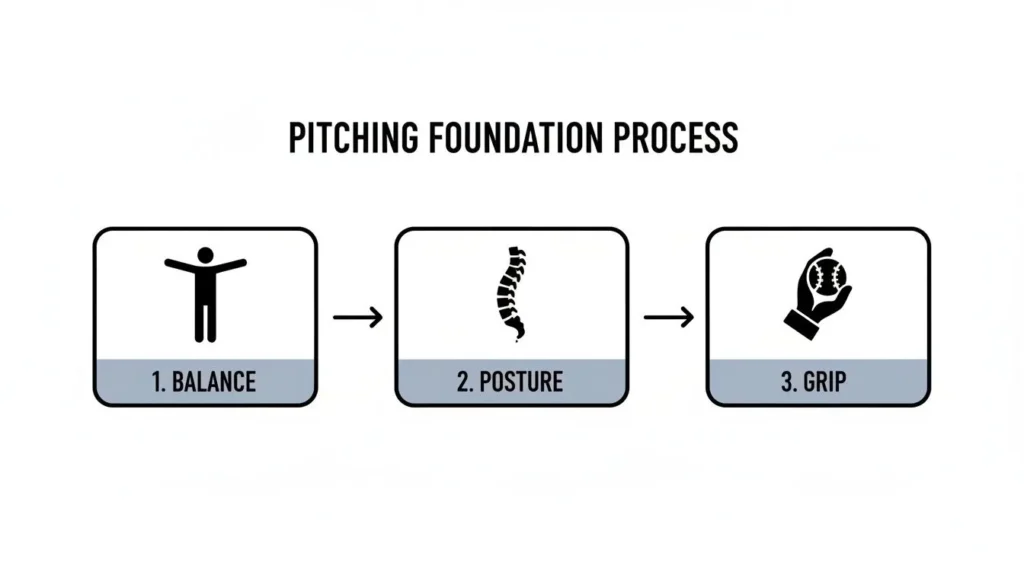
This simple progression reminds us that all powerful movements start from a point of stability. You can’t add speed until you’ve mastered the basics.
The Initial Setup and Windup
Every great pitch starts from the same place: a calm, balanced, and athletic position on the rubber. Get your pitcher to find a comfortable stance where they feel relaxed and in control. The windup that follows is purely for setting their rhythm and building a little momentum—it’s not where the power comes from.
A lot of kids develop a jerky, almost robotic windup. You want to coach that out. The first moves, like a small rocker step, need to be smooth and controlled. This initial rhythm is what sets up the rest of the delivery for success.
The Leg Lift and Stride
From the windup, the pitcher shifts their weight onto their back leg and brings their front knee up. This is the “loading” phase. The single most important thing here is balance. Can your pitcher hold that position for a beat without wobbling? A shaky leg lift almost always leads to an uncontrolled stride.
The stride itself is all about direction. The pitcher needs to move toward the catcher, not drifting off toward first or third base. A great cue is to tell them to lead with their front hip. Their stride foot should land on a direct line to the plate, with the foot staying slightly closed. If that front foot lands open, the hips and shoulders will open up way too early, which kills velocity and puts a ton of stress on the throwing arm.
Coaching Cue: I often tell pitchers to “show the catcher the pocket of your front pants.” This simple visual helps them keep that front hip closed and stay on a direct path to the plate, preventing them from spinning off the ball.
Creating Separation and a Clean Arm Path
This is where the real power is generated. The magic happens through hip-to-shoulder separation. Just as the pitcher’s front foot lands, their hips start to rotate open toward home plate, but their shoulders stay closed, pointing toward third base (for a righty). This creates a powerful stretch—like a rubber band—across their core, storing energy that will explode into the throw.
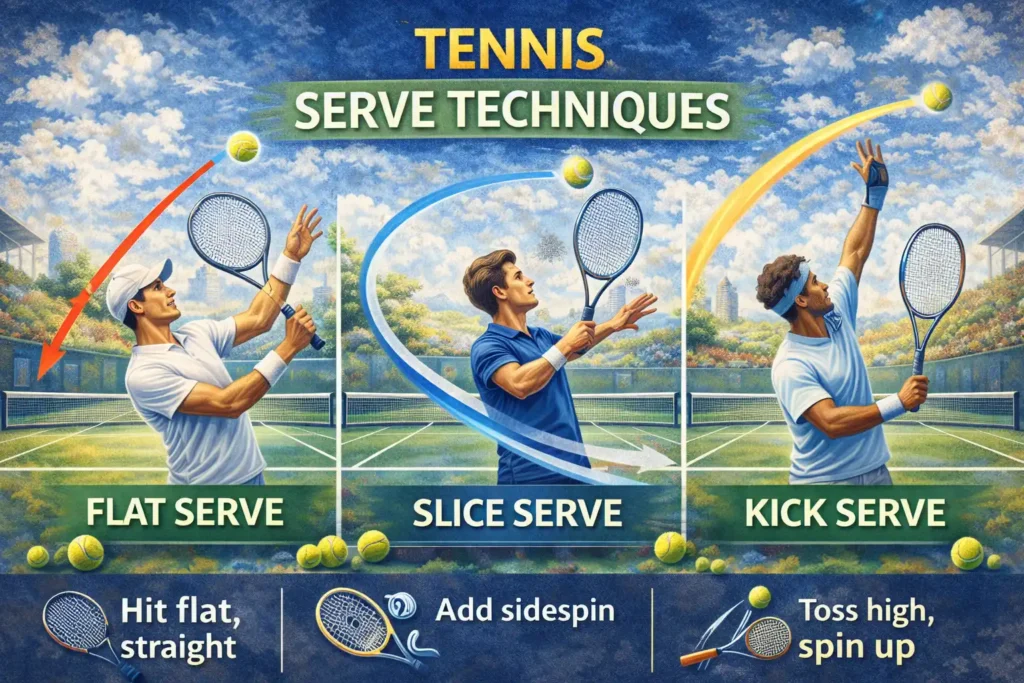
As the body unwinds, the arm naturally follows and comes up into the throwing position. A very common and dangerous flaw with young pitchers is letting the elbow drop below the shoulder. We need that elbow to be at or just above shoulder height for a clean, efficient arm path. It’s less about “throwing” with the arm and more about “unwinding” the body. This idea of transferring power from the core out to the limbs is a key concept in many athletic movements, similar to what you see in high-level tennis serve techniques.
Interestingly, research shows that young pitchers tend to hit their peak kinematic points about 10% earlier in the delivery compared to college and pro athletes. This timing difference, often tied to their shorter stride lengths relative to their height, can mess up the kinetic chain that sends energy from the ground up through the body. The International Journal of Sports Physical Therapy has a great paper if you want to learn more about these youth-specific findings.
The All-Important Follow-Through
Never treat the follow-through as an afterthought. It’s one of the most critical parts of the motion for staying healthy, acting as the body’s natural braking system. After the ball is gone, the throwing arm has to slow down gradually over a long arc.
A good follow-through means the arm continues across the body, with the hand finishing down near the opposite knee. The back leg should also come up and around, helping the pitcher end up in a balanced position, ready to field a ball. Stopping the arm abruptly is a surefire way to invite an elbow or shoulder injury.
Drills to Develop and Reinforce Good Mechanics
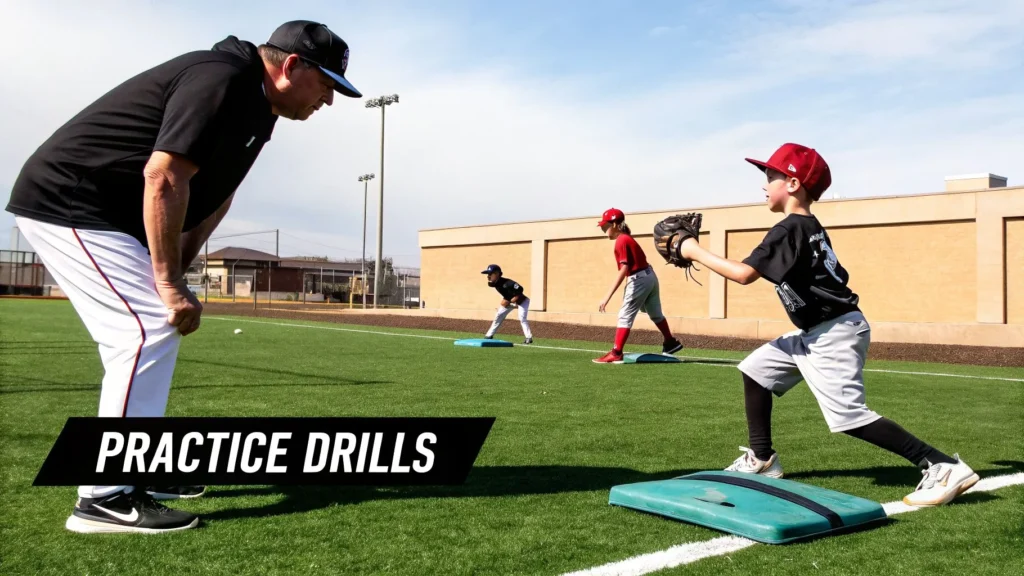
Knowing what good pitching mechanics look like is step one. Getting a young arm to actually do it consistently is the real challenge. This is where the theory hits the dirt.
Solid baseball pitching mechanics for youth are built through thousands of purposeful reps, not by simply thinking about them. The right drills are the key, hardwiring efficient movements until they become second nature.
The best approach is progressive. We isolate a single piece of the delivery, get it right, and then start chaining the movements together into one fluid, powerful motion. You might be surprised how much work can be done without a ball, a glove, or even a catcher. Some of the most foundational work is just about balance and movement.
Foundational Drills Without a Ball
Before a pitcher ever worries about throwing a strike, they need to be able to control their own body. These no-throw drills build a stable platform and teach the body how to move toward the plate with purpose.
1. Balance Point Drill:
This is exactly what it sounds like. The pitcher comes set, lifts their leg to their balance point, and just holds it. The goal is to be rock-solid for 5-10 seconds with no wobbling. It’s a simple drill that builds critical strength in the back leg and core—the very foundation of the throw.
2. Rocker Drill:
From their stance, the pitcher gently rocks their weight back onto their rear foot, then forward. This drill is all about rhythm. It helps the player feel that smooth transfer of momentum toward home plate, teaching them to create a controlled forward glide instead of a jerky, rushed start.
I can’t stress this enough: if a pitcher can’t control their body at the peak of their leg lift, they’ll never have a consistent delivery. Mastering balance is the first non-negotiable step toward repeatable mechanics.
Introducing the Arm Path with Towel Drills
Once the player has a feel for balance and direction, we can work on the arm action without putting any stress on their shoulder or elbow. The towel drill is a coaching classic for a simple reason: it provides instant feedback.
Have the pitcher grip a small hand towel by one end and go through their full motion at about 75% effort. We’re listening for a distinct “snap” of the towel out in front of the body, right around where the ball would be released.
- What to Watch For: If you hear the snap up by their ear, it’s a red flag. It means they’re pulling the ball with their arm instead of letting their body’s rotation create arm speed.
- The Correction: To fix an early snap, cue them to keep their front shoulder closed a little longer. Tell them to “show the catcher the number on your back.” This forces the arm to come along for the ride naturally.
This drill is fantastic. It’s a self-correcting tool that teaches a clean, extended arm path, and you can do dozens of reps in a single practice with zero wear and tear on the arm.
Dynamic Drills to Sync the Upper and Lower Body
Okay, it’s time to put it all together. These drills are designed to sync the power from the legs and core with the rotational speed of the upper body. We’ll use a ball now, but start at a shorter distance and lower intensity.
Walk-Through Drill:
The pitcher starts a few feet behind the rubber, takes two or three walking steps (like a crow-hop), and flows directly into their pitching delivery. This drill is a game-changer because it:
- Forces the body to build and maintain linear momentum toward the plate.
- Smooths out the often-awkward transition from moving forward into rotating.
Reverse Throw Drill:
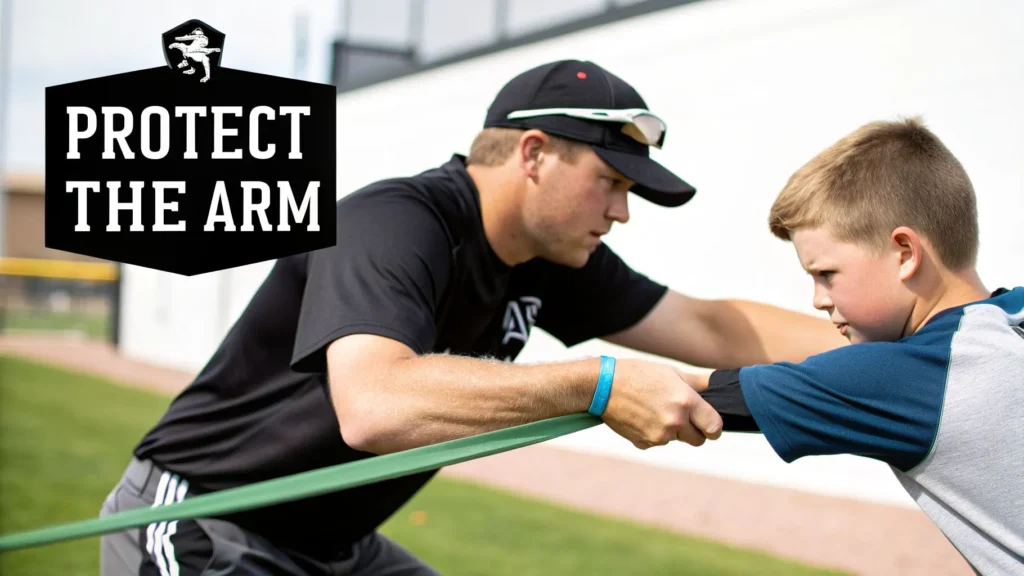
This one isn’t about throwing at all; it’s about feeling the muscles that slow the arm down. Using a light resistance band, have the pitcher start in their follow-through position. From there, they slowly “reverse” the throw, pulling the band back through the motion until they reach the high-cocked position.
This is a phenomenal drill for strengthening the decelerator muscles in the back of the shoulder—a critical part of preventing common arm injuries. It’s a low-impact way to build resilience in those all-important supportive muscles.
How to Prevent Common Youth Pitching Injuries
Nothing takes a young player out of the game faster than an injury. While we spend a lot of time drilling proper baseball pitching mechanics for youth, arm health is a two-part equation. You can’t have one without the other—efficient movement must be paired with smart workload management.
The vast majority of youth pitching injuries don’t come from a single, dramatic throw. Instead, they creep in over time, usually because of three main issues: overuse, flawed mechanics that add stress, and not getting enough rest.
Understanding Overuse Injuries
You’ll frequently hear the terms “Little League Elbow” and “Little League Shoulder.” These aren’t specific diagnoses but catch-all phrases for injuries to the growth plates in the elbow and shoulder, which are especially vulnerable in young, developing bodies. They happen when repetitive throwing causes micro-trauma that the body can’t repair before the next practice or game.
The stats on youth pitching injuries are eye-opening. Studies show that between 26% to 51% of young pitchers report arm pain within a single season, with the 9-12 age group being particularly at risk. In fact, post-2020 trend data showed a surge in pitching injuries of over 30% as kids jumped back into play without a proper conditioning ramp-up. You can read more about the alarming trends in youth pitching injuries and the data behind them.
The most dangerous phrase in youth baseball is, “He’s fine, he says his arm doesn’t hurt.” Young athletes are tough and often conditioned to play through discomfort, but persistent soreness is the body’s primary warning sign that something is wrong.
Age-Based Pitching Guidelines for Injury Prevention
To combat overuse, following established guidelines for pitch counts and rest is non-negotiable. This isn’t about being overly cautious; it’s about being smart and protecting a player’s long-term health. The table below provides a quick reference based on Little League Baseball recommendations.
| Age Group | Max Pitches per Day | Required Rest (1-20 Pitches) | Required Rest (21-35 Pitches) | Required Rest (36-50 Pitches) | Required Rest (51-65 Pitches) | Required Rest (66+ Pitches) |
|---|---|---|---|---|---|---|
| 7-8 | 50 | 0 days | 1 calendar day | 2 calendar days | 3 calendar days | 4 calendar days |
| 9-10 | 75 | 0 days | 1 calendar day | 2 calendar days | 3 calendar days | 4 calendar days |
| 11-12 | 85 | 0 days | 1 calendar day | 2 calendar days | 3 calendar days | 4 calendar days |
| 13-14 | 95 | 0 days | 1 calendar day | 2 calendar days | 3 calendar days | 4 calendar days |
These numbers are a fantastic starting point. Remember to treat them as maximums, not targets. Always listen to the athlete’s body first.
Key Warning Signs to Watch For
As a parent or coach, you’re the first line of defense. It’s your job to watch for the subtle signs that an arm is under too much stress. More importantly, you have to create an environment where a player feels safe telling you they’re sore without worrying about being benched or letting the team down.
Keep a close eye on these red flags:
- Persistent Pain or Soreness: Any soreness that sticks around for more than a day after pitching is not normal.
- A Noticeable Drop in Velocity: If a pitcher is suddenly throwing slower without trying to, their body might be compensating for pain or fatigue.
- Loss of Command: When a usually accurate pitcher can’t find the strike zone, it can be a sign of fatigue-induced mechanical breakdown.
- Visible Swelling or Loss of Motion: Any visible swelling or trouble fully straightening or bending the arm calls for immediate rest and a professional evaluation.
Being proactive is everything. You can discover more about how to prevent sports injuries by taking a holistic approach that includes nutrition, sleep, and smart training.
The Dangers of Year-Round Pitching
The push for early specialization and playing on multiple teams year-round is a major driver of overuse. A young pitcher’s arm needs a real break. Medical experts strongly recommend at least 3-4 consecutive months of rest from any overhead throwing each year.
This rest period doesn’t mean sitting on the couch. It’s the perfect time to play other sports like soccer or basketball, which build different muscle groups and improve overall athleticism. This break is one of the best things a young athlete can do for their baseball future—it protects their arm and makes them a more well-rounded, durable player in the long run.
Choosing the Right Pitches for the Right Age
It’s the question that pops up in every dugout and car ride home: “When can my pitcher start throwing a curveball?” The urge to add breaking balls is totally understandable, but learning to pump the brakes on that is one of the most critical things a coach or parent can do for a young arm.
Before even a thought is given to off-speed stuff, a pitcher has to show they have command of the fastball. We’re not just talking about getting it over the plate. This means hitting spots, consistently, and proving they can control their primary weapon. Mastering fastball mechanics builds the entire foundation for every other pitch.
The First and Safest Off-Speed Pitch
The changeup should always, without exception, be the first off-speed pitch a young player learns. Its value is massive, and the risk is almost zero. The beauty of the changeup is that it uses the exact same arm action as a fastball, which dramatically cuts down on the stress to the elbow and shoulder.
The whole point isn’t nasty movement; it’s about messing with the hitter’s timing. A pitcher who can deliver a pitch that looks identical to their fastball but arrives 8-10 mph slower will generate weak contact and keep hitters guessing. The trick is selling it with the same arm speed, a concept that actually reinforces good fastball mechanics.
Don’t rush the process. A young pitcher with a located fastball and a deceptive changeup is more effective and far safer than one who throws a mediocre curveball with poor command. Mastery comes before variety.
The Curveball and Slider Dilemma
The main reason we hold off on the curveball and slider comes down to simple anatomy. A young pitcher’s growth plates in the elbow and shoulder aren’t fully fused yet. This makes them much more vulnerable to injury from the intense rotational forces—like supination and forearm torque—needed to spin those pitches.
As players hit their early teens, the pressure to throw breaking balls skyrockets. Research highlights this trend: while only about 31% of pitchers aged 9-12 throw a curveball, that figure leaps to over 75% for kids 13 and up. Interestingly, mechanical efficiency also improves with age. For instance, 79% of pitchers aged 13-15 keep their shoulders closed at foot contact, compared to just 62% of younger pitchers, which is a key part of managing torque safely. You can discover more about how pitching habits evolve with age by reviewing this in-depth study.
A Safe Timeline for Pitch Development
So, when is it okay? Every kid develops at a different pace, but a safety-first timeline gives us a solid roadmap to follow.
- Ages 8-10: Focus only on the four-seam fastball. The goals are simple: learn what the strike zone is and build a clean, repeatable delivery.
- Ages 10-12: Once fastball command is truly there, it’s time to introduce the changeup. Dedicate a full season or two to mastering this pitch.
- Ages 13-14: If the pitcher is physically maturing and has excellent command of both their fastball and changeup, you can begin to introduce the curveball. Teach the proper grip and spin, but keep it out of games or use it very sparingly.
- Ages 15 and older: As the pitcher’s body gets closer to full maturity, the slider can be considered. This pitch puts the most stress on the arm and should be the absolute last one added to the arsenal.
This patient approach is all about protecting a young player’s arm and setting them up for a long, healthy career. The goal isn’t to have the slickest curveball at age 12; it’s to still be on the mound, throwing hard and healthy, at age 18 and beyond.
Common Questions About Youth Pitching Mechanics
Even after breaking down all the phases and drills, parents and new coaches always seem to have a few more questions. That’s a good thing. Building solid baseball pitching mechanics for youth is a process of constant learning.
Let’s tackle some of the most practical and frequent concerns I hear at the ballpark. Think of this as your quick-reference guide for direct, trustworthy answers.
How Fast Should a Youth Pitcher Throw?
This is, without a doubt, the question I get asked most often. The simple, honest answer is this: don’t worry about it. For a developing player, the number on a radar gun is one of the least important metrics you can track.
Chasing velocity too early is a recipe for disaster. It almost always pushes a young pitcher to develop poor mechanics—like trying to throw with just their arm—which can lead directly to injury. Instead, the focus should be squarely on clean mechanics and command.
Velocity is an outcome, not an input. It’s the natural result of an efficient, repeatable delivery that syncs up the entire body. A smooth motion that consistently finds the strike zone is infinitely more valuable for a young pitcher’s future than a few extra miles per hour right now. The speed will come naturally over years of proper training.
What Are the Biggest Mechanical Flaws to Watch For?
While every pitcher has their own unique style, a few major mechanical flaws show up time and time again. I consider these red flags because they don’t just hurt performance—they place a massive amount of unnecessary stress on the throwing arm.
Here are the top three I look for in any young pitcher:
- Opening Up Too Early: This happens when the pitcher’s front shoulder and hips fly open toward the plate before their front foot has even landed. It forces the arm to drag behind the body, putting immense strain on the shoulder.
- A Low Elbow (The “Inverted W”): If the elbow drops way below the height of the shoulder during the throwing motion, it creates a dangerous “pushing” action. This puts extreme stress on both the elbow’s ulnar collateral ligament (UCL) and the shoulder joint.
- A Poor Follow-Through: An abrupt follow-through, where the arm stops suddenly after releasing the ball instead of decelerating smoothly across the body, is like slamming on the car’s brakes. All that force has to be absorbed by the small muscles and ligaments in the arm.
Fixing these flaws with specific drills is one of the most critical jobs for any youth coach.
The goal isn’t to make every pitcher look like a carbon copy of the other. However, these specific flaws violate fundamental principles of how the body safely and efficiently produces force. Fixing them is non-negotiable for arm health.
Is It Okay for My Child to Pitch and Catch in the Same Game?
This is a hard “no” from me. Pitching and catching are, by a wide margin, the two most demanding positions on the field when it comes to throwing volume and arm stress. A catcher makes dozens of high-effort throws back to the pitcher and on steal attempts, all on top of the physical toll of squatting and blocking.
Combining the workload of both positions in one game, or even on back-to-back days, is a major risk factor for overuse injuries. In fact, many youth baseball leagues, including Little League, have specific rules that forbid a player from going behind the plate to catch after they’ve thrown a certain number of pitches.
That rule exists for a very good reason. To best protect your child’s arm, have them play a less demanding position like first base or an outfield spot after they’re done on the mound. Their long-term health is far more important than winning a single game.
Should My Young Pitcher Do Strength Training?
Yes, absolutely—but it has to be the right kind of strength training. When people hear “strength training,” their minds often go to heavy barbells and powerlifting. That stuff is not safe or necessary for a young, developing athlete.
For a youth pitcher, the entire focus should be on building a strong, stable foundation. This means prioritizing:
- Core Strength: Exercises like planks, bird-dogs, and medicine ball rotations are perfect. The core is the engine that links the lower body to the upper body.
- Balance and Stability: Single-leg exercises and balance drills are key for improving body control throughout the delivery.
- Flexibility and Mobility: A full range of motion in the hips and shoulders is absolutely essential for an efficient motion.
- Decelerator Muscles: Using resistance bands for exercises like reverse throws is fantastic for strengthening the small muscles in the back of the shoulder that slow the arm down safely.
Heavy weightlifting is not appropriate for athletes whose growth plates have not yet closed. A well-rounded program using bodyweight, resistance bands, and light medicine balls is far safer and more effective for building the athletic base needed for healthy pitching.
At maxijournal.com, we are dedicated to providing clear, practical insights across a wide range of topics, from sports and health to science and technology. We believe in empowering our readers with knowledge that is both accessible and actionable. For more in-depth guides and articles, explore everything we have to offer at https://maxijournal.com.
Discover more from Maxi Journal
Subscribe to get the latest posts sent to your email.