So, what’s the real story with the economy in Russia right now? In short, it’s an economy that has shown remarkable resilience under incredible strain, largely fueled by its vast commodity exports and significant state control. The key is to see it not as a system on the verge of collapse, but as one that has been fundamentally rewired to function on a war footing.
A Snapshot of the Russian Economy News in 2026
Imagine Russia’s economy is like an engine that’s been quickly jury-rigged to keep a machine moving. It hasn’t broken down as many experts predicted, but these emergency repairs are impacting its long-term performance. What we see is a strange mix of surface-level stability and deep structural flaws.
This stability is almost entirely propped up by enormous government spending, especially on the military. This acts as a powerful, albeit unsustainable, fiscal stimulus, creating jobs and demand in the defense sector.
The main vulnerability, however, has not changed: its heavy reliance on commodity exports. Even as Moscow redirects its trade from Europe to Asia, the money it makes from selling oil and gas remains the lifeblood of the federal budget. This leaves the economy extremely vulnerable to swings in global energy prices and the effectiveness of international sanctions, like the G7’s oil price cap.
Russia’s longer-term growth prospects have been weak for years. The war and resulting sanctions have exacerbated structural challenges like unfavorable demographics, a lack of diverse investment, and poor productivity growth, further eroding its potential.
This chart gives a quick visual summary of the core indicators that are defining the economy in Russia.
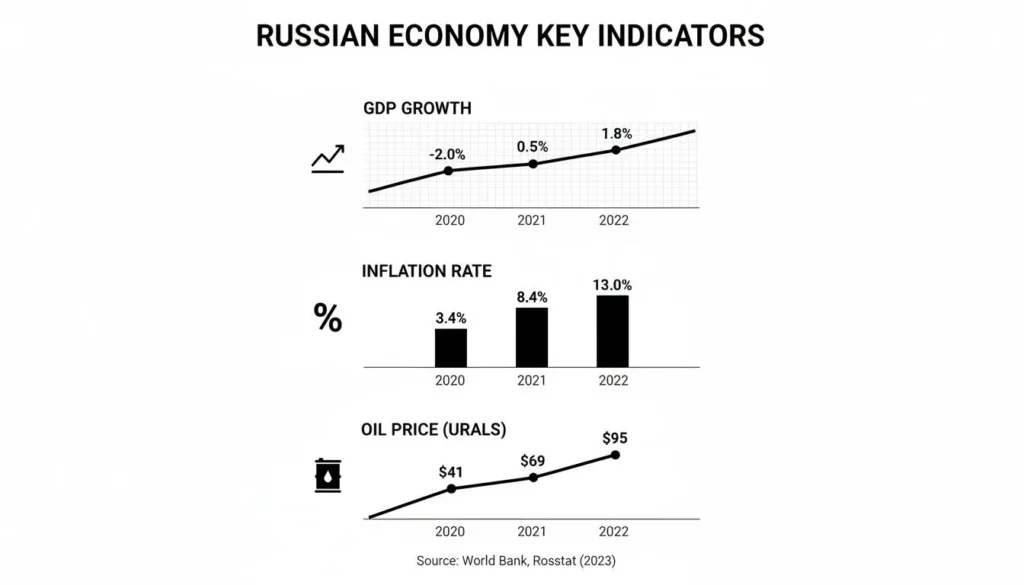
The data really highlights the tightrope Russia is walking, where its GDP is directly tied to the whims of volatile oil markets and the constant battle against inflation at home.
Key Economic Indicators
To put some hard numbers on this, let’s dive into the key metrics that paint the most accurate picture of the current situation. These figures tell the story of an economy that has adapted but is clearly showing signs of strain.
For business owners and freelancers who need to keep tabs on global economic shifts, understanding these core numbers is essential. And if you find yourself managing finances across different currencies and markets, you might want to check out some of the best accounting software for freelancers to help keep your books straight.
Here is a table breaking down the vital statistics for 2026.
Russia Key Economic Indicators 2026
This table summarizes the most important macroeconomic data for the new Russian economy, providing a quantitative snapshot for readers.
| Indicator | Value/Estimate | Trend/Note |
|---|---|---|
| GDP Growth | 0.6% | Slowing significantly from previous quarters, reflecting the limits of stimulus. |
| Inflation Rate | 7.5% | Remains stubbornly high, eroding purchasing power and forcing high interest rates. |
| Urals Oil Price | ~$56/barrel | Consistently below the Brent benchmark due to sanctions and reliance on fewer buyers. |
| Budget Deficit | 2.5% of GDP | Growing due to massive defense spending and lower-than-planned energy revenues. |
| Unemployment Rate | ~2.0% | A historical low, but it signals a severe labor shortage, not economic health. |
This data shows an economy operating under serious stress. That historically low unemployment rate, for instance, isn’t a sign of a booming jobs market; it’s a direct result of military mobilization and a brain drain of skilled workers, which has created critical labor shortages in civilian industries.
Likewise, while the GDP is technically still in the green, its growth has slowed to a crawl. This suggests the initial jolt from massive military spending is wearing off. This is the complex reality of the economy in Russia today.
Exploring the Engine Room of the Economy
To really get a grip on the economy in Russia, you have to look under the hood at the sectors that give it power. While there are several moving parts, one component overwhelmingly drives the entire system: its colossal energy sector.
Think of Russia’s oil and gas industry as the V12 engine in an armored truck. It’s powerful, burns through resources, and provides the brute force needed to move the whole machine. Even with immense international pressure, this engine keeps humming, pumping the cash needed to fund everything from social spending to the military.
Before 2022, Europe was the main destination for this energy. Now, that pipeline has been dramatically rerouted. The much-talked-about “Pivot to the East” means that the bulk of Russia’s crude oil now flows to China and India, keeping revenues alive, but not without a cost. These new buyers know Russia has few other options and consistently negotiate for hefty discounts.
This shift has fundamentally altered Russia’s role in the global energy market. It’s still a top producer, but it has lost a great deal of pricing power, often forced to sell its Urals crude at $15 or more below the global Brent benchmark.
The G7 price cap adds another layer of complexity. It was designed to keep Russian oil flowing to avoid a global price spike while capping the profits Moscow could make. This has pushed Russia to rely on a “shadow fleet” of older tankers with murky insurance and ownership to get around the rules, adding both risk and cost to every barrel sold.
The Foundation of Metals and Mining
Beyond the oil and gas headlines, another pillar of the economy in Russia is metallurgy and mining. If energy is the engine, then metals are the chassis—the strong, foundational frame holding up much of the industrial economy.
Russia is a global heavyweight in a number of key industrial and precious metals. We’re not just talking about basic iron and steel; the country is a critical supplier for high-tech manufacturing across the globe.
- Palladium: Russia produces roughly 40% of the world’s supply. This metal is essential for catalytic converters in gasoline cars, making it a key component for the auto industry.
- Nickel: As a top producer, Russia supplies a vital ingredient for stainless steel and, more critically, for the batteries powering electric vehicles (EVs).
- Aluminum: Russian aluminum giants are major global players, supplying the lightweight metal used in everything from airplanes to soda cans.
This sector provides a second, powerful stream of export revenue. It also directly feeds the country’s own heavy industry, especially the rapidly growing defense sector, which consumes vast quantities of steel, aluminum, and other specialized alloys.
The Unexpected Agricultural Superpower
One of the most surprising stories in Russia’s economy over the last twenty years has been its emergence as an agricultural superpower. A country that was once a major grain importer during the Soviet era is now the world’s number-one exporter of wheat.
This agricultural boom came from a mix of factors: huge areas of fertile “black earth” soil, a surge in private investment, and changing climate patterns that benefited its southern regions. Agriculture has become a genuine bright spot, securing the country’s food supply and providing a reliable source of non-energy export income. Planning an operation on this scale is a massive undertaking; for anyone interested in the basics, you can learn how to create a business plan with our own guide.
State-Driven Domestic Industries
Finally, the modern economy in Russia is increasingly defined by state-led growth in key domestic industries. The most obvious example is the defense industry, which is running at a pace not seen since the Cold War. Massive state contracts for military hardware are acting as a powerful, if distorting, form of economic stimulus.
At the same time, there’s a major push for “technological sovereignty.” Cut off from many Western technologies, the state is pouring money into developing domestic alternatives in software, microchips, and telecommunications. While progress is slow and the challenges are enormous, it signals a strategic pivot toward self-reliance that is reshaping Russia’s internal economy for the long term.
Russia’s Economic Journey From Boom to Headwinds
To get a real grasp on the economy in Russia today, you have to look back at the wild ride it’s been on for the last two decades. This history isn’t just about spreadsheets and charts; it’s a story of sudden wealth, major setbacks, and the strategic thinking that still drives the country’s economic decisions.
The story really kicks off with the “boom years,” an incredible growth spurt from roughly 2000 to 2008. After the total chaos of the 1990s, Russia hit a golden era that was almost entirely bankrolled by a global commodities supercycle. Skyrocketing prices for oil and natural gas—the country’s lifeblood—poured money into the economy like never before.
This wasn’t just a small bump. The economy was transformed, pulling millions of people out of poverty and creating a brand-new, consumer-driven middle class. Cities like Moscow and St. Petersburg saw an explosion in construction and retail as people suddenly had more money to spend.
The Era of Unprecedented Growth
The scale of this boom was staggering. Between 2000 and 2008, Russia’s GDP shot up at an average annual rate of 7%. This turned the country from a post-Soviet basket case into a serious player on the world economic stage.
Disposable incomes more than doubled in real terms and jumped eightfold in U.S. dollars. This gave rise to a powerful new middle class with spending power. You can dig into the numbers yourself using the St. Louis Fed’s economic research database.
This period completely remade the country’s social and economic fabric. It also forged a powerful link between national well-being and the price of oil, a connection that would cause major problems down the road.
For a whole generation of Russians, this era set an expectation that living standards would just keep getting better. The flood of cash also cemented the state’s role in the economy and showed just how much power commodity money had to shape the nation’s future.
But this boom hid some deep-seated weaknesses. The economy in Russia grew dangerously dependent on its oil and gas exports. There was little real pressure to branch out into more innovative, competitive industries.
When the 2008 global financial crisis hit, the party stopped cold. It was a sharp, if temporary, wake-up call, offering the first real look at the vulnerabilities lurking just beneath the surface.
The Shift to Economic Headwinds
The real turning point came in 2014. That year delivered a “perfect storm” of economic troubles that would permanently knock Russia off its growth path. First, global oil prices collapsed, plummeting from over $100 a barrel to less than half that. This one event blew a massive hole in the state budget and sent the ruble into a nosedive.
At the exact same time, Russia was hit with the first serious wave of Western sanctions after it annexed Crimea. These sanctions targeted key individuals, banks, and energy firms, cutting them off from crucial international loans and technology.
This one-two punch tested the economy’s resilience in a way not seen since the 1990s. The government had to scramble, rolling out a whole new playbook designed for survival and self-reliance. This was the end of the easy-money era and the start of a new one defined by economic defense.
- Fiscal Reserves: The Kremlin started dipping into its huge sovereign wealth funds—money saved during the boom years—to fill budget gaps and prop up the currency.
- Monetary Policy: The Central Bank of Russia went on the offensive, sharply hiking interest rates to fight off runaway inflation and stop money from fleeing the country.
- Import Substitution: A formal policy was launched to replace sanctioned Western products with homegrown ones, especially in food production and technology.
These weren’t just abstract policies; they were emergency measures. They were all designed to build a “fortress economy“—one that could survive external pressure by cutting its dependence on Western finance and markets. This defensive strategy, forged in the fire of 2014, became the blueprint for handling the even bigger economic shocks that were still to come.
Navigating Sanctions and a Wartime Economy
You can’t really talk about the modern economy in Russia without focusing on two massive, intertwined forces: sweeping international sanctions and the country’s complete shift to a wartime footing.
Think of it like this: the sanctions walled off the economy, cutting its access to Western money, tech, and customers. At the same time, a firehose of government money for the military was turned on full blast. This created a strange, lopsided boom in some areas while others were left to dry up.
The result is an economy that didn’t collapse as many predicted. But it’s also become deeply distorted, cut off from global trends, and dangerously reliant on state spending. This has created structural problems that will likely last for decades.
The Fortress Economy Strategy in Action
Faced with this pressure, Russia doubled down on its “fortress economy” strategy. This wasn’t just a reaction; it was a long-planned effort to make the country self-sufficient and resistant to outside shocks, even if it meant sacrificing efficiency.
This game plan has a few key parts:
- Financial Insulation: Russia built up massive foreign currency reserves (before a large chunk was frozen) and worked hard to switch trade payments away from the U.S. dollar, mainly to the Chinese yuan.
- Technological Sovereignty: A huge state-backed push is underway to create domestic versions of everything from software and payment systems (like the MIR card) to essential industrial parts.
- Rerouting Trade: The so-called “Pivot to the East” is all about redirecting enormous shipments of oil, gas, and other resources away from Europe and toward new buyers in Asia, especially China and India.
While the fortress strategy helped Russia survive the initial financial blow, it has been expensive. To sell its oil in Asia, for instance, Russia often has to offer big discounts. The G7 oil price cap basically locks in this discount, putting a ceiling on how much Moscow can make from each barrel.
This isn’t a brand-new situation. The groundwork was laid much earlier. The Russian economy first came under serious pressure back in 2014 with plummeting oil prices and the first wave of Western sanctions over Crimea. After growing just 0.6% in 2014, the economy shrank by a sharp 3.7% in 2015. You can dig into the historical data yourself over at Trading Economics.
How a Militarized Budget Fuels the Economy
Today, the single biggest driver of the economy in Russia is its own budget, which is now heavily militarized. With defense spending hitting levels not seen since the Soviet Union, the government is essentially pumping huge amounts of cash directly into the military-industrial complex.
This flood of money acts as a powerful, if temporary, stimulus. Factories making tanks, ammunition, and military electronics are running around the clock, which creates jobs and drives up wages in certain regions and industries.
But this stimulus is causing some serious distortions:
- Crowding Out: Every ruble spent on a tank is a ruble that isn’t being invested in hospitals, schools, or modernizing civilian infrastructure. The non-military parts of the economy are being starved of both money and people.
- Labor Shortages: With mobilization for the army and a “brain drain” of skilled workers fleeing the country, there’s a critical shortage of labor. The defense industry is hoovering up available workers, making the problem even worse and pushing up wages, which fuels inflation.
- Unsustainable Growth: This economic growth is completely artificial. It’s tied directly to massive state spending on the war. It isn’t creating innovative products that can compete on the global market, and it will disappear as soon as that government spending is dialed back.
In the end, this wartime footing is creating an economy that’s great at producing military hardware but struggles with civilian innovation. It has found a way to fund a war, but it’s doing so by mortgaging its own future.
Future Outlook: Risks and Opportunities
Looking at the road ahead, Russia’s economic path is defined by a mix of deep, structural risks and a handful of strategic bets. The current growth, propped up by wartime spending, simply isn’t built to last. This forces a much closer look at the underlying weaknesses that will shape its economy long after the current crisis fades.
The most serious danger is the economy’s heavy reliance on commodities. It’s like a diet made up almost entirely of one food group—it provides a short-term energy boost but leaves the body weak and vulnerable over time. As the world makes a determined push toward green energy, Russia’s dependence on oil and gas exports becomes a massive economic liability.
This problem is made worse by a demographic crisis. Russia’s population is both shrinking and aging, which is creating a major labor shortage that the wartime economy only magnifies. On top of that, the country is grappling with a persistent “brain drain” as hundreds of thousands of skilled professionals, especially from the tech industry, have packed their bags and left.
Deepening Structural Weaknesses
These aren’t new problems, but recent events have thrown gasoline on the fire. A lack of investment in anything outside the military, combined with growing international isolation, is choking off the productivity and innovation needed for any modern economy to grow. This has created a dangerous feedback loop.
Here are the main long-term risks to watch:
- Demographic Decline: A shrinking workforce means fewer people producing and buying things, which puts incredible pressure on pension systems and public services. It’s a natural speed limit on economic growth.
- Technological Lag: Being cut off from Western technology, investment, and collaboration means Russia is at risk of falling further behind in high-value industries like microchips, pharmaceuticals, and advanced manufacturing.
- Commodity Dependency: In a world focused on decarbonization, being one of the world’s top hydrocarbon exporters is a risky game. The global energy transition threatens to permanently slash demand for Russia’s most important exports.
This combination has seriously hurt Russia’s long-term growth potential. Growth was already sluggish before the latest crises, but the war has carved these structural flaws deeper, making the business environment unpredictable and toxic for much-needed foreign investment.
Emerging Opportunities and Strategic Pivots
Despite the grim outlook, Russia isn’t just sitting still. It’s actively hunting for opportunities to secure its economic footing. The most important move is its deepening economic ties with major Asian powers, especially China and India. This “Pivot to the East” is no longer just a talking point; it’s an economic lifeline.
This shift has been essential for keeping export money flowing. Russia’s GDP has always been volatile, swinging wildly with the price of its natural resources. After hitting a high of $2.29 trillion in 2013, it was hammered by sanctions and low oil prices. But recent projections show a rebound, with nominal GDP expected to reach nearly $2.2 trillion in 2024. You can dig into the numbers yourself with this in-depth GDP data for Russia.
Beyond Asia, there are a few other potential bright spots. The government’s push for self-sufficiency has accidentally sparked growth in domestic sectors like agriculture and IT, forging a more resilient internal market.
Another key opportunity is the development of new trade routes. Russia is pouring money into the Northern Sea Route (NSR), a shipping lane through the Arctic that could drastically cut travel times between Europe and Asia. If it becomes viable, the NSR could serve as a new artery for global trade, giving Russia a fresh source of economic and strategic power in a rapidly changing world.
Answering Your Top Questions About Russia’s Economy
The economy in Russia is a complex topic that raises a lot of questions, especially now. Let’s break down some of the most common ones with straightforward answers to give you a clearer picture of what’s happening on the ground.
How Have Sanctions Really Affected the Average Russian Citizen?
For the average person in Russia, the sanctions felt like a one-two punch. The first hit was immediate and obvious: familiar Western brands like McDonald’s and IKEA vanished almost overnight. Prices for imported electronics and cars went through the roof.
Then came the adjustment period. The economy found workarounds, like “parallel imports,” where goods are rerouted through countries in Central Asia or the Middle East. At the same time, Russian and Asian brands quickly moved in to fill the gaps.
The real, lasting pain, though, comes from the economy’s shift to a war footing. The central bank has jacked up interest rates to fight inflation, making it incredibly expensive for people to get a mortgage or for entrepreneurs to get a business loan.
The biggest effect is how the national budget has been reshuffled. Huge spending on the military and security directly takes away from long-term projects. This means less funding for modernizing hospitals, improving schools, and fixing roads, slowly but surely chipping away at the quality of daily life.
Is the New Russian Economy Totally Cut Off From the West?
No, the economy in Russia isn’t completely isolated, but its formal, direct links with the West in key areas are gone. Official trade in things like high-tech parts, advanced equipment, and financial services is either banned or severely restricted.
This has created a massive gray market. A complicated network of middlemen makes sure plenty of Western consumer goods and industrial parts still make it into the country. It’s a slower, pricier, and less reliable supply chain, but it keeps things moving.
Plus, not every Western company left. Some, especially in sectors like medicine and certain food products that weren’t directly sanctioned, are still operating there, though they face major headaches. So while the official economic bridges have been burned, a network of informal trade keeps some connections alive.
If you’re curious about the basics of how capital moves around the world, our guide on how to start investing money is a great starting point for understanding financial markets.
What Is the Pivot to the East and Is It Working?
The “Pivot to the East” is Russia’s big strategy to shift its economic focus from Europe to Asia, mainly China and India. This means redirecting huge shipments of oil and gas, building new pipelines like “Power of Siberia,” and increasing trade in other goods.
Whether it’s working is a mixed bag.
- The Good: The pivot has been a lifeline for Russia’s government finances. China is now Russia’s top trade partner, buying massive amounts of its oil and selling it everything from cars to microchips. This has been crucial for keeping the economy afloat.
- The Bad: This shift has a major downside. Knowing Russia is desperate, Asian buyers demand and get big discounts on its oil and gas. It has also made the economy in Russia extremely dependent on China’s economic performance and political choices, turning Russia into the junior partner in the relationship.
So, the pivot has worked as a survival tactic. It replaced the lost European market and prevented a total economic meltdown. But it has also deepened Russia’s reliance on selling raw materials and swapped its dependency on the West for a new, more concentrated dependency on the East.
Could Russia’s Economy Survive Without Oil and Gas Exports?
Right now? Absolutely not. The economy in Russia could not handle a sudden stop to its oil and gas sales. This money is the bedrock of the federal budget, paying for everything from pensions and hospitals to the military.
Think of it like a company that gets 30-40% of its total income from just one product. If you took that product away, the company would face an immediate financial crisis. That’s how important oil and gas are to the Russian budget.
For years, the government has talked about diversifying the economy, but other industries like manufacturing and services just aren’t big or efficient enough to fill the massive budget hole that would be left.
A complete stop to energy sales would set off a devastating chain reaction:
- A massive, unmanageable budget deficit.
- The ruble’s value would collapse.
- Hyperinflation would kick in as the cost of all imported goods would soar.
- Living standards for the entire population would plummet.
So, while getting less dependent on energy is a long-term goal, the idea of the economy in Russia functioning without it anytime soon is simply not realistic. The entire economic system is built on pulling resources out of the ground and selling them abroad.
Discover more from Maxi Journal
Subscribe to get the latest posts sent to your email.