So, what exactly is the world’s fastest rocket? If you’re looking for a quick, simple answer, it’s NASA’s Parker Solar Probe, which has been clocked at a mind-bending 430,000 mph (692,000 km/h).
But that’s where the simple answer ends. The Parker Solar Probe isn’t a rocket in the way we usually picture one—a massive vehicle blasting off from a launchpad. Its record-shattering speed is the result of a brilliant cosmic ballet, using the Sun’s own massive gravity to slingshot itself faster and faster.
The Hunt for the World’s Fastest Rocket
When you start digging into the “world’s fastest rocket,” you quickly realize it’s not a single titleholder. It’s more like a hall of fame, with different champions for different events.
Trying to pick just one is like trying to name the single “fastest athlete” on the planet. How do you compare a 100-meter sprinter to a marathon runner or a downhill skier? Each is an absolute master of speed, but they compete in completely different arenas with different rules. The same is true for rockets.
To really get to the bottom of this, we have to break down what “fastest” even means. Are we talking about the raw, explosive power needed to escape Earth’s gravity? The incredible sustained velocity of a probe journeying between planets? Or the blistering, air-friction-defying speed of a craft flying within our own atmosphere?
Different Kinds of Speed
To crown the true champions of velocity, you have to look at what they were built to do and where they do it. Each category of “fastest” involves overcoming unique physical challenges and achieving speed in entirely different ways.
Deep Space Probes: Think of these as the marathon runners of the cosmos. Probes like the Parker Solar Probe achieve their incredible speeds not just from their initial launch, but by performing “gravity assists.” They cleverly use the gravitational pull of planets—and in Parker’s case, the Sun itself—to slingshot to speeds that no launch rocket could ever dream of reaching on its own.
Launch Vehicles: These are the heavyweight powerlifters of the space world. Towering rockets like the legendary Saturn V or SpaceX’s Starship are built for one thing: generating enough brute force to conquer Earth’s gravity and haul massive payloads into orbit. Their peak speed during launch is immense, but it’s just the first step in a much longer journey.
Atmospheric Vehicles: These are the sprinters. Rocket-powered experimental aircraft, like the iconic X-15, were designed for pure, unadulterated speed inside the Earth’s atmosphere. They fought against intense air resistance and friction to set records that are still jaw-dropping today, blurring the line between aviation and spaceflight.
To help clarify these distinctions, let’s break down the main categories and their record-holders.
Quick Guide to “Fastest” Rocket Categories
The table below summarizes the different ways we measure rocket speed and highlights the current champion in each class. It’s a quick reference for understanding who’s the fastest, and why.
| Category | Record Holder | Record Speed (Approx.) | Context of Speed |
|---|---|---|---|
| Overall Speed (Any Object) | Parker Solar Probe | 430,000 mph | Achieved via multiple solar gravity assists. |
| Speed Relative to Earth (Escape) | New Horizons | 36,400 mph | Fastest object at the time of its Earth departure. |
| Fastest Launch Vehicle | Saturn V | 25,000 mph | Peak velocity reached during ascent to send Apollo to the Moon. |
| Fastest Air-Breathing Aircraft | NASA X-43A | 7,000 mph | Used a scramjet engine; record for an air-breathing vehicle. |
| Fastest Crewed Aircraft | North American X-15 | 4,520 mph | Rocket-powered aircraft; held the crewed speed record for decades. |
Each of these machines is a marvel of engineering, optimized for a very specific kind of speed in a very specific environment.
The key thing to remember is that the title of “world’s fastest rocket” isn’t about one winner. It’s about celebrating different kinds of speed—from the explosive, ground-shaking violence of a liftoff to the silent, patient acceleration of a probe on a decades-long voyage.
This deep dive into velocity will take us through the physics, introduce the record-holders in detail, and even peek at the next generation of technology poised to leave today’s records in the dust. From the Sun’s fiery atmosphere to the very edge of our solar system, the human quest for speed is just getting started.
Understanding the Physics of Cosmic Speed
To really get your head around the mind-bending speeds these rockets achieve, you need to know a little about the science behind it all. Reaching cosmic velocity isn’t as simple as putting the pedal to the metal. It’s more like playing a high-stakes game of chess against the universe, where gravity is both your biggest enemy and your most powerful friend.
Think of a rocket blasting off from Earth. It’s a pure, brute-force sprint. It needs an incredible burst of acceleration to fight against the planet’s immense gravity and punch through the thick lower atmosphere. To break free completely, it has to hit escape velocity—a staggering 25,000 mph (40,270 km/h).
But once a spacecraft is out in the vacuum of space, the game changes entirely. The focus shifts from raw power to clever maneuvering to reach the highest possible top speed.
The Cosmic Slingshot Effect
This is where the true genius of the gravity assist—or “slingshot maneuver”—comes into play. Instead of just burning more fuel, a spacecraft can literally steal a little bit of speed from a planet. Imagine a skateboarder grabbing onto the back of a moving bus for a boost. The spacecraft does something similar, using a planet’s gravity to whip around it and get flung out the other side much, much faster.
The Parker Solar Probe is the undisputed champion of this technique. It performs a series of close flybys of Venus, using the planet’s gravity to bend its path and slingshot itself closer to the Sun with each pass. Every maneuver is like another push on a cosmic swing, building incredible momentum for its final, record-shattering dive.
How Orbits Create Super Speed
A fundamental rule of space travel, figured out by Johannes Kepler hundreds of years ago, is that an object in orbit moves fastest when it’s closest to the body it’s orbiting. For our solar system, this closest point to the Sun is called the perihelion.
As a spacecraft like the Parker Solar Probe gets closer to the Sun, the star’s massive gravity pulls it in, causing it to accelerate dramatically. It’s essentially trading potential energy (being far away) for kinetic energy (the energy of motion), hitting its peak speed at the exact moment of its closest approach.
This is precisely why the probe’s record-breaking speeds are only achieved for a moment during these perihelion passes. It’s not a constant velocity but a brief, breathtaking peak reached by “falling” toward the biggest and most powerful object in our neighborhood. Seeing the first real images of black holes gives you an even deeper appreciation for just how powerful gravity can be.
This diagram helps break down the different zones where rocket speed matters.
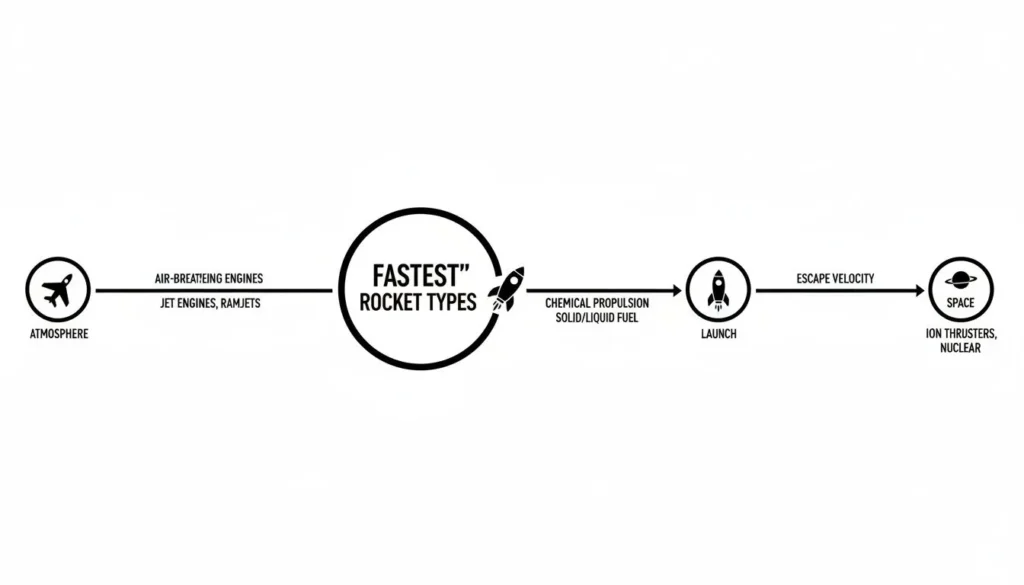
As you can see, hitting top speed is a journey through different stages. It starts with fighting atmospheric drag, moves to achieving a stable orbit, and finally involves navigating the unique physics of deep space.
Different Physics for Different Goals
Grasping these ideas is crucial to understanding why you can’t just compare the speed of a launch rocket to a deep-space probe. They’re playing two completely different games governed by different rules.
- Launchers (like Saturn V): Their job is all about one thing: beating Earth’s gravity. Their speed is a measure of pure, raw power unleashed for a short, violent climb into orbit.
- Probes (like Parker): Their mission is to cross enormous distances. Their speed comes from years of cleverly manipulating gravitational forces to build up velocities that would be impossible to achieve with engine thrust alone.
In the end, the physics of cosmic speed teaches us a vital lesson. Becoming the world’s fastest rocket isn’t just about having the most powerful engine—it’s about mastering the invisible forces that shape our entire solar system.
The Undisputed King of Speed: NASA’s Parker Solar Probe
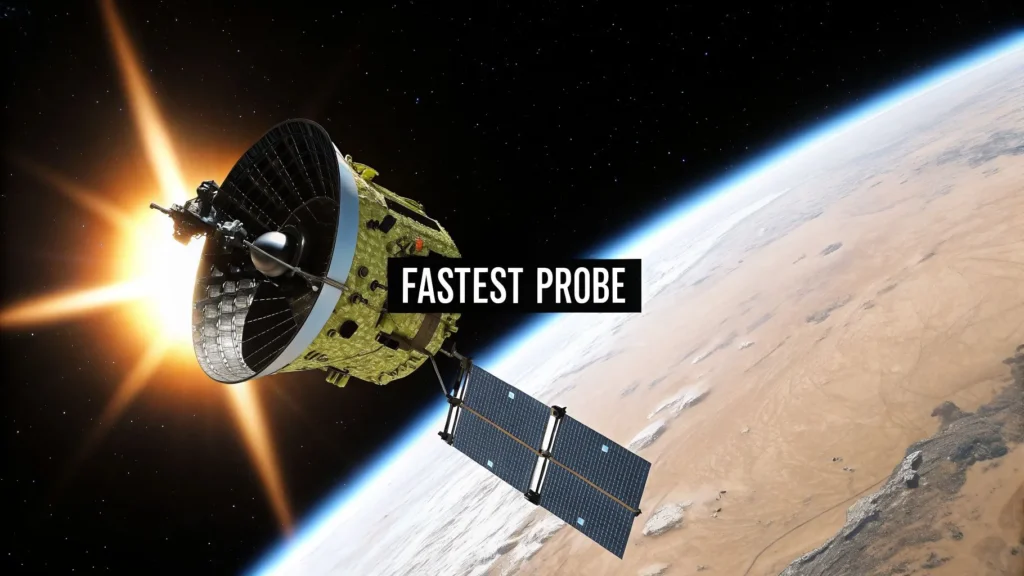
When the conversation turns to the fastest object humanity has ever built, there’s only one name that matters: the Parker Solar Probe. This isn’t just a fast spacecraft; it’s in a league of its own, built for a mission that sounds like science fiction—to fly straight into the Sun’s outer atmosphere and “touch” our star.
Its journey started with a massive boost from a Delta IV Heavy rocket, but that was just the very beginning. The real key to its incredible speed is a long, carefully choreographed dance through the inner solar system.
By repeatedly swinging past Venus, the probe uses the planet’s gravity to bend its path and slingshot itself closer and closer to the Sun. Each pass acts like a cosmic whip-crack, adding more and more velocity.
Built to Survive an Inferno
Flying into the Sun’s corona isn’t for the faint of heart. At its closest approach, the Parker Solar Probe has to withstand temperatures hitting nearly 2,500°F (1,377°C), more than hot enough to melt steel.
To survive this furnace, engineers designed a groundbreaking piece of gear: the Thermal Protection System (TPS). This 8-foot-wide, 4.5-inch-thick carbon-composite heat shield is an absolute marvel.
While the sun-facing side of the shield glows red-hot, the sensitive instruments and the body of the spacecraft just behind it stay at a comfortable 85°F (30°C). It’s like standing feet from a bonfire but feeling like you’re in an air-conditioned room.
Speed, in this case, isn’t just about raw power. It’s the result of brilliant orbital mechanics paired with engineering tough enough to handle one of the most hostile places in our solar system.
But this mission isn’t just a joyride to set speed records. The probe’s mind-bending velocity is a direct result of needing to get close enough to the Sun to tackle two of its biggest mysteries:
- The Coronal Heating Problem: Why is the Sun’s corona, its outer atmosphere, hundreds of times hotter than the surface below it?
- Solar Wind Origins: What mechanism accelerates the constant stream of charged particles that flow from the Sun across the entire solar system?
By flying right through the region where these things happen, the probe can sample particles and measure magnetic fields directly. It’s collecting data that we could never hope to get from Earth.
A Legacy of Shattered Records
The Parker Solar Probe’s journey is one of constantly raising the bar. With every close pass of the Sun, it breaks its own speed record. It’s this relentless acceleration that makes it such an outlier when we talk about the world’s fastest rocket.
Think about this: on December 24, 2024, the probe clocked in at an official 192.22 kilometers per second. That’s over 692,000 kilometers per hour (430,000 mph), a speed that earned it a spot in the Guinness World Records as the fastest spacecraft.
And it’s not even done. The probe’s final, most daring orbits are set for late 2024 and 2025. It will dive to within just 3.8 million miles of the Sun’s surface, where its speed is expected to peak at an almost unimaginable 430,000 mph (692,000 km/h). At that speed, a trip from New York to Tokyo would take less than a minute.
While other spacecraft have achieved impressive speeds, the Parker Solar Probe’s repeated gravity assists and close solar passes put it in a category of its own. Here’s how it stacks up against other famous speedsters.
Parker Solar Probe vs. Other Fast Spacecraft
| Spacecraft | Peak Speed (km/s) | Year of Peak Speed | Primary Mission |
|---|---|---|---|
| Parker Solar Probe | 192.22 | 2024 (and ongoing) | Studying the Sun’s corona |
| Helios 2 | 70.22 | 1976 | Studying the Sun |
| Juno | 73.8 | 2016 | Orbiting Jupiter |
| Voyager 1 | 17.0 | Ongoing | Interstellar exploration |
| New Horizons | 16.26 | 2007 | Pluto and Kuiper Belt |
As the table shows, while probes like Helios 2 and Juno were incredibly fast for their time, the Parker Solar Probe’s velocity is nearly three times greater than its closest predecessor. It truly is the undisputed champion of speed.
Revisiting the Legacy of the Supersonic X-15

While deep space probes hold the all-time speed records, the title of world’s fastest rocket gets a lot more complicated inside our atmosphere. Down here, speed isn’t about getting a gravity assist from Jupiter; it’s about wrestling with crushing air resistance. In that arena, one legendary machine still stands out: the North American X-15.
This wasn’t your typical ground-launched rocket. The X-15 was a pure-bred speed demon, dropped from the wing of a B-52 Stratofortress bomber at 45,000 feet. Only after falling away from its mothership would the pilot light the engine, unleashing a furious blast of power that literally pushed the envelope of flight.
The X-15 program, a joint project between NASA and the U.S. Air Force, was the critical bridge between aviation and spaceflight. It was built to answer the big questions of the space race: How do you build something that won’t melt during reentry? And how do you steer a craft at hypersonic speeds when normal wings and rudders stop working?
Pushing the Edge of Space
Flying the X-15 was a job for a special kind of pilot. Only a dozen hand-picked test pilots, including a young Neil Armstrong, ever got to strap into its cockpit. Their mission was to fly higher and faster than any winged aircraft in history, collecting data that would directly shape the design of spacecraft like the Space Shuttle.
The X-15 didn’t just fly fast—it flew to the very edge of the cosmos. Many of its flights soared past the 50-mile (80 km) altitude line, the official boundary of space, earning its pilots their astronaut wings. Up there, the air is so thin that pilots had to use small rocket thrusters to steer, just like a real spaceship.
The X-15 sits in a class of its own. It was a crewed vehicle that completely blurred the line between airplane and rocket. Its entire purpose was to master that terrifying transition from atmospheric flight to the vacuum of space, a problem no one had really tackled head-on before.
During the height of the Space Race in the 1960s, the X-15 became an icon. On October 3, 1967, pilot William J. “Pete” Knight pushed the craft to its absolute limit, hitting a staggering Mach 6.70—that’s 7,274 km/h (4,520 mph). This incredible achievement is still the official world record for the fastest speed ever flown by a crewed, powered aircraft. To get the full story on this machine, you can dive into the details of the world’s fastest rocket plane.
A Lasting Engineering Heritage
The lessons learned from the X-15 program became the bedrock of aerospace engineering for decades. The data gathered over its 199 missions was absolutely priceless, giving us breakthroughs in several key areas.
- Advanced Materials: The craft was skinned with an exotic nickel-chromium alloy called Inconel-X. It was one of the few materials that could withstand the 1,200 °F (650 °C) temperatures caused by air friction at hypersonic speeds.
- Aerodynamic Design: Its odd, wedge-shaped tail and blunt nose were designed to handle the intense heat and shockwaves of high-Mach flight. This research directly influenced the design of the Space Shuttle and other vehicles built to survive reentry.
- Control Systems: The X-15 was the first to perfect a “reaction control system” (RCS). These are the tiny thrusters used to maneuver in a near-vacuum, and they became a standard feature on every U.S. spacecraft that followed.
The X-15 was never just another fast plane. It was a flying laboratory that systematically solved the puzzle of hypersonic flight, earning its rightful place in the story of the world’s fastest rocket.
The Rise of Amateur Rocketry
The race to build the fastest rocket isn’t just happening at NASA or SpaceX anymore. Some of the most exciting breakthroughs are coming from a different kind of space race—one happening in university labs and hobbyist workshops across the country.
This is the world of amateur rocketry, where passion and smarts are proving to be just as powerful as billion-dollar budgets. It feels a lot like the early, experimental days of the aerospace giants, showing that with today’s tools and a solid grasp of physics, small teams can pull off incredible feats.
A perfect example of this is the USC Rocket Propulsion Lab. These engineering students didn’t just launch a rocket; they completely shattered expectations for what’s possible outside of a professional setting.
A Record-Breaking Flight to the Edge of Space
The USC team recently made history with Aftershock II, a student-designed and built rocket. This wasn’t a weekend project. It was a showcase of serious engineering that ended with a spectacular launch from Nevada’s Black Rock Desert.
On October 20, 2024, Aftershock II blasted off its launchpad, pushed by a custom solid-fuel motor. The 4-meter-long rocket soared to an incredible altitude of 470,400 feet (143.3 kilometers), officially crossing into the edge of space. In less than 10 minutes, a rocket built by students had rewritten the amateur rocketry record books.
This wasn’t just about hitting a new altitude. It proves that student teams, armed with STEM knowledge and pure determination, can literally reach for the stars—and get there.
But Aftershock II wasn’t just high; it was seriously fast. During its climb, the rocket hit a blistering top speed of 5,283 feet per second (1,610 m/s). That’s Mach 5, a new speed record for any amateur rocket.
The New Generation of Rocket Scientists
The success of projects like Aftershock II is a huge inspiration. It shows what can happen when students get hands-on experience in fields like aerospace engineering, materials science, and programming.
These university labs are becoming crucial training grounds, churning out the next generation of engineers who will one day be leading missions for major space agencies and private companies. It’s a powerful reminder that the next big leap in rocketry might not come from a massive corporation, but from a determined group of students in a workshop, fueled by a passion for going higher and faster.
Future Propulsion and the Next Generation of Speed
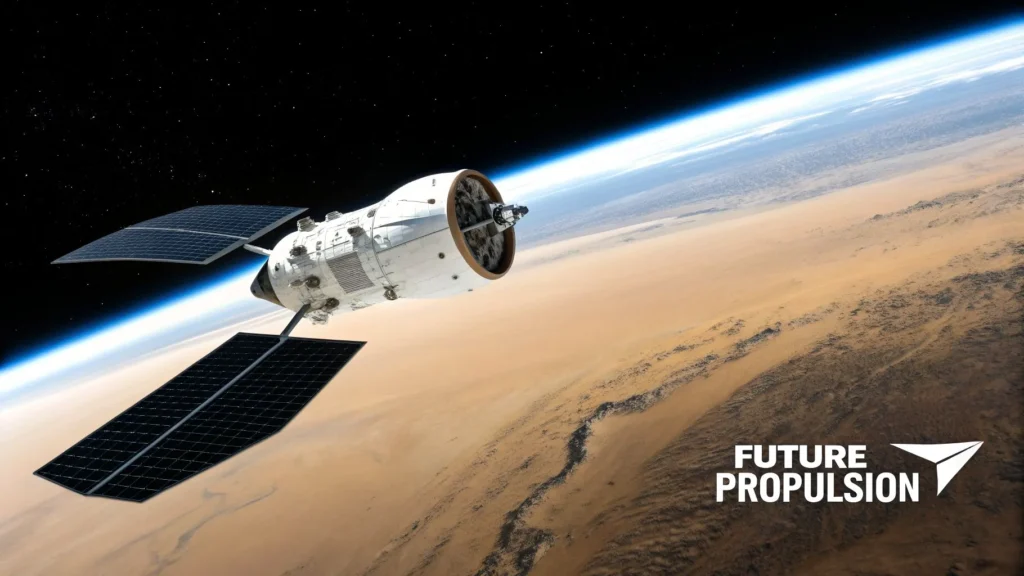
While the Parker Solar Probe keeps setting new speed limits, engineers are already dreaming bigger. The fastest rockets we have today—whether they’re beastly launch vehicles or zippy deep-space probes—are all running on the same basic principle: chemical combustion. But if we ever want to make the solar system feel like our own backyard, we have to move past just burning fuel.
The next leap in speed will come from technologies that sound like they’ve been pulled straight from science fiction. These systems are all about extreme efficiency and sustained acceleration, promising velocities that could shrink a trip to Mars from months down to weeks. It’s a complete rethink of how we get from Point A to Point B in space.
Harnessing New Power Sources
The fundamental problem with chemical rockets is that you have to haul every last drop of your propellant with you. Future designs are trying to crack this problem by tapping into far more powerful and efficient energy sources. It’s not just about getting there faster; it’s about changing the entire economic equation of deep space exploration.
Two concepts, in particular, are making the jump from theory to reality:
Nuclear Thermal Propulsion (NTP): Picture a rocket engine with a compact nuclear reactor at its core. This reactor superheats a propellant like liquid hydrogen and blasts it out the nozzle at incredible speeds. NTP engines are expected to be twice as efficient as our best chemical rockets, offering more kick for longer. That alone could slice the travel time to Mars nearly in half.
Solar Electric Propulsion (SEP): Instead of a violent explosion, SEP uses huge solar arrays to generate electricity. That electricity then powers an engine that accelerates ions (charged atoms) to produce thrust. The push is incredibly gentle—often compared to the weight of a sheet of paper in your hand—but it’s constant. Over months and years, that relentless nudge adds up to mind-boggling speeds that no chemical rocket could ever hope to match on a long-haul trip.
The big idea behind these next-gen systems is to swap the explosive, short-lived power of chemical reactions for a sustained, super-efficient push. It’s the difference between a dragster and a maglev train—one is built for a ferocious sprint, the other for covering immense distances at incredible, sustained speeds.
Concepts on the Edge of Science
Looking even further out, scientists are tinkering with propulsion that could one day power interstellar missions. These are technologies that get their push by manipulating the fundamental laws of physics.
Solar Sails are a perfect example, as elegant as they are brilliant. They are massive, paper-thin mirrors designed to catch photons from the Sun, much like a sailboat catches the wind. While the pressure from sunlight is tiny, in the frictionless vacuum of space, this constant push can accelerate a craft to staggering speeds over time—all without carrying a single ounce of propellant.
Then there’s the holy grail: fusion propulsion. This is the concept of building and controlling a miniature star inside a rocket engine. By smashing hydrogen atoms together, a fusion rocket would unleash enormous energy, producing exhaust velocities that approach a fraction of the speed of light. It’s still highly experimental, but understanding what a fusion reaction is makes it clear why this is seen as the ultimate power source for deep space travel.
These are the kinds of advanced concepts that will unlock the next era of speed. They’re what will make currently impossible missions—like sending crews to Mars and the outer planets, or even probes to other stars—finally within our reach.
Frequently Asked Questions About Rocket Speed
Even after exploring the fastest machines humanity has ever built, a few big questions usually pop up. Let’s tackle some of the most common ones about the incredible velocities of the world’s fastest rocket technologies.
How Is Rocket Speed Actually Measured in Space?
You can’t just point a radar gun at a probe billions of miles away. Instead, scientists use a much more elegant solution: NASA’s Deep Space Network (DSN). This global system of massive radio antennas pings a spacecraft with a signal, which the craft then beams right back.
Engineers measure the tiny frequency shift in that returning signal—a principle known as the Doppler effect—and precisely time the round-trip journey. This allows them to calculate a spacecraft’s speed and location with mind-boggling accuracy, even across the solar system.
Why Can’t a Rocket Like the Saturn V Go as Fast as the Parker Solar Probe?
This is a great question that gets to the heart of rocket design. It’s really a classic “apples and oranges” situation. A launch vehicle like the mighty Saturn V is a pure sprinter, designed for one thing: producing overwhelming brute force to escape Earth’s gravity. Its job is over in minutes.
The Parker Solar Probe, however, is an endurance athlete. It doesn’t rely on raw power. Instead, it masterfully uses gravity assists, slingshotting around planets and the Sun itself to build up speed over years. This cosmic billiard game lets it achieve speeds that no chemical rocket could ever hope to reach on its own. Saturn V was about raw power; Parker is about patience and clever physics.
Escape velocity is the “magic number” a rocket must hit to break free from a planet or moon’s gravity. For Earth, that speed is roughly 25,000 mph (about 11.2 km/s).
Think of it like trying to throw a ball into space. Throw it too slow, and gravity always wins. But if you could somehow hurl it at escape velocity, it would fly away from Earth and never fall back. Every mission to another world has to conquer this fundamental barrier first. You can dig deeper into the challenges of settling other planets in our guide on how long it would take to terraform Mars.
Will We Ever Be Able to Travel at the Speed of Light?
Based on everything we know about physics, traveling at the speed of light is off the table for any object with mass. As you get closer to light speed, your mass effectively increases, demanding more and more energy for every tiny bit of extra acceleration. Hitting the final number would literally require infinite energy.
That said, it doesn’t mean interstellar travel is a total fantasy. Futuristic concepts like fusion rockets or other theoretical propulsion systems could one day push spacecraft to a significant fraction of light speed—maybe 10% or even 20%. It’s not quite Star Trek, but it would be enough to turn a journey to the nearest stars from an impossible dream into a multi-generational reality.
At maxijournal.com, we delve into the science and stories that shape our world. From the edge of space to the heart of technology, find fresh perspectives daily.
Discover more from Maxi Journal
Subscribe to get the latest posts sent to your email.