The first Webb deep-field image looked almost unreal. Tiny smudges of light turned out to be galaxies, and many of them had been traveling toward us since the early universe.
That reaction, the sudden mix of awe and confusion, leads to the central question. How does the James Webb Telescope work, and why was it built in such an unusual way?
A New Window to the Cosmos
The first time many people saw a Webb image, the reaction was almost childlike: how can the universe look like that? The answer begins with a simple but astonishing fact. Webb was built to catch kinds of light that human eyes never could, from objects so distant that their light set out billions of years ago.
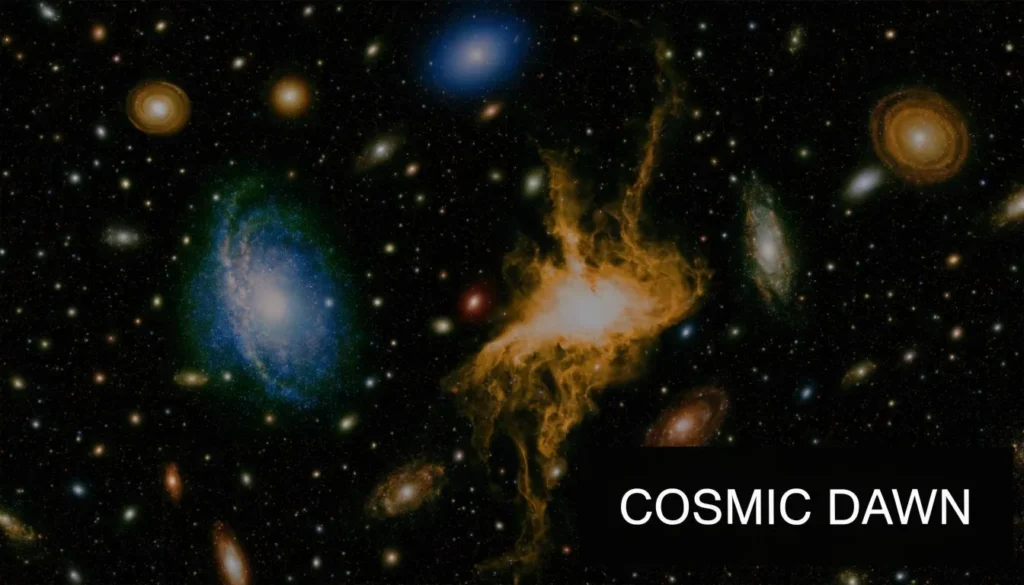
That is why Webb exists. Astronomers wanted more than prettier pictures of space. They wanted to study the first generations of galaxies, watch stars forming inside dusty clouds, and test the atmospheres of planets around other suns. Those goals all point to the same conclusion: a normal visible-light telescope would miss too much.
Here is the key idea. The universe does not send all its information in visible light.
Light from the earliest galaxies has been stretched during its long trip across an expanding universe, shifting it into infrared. Dusty regions that block ordinary light become more transparent in infrared, letting Webb peer into places that would otherwise look sealed shut. Planet atmospheres also leave some of their clearest fingerprints in infrared wavelengths. If scientists wanted answers to those questions, Webb had to be designed around infrared from the start.
That choice created a second problem. Anything warm gives off infrared radiation, including the telescope itself. A warm infrared observatory would glow like a lantern while trying to study fireflies in the distance. So Webb was built as a tightly coordinated system in which each major design choice serves the same purpose: collect faint infrared light without contaminating it.
Key Design Principles
Webb works because several engineering decisions all support the science it was meant to do:
- A very large mirror collects enough faint light from distant galaxies and dim planetary signals to measure them.
- Infrared-sensitive instruments detect light that has been redshifted, filtered through dust, or emitted by cool objects.
- Extreme cooling keeps the telescope from swamping its own detectors with heat.
- A carefully chosen observing location and orientation help it stay cold and keep its view stable.
Those choices only make sense when you connect them to the mission. Webb is less like a general camera pointed at space and more like a custom-built listening device tuned for whispers that have crossed the cosmos for ages.
By mid-2022, all of Webb’s observing modes had been checked and approved for science operations. That milestone mattered because the observatory only succeeds when every part works together. The mirror must focus faint light precisely. The detectors must register tiny infrared signals. The shielding and orbit must keep the telescope cold enough for those signals to stand out. Webb’s strange shape, distant location, and delicate deployment sequence all trace back to one question: how do you build an instrument capable of seeing the hidden universe?
The Golden Eye and Its Perfect Vision
Long before Webb sent back those crisp, glowing images, its first challenge was brutally simple: catch enough light to make the universe visible at all.
That sounds obvious, but it drives nearly every choice in the telescope’s mirror. The oldest galaxies are dim because their light has spent billions of years spreading out across space before a tiny fraction of it reaches us. Webb needed a collecting surface big enough to gather those scarce photons, the way a wide rain barrel gathers more water than a cup during the same brief shower.
Why the mirror had to be huge
Webb’s primary mirror spans 6.5 meters (21.3 feet) and is built from 18 hexagonal segments. The reason is scientific before it is mechanical. A larger mirror gathers more light, which gives astronomers a stronger signal from objects that would otherwise be too faint to study with confidence.
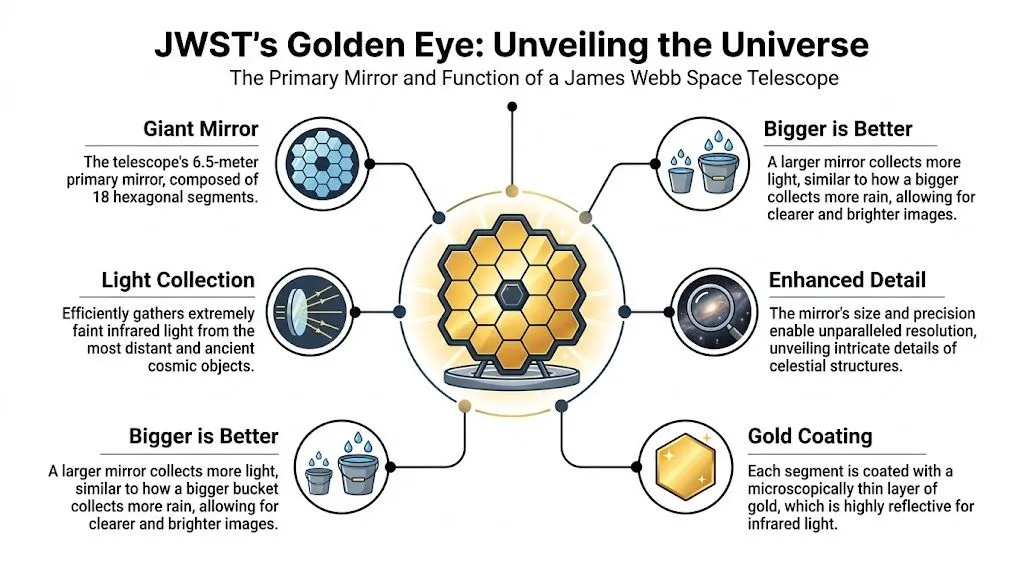
Mirror size also affects sharpness. If you are trying to separate a newborn star from the dusty cloud around it, or tease apart structure in faraway irregular galaxy images and examples, collecting more light is only part of the job. The telescope also has to focus that light into a clean, precise image. Bigger aperture helps with both.
So the mirror is not large for spectacle. It is large because Webb was built to study targets at the edge of detectability.
Why the mirror is segmented
A one-piece mirror that large could not fit inside the rocket fairing that launched Webb. Engineers solved that constraint by breaking the primary mirror into 18 pieces that could fold for launch and open in space.
The hexagon shape was not chosen by accident. Hexagons pack tightly, leaving very little wasted area, so the segments can form a broad mirror that behaves almost like a circle. Nature uses the same trick in honeycombs when space has to be used efficiently.
That folding design created a second problem. A segmented mirror only works if all of its pieces line up so well that incoming starlight reflects as though it hit one continuous surface. If the segments are even slightly off, the telescope does not see one sharp image. It sees a blur of mismatched reflections.
Why alignment had to be unbelievably precise
After deployment, Webb’s mirror segments had to be adjusted until they worked together as one optical surface. That process is called phasing, and it is one of the quiet engineering miracles behind every Webb image.
Each segment can be moved and tilted by tiny actuators. The goal is not just to point the mirrors in roughly the same direction. The goal is to match them so closely that light waves reflected from all 18 segments arrive in step, reinforcing one another instead of smearing the image. In practical terms, Webb had to turn a cluster of separate mirrors into one giant, exquisitely shaped eye.
That is why the alignment process mattered so much. Collecting faint light is useless if the telescope cannot bring that light to a precise focus.
Why the mirror is gold
The gold coating often gets treated like a fun visual fact, but it exists for a specific reason. Webb studies infrared light, and gold reflects infrared especially well. A better reflective coating means less precious signal is lost before the light reaches the instruments.
In other words, the gold helps Webb waste less of the ancient light it worked so hard to collect.
The mirror segments themselves are made of beryllium for a similar reason rooted in the mission. Webb operates in extreme cold, and its mirrors must keep their shape as temperatures change. Beryllium is useful here because it is light, stiff, and stable when chilled. Engineers needed a material that could survive launch, unfold in space, cool down, and still hold the exact curvature required for precision astronomy.
Seen up close, Webb’s mirror is not just beautiful hardware. It is a chain of carefully chosen answers to one scientific problem: how do you gather a whisper of infrared light from the deep universe and focus it with enough accuracy to learn something new?
Sensing the Invisible Universe in Infrared
A TV remote sends out light your eyes cannot see, yet it still carries a signal. Space is full of hidden light like that. Webb was built to detect it, because some of the universe’s biggest stories arrive in infrared, not in the colors human vision can catch.
That choice was not just about seeing something different. It was about seeing what other telescopes would miss.
Why infrared matters
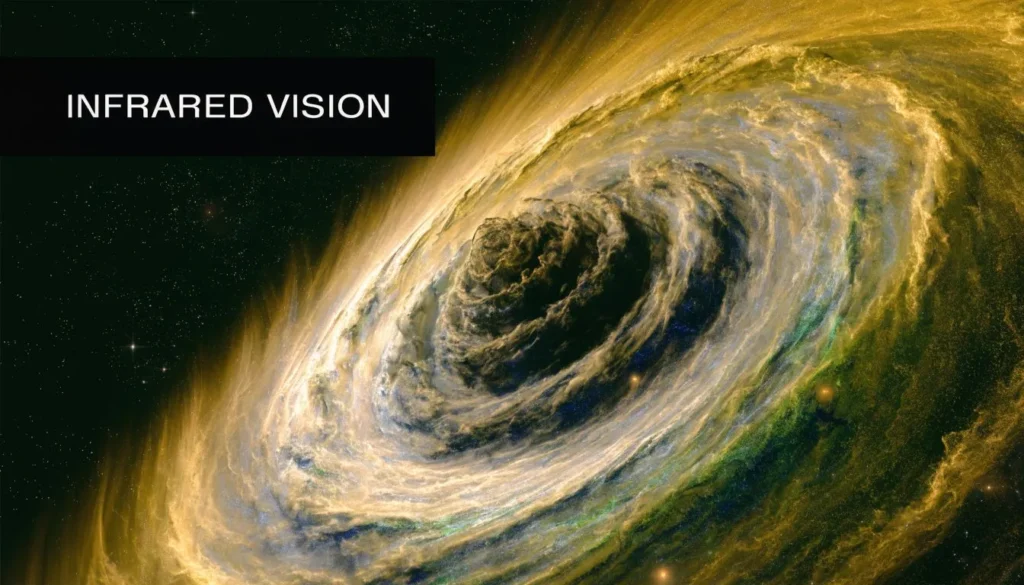
Webb observes light from the red end of the visible spectrum out into the mid-infrared. That range matters because the cosmos often hides its most interesting places behind two obstacles: dust and distance.
Dust clouds are where stars and planets form, but visible light has trouble getting through them. Infrared light slips through more easily, giving astronomers a way to peer inside nurseries that would otherwise look like dark fog.
Distance creates a different problem. As the universe expands, light traveling across billions of years gets stretched into longer wavelengths. Light that began as visible or ultraviolet can arrive at Earth as infrared. If you want to study some of the earliest galaxies, you need instruments tuned to catch that stretched, ancient glow. The Canadian Space Agency overview of JWST explains this broad infrared focus and why it lets Webb study very distant, very old objects.
That is why Webb gets called a time machine. The phrase is shorthand, but the idea is real. Webb reads light that began its journey long ago and has been altered by the expansion of space itself.
For readers who enjoy unusual galaxy forms, collections of irregular galaxy pictures make this easier to picture. Webb is especially useful for studying distant systems that look clumpy, chaotic, or still under construction.
The four instruments as a toolbox
Catching infrared light is only the first step. Astronomers also need to sort it, measure it, and compare it. That is why Webb carries several instruments inside the Integrated Science Instrument Module, or ISIM. Each one answers a different scientific question.
- NIRCam: Webb’s main near-infrared camera. It takes sharp images and also helps the observatory maintain the precise performance needed for good observations.
- NIRSpec: The instrument that spreads light into spectra, letting astronomers study what an object is made of, how hot it is, and whether it is moving toward or away from us.
- MIRI: Webb’s mid-infrared specialist. It reaches longer wavelengths, which makes it useful for cooler objects such as dust disks, distant galaxies, and worlds that do not glow brightly in visible light.
- FGS-NIRISS: A two-part system. One part helps Webb point with extraordinary accuracy, and the other supports specialized observations, including studies of exoplanets.
A camera tells you what is there. A spectrograph tells you what it is. A mid-infrared instrument reveals colder material. A guidance system keeps the whole observatory locked onto its target long enough to gather a faint signal without blur.
What these tools let astronomers do
Together, these instruments turn dim infrared light into evidence. Webb can photograph a galaxy, split its light into a spectrum, find chemical fingerprints, and probe dusty regions where stars are forming. It can study alien atmospheres when a planet passes in front of its star. It can examine objects so distant that their light has been traveling since the universe was young.
A short explainer can help if you want to see the idea in motion:
Different Webb instruments examine the same incoming light in different ways, much like a photographer, a chemist, and a surveyor studying the same scene for different kinds of evidence.
The Ultimate Sunscreen for Extreme Cooling
A warm telescope would blind itself.
Webb studies infrared light, which is closely tied to heat. That creates a strange engineering problem. The observatory is trying to detect faint warmth from distant galaxies, newborn stars, and planetary atmospheres, while making sure its own heat does not wash out the signal. It is like trying to spot the glow of a candle while standing next to a bonfire.
Why Webb has a giant sunshield
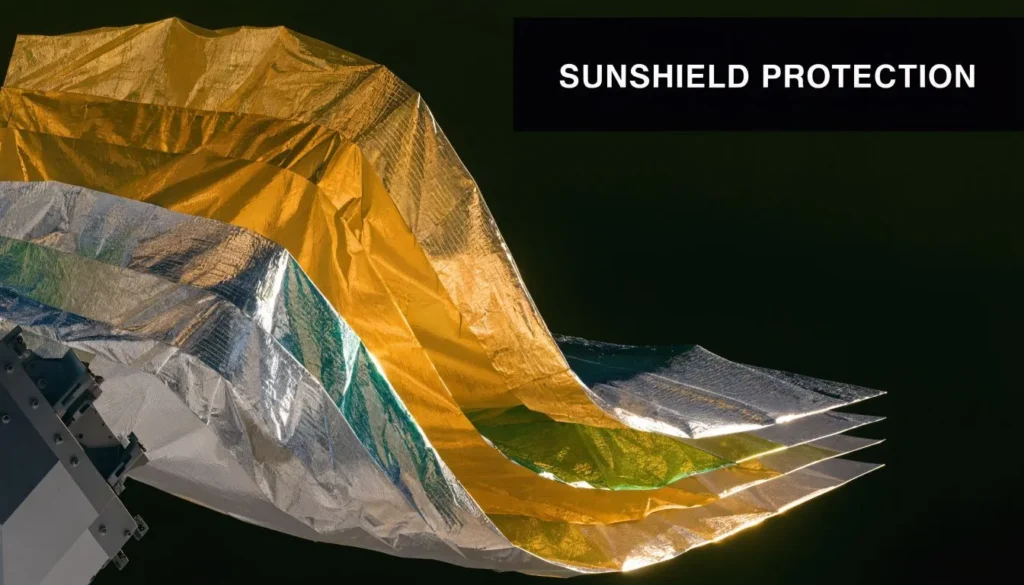
That is why Webb carries something that looks less like a telescope accessory and more like a spacecraft-sized parasol. Its five-layer sunshield, made of aluminized Kapton, lets the observatory reach about 45 Kelvin (-380°F), according to Northrop Grumman’s Webb technical details.
The key idea is separation. One side faces the Sun and absorbs punishment. The other side shelters the mirrors and instruments in deep cold. Webb needs that split because infrared detectors work best when the telescope itself stays quiet in thermal terms. If the hardware glows too much, the science gets buried under the observatory’s own infrared shine.
How five layers help
Five layers work better than one for the same reason several oven mitts protect your hand better than a single thin cloth. Each layer blocks, reflects, and sheds heat before that energy can pass inward. The space between the layers also matters. In the vacuum of space, heat cannot travel by convection, so the shield is built to interrupt radiation step by step.
The result is astonishing. The sun-facing side can get hot enough to boil water, while the telescope side stays near absolute zero. Webb was designed to keep a furnace and a freezer on the same spacecraft because that thermal contrast is what allows it to study the cold, faint universe.
Why passive cooling was such a smart choice
Most of Webb gets cold through passive cooling, meaning the sunshield and observatory layout do the bulk of the work without refrigerating everything mechanically. That choice saves mass, power, and complexity. It also reduces vibration, which matters when you are trying to hold a telescope very steady while collecting tiny traces of ancient light.
One instrument still needs extra help. MIRI observes even longer infrared wavelengths, so it uses its own cryocooler to reach 7 K. That detail says a lot about Webb’s design philosophy. Cool the whole observatory as much as possible with smart architecture, then use active cooling only where the science requires it.
The sunshield doesn’t just protect Webb from sunlight. It protects Webb from Webb.
That is the deeper logic behind the whole system. To see the universe’s faint heat, the telescope has to become almost thermally invisible itself.
A Million-Mile Journey to a Gravitational Sweet Spot
On Christmas Day in 2021, Webb began a trip that sounds almost backward for a telescope. Instead of staying relatively close to Earth, where spacecraft are easier to reach, it headed outward toward a place where gravity and motion create a special kind of balance. That choice tells you a lot about Webb’s mission. To detect faint infrared light from the early universe, the telescope needed an environment that was calm, cold, and predictable.
Webb operates near the L2 Lagrange point, about 1.5 million kilometers from Earth. L2 works like a moving sweet spot in space. A spacecraft there travels around the Sun in step with Earth, which lets Webb keep the Sun, Earth, and Moon on the same side of the observatory most of the time.
That geometry is the true prize.
With those major heat sources grouped in one direction, Webb’s sunshield can do its job continuously instead of fighting a changing thermal situation from all angles. If the telescope orbited low Earth orbit like Hubble, Earth itself would keep sliding in and out of view as a bright, warm source of infrared contamination. For an observatory built to measure faint heat signatures, that would be like trying to spot a firefly while someone sweeps a floodlight across your face.
L2 also helps Webb stay efficient in quieter ways. The spacecraft can keep its solar panels pointed toward sunlight and its antenna oriented for regular contact with Earth, while the science instruments remain tucked in the cold shadow behind the sunshield. The design is elegant because one orientation solves several problems at once.
There is one subtle point that often confuses people. Webb does not sit motionless at L2 like a car in a parking space. It loops around that region in a controlled orbit. That path keeps the observatory from falling into Earth’s shadow, maintains a steady thermal setup, and gives mission controllers room to make course corrections.
Getting there was a feat of engineering in its own right. Webb was too large to launch in its working form, so it had to be folded for the ride and then unfold in space piece by piece. The mirror segments, support structures, and sunshield all had to deploy with extraordinary precision because this observatory was never meant to be serviced like Hubble.
The whole process felt less like flipping on a machine and more like watching a mechanical flower open in the dark.
Even after the hardware unfolded correctly, Webb still was not ready to observe. Its primary mirror is made of 18 separate hexagonal segments, and those segments had to act like a single mirror. Engineers spent weeks adjusting them until light from a star landed in the right place and all the segments worked together as one sharp optical surface.
A choir is the right comparison here. Eighteen talented singers warming up can sound scattered. Once they match pitch and timing, the individual voices merge into something powerful and clear. Webb’s mirror had to achieve that same kind of unity, except with light waves measured on a scale far smaller than a human hair.
That is why the journey to L2 matters so much. It was not just about distance. It was about creating the stable conditions Webb needs to study the faint glow of newborn galaxies, distant exoplanets, and dusty stellar nurseries. Some of the same extreme gravity and light-bending ideas show up in observations connected to images of black holes, but Webb’s route to discovery begins with something more basic and more difficult. Put the telescope in the one place where heat, light, and motion stop getting in its way.
Turning Starlight into Groundbreaking Science
The public usually meets Webb through images, but the telescope’s raw output doesn’t arrive as polished cosmic wallpaper. It begins as detector readings. Scientists then process those signals, calibrate them, and translate them into forms people can interpret.
Some of the famous Webb pictures are false-color images. That term can sound misleading, but it isn’t. It means scientists assign visible colors to infrared data so our eyes can see patterns that would otherwise remain invisible. Color in these images is a language for structure, chemistry, and temperature, not a trick.
From signal to meaning
The hardware choices only become valuable when they produce useful science.
Webb can take images, but it can also perform spectroscopy, which is one of its most powerful abilities. Spectroscopy breaks incoming light into components that reveal what an object may contain. That’s how astronomers study exoplanet atmospheres, distant galaxies, and dusty star-forming regions with much greater depth than a photograph alone can provide.
By 2026, Cycle 4 observations are projected to emphasize mid-IR spectrography for exoplanet biosignatures, and NIRSpec’s 62,000 microshutters can produce simultaneous spectra for over 100 objects, with the verified data describing this as 100x over Hubble and also noting follow-up on transient events like supernovae within 48 hours, as summarized in the JWST reference used in the verified data. Because this is future-dated in the prompt, it should be read as a projection, not a settled present-day result.
What Webb can do that feels new
A good way to understand Webb’s impact is to look at the kinds of targets it handles especially well:
- Ancient galaxies: Webb can detect very distant systems whose light has been stretched into infrared.
- Dusty nurseries: It can peer through obscuring material where visible-light telescopes see less.
- Exoplanet atmospheres: Spectra can reveal clues about gases around distant worlds.
- Fast-changing events: It can respond quickly to things like supernovae.
Readers who are drawn to other extreme cosmic phenomena may also enjoy these images of black holes, which capture a different side of how astronomy turns faint signals into meaningful visuals.
A Webb image is never just a picture. It’s a measurement made visible.
That’s why the observatory matters so much. It changes starlight into evidence.
Answering Your Biggest Webb Telescope Questions
Webb works because several bold design choices reinforce one another. It has a giant segmented mirror to gather faint light, specialized infrared instruments to analyze what visible-light telescopes miss, and a cold, stable home in deep space so its own heat doesn’t interfere.
None of those parts would be enough alone. The mirror without cooling would be noisy. The cold instruments without the right orbit would struggle to stay cold. The orbit without the infrared toolbox would not deliver the science people now associate with Webb.
Common Questions About the JWST
| Question | Answer |
|---|---|
| Why can’t Webb see everything Hubble sees? | Webb was optimized for infrared, not for being a direct replacement for every kind of Hubble observation. The two observatories are built for overlapping but different jobs. |
| Why is Webb so far from Earth? | Its deep-space location helps it keep the Sun, Earth, and Moon on the same side, so one sunshield can protect the cold telescope side continuously. |
| Why does Webb need to be cold? | Infrared telescopes detect heat-like radiation. If Webb were warm, its own glow would interfere with faint cosmic signals. |
| Are the colorful images “real”? | They are based on real data, but the colors are assigned to make invisible infrared information understandable to human eyes. |
| Can astronauts repair Webb like Hubble? | Webb was designed to operate far away, so it does not have the same servicing setup that made Hubble repairs possible. |
One last big-picture question
People often ask whether Webb is mainly about the distant past or about alien life. The answer is both, plus much more. It studies galaxy assembly, star birth, planetary systems, and exoplanet atmospheres because all of those questions are connected. To ask how worlds form is also to ask how chemistry evolves, and to ask how galaxies formed is to ask how our own cosmic neighborhood came to exist.
If big-picture cosmic questions pull you in, this thoughtful exploration of whether there is an end to the universe makes a fitting next read.
If you enjoy clear, approachable writing on science, technology, education, culture, and more, visit maxijournal.com. It’s a smart place to keep your curiosity well fed, and a welcoming destination for readers who want fresh ideas explained without jargon.
Discover more from Maxi Journal
Subscribe to get the latest posts sent to your email.