
While spiral and elliptical galaxies often steal the cosmic spotlight with their ordered shapes, the universe is also filled with a captivating class of objects that defy neat categorization: the irregulars. These galaxies, lacking any distinct, uniform structure, are cosmic canvases displaying the results of violent star birth, gravitational tugs-of-war, and galactic collisions. Far from being simple, their chaotic forms are a direct consequence of their dynamic and often violent histories.
This article is your curated gallery, presenting some of the most spectacular irregular galaxy pictures ever captured by our most powerful telescopes. We will journey through these beautifully disordered structures, exploring the scientific stories they tell, from our own galactic backyard to the more distant universe. Each image offers a unique window into the ever-evolving nature of galaxies, revealing processes that are fundamental to cosmic evolution.
Prepare to see the cosmos in a new, unstructured light. This collection goes beyond just pretty pictures; it provides the context behind the chaos. You’ll discover the forces that shape these celestial masterpieces and learn how astronomers decode their secrets. For each entry, we provide details on the science, the image source, and even tips for amateur observers hoping to catch a glimpse of these cosmic outliers for themselves.
1. The Large Magellanic Cloud (LMC) – Our Galaxy’s Nearest Irregular Companion
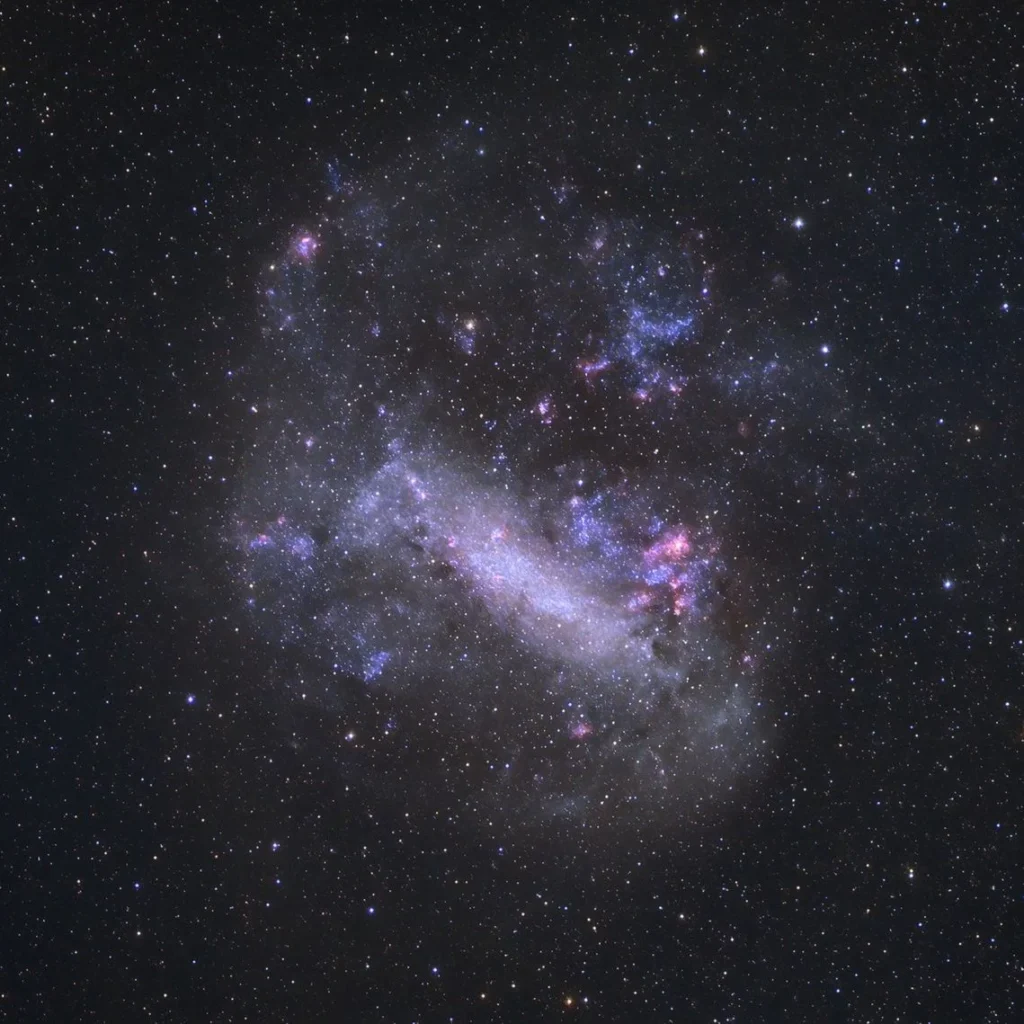
Kicking off our gallery is a celestial object so significant it’s practically in our backyard: the Large Magellanic Cloud (LMC). Located a mere 160,000 light-years away, the LMC is a satellite galaxy orbiting our own Milky Way. Its proximity and chaotic structure make it a perfect starting point for exploring the best irregular galaxy pictures available. Unlike the elegant spirals of Andromeda or the smooth ellipses of other galaxies, the LMC is a beautiful mess, a testament to the gravitational tug-of-war it endures with the Milky Way and its smaller companion, the Small Magellanic Cloud.
Why the LMC is a Celestial Laboratory
The LMC isn’t just a pretty sight; it’s a critical natural laboratory for astronomers. Its jumbled appearance is bursting with activity, offering an unparalleled view of galactic processes. High-resolution images from observatories like the Hubble Space Telescope reveal its intricate details.
- Star Formation: The LMC is famous for the Tarantula Nebula (30 Doradus), one of the most active star-forming regions in our local galactic group. Pictures of this nebula showcase massive, young, blue stars whose intense radiation carves out vast cavities in the surrounding gas.
- Stellar Evolution: Because it’s relatively close, astronomers can study individual stars within the LMC. This helps them piece together the life cycles of stars, from birth in dusty nurseries to their explosive deaths as supernovae. The remnant of Supernova 1987A, the closest supernova observed in centuries, provides a real-time example of this process.
Observing and Appreciating the LMC
For those in the Southern Hemisphere, the LMC is a faint, cloud-like smudge visible to the naked eye. To truly appreciate its structure, you’ll want some tools and resources.
Observing Tips:
- Best Viewing: Aim for the Southern Hemisphere’s winter months (June-August) when the LMC is high in a dark, moonless sky.
- Equipment: A good pair of wide-field binoculars will reveal its shape and brightest clusters. A small telescope will start to resolve individual nebulae and star-forming regions.
- Digital Exploration: Pair your real-world viewing with online archives. NASA and ESA provide stunning, high-resolution images that unveil details impossible to see from Earth.
The LMC’s chaotic beauty and scientific importance serve as a powerful reminder of the dynamic and ever-changing nature of the cosmos. Studying such objects helps us ponder the grand scale of reality and the fundamental questions about its structure, much like exploring the concept of whether there is an end to the universe.
2. The Small Magellanic Cloud (SMC) – A Disrupted Dwarf Galaxy
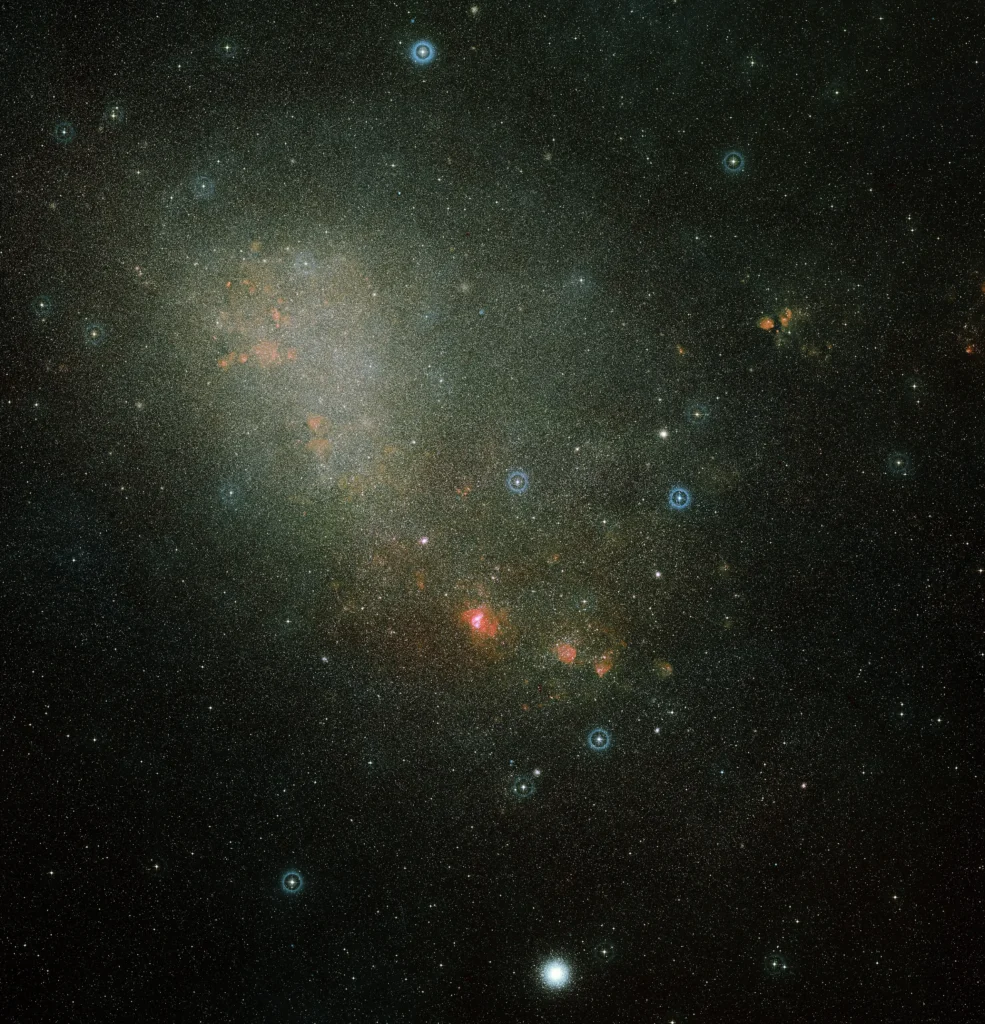
Following its larger sibling, the Small Magellanic Cloud (SMC) offers another spectacular example of a nearby cosmic neighbor shaped by gravitational forces. Located about 200,000 light-years away, the SMC is a dwarf irregular galaxy locked in a complex dance with both the Milky Way and the LMC. Its more fragmented and stretched-out appearance in irregular galaxy pictures tells a story of tidal disruption, where gravity has pulled it apart, scattering stars and gas across the sky.
Why the SMC is a Case Study in Galactic Disruption
The SMC provides a clear and accessible view of how larger galaxies can dominate and distort their smaller companions. Its elongated shape isn’t a stable form but rather the result of ongoing gravitational stripping. Deep-field observations and stellar data reveal the consequences of these powerful interactions.
- Tidal Stripping: High-resolution images from surveys like the VISTA Magellanic Cloud Survey show a “bridge” of gas and stars connecting the SMC to the LMC, evidence of material being pulled from the smaller galaxy. This process fuels star formation in both galaxies.
- Stellar Populations: Despite its chaotic state, the SMC contains a mix of old and young stars. Data from the Gaia mission, which maps the positions and velocities of stars, helps astronomers trace how stellar groups have been displaced and scattered by its gravitational encounters. This makes it a fantastic target for studying galactic archaeology.
Observing and Appreciating the SMC
Like the LMC, the SMC is a treasure of the Southern Hemisphere sky, appearing as a detached, hazy patch of the Milky Way to the unaided eye. To truly see its structure, you’ll need a dark location and the right tools.
Observing Tips:
- Best Viewing: Visible year-round from southern latitudes, but it’s highest and clearest during the austral winter (June-August) in skies free from city lights.
- Equipment: A telescope with a wide field of view is ideal for capturing the galaxy’s full extent. Binoculars are great for spotting its overall shape and locating its brightest star cluster, 47 Tucanae, which appears nearby.
- Digital Exploration: Explore online data from the Digitized Sky Survey for incredibly detailed views. These resources let you zoom in on stellar nurseries and filamentary structures that are invisible through most amateur telescopes.
The SMC’s disrupted beauty serves as a dramatic illustration of gravity’s power to shape galactic structures over billions of years, making it a compelling subject for both stargazers and professional astronomers.
3. Messier 82 (M82) – The Cigar Galaxy’s Starburst Activity
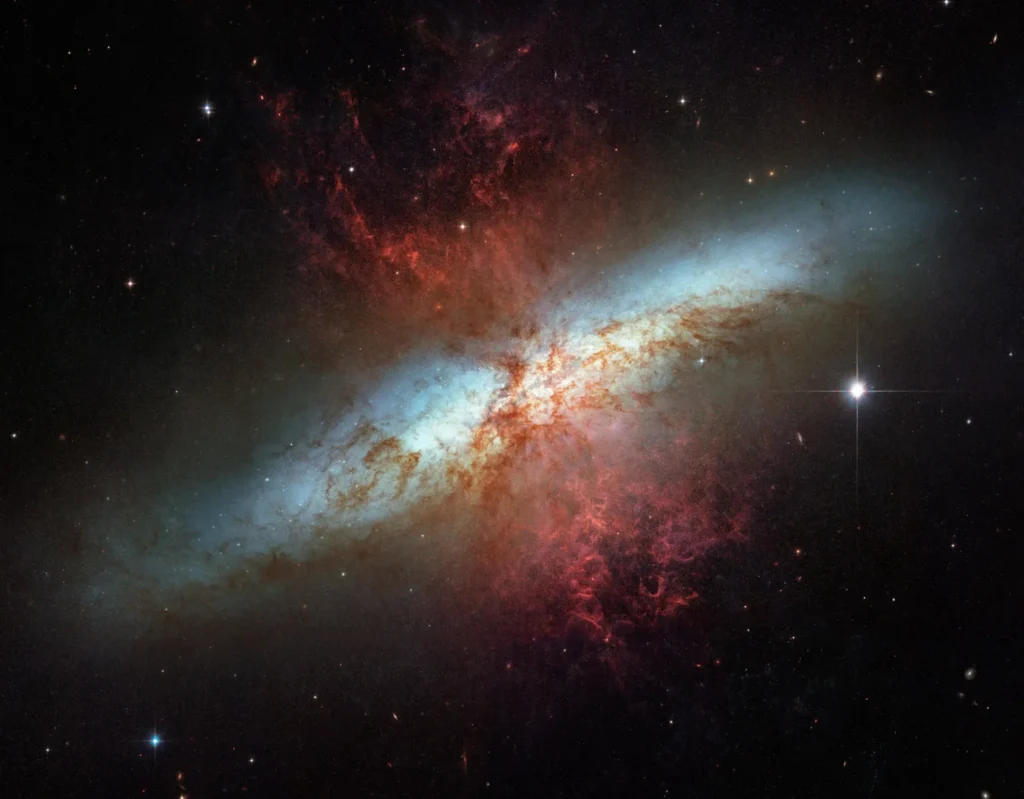
Next up is an object famous for its explosive energy: Messier 82, often called the Cigar Galaxy. Located about 12 million light-years away, M82 is the quintessential starburst galaxy. Its classification as irregular comes from the violent, chaotic activity at its core, a result of a past gravitational encounter with its larger neighbor, M81. The resulting irregular galaxy pictures of M82 showcase a dramatic and fiery object that is one of the most dynamic environments in our cosmic neighborhood.
Why M82 is a Starburst Spectacle
M82 isn’t just an object of beauty; it’s a stellar factory working in overdrive. The gravitational interactions with M81 funneled massive amounts of gas into M82’s center, triggering a furious burst of star formation. High-resolution images from multiple telescopes paint a vivid picture of this process.
- Starburst Core: At its heart, stars are being born at a rate 10 times faster than in our entire Milky Way galaxy. This intense activity creates a powerful “superwind” of charged particles and hot gas.
- Dramatic Outflows: The most striking feature of M82 is the colossal plume of reddish-glowing hydrogen gas blasting out from its core, perpendicular to the galactic disk. These outflows, captured in stunning detail by the Hubble Space Telescope, are a direct consequence of the combined stellar winds and supernova explosions from the starburst region. This process is powered by a chain reaction not unlike the a stellar engine, and understanding the core physics helps us grasp concepts related to what a fusion reaction is on a galactic scale.
Observing and Appreciating M82
While you’ll need a telescope to see M82, its relative brightness makes it a rewarding target for amateur astronomers.
Observing Tips:
- Best Viewing: Look for M82 during the spring in the Northern Hemisphere, where it resides in the constellation Ursa Major, not far from the Big Dipper.
- Equipment: A 6-inch or larger telescope is recommended to begin discerning its elongated, cigar-like shape and perhaps a hint of its mottled texture. Dark skies are crucial.
- Digital Exploration: To truly appreciate the violence of the starburst, explore the multi-wavelength images online. Chandra X-ray Observatory images show the superheated gas in the outflows, while Spitzer’s infrared views pierce through the dust to reveal the hidden stellar nurseries.
M82 serves as a spectacular example of how gravitational interactions can transform a galaxy, fueling a short-lived but incredibly powerful burst of creation that reshapes its structure and appearance.
4. NGC 1569 – A Nearby Blue Compact Dwarf Galaxy
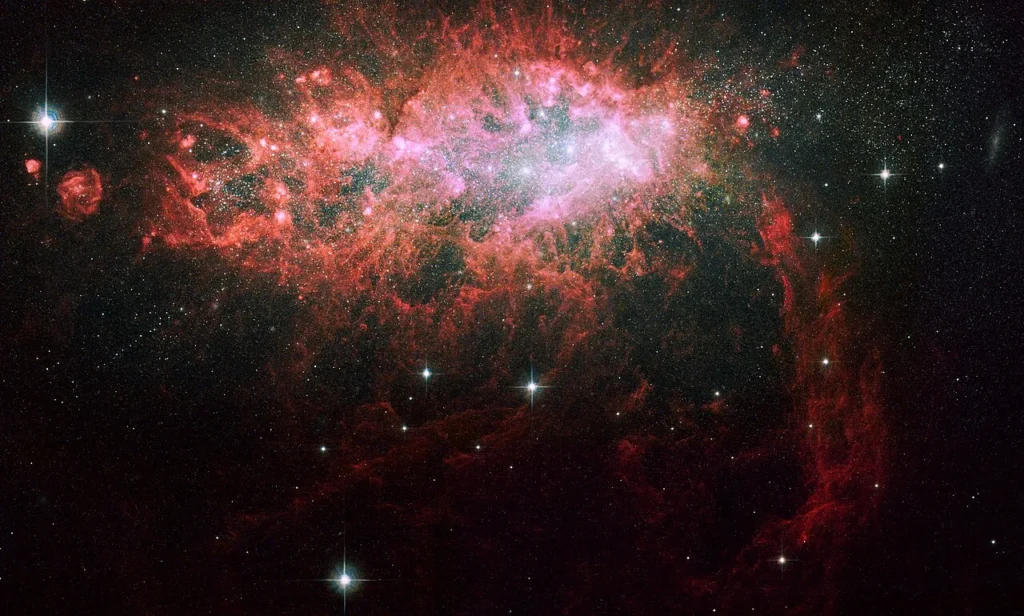
Credit for Wide Field Planetary Camera 2 Data: NASA, ESA, P. Shopbell (California Institute of Technology), R. Dufour (Rice University), D. Walter (South Carolina State University, Orangeburg), and A. Wilson (University of Maryland, College Park)
Next in our collection is the brilliant NGC 1569, a blue compact dwarf galaxy that offers a spectacular view into frenzied star birth. Located about 11 million light-years away, this galaxy is small but mighty, packing an astonishing rate of star formation into a condensed volume. Its small size and intense activity make it a prime target for capturing some of the most vibrant irregular galaxy pictures. High-resolution photographs reveal a dazzling blue hue, a direct result of the countless young, hot, massive stars that dominate its stellar population.
Why NGC 1569 is a Starburst Showcase
NGC 1569 is more than just a bright spot in the sky; it provides a crucial window into the processes that shape galaxies. Its chaotic structure is driven by powerful stellar winds and the explosive deaths of massive stars, all of which are visible in detailed imagery.
- Intense Star Formation: Unlike larger, more settled galaxies, NGC 1569 is experiencing a “starburst” phase. Hubble Space Telescope images resolve its massive star clusters, showing how stars form in a low-metallicity environment, similar to conditions in the early universe.
- Supernova Remnants: The galaxy is riddled with the aftermath of supernovae. Radio observations from facilities like the Very Large Array (VLA) have mapped out these remnants, allowing astronomers to study how the energy from these explosions interacts with the surrounding interstellar gas.
Observing and Appreciating NGC 1569
Visually observing NGC 1569 is a challenge, but modern tools and data make it accessible to dedicated sky-watchers. Its compact nature requires a bit of effort to resolve.
Observing Tips:
- Best Viewing: Look for it during the winter months in the Northern Hemisphere (December-February) in a dark sky far from city lights.
- Equipment: A telescope with an aperture of 8 inches or larger is recommended to spot this faint object. It will appear as a small, fuzzy patch of light.
- Digital Exploration: Complement your viewing by exploring professional data archives. The Hubble Legacy Archive and data from the Keck Observatory offer spectroscopic and imaging data that reveal the galaxy’s true, fiery nature.
NGC 1569’s concentrated burst of activity provides a powerful glimpse into the violent and creative forces that build galaxies, reminding us that even small cosmic objects can host immense power and beauty.
5. NGC 4449 – A Local Group Irregular Galaxy
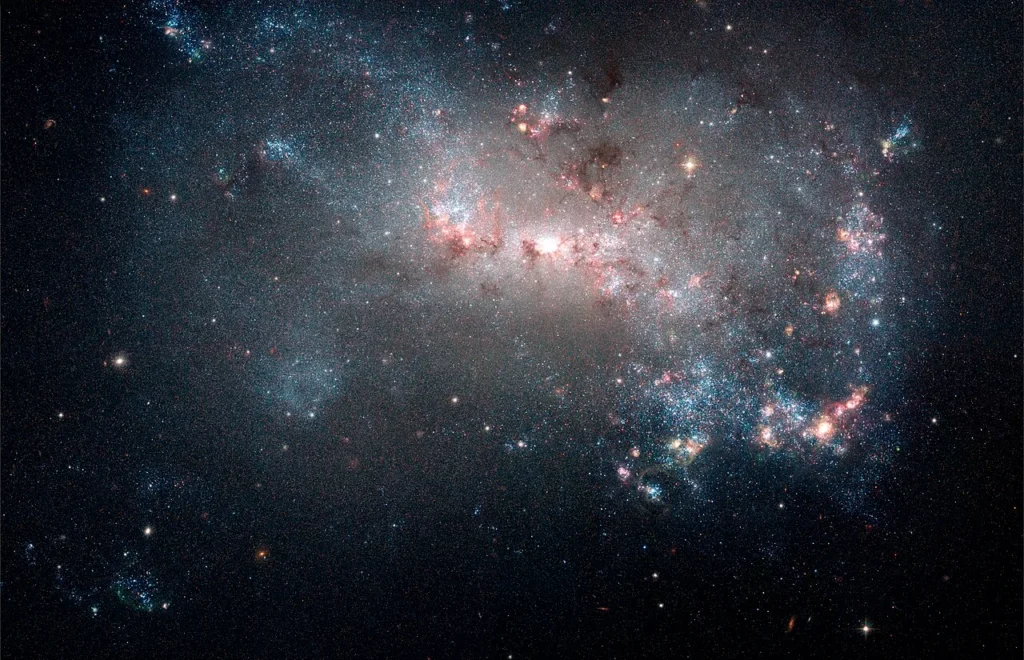
Our tour of cosmic peculiarities brings us to NGC 4449, a brilliant example of a dwarf irregular galaxy. Located about 12.5 million light-years away in the constellation Canes Venatici, this galaxy is a vibrant spectacle of star birth. Its appearance is a chaotic jumble of bright blue star clusters and pinkish nebulae, making it a prime target for anyone searching for dynamic irregular galaxy pictures. The galaxy’s messy form is thought to be the result of ongoing gravitational interactions, which trigger its intense star-forming activity.
Why NGC 4449 is a Model for Starbursts
NGC 4449 is often described as a “starburst” galaxy, meaning it’s undergoing a period of exceptionally high star formation. It serves as a fantastic case study for how galaxies evolve, with multi-wavelength images providing a complete picture of its processes. Data from the Hubble Space Telescope and ground-based observatories paint a detailed portrait.
- Complex Structure: High-resolution photographs show that NGC 4449 is far from simple. It contains a prominent bar of older, yellowish stars at its core, surrounded by a sprawling disk of younger, blue stars and active HII regions. This complexity makes it a rich subject for scientific study.
- Widespread Star Formation: Unlike galaxies where star birth is confined to spiral arms, star formation in NGC 4449 occurs across its entire disk. Images from radio telescopes reveal a massive halo of neutral hydrogen gas extending far beyond its visible limits, fueling this ongoing stellar creation.
Observing and Appreciating NGC 4449
While not visible to the naked eye, NGC 4449 is a rewarding target for amateur astronomers with the right equipment and a dark sky.
Observing Tips:
- Best Viewing: Look for this object during late spring and early summer when Canes Venatici is high in the night sky.
- Equipment: You will need a 10-inch or larger telescope to begin resolving its shape and the brightest knots within it. The galaxy will appear as a faint, rectangular patch of light.
- Technique: Use averted vision, looking slightly to the side of the object rather than directly at it. This technique uses the more light-sensitive parts of your eye to help detect faint details and mottling in the galaxy’s structure.
6. IC 10 – The Nearest Starburst Galaxy to the Milky Way
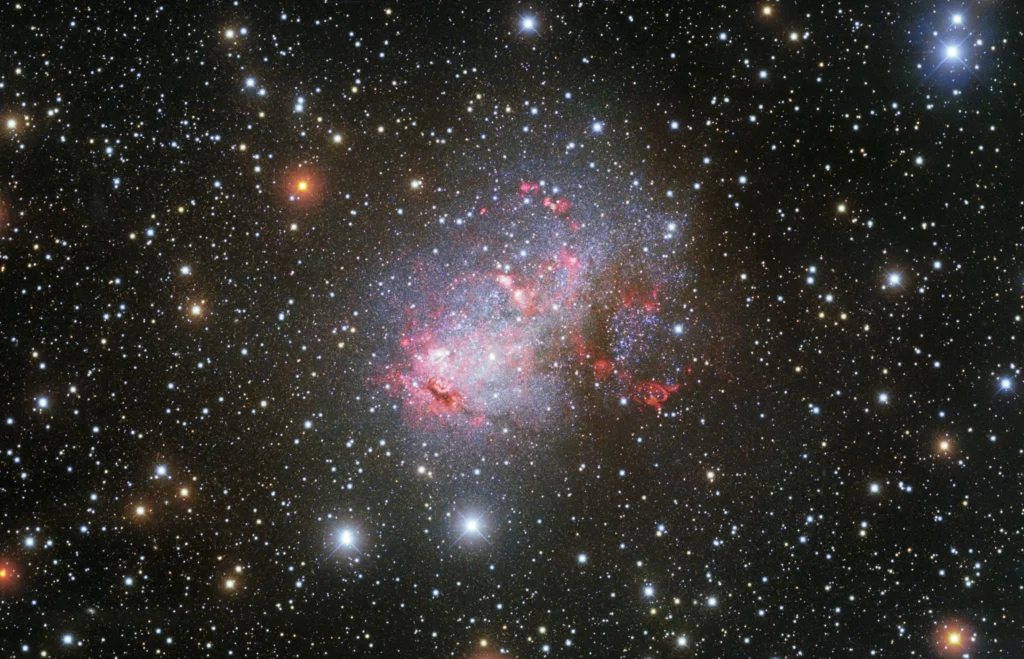
Data obtained and processed by: P. Massey (Lowell Obs.), G. Jacoby, K. Olsen, & C. Smith (NOAO/AURA/NSF)
Image processing: Travis Rector (University of Alaska Anchorage), Mahdi Zamani & Davide de Martin
Next in our cosmic tour is IC 10, a galaxy that holds a unique and powerful title: it’s the closest known starburst galaxy to our Milky Way. Located approximately 2.2 million light-years away in the constellation Cassiopeia, IC 10 is a member of our Local Group. Its chaotic appearance is the direct result of an exceptionally high rate of star formation. The resulting irregular galaxy pictures of IC 10 are not just visually striking; they are a deep dive into the most intense and violent processes of stellar creation in our galactic neighborhood.
Why IC 10 is a Celestial Laboratory
IC 10’s status as a nearby starburst galaxy makes it a prime target for studying extreme cosmic phenomena. Unlike more distant examples, its proximity allows astronomers to resolve individual star clusters and even powerful X-ray sources with relative clarity. Professional observatories provide a multi-wavelength view that peels back its layers.
- Starburst Activity: IC 10 is brimming with young, massive stars and Wolf-Rayet stars, which are evolved, massive stars that have lost their outer hydrogen layers. Infrared images from the Spitzer Space Telescope cut through the dust to reveal the glowing nurseries where these stars are born at a furious pace.
- Supernova Remnants: The galaxy is littered with the aftermath of stellar explosions. Data from the Chandra X-ray Observatory highlights numerous “superbubbles,” vast cavities blown into the interstellar gas by the combined winds and supernova detonations of massive star clusters. This provides a clear look at how stellar feedback shapes a galaxy’s structure and evolution.
Observing and Appreciating IC 10
Visually observing IC 10 is a significant challenge for amateur astronomers. It is faint, small, and heavily obscured by the dust within our own Milky Way galaxy, making it a notoriously difficult target.
Observing Tips:
- Best Viewing: Due to its dimness, this is not a naked-eye or binocular object. It requires a large-aperture telescope under exceptionally dark and clear skies, and even then, it appears as little more than a faint, hazy patch.
- Equipment: The most rewarding way to experience IC 10 is not through an eyepiece but through a screen.
- Digital Exploration: To truly appreciate its starburst nature, consult online archives from NASA, ESA, and other observatories. Exploring professional infrared, X-ray, and radio images reveals the dynamic processes hidden from visual light.
IC 10’s furious star formation offers a potent glimpse into a key phase of galactic life. By studying it, we gain a better understanding of how galaxies build up their stellar populations in short, intense bursts of activity.
7. NGC 6240 – A Merging Galaxy Pair Showing Chaotic Irregularity
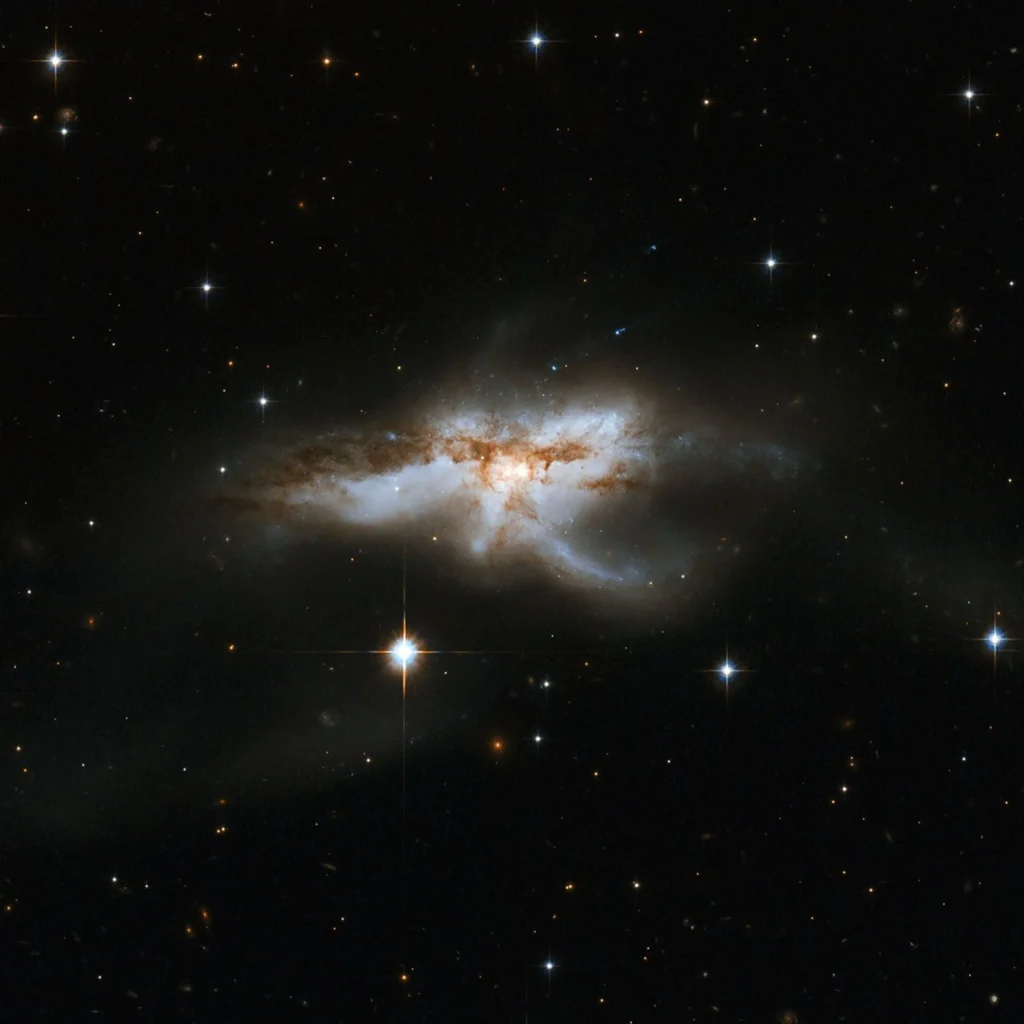
Our tour of cosmic chaos brings us to NGC 6240, a stunning testament to the violent processes that forge galaxies. Located roughly 400 million light-years away, this object isn’t just one galaxy but two large ones caught in a spectacular, ongoing collision. The result is a profoundly disturbed system that offers some of the most dramatic irregular galaxy pictures available, showcasing the raw power of gravitational interaction. Its distorted shape, complete with wispy tidal tails and multiple nuclei, is a snapshot of galactic evolution in action.
Why NGC 6240 is a Cosmic Crash Site
NGC 6240 is far more than a pretty mess; it’s a premier laboratory for studying galaxy mergers. The intense gravitational forces are ripping the original galaxies apart, triggering furious bursts of star formation and feeding two supermassive black holes at its core. High-resolution imagery from major observatories provides a front-row seat to this process.
- Dual Black Holes: Chandra X-ray Observatory studies famously confirmed that NGC 6240 contains two active supermassive black holes spiraling toward each other. This provides a rare glimpse into a future merger that will produce a single, even larger black hole and send gravitational waves across the universe. For more on this, check out these stunning images of black holes.
- Galactic Dynamics: Spectroscopic mapping from instruments like the Very Large Telescope (VLT) allows astronomers to trace the motion of gas and stars. These studies reveal the complex dynamics of the collision, showing how material is funneled inward to fuel the starbursts and active black holes. HST images, in turn, resolve bright, young star clusters born from the chaos.
Observing and Appreciating NGC 6240
Due to its immense distance, NGC 6240 is beyond the reach of amateur telescopes. Its scientific value and visual splendor are best appreciated through the data collected by professional-grade instruments.
Observing Tips:
- Professional Imagery: The best way to explore this object is through the public archives of NASA, ESA, and other space agencies. Search for images from Hubble (HST), Chandra, and Spitzer.
- Digital Exploration: Look for time-series observations and multi-wavelength composites. These combine data from different telescopes to show how gas, dust, and stars interact during the merger.
- Scientific Data: For the more technically inclined, delve into the actual data sets and scientific papers that use NGC 6240 to test theories of galaxy formation.
NGC 6240 powerfully illustrates how interactions and mergers drive galactic evolution. It serves as a living preview of our own Milky Way’s eventual collision with the Andromeda galaxy, billions of years from now.
8. UGC 8335 (Integral Sign Galaxy) – An Artistic Irregular Structure
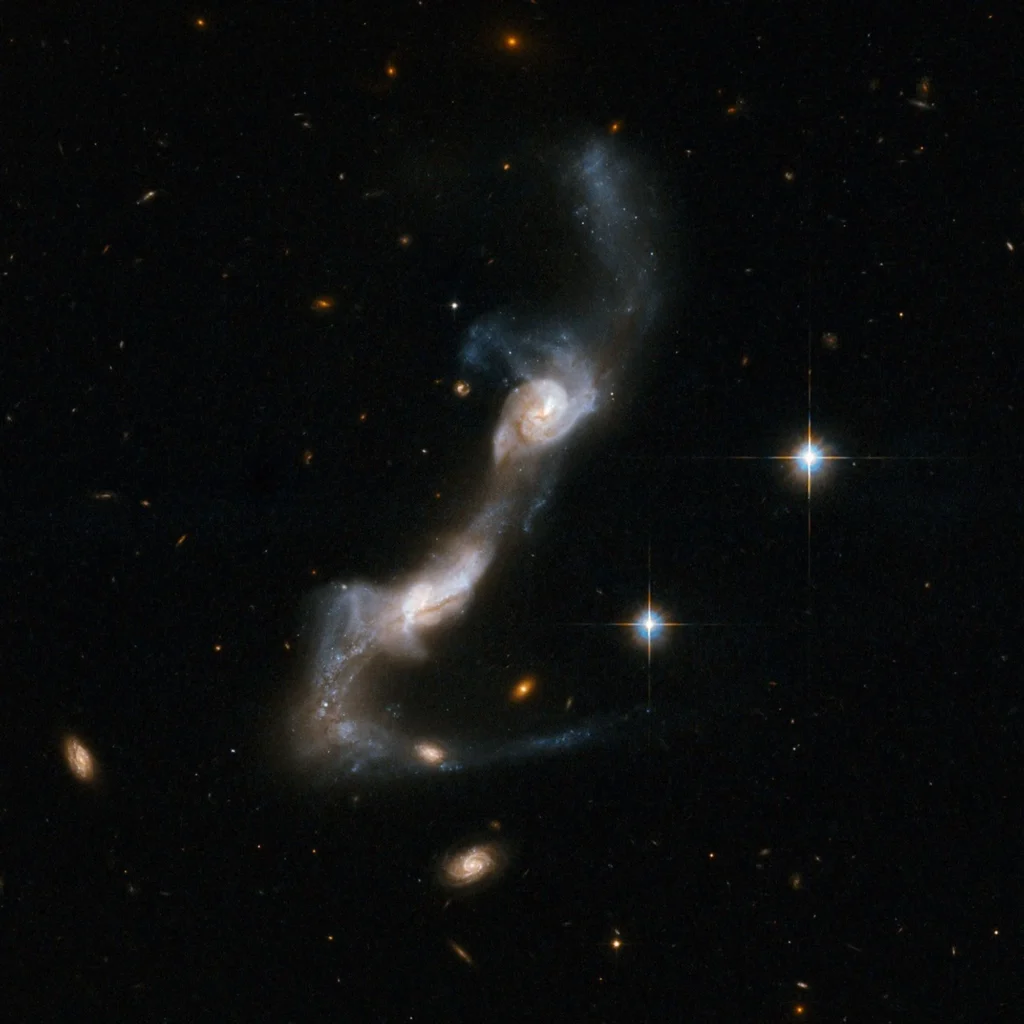
Next on our tour of celestial oddities is a galaxy that seems to have jumped right out of a mathematics textbook: UGC 8335, the Integral Sign Galaxy. Located roughly 150 million light-years away, this object earned its memorable nickname from the amateur astronomy community for its striking resemblance to the ∫ symbol. Its elegant, curved shape is a prime example of how gravity can sculpt galactic matter into forms that are both scientifically intriguing and artistically beautiful, making it a standout object in collections of irregular galaxy pictures.
Why UGC 8335 is a Cosmic Sculpture
The unique form of UGC 8335 makes it more than just a curiosity; it is a case study in galactic dynamics. Its elongated, S-shaped structure is a puzzle for astronomers, who speculate that it could be the result of a past gravitational interaction with another galaxy or perhaps the outcome of its own internal rotational forces.
- Galactic Interactions: The most common theory is that UGC 8335 was distorted by a close encounter with another galaxy. The tidal forces from such an event could have stretched and pulled its stars and gas into the long, arcing streams we see today.
- Asymmetrical Morphology: High-resolution images from observatories reveal a distinct lack of symmetry. Unlike a spiral galaxy with balanced arms, the Integral Sign Galaxy’s structure is lopsided and thin, offering a clear visual representation of disruptive cosmic forces at work.
Observing and Appreciating UGC 8335
Due to its immense distance and faintness, viewing UGC 8335 directly is a challenge reserved for very large telescopes. For most of us, appreciation comes through the stunning images captured by professional observatories.
Observing Tips:
- Best Viewing: This galaxy is not a target for backyard telescopes. Your best access is through digital archives.
- Equipment: High-powered professional observatories like the Hubble Space Telescope are required to resolve its shape.
- Digital Exploration: Search for “UGC 8335” on astronomy databases like the NASA/IPAC Extragalactic Database (NED) or the ESA/Hubble image archive. Comparing its image to other distorted galaxies, like the Antennae Galaxies, helps put its unique shape into context.
The Integral Sign Galaxy’s graceful curve serves as a powerful reminder that the universe is filled with objects of unexpected and often profound beauty. It demonstrates that even the fundamental laws of physics can produce results that look like pure art.
Comparison of 8 Irregular Galaxy Images
| Galaxy / Object | Observation complexity | Resource requirements | Expected scientific outcomes | Ideal use cases | Key advantages |
|---|---|---|---|---|---|
| Large Magellanic Cloud (LMC) | Low (naked-eye in south) | Small telescopes to space observatories; southern access | Resolved-star studies, star formation, tidal effects | Detailed stellar evolution and public outreach | Very nearby, extensive archival data, bright star-forming regions |
| Small Magellanic Cloud (SMC) | Low–Medium (fainter than LMC) | Dark skies, moderate telescopes, southern surveys | Dwarf disruption, low-metallicity populations, tidal dynamics | Studies of tidal stripping and dwarf galaxy evolution | Clear interaction signatures, diverse stellar populations |
| Messier 82 (M82) | Medium (bright northern object) | 6″+ amateur scopes; optical/IR/X-ray observations | Starburst physics, galactic winds, feedback processes | Multi-wavelength starburst and feedback research | Intense star formation, prominent bipolar outflows, rich datasets |
| NGC 1569 | Medium–High (compact, bright regions) | 8″+ telescopes; spectrographs for detail | Low-metallicity star formation, cluster evolution | Compact dwarf star-formation studies | Very high surface brightness, well-studied clusters |
| NGC 4449 | Medium (small angular size) | 10″+ telescopes; archival multiwavelength data | Environmental effects on star formation, tidal interactions | Dwarf interaction and structural studies | Complex morphology, extensive HST and survey imagery |
| IC 10 | High (dust-obscured, optically faint) | Infrared, radio, X-ray facilities; professional data | Extreme starburst feedback, recent supernova studies | Nearby starburst physics using multiwavelength campaigns | Nearest starburst, excellent for detailed physical measurements |
| NGC 6240 | High (distant, highly disturbed) | Large telescopes, X-ray/radio, numerical simulations | Merger dynamics, dual AGN activity, tidal structure | Merger-driven evolution and black hole feedback research | Direct example of ongoing major merger with dual nuclei |
| UGC 8335 (Integral Sign) | Medium–High (distinctive, distant) | Professional imaging for morphology studies | Interaction/post-merger morphology and tidal shaping | Morphology diversity and tidal distortion case studies | Visually striking shape, useful for education and morphology research |
From Chaos Comes Creation: Final Thoughts
Our journey through this curated collection of irregular galaxy pictures has revealed a fundamental truth of the cosmos: cosmic chaos is the very engine of creation. By moving beyond the familiar spirals and stately ellipticals, we have ventured into the untamed frontier of galactic evolution. These objects, from the vast, sprawling structures of the Magellanic Clouds to the explosive starburst heart of Messier 82, challenge our notions of order and beauty.
What we once might have dismissed as messy or unstructured, we can now see as dynamic and vibrant. The images of NGC 1569 and IC 10, for example, are not just snapshots of scattered stars; they are active laboratories showing us how the raw materials of the universe are forged into new suns and solar systems at an astonishing rate. These irregular galaxy pictures are invaluable scientific artifacts, capturing fleeting moments in the multi-billion-year lifespan of a galaxy. They provide direct evidence of galactic mergers, gravitational interactions, and the powerful feedback from massive stars.
Key Takeaways from Our Cosmic Gallery
Reflecting on these eight remarkable cosmic subjects, several key points emerge that are crucial for both stargazers and armchair astronomers alike:
- Irregularity Signifies History: The lack of a defined shape is a historical record. It tells a story of past collisions, near misses with other galaxies, or intense internal pressures that have disrupted any semblance of a settled structure, as seen in the merging system of NGC 6240.
- Hubs of Stellar Genesis: Many irregulars, particularly dwarf irregulars and starburst galaxies like M82, are undergoing periods of incredibly rapid star formation. Looking at these irregular galaxy pictures is like peering into the universe’s most productive stellar nurseries.
- Accessibility for Observation: You don’t always need a space telescope to appreciate this chaos. The Large and Small Magellanic Clouds are prime targets for amateur astronomers in the Southern Hemisphere, offering a direct, personal connection to galactic evolution.
These galaxies remind us that the cosmos is not a static museum of perfect forms but an active, ever-changing environment. The artistic sweep of the Integral Sign Galaxy (UGC 8335) shows that even in these tumultuous settings, a unique and compelling beauty arises. They are a testament to the powerful forces that shape our universe, from gravity’s relentless pull to the explosive energy of supernovae. Whether you are observing them with your own telescope or appreciating the data captured by world-class observatories, these galaxies offer a profound perspective on our own place within this grand, messy, and magnificent cosmos.
For more deep dives into astronomy, cutting-edge science, and the wonders of our universe, explore the extensive articles and resources available at maxijournal.com. Our platform is dedicated to curating fascinating content that connects you with the latest discoveries and timeless knowledge. Continue your journey of exploration with us at maxijournal.com.
Discover more from Maxi Journal
Subscribe to get the latest posts sent to your email.


.jpg)