Your dog is staring at your cereal bowl, your coffee, or the last splash of milk in a glass. That usually leads to the same question. Can dogs drink milk, or is that a bad idea?
The honest answer is: sometimes a tiny amount is tolerated, but most adult dogs don’t handle milk well. That’s where many owners get tripped up. People remember that puppies drink milk, so it feels logical that milk must be wholesome for dogs in general. But puppy nutrition and adult digestion are not the same thing.
If you’re trying to decide what to do right now, the safest default is simple. Don’t make milk a routine treat. If your dog already licked some, watch for digestive signs and keep the rest of the day bland and simple. If you’re thinking about offering dairy on purpose, it helps to know which products are lower risk, how to test carefully, and when to skip it altogether.
The Complicated Truth About Dogs and Milk
Milk gets its good reputation from human nutrition and from the image of nursing puppies. Those two ideas blur together, and that’s why so many owners assume milk is naturally good for dogs. It isn’t that simple.
Puppies are built to digest their mother’s milk. Adult dogs usually aren’t built to digest cow’s milk well. That’s the key distinction. A very young puppy relies on species-appropriate milk, then gradually moves to solid food. Once that transition happens, tolerance often changes.
Why the answer isn’t a simple yes or no
A dog might drink a small sip and seem fine. Another dog might have loose stool, gas, or vomiting after a similar amount. That doesn’t mean one owner did something wrong. It means dairy tolerance varies, and milk is one of those foods where the dog’s individual gut response matters more than tradition.
A practical way to think about it is this:
- Puppies with their mother: Normal and expected.
- Orphaned puppies: They need a proper canine milk replacer, not grocery-store cow’s milk.
- Healthy adult dogs: Milk is optional at best, and often not worth the risk.
- Dogs with sensitive stomachs: It’s usually smarter to skip dairy altogether.
Milk isn’t a required part of an adult dog’s diet. If your dog never drinks it, they’re not missing anything essential.
The myth that milk is a healthy everyday treat
Owners often offer milk with good intentions. They want to give something comforting, tasty, or nourishing. The problem is that a treat can still be a poor digestive fit.
So when people search dogs drink milk, the better question is usually not “Can they?” but “What happens if they do, and how can I handle it safely?” That mindset leads to better choices than treating milk like a harmless staple.
Why Milk Can Be a Problem for Most Dogs
Your dog laps up a little milk from a cereal bowl and looks completely fine. An hour later, you hear stomach gurgling, then the trip to the yard becomes urgent. That pattern is common, and the reason usually starts with one sugar: lactose.
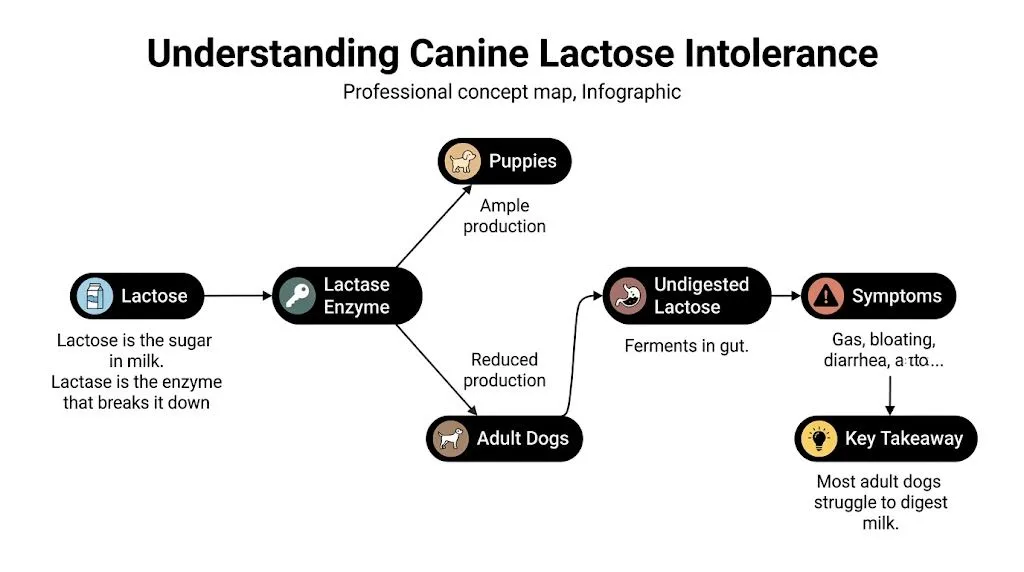
Lactose is the natural sugar in milk. To break it down, the small intestine uses an enzyme called lactase. Young puppies produce more lactase while they are nursing. As dogs mature, lactase production often drops, so the same body that handled mother’s milk early in life may struggle with dairy later on. PetHonesty’s overview of canine lactose intolerance explains that this decline after weaning is a major reason adult dogs react poorly to milk.
What actually goes wrong in the gut
Lactase works like scissors for lactose. It cuts the milk sugar into smaller parts the body can absorb. If there is not enough lactase, the lactose keeps traveling through the digestive tract undigested.
Then the lower gut takes over, and not in a helpful way. Gut bacteria ferment that leftover sugar. Fermentation produces gas. The undigested lactose also pulls extra water into the intestines. Put those two effects together, and you get the signs owners often notice at home: gas, belly discomfort, loose stool, and sometimes vomiting.
If your dog brings up milk or other stomach contents after drinking dairy, this guide on why dogs cough up white foam can help you sort out whether you are seeing simple stomach irritation or a sign that deserves a call to your veterinarian.
Why one dairy food causes trouble and another may not
Milk is not one single category from a dog’s point of view. The question is less “dairy or no dairy?” and more “how much lactose and fat is in this specific product?”
A simple way to picture it is to compare dairy foods to levels on a risk dial:
- Higher lactose, often harder on the gut: regular cow’s milk, goat’s milk, ice cream, sweetened condensed milk
- Sometimes better tolerated in tiny amounts: plain yogurt with live cultures, small pieces of hard cheese
- Usually poor choices because of more than lactose: flavored yogurt, chocolate dairy products, whipped cream with sugar or additives
That is why two owners can both say, “My dog had dairy,” and mean very different things. A teaspoon of plain yogurt is not the same test as a bowl of whole milk.
A safe decision framework for owners
If you are trying to decide whether milk is worth offering, use this checklist:
- Start with your dog’s history. If your dog has a sensitive stomach, past diarrhea after treats, pancreatitis, or food intolerance, skip milk.
- Check the product. Plain is safer than flavored. Lower lactose is usually easier than higher lactose. Added sugar is a poor trade.
- Test only a very small amount. A lick or teaspoon is enough for a first trial in most dogs.
- Watch for 24 hours. Look for gas, soft stool, repeated swallowing, lip licking, restlessness, or vomiting.
- Stop at the first sign of trouble. A food that causes even mild digestive upset is not a useful treat.
This approach keeps the test small and the consequences small. That matters because milk offers no special nutrition an adult dog needs, so there is no reason to push through a questionable reaction.
Plain-language takeaway
- The main problem is lactose
- Adult dogs often have less lactase to digest it
- Undigested lactose leads to gas, cramping, and diarrhea
- The amount and type of dairy matter
- If you choose to test dairy, use a tiny amount and monitor closely
Practical rule: If a treat regularly leaves your dog gassy, uncomfortable, or rushing outside, it is the wrong treat for that dog.
Recognizing the Signs of Dairy Intolerance
Your dog laps up spilled milk in the kitchen. An hour later, you are watching for clues and wondering whether this is a harmless treat mistake or the start of a rough night.
The first thing to know is where to look. Dairy intolerance usually shows up in the digestive tract. In plain terms, the gut is where the trouble starts, so the clearest signs are changes in stool, gas, nausea, and comfort.

What you may notice at home
Some dogs react quickly. Others seem fine at first, then develop symptoms later the same day. A mild reaction may look like one soft stool and extra gas. A stronger reaction can look like repeated diarrhea, vomiting, belly pain, or obvious restlessness.
Watch for these signs:
- Loose stool or diarrhea: Often the easiest sign to spot. One episode may stay mild. Repeated trips outside suggest the gut is struggling.
- Gas and stomach noises: Rumbling, flatulence, or a swollen-looking belly can follow dairy that is not being digested well.
- Vomiting or nausea: Your dog may vomit, drool more than usual, lick their lips, or swallow repeatedly.
- Abdominal discomfort: Pacing, stretching into a prayer position, looking at the belly, or trouble settling can all point to cramping.
- Behavior changes: Some dogs become clingy, restless, tired, or less interested in food because their stomach feels off.
A simple way to picture it is this: mild intolerance often causes mess and discomfort. More serious illness causes weakness, repeated vomiting, or signs that go beyond the stomach.
A quick symptom guide
| What you see | What it may mean | What to do |
|---|---|---|
| One soft stool, otherwise normal behavior | Mild digestive upset | Offer water, skip all dairy, and monitor for the rest of the day |
| Gas, belly rumbling, mild restlessness | Dairy did not sit well | Keep meals bland if needed and watch for worsening signs |
| Repeated diarrhea or more than one vomiting episode | Stronger intolerance or irritation | Stop dairy and call your vet if it continues or your dog cannot keep water down |
| Lethargy, pain, repeated vomiting, or signs of dehydration | More than a minor food reaction | Contact your veterinarian promptly |
If your dog is coughing, gagging, or bringing up foam instead of showing classic stomach upset, follow a different line of thinking. This guide on why a dog may be coughing up white foam can help you sort out whether the problem sounds respiratory, stomach-related, or more urgent.
How to tell mild intolerance from a vet visit
Use this quick decision rule.
Monitor at home if your dog had a small amount, is bright and comfortable, and only has mild gas or one soft stool.
Call your veterinarian if your dog has repeated vomiting, repeated diarrhea, marked bloating, clear abdominal pain, weakness, or refuses water. Puppies, senior dogs, and dogs with pancreatitis, inflammatory bowel disease, or other digestive problems should get attention sooner because they can dehydrate faster and have less room for error.
If you are unsure, trust the pattern more than any single symptom. One burp is not very concerning. A dog who cannot settle, keeps vomiting, and looks miserable needs help.
Safe Milk and Dairy Guidance for Your Dog
You open the fridge, your dog gives you the hopeful stare, and a splash of milk feels harmless. This is the point where a simple plan helps. The goal is not to prove that dairy is “good” or “bad.” The goal is to answer a practical question safely: can your dog handle a very small amount of a specific dairy food without trouble?
A home test should be quiet, controlled, and easy to interpret. AKC guidance on dogs and milk recommends starting with a very small amount of diluted goat’s milk and then watching for delayed stomach upset over the next day or two. Goat’s milk contains a little less lactose than cow’s milk, which is why some owners use it as a cautious first trial. Less lactose does not mean risk-free. It only means the starting point may be gentler for some dogs.
How to test tolerance at home
Use this step-by-step approach:
- Choose a normal day. Skip the test if your dog is stressed, traveling, boarding, or already has a touchy stomach.
- Pick one dairy food only. Do not test milk, yogurt, and cheese on the same day.
- Start with a tiny amount. A teaspoon of diluted goat’s milk is a reasonable first check.
- Keep the rest of the diet unchanged. That gives you a cleaner answer if symptoms show up.
- Watch for 24 to 48 hours. Check stool, gas, belly sounds, energy, and comfort.
- Stop after any reaction. Do not retry later that day to “confirm” it.
A food trial works like changing one ingredient in a recipe. If you change three things at once, you cannot tell what caused the problem.
Breed, size, and individual history can all affect tolerance, but they do not predict it perfectly. One dog may lick a spoon of yogurt and feel fine. Another may get loose stool from a small sip of milk. Your own dog’s response matters more than comparisons with a neighbor’s dog.
Quick guide to safer and riskier dairy choices
| Product | Best use | Practical guidance |
|---|---|---|
| Goat’s milk | Test only, with caution | Start very small and dilute it. Use it only if you want to check tolerance carefully. |
| Plain yogurt | Often easier for some dogs | Fermentation reduces lactose, so a small lick or spoonful may be better tolerated than milk. Choose plain, unsweetened yogurt. |
| Plain kefir | Sometimes tolerated better than milk | Offer only a small amount at first. Keep it plain and unsweetened. |
| Cow’s milk | Higher-risk trial item | More likely to cause stomach upset than fermented dairy. Usually not the best first choice. |
| Cheese | Depends on type and amount | Small bits of plain cheese may be tolerated by some dogs, but it is still rich and easy to overfeed. |
| Flavored milk | Avoid | Sugar, chocolate, flavorings, or sweeteners add extra risk. |
| Sweetened condensed milk | Avoid | Very sugary and too rich for dogs. |
| Ice cream | Avoid | Dairy, sugar, and fat together make it a common problem food. |
A simple rule helps here. The more plain, unsweetened, and lightly processed the product is, the safer it usually is to evaluate. The sweeter and richer it is, the less useful and less safe it becomes.
How much is too much
For adult dogs, dairy belongs in the treat category. It should never replace water, and it should not become a daily habit just because one small test went well. Even dogs that tolerate dairy can run into trouble if the portion grows from “a taste” to “a snack.”
If you want a practical ceiling, stay far below the point where dairy starts crowding out balanced food or adding a lot of extra calories. A spoonful is a test. Half a bowl is a gamble.
If your dog enjoys extras with meals, it makes more sense to improve the whole diet than to keep experimenting with milk. This guide to vet-recommended dog food brands is a better place to start if your goal is long-term nutrition, not just an occasional treat.
A quick decision framework
Use dairy only if all three of these are true:
- Your dog is healthy and not already having digestive trouble.
- You can test one plain product in a tiny amount.
- You are willing to stop after the first sign that it does not agree with your dog.
Skip the test and ask your veterinarian first if your dog is a puppy, a senior, has pancreatitis, has inflammatory bowel disease, or has a history of vomiting or diarrhea after rich foods. In those dogs, even a small “treat test” can create more trouble than it is worth.
Healthy Milk Alternatives for Your Canine Companion
Your dog finishes dinner, then follows you to the fridge and gives you that hopeful look. If the goal is to offer something comforting or a little more interesting than kibble, you have safer options than pouring milk into the bowl.
A good way to choose is to ask one simple question first. What problem are you trying to solve? Hydration, extra calories, a tempting topper, or a hand-fed treat all call for different answers.
Better options for puppies and adults
Puppies are the clearest case. They should not be “tested” with grocery-store cow’s milk. If a puppy needs milk support, use a veterinary milk replacer made for puppies and ask your veterinarian to guide the amount and feeding schedule. Puppy nutrition works like infant feeding. The formula matters as much as the volume.
Adult dogs usually do best with simpler choices:
- Fresh water: Best for daily hydration, before and after walks, and any time the weather is warm.
- Canine milk replacer products: Reserved for puppies or specific medical situations your veterinarian is managing.
- Plain yogurt or plain kefir: Some adult dogs handle fermented dairy better than liquid milk, but these still count as treats and still need a small test portion.
- Unsalted bone broth: A practical option for dogs who need encouragement to drink or eat, as long as it has no onion, garlic, heavy fat, or salty seasoning.
- Dog-specific food toppers: Useful if your real goal is variety, not milk itself.
Here is a quick reference that can help in the moment:
Usually safer to consider in small amounts
- Water
- Plain unsalted broth
- Plain dog food toppers
- Plain yogurt or kefir, if your dog has already tolerated a tiny test
Usually best to skip
- Cow’s milk in a bowl
- Heavy cream or half-and-half
- Sweetened condensed milk
- Ice cream
- Flavored yogurt
- Dairy products sweetened with xylitol or packed with sugar
Be careful with plant milks
Plant milks can sound like an easy workaround, but the label matters more than the marketing. Almond, oat, coconut, and soy drinks often contain added sugar, thickeners, flavorings, or sweeteners. Xylitol is the big danger because it is toxic to dogs, but rich fat content and extra ingredients can also upset the stomach.
If you are deciding whether a “healthy human food” belongs in your dog’s bowl, the same label-checking habit helps with fruits and add-ins too. This guide on whether dogs can eat cranberries shows the kind of questions to ask before sharing.
A short visual recap can help if you’re choosing between hydration and treats.
A practical replacement rule
Use this framework:
- Need hydration? Offer water.
- Need nutrition? Use complete dog food or a veterinarian-approved puppy replacer.
- Need appetite support? Try a small spoonful of plain topper or a little unsalted broth.
- Need a treat? Pick a dog-safe treat and keep the portion small.
If you are ever unsure, choose the option with the shortest ingredient list and the clearest purpose. That approach keeps treat decisions simple and lowers the chance of turning a kind gesture into a stomach problem.
Frequently Asked Questions About Dogs and Milk
Is raw milk better than pasteurized milk for dogs
Some people argue that raw milk is easier to tolerate because it retains enzymes. But as noted by Dogs Naturally Magazine’s discussion of raw versus pasteurized milk for dogs, the bigger issue is still the lactose and fat content, and raw milk also carries a pathogen risk, including Salmonella. So even if someone frames raw milk as more natural, it isn’t automatically safer.
What should I do if my dog accidentally drinks a lot of milk
Remove access to more milk, provide water, and watch for diarrhea, vomiting, gas, and discomfort. Keep meals simple for the rest of the day unless your veterinarian tells you otherwise. If your dog seems painful, repeatedly vomits, or becomes weak, call your vet.
Can milk cause long-term problems
For some dogs, the issue is a short-lived digestive upset. For others, repeated exposure can keep triggering stomach problems and make owners misread a preventable food issue as a mysterious “sensitive stomach.” That’s one reason routine dairy feeding usually isn’t worth it.
Is cheese or yogurt always safe if milk isn’t
No. Some dogs do better with fermented dairy, but “better tolerated” doesn’t mean “safe for every dog.” Introduce one product at a time, in a tiny amount, and stop if your dog reacts.
What’s the safest overall choice
For most adult dogs, the safest answer is simple. Skip milk unless you have a specific reason, use proper milk replacer for puppies, and choose dog-appropriate treats for everyone else.
If you like clear, practical pet guides without the fluff, explore more approachable health and pet articles at maxijournal.com. If you’re a curious reader or a writer looking for a home for useful, well-explained content, it’s worth a visit.
Discover more from Maxi Journal
Subscribe to get the latest posts sent to your email.