Germany hosts some of Europe’s most influential corporate assets, but revenue rankings alone give an incomplete picture of where the country’s business relevance now sits. The stronger signal for 2026 is the mix of sectors shaping demand: enterprise software, industrial automation, biotechnology, telecom infrastructure, premium consumer brands, and digital subscription services.
That mix matters because it changes how investors, job seekers, and commercial partners should read the German market.
A narrow focus on carmakers misses the breadth of current opportunity. Germany still matters for advanced manufacturing, yet its competitive position also depends on companies that run global business systems, commercialize scientific research, expand digital networks, and sell directly to consumers at scale. Readers tracking how software and automation increasingly intersect with industry may also want a practical primer on robotics and industrial automation systems.
This list selects seven companies that show that wider economic profile:
- SAP SE represents Germany’s role in enterprise software and data infrastructure.
- Siemens AG shows how industrial strength is increasingly tied to automation, digital engineering, and energy systems.
- BioNTech SE reflects the country’s ability to turn scientific research into globally relevant commercial platforms.
- BMW Group remains a core industrial name, but its relevance now also rests on electrification, software, and premium positioning.
- adidas AG adds consumer brand power and global distribution.
- Deutsche Telekom AG anchors the connectivity layer behind business and consumer digital activity.
- HelloFresh SE illustrates a newer side of German corporate scale. Platform-led consumer services with international reach.
Taken together, these companies offer a more accurate cross-section of Germany’s economy than the usual manufacturing stereotype. They show a market where industrial capability still matters, but where current relevance increasingly comes from combining engineering discipline with software, science, networks, and direct customer access.
1. SAP SE
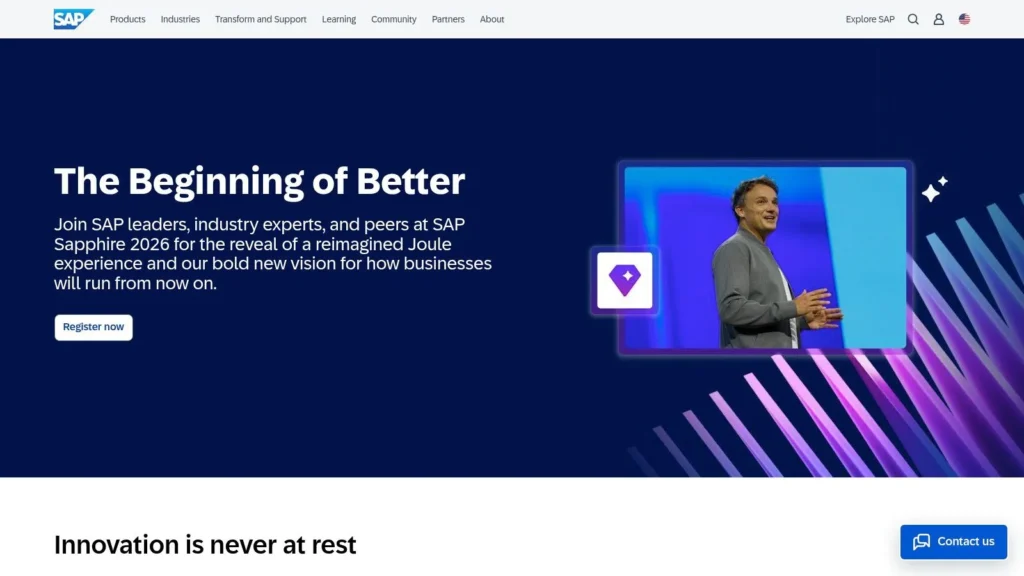
SAP is the clearest example of why any serious review of companies in Germany has to move past manufacturing stereotypes. It’s Germany’s flagship enterprise software company, and its relevance comes from how extensively it integrates into day-to-day operations across finance, supply chain, procurement, manufacturing, and analytics.
For buyers, the core attraction is breadth. SAP S/4HANA Cloud covers core ERP processes, while the SAP Business Technology Platform extends analytics, integration, and application development. That matters in Germany because many firms are still underusing their own data. Only 6% of German companies fully exploit the potential of their available data, according to Bitkom figures discussed by IBsolution. A vendor that combines operational systems with analytics therefore carries unusual strategic weight.
Why SAP matters now
SAP fits the current German market because many companies don’t need another isolated tool. They need systems that connect operational records to reporting, planning, and process automation. Readers who want a broader grounding in how those layers interact can pair this with a plain-English guide to data science concepts.
- End-to-end stack: SAP combines ERP, analytics, integration, and workflow tooling in one ecosystem.
- Industry fit: Its product design reflects the needs of manufacturers, distributors, and regulated enterprises.
- Partner depth: Large implementations usually depend on consulting and integration partners, and SAP’s ecosystem is one of its strongest assets.
Practical rule: SAP is strongest when a company wants standardization across departments, not just a faster finance system.
The tradeoff is complexity. Pricing is often quote-based, licensing can be hard to compare, and implementation success depends heavily on governance and change management. For employers and job seekers, that cuts both ways. It creates demand for SAP-skilled professionals, but it also means projects can stall if companies treat ERP transformation as a software purchase instead of an operating model change.
You can explore the platform at SAP’s official website.
2. Siemens AG
Siemens is one of the clearest examples of how German corporate strength now extends beyond classic manufacturing into industrial software, grid technology, rail systems, and building infrastructure. That mix makes it relevant to three audiences at once. Investors watch it as a proxy for capital spending and industrial digitization. Job seekers see a company where engineering and software increasingly overlap. Partners see a platform vendor with reach across factories, energy systems, and transport networks.
Its role is easiest to understand in relation to Germany’s broader economy. As noted earlier, industry remains a central pillar of German output and exports. Siemens matters because it supplies the systems that help other sectors run better: factory controls, digital design tools, electrification equipment, and mobility technology. In practical terms, it sits upstream of productivity.
Where Siemens stands out
Siemens has scale, but scale alone is not the point. The more relevant advantage is its position across multiple layers of industrial decision-making.
- Automation plus software: Siemens combines physical control systems with engineering and industrial software. That matters for manufacturers trying to connect design, production, maintenance, and quality data.
- Exposure to long-cycle markets: Its presence in rail, buildings, energy, and industrial infrastructure gives it relevance beyond short-term consumer demand swings.
- Partner relevance: System integrators, equipment makers, and enterprise customers often work with Siemens because they need interoperability, domain knowledge, and support over long deployment cycles.
Siemens Xcelerator is a useful example of that strategy. It brings together software, IoT connectivity, and a partner ecosystem around industrial transformation rather than treating each product as a standalone sale. For readers who want context on the science and engineering layer behind this shift, a primer on biotechnology and advanced technical industries helps show why cross-disciplinary skills now matter across German companies, not only in labs or healthcare.
Why Siemens matters now
The company’s relevance today comes from timing. European industry is under pressure to improve energy efficiency, modernize aging infrastructure, strengthen supply-chain resilience, and digitize operations without sacrificing reliability. Siemens sells into all four priorities.
That creates a different profile from SAP, which is centered on enterprise systems, and from BioNTech, which is centered on scientific innovation. Siemens sits in the operating layer of the physical economy. Its products affect uptime, safety, power use, throughput, and asset life.
Siemens is relevant now because industrial competitiveness increasingly depends on software-linked infrastructure, not machinery in isolation.
There are tradeoffs. Siemens can be difficult to evaluate quickly because its portfolio is broad, buying cycles are long, and many deals depend on technical configuration rather than simple list pricing. Yet that complexity is also part of the moat. For companies building or modernizing physical operations, Siemens remains one of the most consequential partners in Germany.
Its corporate platform is at Siemens online.
3. BioNTech SE
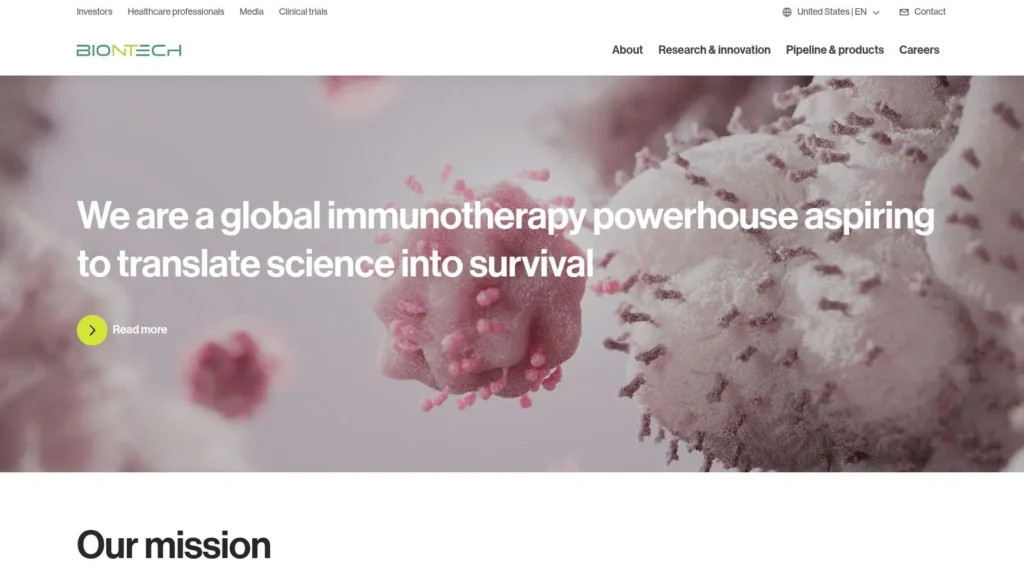
BioNTech changed how many international readers think about German business. It showed that Germany can produce a globally consequential biotech platform company, not just world-class manufacturers.
Its public identity was shaped by COMIRNATY, the COVID-19 vaccine co-developed with Pfizer, but the deeper reason to watch BioNTech is its platform orientation. The company sits at the intersection of mRNA science, oncology, immunotherapy, and clinical development. That’s a very different profile from the traditional image attached to companies in Germany.
Why BioNTech is more than a pandemic-era story
For investors and scientific partners, BioNTech is relevant because it pairs commercial experience with continued pipeline risk and possibility. It isn’t a consumer-facing company in the way adidas or HelloFresh are. Its value comes from research execution, regulatory navigation, and collaboration quality.
That creates a different decision framework:
- Platform potential: mRNA and immune-based approaches can support multiple disease areas.
- Scientific depth: BioNTech’s relevance comes from R&D capability, not just a single marketed product.
- Partnership appeal: Biotech scale often depends on alliances with pharma, academia, and health systems.
Anyone trying to place BioNTech in the broader innovation environment should read it through the lens of modern biotechnology, not just vaccine headlines.
There’s also a useful macro signal around this company. Germany’s economy is often described through industrial champions and the Mittelstand, yet higher-growth scientific commercialization still gets less everyday attention than it deserves. BioNTech stands out because it proves Germany can generate globally watched biotech assets with real platform credibility.
The key risk is obvious. Clinical and regulatory outcomes are uncertain by nature, and future value depends on execution beyond past success. Even so, BioNTech remains one of the most important signals that Germany’s corporate future includes serious life sciences alongside engineering.
The company’s site is BioNTech’s official homepage.
4. BMW Group
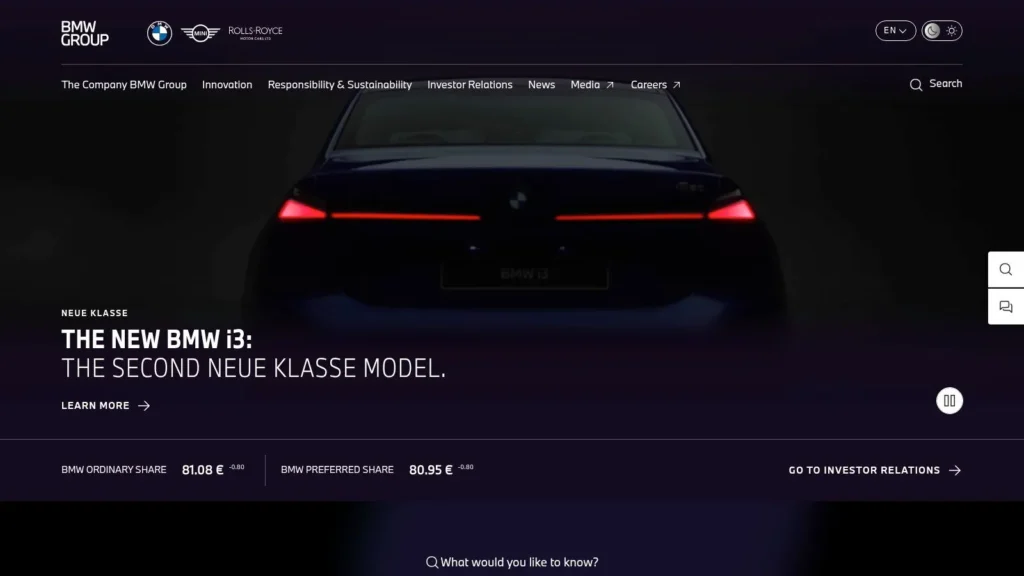
BMW Group remains one of the clearest indicators of how much Germany still depends on high-value manufacturing with global brand reach. As noted earlier, it ranks among the country’s largest companies by revenue. More important than size, though, is what BMW now represents. It sits at the intersection of Germany’s industrial heritage and the shift toward electric drivetrains, software-defined vehicles, and premium mobility services.
That combination makes BMW relevant well beyond the auto sector.
Why BMW still matters now
BMW is not just a carmaker with a famous badge. It is a premium manufacturing group managing several strategic demands at once:
- Brand pricing power: BMW, MINI, and Rolls-Royce give the group coverage across distinct premium segments without pushing it into mass-market competition.
- Industrial significance: Automotive still carries outsized weight in Germany’s export profile, supplier base, and engineering labor market.
- Technology transition: BMW has to improve battery-electric offerings, in-car software, and digital services while protecting the profitability of its established product lines.
- Ecosystem influence: Its purchasing scale and quality requirements affect suppliers, engineering firms, software vendors, and logistics partners across Europe.
For investors, that creates a more nuanced case than simple exposure to car sales. BMW offers a view into whether German industry can convert manufacturing strength into competitiveness in a market increasingly shaped by batteries, chips, and software updates.
What different audiences should examine
BMW’s relevance changes depending on who is looking at it.
- Investors should watch margin discipline, model mix, electric vehicle execution, and the company’s ability to keep premium pricing credible during an industry-wide technology shift.
- Job seekers should see BMW as a large employer with demand across mechanical engineering, software development, design, production systems, procurement, and advanced manufacturing.
- Partners and suppliers should read BMW as a high-standard customer whose requirements often signal where the wider automotive value chain is heading next.
One practical point stands out. Premium automakers have more room than volume manufacturers to absorb the cost of new technology, but they also face sharper expectations from customers who expect design quality, digital performance, and brand consistency at the same time.
The strategic tension behind the brand
BMW’s strength has long come from engineering quality, product positioning, and international brand recognition. The current challenge is more complex. Success now depends on whether the company can combine those traditional advantages with software capability and platform efficiency.
That is why BMW belongs in a broader review of companies in Germany. It shows that the country’s economic profile is not only about industrial scale. It is also about whether established champions can adapt fast enough to remain attractive to capital, talent, and commercial partners.
The risk is straightforward. Premium demand can soften, input costs can pressure margins, and the shift to more software-intensive vehicles raises both development complexity and competitive pressure. Even so, BMW remains one of the most useful case studies in German business because it captures both the resilience and the strain inside the country’s most visible industrial sector.
You can review the group at BMW Group online.
5. adidas AG
adidas is the cleanest reminder that Germany’s corporate relevance isn’t confined to B2B systems and industrial heavyweights. It’s a global consumer brand with strong visibility in performance sportswear, fashion crossover, and direct-to-consumer commerce.
That makes it valuable in this list for two reasons. First, it broadens the picture of companies in Germany beyond engineering. Second, it shows how German firms can remain globally influential through brand management, product drops, collaborations, and e-commerce execution rather than industrial scale alone.
Why adidas belongs in a serious economic snapshot
For market watchers, adidas shows how German business can compete on culture as well as capability. Product relevance comes from a broad catalog across sport and lifestyle categories, plus the steady rhythm of launches and collaborations that keep the brand visible.
A few practical strengths define the company:
- Direct-to-consumer reach: adidas can sell through its own digital channels rather than relying only on wholesale partners.
- Brand elasticity: It can move between athletic performance and everyday streetwear.
- Global familiarity: Partners, retailers, and consumers already understand the brand, which reduces market education costs.
This kind of company matters to job seekers for a different reason than SAP or Siemens. The opportunity set includes merchandising, digital marketing, supply-chain planning, retail operations, product design, and membership-led customer retention, not just engineering or enterprise sales.
The limits are brand-business limits. Hype-driven product cycles can create stock and demand swings, and fit or sizing consistency can vary across silhouettes. But that variability is also part of the category. adidas succeeds when it balances scale with freshness, and that balancing act is now a core business capability in itself.
Its official storefront and corporate presence start at adidas online.
6. Deutsche Telekom AG
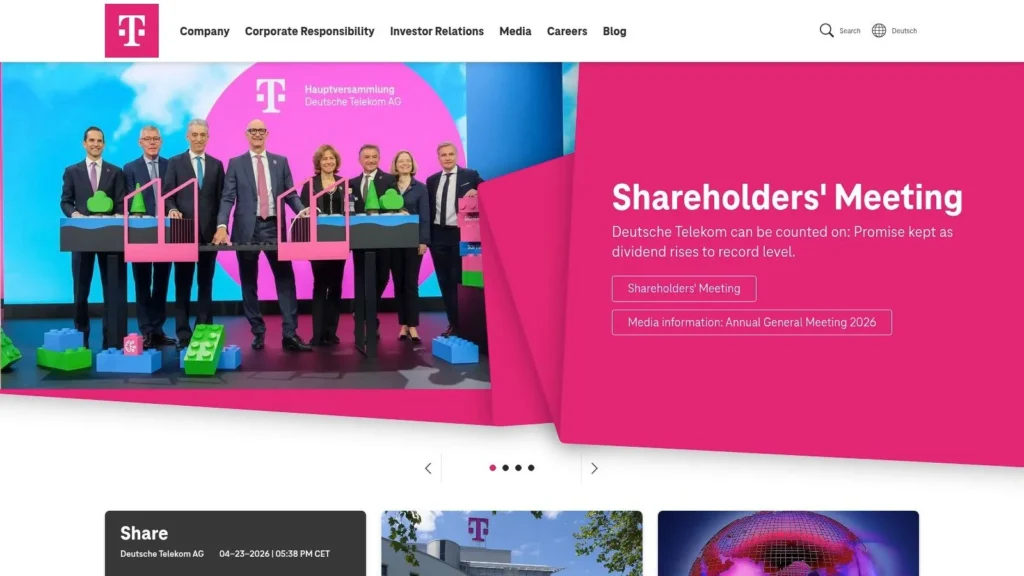
More than 90 percent of German companies had internet access and just over a quarter used cloud computing, according to Germany’s Federal Statistical Office. That gap helps explain why Deutsche Telekom belongs in any serious view of German business. It sits at the point where basic connectivity turns into digital revenue, enterprise services, and cross-border platform reach.
This is also one of the clearest examples of Germany’s economy extending beyond its industrial stereotype. Deutsche Telekom is still an infrastructure company, but its relevance now comes from a broader mix of assets: mobile networks, fiber rollout, enterprise IT services, cybersecurity, and its stake in the scale of T-Mobile US. For investors, that creates exposure to recurring telecom cash flow plus international growth. For job seekers, it opens roles across network engineering, cloud, data, security, product, and B2B services. For partners, it remains a gatekeeper to connectivity-heavy sectors.
Why Deutsche Telekom matters now
The company’s position is stronger than a simple telecom label suggests.
- It underpins digital adoption: Cloud services, AI workloads, connected devices, and remote operations all depend on reliable fixed and mobile networks.
- It has two engines of relevance: Germany and Europe provide infrastructure depth, while T-Mobile US gives the group a much larger consumer and 5G growth story.
- It reaches enterprise buyers directly: Through T-Systems and related services, Deutsche Telekom sells more than bandwidth. It also sells managed IT, security, and digital transformation support.
- It benefits from recurring demand: Mobile contracts, broadband subscriptions, and business connectivity tend to produce steadier revenue than many cyclical sectors.
A useful distinction separates Deutsche Telekom from the industrial names earlier on this list. Siemens and BMW show how German companies build advanced products. Deutsche Telekom shows how Germany participates in the digital economy by owning the networks and service layers those products increasingly rely on.
That makes it relevant in a less visible, but highly durable, way.
The constraints are real. Telecom is capital-intensive, regulation affects pricing and rollout economics, and network quality remains a public benchmark that can shape customer perception quickly. Enterprise services also face pressure from hyperscalers and specialized software firms. Still, scale, brand trust, and infrastructure ownership give Deutsche Telekom a position that is hard to replicate.
Its corporate site is Deutsche Telekom online.
7. HelloFresh SE
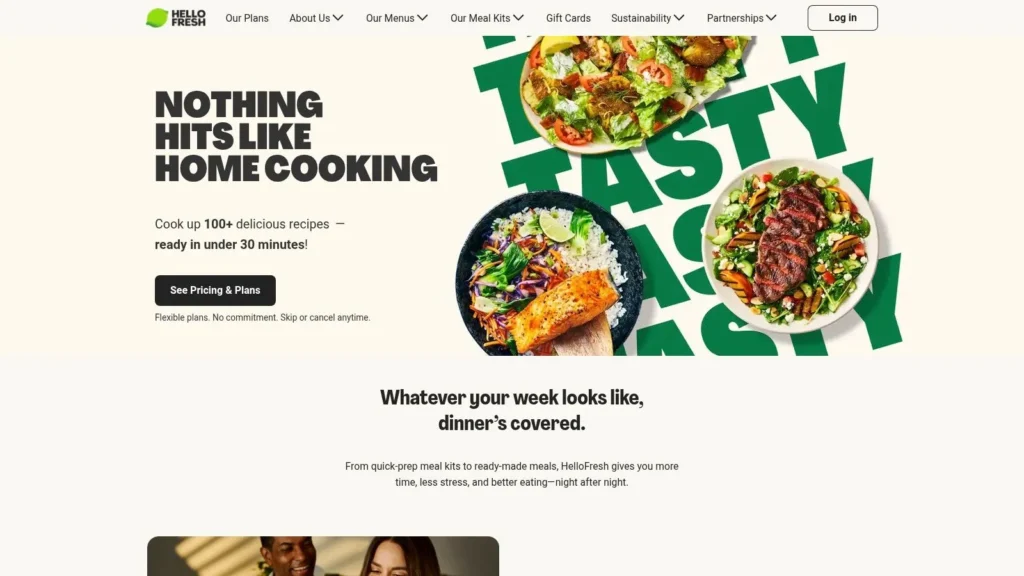
HelloFresh is the most consumer-service-oriented company on this list, and that’s exactly why it belongs here. Germany’s economy isn’t just built by industrial exporters and enterprise vendors. It also produces companies that package logistics, software, consumer behavior analysis, and subscription design into a mainstream service.
Berlin-founded HelloFresh gives this list a useful digital consumer layer. Its meal-kit model depends on forecasting, fulfillment, recipe planning, customer retention, and operational precision. In other words, it looks like a food brand to customers, but it functions like a data-driven service business behind the scenes.
The real business case behind the meal kit
For market observers, HelloFresh is relevant because it shows what a globally scalable German consumer platform can look like. It offers broad recipe choice, flexible subscription management, app-based account control, and nationwide delivery across much of the U.S. market.
Its strengths are practical:
- Convenience proposition: It reduces planning friction for home cooking.
- Operational sophistication: Subscription businesses live or die on logistics and repeat engagement.
- Cross-border scalability: HelloFresh demonstrates that a Germany-founded company can build everyday presence in foreign consumer markets.
This company also reflects a broader point about Germany’s business identity. Some of the most interesting companies in Germany don’t export a machine or a car. They export a repeatable operating model.
The risks are equally practical. Subscription customers need to manage cutoff dates carefully, and visible promotional pricing doesn’t always equal long-run customer economics. But for partners, analysts, and job seekers interested in digital commerce, retention marketing, operations, and consumer analytics, HelloFresh shows a side of German business that deserves more attention than it usually gets.
The company’s consumer platform is at HelloFresh online.
Top 7 German Companies Comparison
| Company | Implementation complexity | Resource requirements | Expected outcomes | Ideal use cases | Key advantages |
|---|---|---|---|---|---|
| SAP SE | High, large-scale ERP rollouts and significant change management | Significant budget, skilled implementation partners, integration and training | Unified cloud ERP with embedded analytics/AI and industry processes | Large enterprises seeking end-to-end cloud ERP and industry solutions | Market leader, extensive partner ecosystem, extensible Business Technology Platform |
| Siemens AG | High, complex industrial integrations and multi-product stacks | Engineering teams, systems integrators, hardware/software investments | Digital twin and IIoT-enabled automation and operational optimization | Manufacturers pursuing PLM, automation, and IIoT/digital-twin projects | Broad industrial software/hardware portfolio and Xcelerator marketplace |
| BioNTech SE | High, clinical development, manufacturing and regulatory complexity | Substantial R&D funding, lab/clinical-trial infrastructure and pharma partners | Advanced mRNA therapeutics and vaccines; clinical-stage oncology outcomes | Organizations seeking mRNA platforms, vaccines or oncology clinical collaborations | Proven mRNA platform (COMIRNATY), deep scientific collaborations and regulatory experience |
| BMW Group | Medium, vehicle adoption is straightforward; advanced tech needs integration | Purchase/ownership budget, dealer/service network, EV charging where applicable | Premium driving experience across combustion, hybrid and EV lineups | Buyers seeking premium, performance or luxury vehicles and EV options | Strong brand equity, driving dynamics, broad dealer and service network |
| adidas AG | Low–Medium, retail/e‑commerce operations and drop logistics | Inventory management, marketing, direct-to-consumer platform and membership ops | Wide product range, frequent drops and high cultural relevance | Consumers seeking performance apparel, streetwear or limited-release products | Large catalog, frequent collaborations, strong DTC and membership program (adiClub) |
| Deutsche Telekom AG | Medium, service activation is simple; network projects are complex | Network infrastructure, devices, customer support and plan provisioning | Nationwide 5G coverage and diverse consumer/business plans with bundled perks | Consumers and businesses needing reliable mobile and home internet services | Competitive, perk-rich plans (via T‑Mobile US) and strong 5G footprint |
| HelloFresh SE | Low–Medium, subscription and logistics coordination required | Supply chain/fulfillment, recipe development, subscription management platform | Convenient meal kits with recipe variety and predictable meal planning | Households seeking at-home cooking convenience and flexible subscriptions | Extensive recipe library, flexible plans, broad U.S. delivery coverage |
The Future of Made in Germany
99.2% of German enterprises were small and medium-sized businesses in 2022, and they employed 19.1 million people, according to the Institut für Mittelstandsforschung Bonn. That context matters when assessing SAP, Siemens, BioNTech, BMW, adidas, Deutsche Telekom, and HelloFresh. They are large listed companies, but they sit within a much broader economic system built on specialist suppliers, export capability, applied research, and long-term industrial coordination.
This is why an auto-first view of Germany now misses too much. The seven companies in this list point to a more useful cross-section of the economy: enterprise software, industrial automation, mRNA biotech, premium manufacturing, global consumer brands, telecom infrastructure, and digitally managed consumer services. For investors, job seekers, and commercial partners, that mix says more about where Germany is heading than any single sector can.
The core question is no longer whether Germany can produce high-quality goods. It can. The harder question is whether German firms can combine engineering depth with software, data, and scale quickly enough to protect margins and global relevance. AI adoption is rising across German business, as noted earlier, but adoption alone is not a competitive moat. The stronger signal is whether companies can turn digital tools into faster product cycles, better customer retention, lower operating costs, and new revenue streams.
Germany also has a scaling problem. ZEW reports that the country has 1,600 Hidden Champions among SMEs, firms that are strong in niche markets but weak in growth. That finding helps explain why the most relevant German companies today are not only those with technical excellence, but those able to commercialize it across markets, platforms, and customer segments.
A few implications stand out:
- For investors: Germany remains attractive, but the better opportunities are spread across different business models, not concentrated in industrial exporters alone.
- For job seekers: Demand is shifting toward firms that combine domain expertise with digital execution, especially in software, data, automation, biotech, and direct-to-consumer operations.
- For partners and suppliers: Market access in Germany still benefits from reliability and technical quality, but growth increasingly depends on integration into digital systems, not just product performance.
“Made in Germany” still signals quality. It now also signals diversification, platform thinking, and a broader set of competitive strengths than the stereotype suggests.
If you want more approachable analysis on business, technology, health, science, culture, and the wider trends shaping companies like these, visit maxijournal.com. It’s a strong place to discover fresh commentary, explore practical explainers, and find publishing opportunities if you’re interested in contributing your own perspective.
Discover more from Maxi Journal
Subscribe to get the latest posts sent to your email.