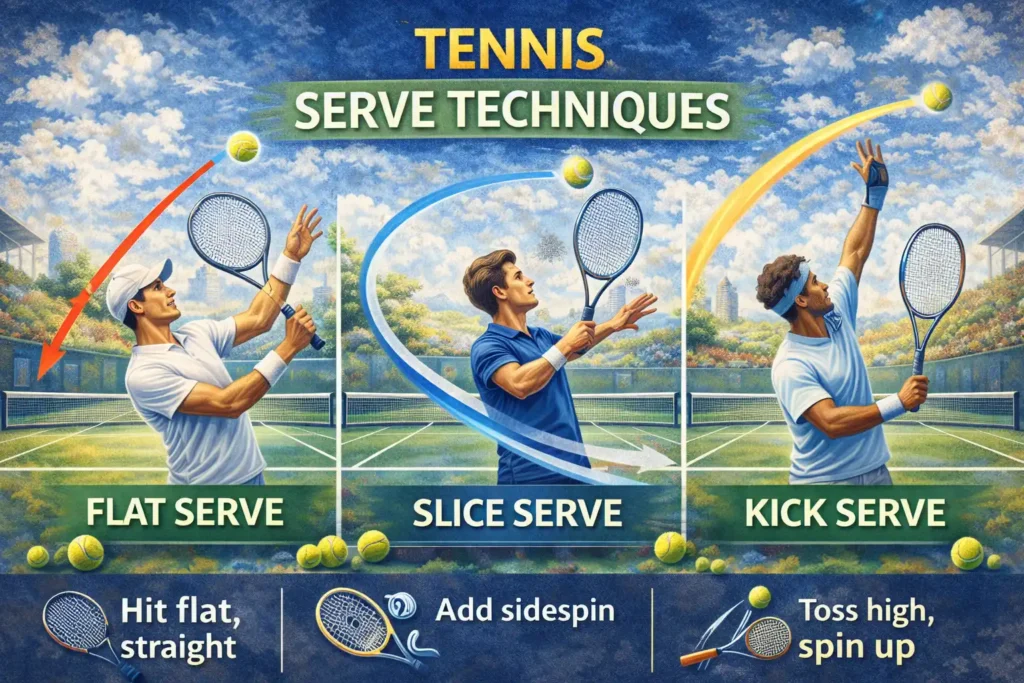
Andre Agassi spent years as the loudest man in the room, at least in tennis terms. Steffi Graf built her legend by doing the opposite, saying little, missing less, and letting her forehand do the talking.
The Ultimate Tennis Power Couple
Andre Agassi and Steffi Graf still feel like an unlikely pairing, which is part of why their story has lasted. He arrived in public life as a rebel, all flash and edge. She carried herself like a private craftsman, focused on work, almost allergic to noise.
That contrast gave the andre agassi steffi graf story its grip from the start. Agassi openly admired Graf long before they became a couple, and tennis fans loved the mismatch of personalities. The showman liked the perfectionist. The extrovert was drawn to the player who always seemed most comfortable away from the spotlight.

Why their partnership feels bigger than celebrity
A lot of sports couples share fame. Very few share a language of excellence this completely.
Agassi understood reinvention because he had to fight for it. Graf understood precision because she lived by it. Put those traits together and you get a partnership built on habits that matter in any field:
- Discipline under pressure. Both spent years solving problems in public, on the biggest stages in tennis.
- Respect for craft. Neither became great by accident. Their games were built shot by shot.
- Selective privacy. They never treated their marriage like a marketing campaign.
- Purpose after fame. Their post-tennis lives show that ambition didn’t end with retirement.
What makes them enduring isn’t only that both were champions. It’s that they seem to have recognized something in each other that tennis had already taught them. Greatness is demanding. It requires repetition, restraint, and a tolerance for lonely work. Those qualities can make a player formidable. They can also make a partnership steady.
A useful way to read their story: not as a fairy tale, but as a meeting of two people who already knew what commitment looked like.
That’s why they remain more than a nostalgic headline. They stand as one of the rare sports couples whose shared legacy feels earned in two arenas, competition and character.
The Rebel Prince of Tennis Andre Agassi
Andre Agassi arrived in tennis like a disruption no one could ignore. Long hair, denim shorts, neon colors, and a return game that seemed to steal time from opponents before rallies could even begin. For younger readers, that mix can be hard to picture now because the sport has since absorbed so much of what once made him look rebellious. In his early years, though, Agassi felt like a challenge to tennis convention in human form.
His career is easiest to understand in three acts. The first gave the sport a new kind of star. The second exposed how unstable fame and talent can look when they are not yet guided by discipline. The third showed what happened once Agassi brought his gifts under control.
A star who changed the look of men’s tennis
Agassi’s appeal was never only cosmetic. The image drew attention, but the ball-striking kept it.
He took the ball unusually early, especially off the return, and that changed the geometry of points. A rally against Agassi could feel like trying to read a sentence with half the words missing. He shortened your preparation time, rushed your decisions, and pushed baseline tennis toward a more aggressive future. What later became common on hard courts looked daring when he was doing it.
That is why his rise mattered beyond celebrity. He was not merely popular. He was influential.
The struggle was part of the story
Agassi’s middle years remain important because they explain why so many people stayed emotionally invested in him. Fans did not see a polished machine. They saw a great player trying to bring order to a gifted, restless mind.
That tension made him compelling. Some champions create distance through perfection. Agassi created connection through vulnerability, frustration, and recovery. He could look brilliant one month and unsettled the next, which made every comeback feel earned rather than automatic.
For a sports journalist, that is often the dividing line between admiration and attachment. People admired Agassi’s talent. They attached themselves to his effort to master it.
Maturity turned talent into a full career
Later, the noise faded and the tennis sharpened. Agassi became less of a spectacle and more of a problem solver, the kind of veteran who understood not only how to hit a ball, but how to control a match.
A few achievements explain his place in the sport:
- He completed the Career Grand Slam, winning all four major singles titles across very different surfaces.
- His 1992 Wimbledon title carried special weight because it proved a baseline-first player could win on grass at the sport’s most tradition-bound major.
- His 1996 Olympic gold medal added another layer to a resume that traveled across formats, surfaces, and eras.
Those milestones matter on their own, but they also tell a larger story. Agassi’s greatness was built through adjustment. He learned to use timing, return position, and court awareness with more discipline as he aged. The rebellious edge never disappeared. It matured.
Why this matters in the larger Agassi-Graf story
Agassi’s later life makes more sense if you first understand this pattern. He succeeded when he stopped treating discipline as something imposed from outside and started making it part of his own identity. The same habit showed up off court.
The man who once seemed defined by turbulence became known for sustained work, especially in education philanthropy and family life. That is one reason his partnership with Steffi Graf has always felt believable rather than surprising. Both knew what repetition, restraint, and private standards could produce. On court, those qualities win long matches. Off court, they help build a durable marriage and a serious charitable mission.
Young players can still learn from Agassi because his career answers a question that extends beyond tennis. Raw ability gets attention. Self-correction builds a legacy.
The Unwavering Dominance of Steffi Graf
Steffi Graf could quiet a stadium without saying much at all. A few light adjustment steps, one heavy forehand, and the shape of a match changed. Covering her through the late 1980s and 1990s often felt like watching a master craftsperson at work. Nothing looked wasted, yet everything carried force.
That economy is the best place to begin. Fans who know Graf only by the headline achievements can miss what made her so hard to live with across two sets and three. Her tennis was built on discipline you could see. Early preparation. Clean footwork. Clear choices under pressure. The same habits that made her relentless on court later fit naturally into the private, orderly life she built with Andre Agassi and into the charitable work they approached with similar seriousness.
Her most famous season still stands alone. Graf is the only player to complete a calendar year Golden Slam in 1988, and the WTA also lists her career totals at 22 Grand Slam singles titles, 377 weeks at world No. 1, and eight year-end finishes at No. 1, as noted on her official Steffi Graf player profile.
Numbers like that can become abstract, so it helps to translate them. Graf did not just win the biggest tournaments. She kept returning to them as the player others had to solve. For rivals, facing her was a bit like seeing the same hard exam in different classrooms. Clay, grass, hard court. The questions changed, but her standards did not.
Why her game traveled so well
Graf’s forehand was the headline stroke, but the larger story was how efficiently her whole game worked. She moved into position early, shortened opponents’ time, and used the slice backhand to keep rallies on her terms. That pattern matters. A player does not need every shot to be equally destructive if she can keep arranging points so her best shot arrives at the right moment.
Her success across every major reflected that design. She won Wimbledon seven times, the French Open six times, the US Open five times, and the Australian Open four times. That spread tells you something plain and important. Graf was not tied to one surface or one style of opponent. She could impose order in very different conditions.
If you want a technical comparison, her stroke production followed the same principle coaches teach in good tennis serve techniques. Efficient mechanics buy time. Time creates choices. Graf used that extra fraction of a second better than almost anyone.
One sentence captures her competitive identity. She got to the ball early and made the next decision easier than her opponent’s.
The reserve that people misread
Graf’s calm exterior sometimes led newer fans to mistake her for a passive champion. She was nothing of the sort. Her restraint was a competitive tool. She kept matches from becoming emotional theater and turned them instead into tests of repetition, depth, and nerve.
That trait also helps explain why her later partnership with Agassi made sense. He spent years learning to turn talent into daily discipline. Graf had lived that discipline from the start. In different ways, both learned that lasting success comes from habits repeated when no one is applauding.
| Trait | What it looked like in Graf’s career |
|---|---|
| Focus | Minimal emotional drift during matches |
| Adaptability | Major titles on every surface |
| Durability | Top-level results sustained over many seasons |
| Competitive clarity | Point patterns built around her strongest weapon |
This is why any serious discussion of the greatest women’s players still has to stop at Graf for a long look. Her record matters. So does the manner in which she built it. Precision, restraint, and fierce competitive order carried her through a historic career, then resurfaced in the disciplined family and philanthropic life she later shared with Agassi.
When Worlds Collided The Agassi Graf Love Story
The romance became public folklore because it had a long prehistory. Agassi admired Graf from a distance before there was any real relationship to speak of, and tennis fans knew it. That early fascination made later events feel less like gossip and more like a story waiting for its moment.
From awkward admiration to real connection
One of the most often retold moments from their shared orbit came at the Wimbledon Champions’ Ball in the early 1990s, when Agassi’s interest in Graf was already obvious and her reserve was just as obvious. It has survived in memory because it captures them so well. He was expressive and somewhat impulsive. She was careful, private, and hard to read.
For years, that seemed to be the whole story. Two superstars on parallel tracks, connected by reputation more than by daily life.
Then timing changed.
Why 1999 mattered so much
Tennis careers don’t always move in clean lines, and neither do personal lives. By the end of the 1990s, both had already lived enough public pressure to know what they valued and what they didn’t.
That matters in understanding why their eventual relationship felt grounded rather than theatrical. They didn’t meet as blank slates. They met as people who had already gone through fame, scrutiny, setbacks, and difficult private chapters under public observation.
A seasoned observer of tennis could see why they made sense. Agassi had become more reflective. Graf had always valued steadiness. By then, each likely appreciated in the other what the public spotlight often ignores: discipline, emotional intelligence, and a preference for substance over spectacle.
Their love story is compelling because it matured at the pace of adult life, not tabloid fantasy.
A marriage built in their own style
When they married in 2001, they did it in the manner that suited them. Privately. Without turning a private milestone into a public production.
That choice told you almost everything important. They had no need to perform the relationship for an audience. In that sense, their marriage has always reflected the strongest part of both careers. They trusted preparation more than noise.
A few qualities define the union people have watched ever since:
- Privacy as protection. They drew clear lines around family life.
- Shared vocabulary. Both knew what sacrifice, repetition, and elite pressure felt like.
- Mutual credibility. Neither had to explain the cost of greatness to the other.
- Long-view thinking. Their life together has looked less impulsive than intentional.
Why the story still resonates
Sports fans often assume couples this famous can’t stay ordinary in the ways that matter. Agassi and Graf challenged that assumption.
They remained recognizable public figures, but they never seemed eager to live as permanent celebrities. That restraint is one reason the andre agassi steffi graf partnership still feels convincing. The relationship always looked less like branding and more like two accomplished adults choosing a life that fit them.
In an age when public romance is often monetized, theirs still feels rooted in older virtues. Respect. Timing. Patience. Shared work.
Agassi vs Graf A Career Comparison
Comparing Andre Agassi and Steffi Graf is a little tricky because they reached greatness through different shapes of career. Agassi’s path was dramatic, uneven, and full of reinvention. Graf’s was cleaner and more sustained at the summit. Put side by side, though, the contrast becomes useful rather than unfair.
Career at a glance
| Statistic | Andre Agassi | Steffi Graf |
|---|---|---|
| Grand Slam singles titles | 8 | 22 |
| Olympic gold | 1996 | 1988 |
| Career prize money | $31 million | $21.9 million |
| Net worth projection | Around $150 million as of 2026 | Around $150 million as of 2026 |
| Combined net worth projection | – | Around $300 million as of 2026 |
The financial figures above come from a 2026 projection on Agassi and Graf’s combined net worth, which also notes that they have been married for 25 years since 2001 in that projected framing.
What the numbers do and don’t say
Graf’s side of the table tells the story of dominance. Agassi’s tells the story of range. That’s the cleanest way to interpret them.
Graf’s total of 22 major titles places her in a different statistical neighborhood. Agassi’s 8 majors are fewer, but his achievement profile remains unusual because he completed the full set of majors and added Olympic gold. One career says supremacy. The other says versatility and resilience.
If you want a technical lens on why their careers looked so different, this breakdown of tennis forehand technique offers a useful frame. The forehand often reveals a player’s identity. Graf’s was a finishing weapon built into a larger machine of control. Agassi’s was part of a fast-taking baseline architecture that pressured time itself.
Different models of greatness
Their comparison works best when you stop trying to make them identical.
- Graf represents sustained command. Her record invites words like order, precision, and inevitability.
- Agassi represents adaptive greatness. He won by changing, recalibrating, and surviving.
- Together they represent complete tennis literacy. Between them, you can study pressure management, surface adaptation, shot economy, and the long psychology of elite sport.
The clean takeaway: Graf had the higher peak of control over her field. Agassi had one of the most compelling arcs of reinvention in modern tennis.
Why the comparison still matters
Fans don’t compare them because they were married. They compare them because each answers a different tennis question.
How dominant can one player be over time? Graf answers that. How much can a player evolve without losing identity? Agassi answers that. Set beside each other, they form a rare dual portrait of excellence. One built on relentless stability. One built on transformation.
Beyond the Baseline Philanthropy and Family Life
Retirement can expose athletes. Once the rankings vanish, what remains? In Agassi and Graf’s case, what remained was structure, purpose, and a strong instinct to protect what matters.

Their second act makes the central theme of their lives clearer. The same traits that carried them through elite tennis also shaped their work off court. They commit for the long haul. They choose institutions over gestures. They seem to prefer impact that can be built, measured, and sustained.
How discipline became service
The Andre Agassi Foundation for Education has raised over $180 million, and its charter school has a 100% college acceptance rate, according to this report on an Agassi and Graf foundation event in Italy. The same report says Steffi Graf’s Children for Tomorrow has supported over 5,000 children across 20 countries, providing mental health services to young refugees.
Those facts matter because they show a common pattern. Neither foundation feels accidental. Agassi’s work in education reflects his long-stated belief that opportunity changes lives. Graf’s work with children affected by war and violence reflects a similarly focused concern for recovery and dignity.
Here’s the deeper connection to tennis. Elite athletes learn early that vague effort doesn’t hold up. You need routines, targets, and accountability. Their charitable work carries that same imprint.
- Agassi’s lane is educational access. It’s organized around futures that can be built.
- Graf’s lane is mental health support. It responds to trauma with steadiness and care.
- Together they model selective public leadership. They appear when the cause matters, not merely when cameras do.
Family life away from the circus
The public has always been curious about their family, but the couple has never encouraged overexposure. They are parents first in the plainest sense of the phrase. That plainness is probably part of the achievement.
A short clip gives a sense of the public-facing side of that work and partnership:
What stands out most is not celebrity sparkle. It’s steadiness. They built a household and a set of causes with the same patience they once brought to match play. That’s rare. It’s also why their legacy feels larger than trophies.
Timeline of a Tennis Dynasty
Some sports stories are best understood not through argument but through sequence. The timeline of andre agassi steffi graf shows how separate legends became a shared institution. You can trace it from youth and ascent, through championship years, into marriage, parenthood, and public service.
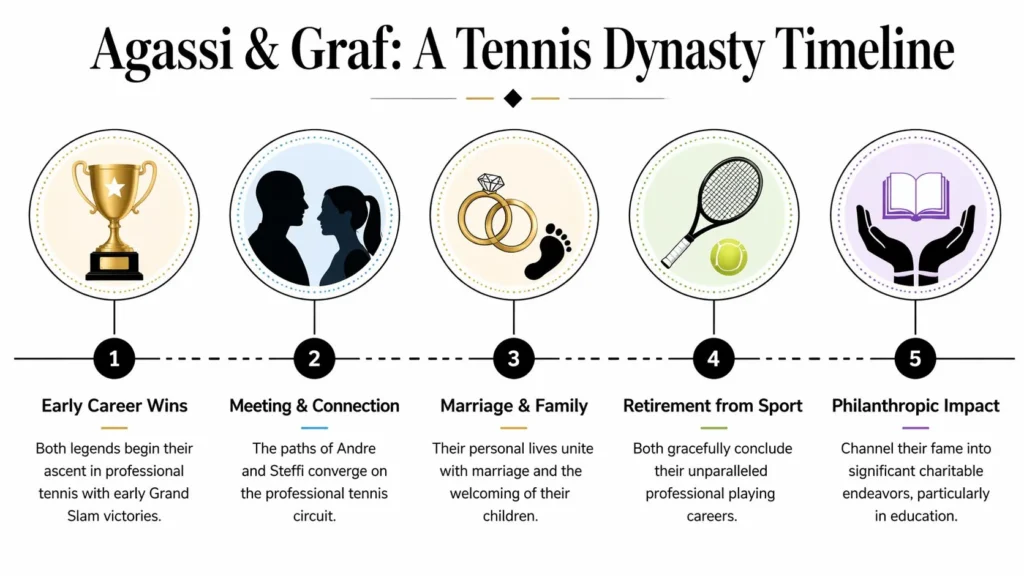
The main stages that define the story
- Early career wins. Both entered professional tennis young and quickly showed they weren’t passing talents. Each built a distinct style that people could recognize instantly.
- Meeting and connection. Their paths crossed on tour, first as admired peers, later as something more personal.
- Marriage and family. Their private life became the foundation for everything that followed.
- Retirement from sport. They left competition, but not discipline.
- Philanthropic impact. Their names stayed relevant because they attached them to lasting causes.
What changed and what didn’t
The surfaces changed. The uniforms changed. The professional obligations changed. What didn’t change was the internal code.
That’s why their recent public appearances still draw interest. A note connected to a recent keynote says they maintain a low-profile family life, have no verified social media accounts as of 2026, and continue to choose selective public roles rather than constant visibility, according to this video reference about their off-court high-performance approach. In an age of endless self-disclosure, that decision says a lot.
Readers interested in the longevity side of athletic life will notice something else. Their choices mirror the best advice in guides about how to prevent sports injuries. Lasting performance depends on restraint, recovery, and respecting limits. They appear to have applied that same thinking to fame itself.
Privacy, in their case, doesn’t look like withdrawal. It looks like selective energy management.
Why the timeline matters
A timeline helps because it prevents a lazy reading of their lives. They weren’t merely stars who married. They were two people shaped by exacting careers, then tested by the challenge that follows renown. Could they build a life with meaning after the applause became optional?
The answer appears to be yes. Not because they stayed visible at all times, but because they didn’t need to. Their dynasty isn’t only about titles. It’s about continuity. The values that made them formidable on court still show up in marriage, parenting, and philanthropy.
That continuity is the legacy.
If you enjoy sports stories that explain the people behind the records, maxijournal.com publishes approachable writing across sports, health, science, culture, and more. It’s also a welcoming place for readers and prospective contributors who want clear, thoughtful commentary without the usual noise.
Discover more from Maxi Journal
Subscribe to get the latest posts sent to your email.