You might be looking at a market screen, a supplier contract, or a central bank headline and wondering why china interest rates keep showing up in stories that seem only loosely connected to China. A factory in Southeast Asia, a luxury brand in Europe, a commodity exporter in Latin America, and a portfolio manager in New York can all end up reacting to the same move from Beijing.
That’s because China doesn’t just set borrowing costs for its own economy. It shapes financing conditions for manufacturers, property developers, exporters, banks, and savers across one of the world’s biggest economic systems. When the People’s Bank of China, or PBOC, changes how money flows through that system, the effects don’t stay neatly inside China’s borders.
What makes this topic tricky is that China doesn’t use monetary policy quite the way the Federal Reserve or the European Central Bank typically does. If you only track one headline rate, you’ll miss the full picture. The deeper story is about tools, trade-offs, and side effects. That includes a growing tension between low borrowing costs and the risk that households pull money away from traditional bank deposits into other products.
Why China’s Interest Rates Matter Globally
A business owner sourcing components from China doesn’t need a PhD in central banking to feel the impact of Chinese rate policy. If credit is cheap inside China, factories may find it easier to finance inventory, equipment, and expansion. If property stress worsens, demand for raw materials can weaken. If the yuan comes under pressure, export pricing can change quickly.
For investors, the chain of cause and effect is just as direct. Lower rates can support borrowing and refinancing. They can also squeeze returns on deposits and push money toward stocks, bonds, property, or offshore assets. That changes how capital moves, which sectors get support, and which balance sheets start to look fragile.
China’s scale is the reason this matters so much. It is widely described as the world’s second-largest economy in the verified data, and its policy choices influence supply chains and commodity demand. A shift in Chinese financing conditions can alter the mood in markets far beyond Asia.
The global knock-on effects
When people hear “interest rates,” they often think only about mortgages or bank loans. In China, the consequences spread much wider:
- For manufacturers: Lower financing costs can support production and export competitiveness.
- For commodity markets: Changes in Chinese investment appetite can affect demand for industrial inputs.
- For global portfolios: Chinese rate policy can shape flows into bonds, equities, and currency-sensitive assets.
- For multinational firms: Treasury, pricing, and expansion decisions often depend on whether Chinese credit conditions are easing or tightening.
A useful comparison is how readers follow other major economies to understand broader market direction, such as this overview of the economy in Russia. China deserves at least as much attention, often more, because its policy choices touch trade, finance, and industrial activity all at once.
China’s monetary policy isn’t a distant technical debate. It can affect what companies pay to borrow, what investors choose to hold, and how global supply chains price risk.
Inside the PBOC’s Monetary Policy Toolkit
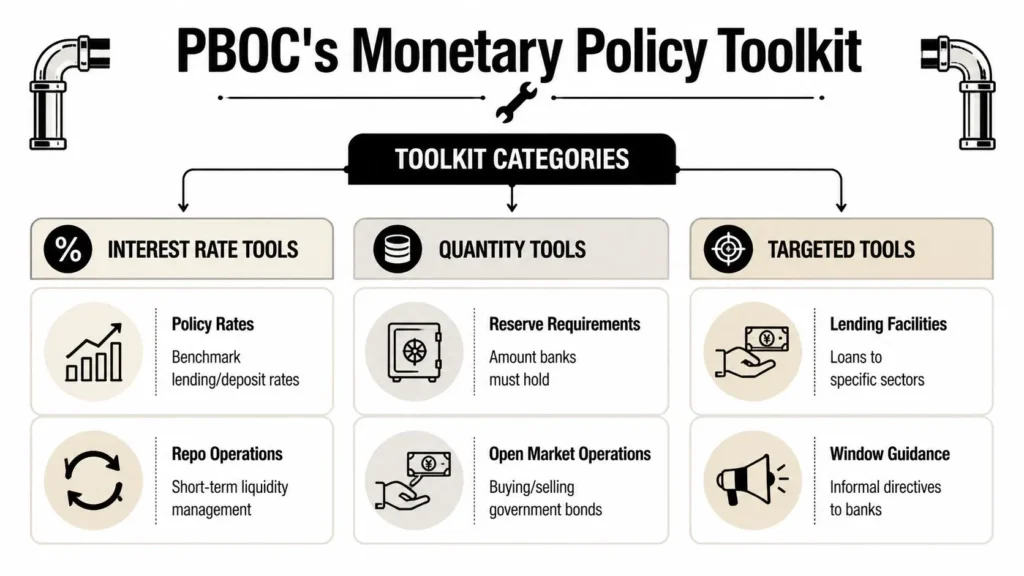
The easiest way to understand the PBOC is to think like a plumber. A plumber doesn’t fix every problem with one wrench. Sometimes the job requires adjusting pressure. Sometimes it requires opening a valve. Sometimes it means directing flow to one part of the system without flooding another.
China’s central bank works the same way. It has interest rate tools, quantity tools, and more targeted instruments. That mix is one reason china interest rates often confuse readers who are used to simpler Western policy narratives.
The LPR is the price signal
The Loan Prime Rate, or LPR, became central to China’s framework when it was introduced on August 20, 2019, under the PBOC reform process described in the PBOC’s English-language explanation of the LPR mechanism. It is calculated from quotes by 18 banks based on the PBOC’s open market operations rate, and the reform now anchors over 200 trillion yuan in loans. In late 2024, the 1-year LPR was around 3.45% and the 5-year LPR around 3.95% in that same PBOC-linked description.
That sounds technical, but the practical meaning is simple. The LPR is the reference point banks use for much of the pricing across corporate credit, mortgages, and consumer lending. If the LPR moves, a large amount of borrowing across the economy can reset.
Think of it as the labeled setting on the faucet. It tells everyone roughly what borrowing should cost.
The RRR is the pressure valve
The Reserve Requirement Ratio, or RRR, works differently. It doesn’t directly tell banks what rate to charge. Instead, it determines how much money banks must keep in reserve rather than lend out.
That makes the RRR more like the main valve in a building. Open it a little, and more water flows through the pipes. Cut the RRR, and banks have more room to extend credit or manage funding conditions.
This distinction matters because the PBOC can support liquidity without making a dramatic statement through headline rate cuts. That is one of the most important differences between China and many Western central banks.
A toolkit, not a single lever
Other tools also matter, even when they get less attention in headlines. Open market operations help shape short-term liquidity. Lending facilities can direct support toward specific corners of the economy. Informal guidance can influence bank behavior without a big public rate move.
Here’s the practical snapshot readers usually want.
| Rate Type | Current Rate | Primary Use |
|---|---|---|
| Policy rate | 3.0% | Broad policy signal and monetary stance |
| 1-year LPR | 3.0% | Corporate and shorter-term household borrowing reference |
| 5-year LPR | 3.5% | Mortgage and longer-duration borrowing reference |
| Deposit interest rate | 1.50% | Return on savings deposits |
Why readers often get confused
Many people assume one “China rate” should explain everything. It doesn’t. China runs a layered system.
- The LPR sets borrowing benchmarks: It’s the visible price of credit for much of the economy.
- The RRR changes bank capacity: It affects how much liquidity the banking system can circulate.
- Open market tools shape short-term funding: These help the central bank fine-tune conditions.
- Targeted measures steer money: Beijing can encourage lending to chosen sectors without broad-based moves.
Practical rule: When you read a headline on china interest rates, ask two questions first. Did Beijing change the price of money, or did it change the quantity of money available to banks?
The Long Decline of Chinese Interest Rates
China’s current low-rate environment didn’t appear overnight. It is the result of a long transition from a capital-scarce, state-directed system to a more market-oriented financial structure designed to keep credit flowing.
The simplest place to see that transformation is in deposit rates. According to YCharts data on China’s deposit interest rate, China’s deposit interest rate stood at 1.50% in 2024, well below its long-term average of 4.44%. The same data shows the rate was 5.76% on December 31, 1984.
Those numbers tell a story about priorities. Earlier in the reform era, higher deposit rates fit an economy that needed to mobilize household savings in a very different financial environment. Today, much lower deposit yields reflect a policy environment that has favored low-cost credit and investment-led growth.
From savings reward to growth support
A non-specialist reader may ask a fair question. Why would a country want lower deposit rates?
Because low deposit rates can help lower funding costs throughout the banking system. If banks don’t have to pay much for deposits, they can often support lending on easier terms. That helps governments that want investment, industrial expansion, and cheaper financing.
The verified data links this long decline to China’s broader shift after late-20th-century reforms. It also notes that rapid GDP growth averaged over 9% annually from 1980 to 2010 in that long development phase, alongside a policy preference for credit expansion and investment.
Why a return to old levels looks unlikely
That doesn’t mean rates can never rise. It does mean a return to the old structure would clash with the logic that has guided Chinese growth for decades.
Several effects flow from this lower-rate model:
- Cheaper credit for borrowers: This can support businesses and investment-heavy sectors.
- Weaker returns for savers: Households earn less on plain deposits.
- More pressure to seek alternatives: People look harder at wealth products, property, and markets.
- A different growth model: The system leans more heavily on financing activity than on rewarding savings.
The verified data also notes that China’s savings glut has been estimated at over 40% of GDP, compared with global norms of around 25% in that same data summary. That helps explain why deposit policy matters so much. In a high-saving economy, even a modest change in deposit incentives can reshape household behavior.
Low deposit rates are not just a monetary setting. They are a signal about what the system wants households and banks to do with money.
Decoding China’s Recent Policy Stance
The headline fact in early 2026 is straightforward. China’s policy rate has stabilized at 3.0%, a historic low according to TheGlobalEconomy’s China policy rate series. The more interesting part is what the PBOC has chosen not to do. It hasn’t relied mainly on deeper headline rate cuts. Instead, it has favored RRR cuts as a way to support the economy while limiting pressure on the yuan against the US dollar.
That looks passive if you only watch the top-line rate. It isn’t passive at all.

Why RRR cuts can be more useful than rate cuts
A direct rate cut sends a loud signal. It tells markets that the central bank wants borrowing costs lower right now. That can help domestic activity, but it can also widen the policy gap with other major economies and add depreciation pressure to the currency.
An RRR cut is quieter. It injects liquidity into the banking system by freeing up funds that banks would otherwise hold in reserve. The system gets more room to lend, refinance, or roll over debt, but the headline rate structure doesn’t have to change in the same dramatic way.
For China, that matters because currency stability still matters a great deal. If policymakers cut too aggressively while the US dollar remains strong, they risk making yuan management more difficult.
What this says about Beijing’s priorities
The current stance suggests the PBOC is trying to preserve optionality. It wants enough support for domestic demand, but it doesn’t want to look reckless on the currency front. That’s a more surgical approach than many casual readers expect.
It’s comparable to a driver easing off the brake and gently pressing the accelerator rather than stomping on one pedal. The movement is deliberate, but controlled.
Here’s how that strategy reads in plain language:
- Support growth: Banks get more room to lend when reserves are loosened.
- Avoid an abrupt currency signal: Holding rates steadier can reduce pressure on the yuan.
- Keep future options open: If conditions worsen, the PBOC still has room to adjust tools later.
Why this matters for investors and firms
For bond investors, the distinction between a rate cut and an RRR cut isn’t academic. The tools affect market expectations differently. For multinational firms, it shapes assumptions about funding conditions, exchange-rate pressure, and policy direction.
A treasurer at a manufacturing company might read this as a sign that Beijing wants easier money, but not disorderly money. An equity investor might read it as support for liquidity without a blanket promise of rescue for every weak sector.
The absence of a dramatic rate cut doesn’t mean Beijing is standing still. In China, the quieter tool can be the more revealing one.
The Trilemma Driving Beijing’s Decisions
At the center of china interest rates is a policy trilemma. Beijing has to juggle three goals that often pull against one another. It wants stronger domestic demand. It wants a stable currency. It wants to limit financial risk.
Those goals don’t line up neatly. Help one too much, and you can make the others harder to manage.

According to Trading Economics’ summary of China’s interest rate framework, China’s 1-year LPR was 3.0% and the 5-year LPR 3.5% in 2026, reflecting this balancing act. The same verified data describes the PBOC as navigating domestic stimulus needs, exchange-rate stability, and financial-risk control through flexible tools such as RRR cuts.
Goal one is domestic stimulus
Lower rates generally help growth. They can reduce debt-servicing pressure, ease financing for firms, and support credit-sensitive areas like housing and investment.
That’s the easy part of the story. If growth is weak, lower borrowing costs are the standard remedy.
But policy in China can’t stop there, because every pro-growth move has side effects.
Goal two is currency stability
If China cuts too far or too fast while major peers stay tighter, money can become more eager to leave or reprice. That can add stress to the yuan.
For a country with deep trade links and global financial exposure, that’s not a side issue. Currency stability affects importer costs, exporter competitiveness, and investor confidence. It also shapes how comfortably Beijing can loosen policy without triggering a broader market reaction.
Goal three is financial risk control
Low rates can help stressed borrowers. They can also keep weak structures alive longer than they should. That’s especially sensitive when parts of the property system and local financing channels are already under scrutiny.
This is why observers who ask, “Why doesn’t China just cut more?” are asking the wrong question. Beijing isn’t only trying to stimulate. It is trying to stimulate without destabilizing the currency or inflaming hidden vulnerabilities.
The balancing act in one view
The trilemma becomes clearer if you frame each choice by what it helps and what it threatens.
- Cut rates more aggressively: Good for near-term demand, harder for currency stability.
- Hold rates steady: Better for external confidence, less punch for domestic stimulus.
- Use RRR and targeted tools: More flexible, but less dramatic than a broad rate reset.
That’s why China’s dual-rate structure matters. The 1-year LPR and 5-year LPR don’t just split maturities. They also reflect a system trying to direct support where it’s needed while avoiding a one-size-fits-all shock.
Beijing isn’t choosing between good and bad options. It is choosing between trade-offs, then trying to soften the downsides of each.
How Low Rates Impact Markets and Sectors
Low rates are usually sold as good news. Borrowing gets cheaper. Refinancing gets easier. Troubled sectors get breathing room. All of that is true, up to a point.
The overlooked part is that very low rates can also weaken the traditional banking model. In China, that’s becoming one of the most important side effects to watch.

According to the verified data summarized from ThinkChina’s discussion of where Chinese households are parking money in a low-interest-rate era, ultra-low rates are fueling banking disintermediation. Households shift funds away from low-yield deposits and toward wealth management products, or WMPs, and other market instruments. The same data says bank net interest margins fell to 1.53% in 2024.
The intended market effects
Policymakers do want low rates to change behavior.
Cheaper financing can support companies that need credit. It can relieve pressure on borrowers tied to long-duration loans. It can also encourage more activity in capital markets, which aligns with Beijing’s broader interest in deepening non-bank funding channels.
That means some of the money leaving deposits isn’t necessarily an accident. Part of the shift fits the policy direction.
Still, what helps capital markets can complicate life for banks.
Why disintermediation matters
Banks rely on deposits as a stable funding base. If savers decide deposits aren’t worth holding because yields are too low, money starts moving elsewhere. That weakens the old model in which large banks sit firmly at the center of financial intermediation.
For a state-dominated banking system, that’s not a small development. It changes who captures household savings, who bears risk, and how credit gets financed.
A useful way to think about it is this:
- Deposits are the mattress money of the formal system: steady, familiar, low-return.
- WMPs are the reach-for-yield alternative: more attractive when deposit rates feel unrewarding.
- Capital markets gain relevance: households and institutions become more willing to take market exposure.
- Banks face margin pressure: low deposit yields don’t automatically protect profits if lending returns compress too.
For readers who follow business metrics and competitive positioning, the logic isn’t so different from comparing financial performance indicators across firms, as in these guides to benchmarking performance indicators. A bank can look stable on the surface while its underlying funding model gets steadily less comfortable.
Sector winners and exposed areas
The impact of china interest rates isn’t uniform.
Some areas can benefit from easier credit conditions. Borrowers with refinancing needs often welcome lower rates. Firms in technology and manufacturing can gain from lower funding costs. Real-estate-linked lending can get some relief when financing benchmarks are subdued.
But there are also pressure points:
- Banks: Margin compression and deposit competition become more serious.
- Wealth managers and market products: They can attract funds from savers seeking better returns.
- Equities and bonds: Lower rates can push more money toward listed and fixed-income assets.
- Households: Savers face a harder decision between safety and yield.
This short video offers a useful market lens before going further.
The strategic takeaway
Investors often ask whether low rates are bullish or bearish for China. The better answer is that they are selectively supportive and structurally disruptive.
They can cushion weak sectors and support liquidity. They can also push the financial system toward a different shape, one where banks lose some of their old dominance and market-based channels gain influence. That’s why disintermediation deserves more attention than it usually gets.
A low-rate policy can stimulate the economy and unsettle the institutions transmitting that stimulus at the same time.
Key Takeaways and Practical FAQs
If you only remember a handful of points about china interest rates, make them these:
- China uses multiple monetary levers: The LPR affects the price of borrowing, while the RRR changes how much liquidity banks can deploy.
- The current stance is deliberately restrained: Beijing has leaned on liquidity tools rather than relying only on headline rate cuts.
- Low rates are part of a long policy arc: China’s financial system has shifted over decades toward lower deposit returns and cheaper credit.
- The main policy problem is a trilemma: Growth support, currency stability, and financial-risk control don’t all move in the same direction.
- The hidden risk is banking disintermediation: Ultra-low yields can push savers out of deposits and into market products.
How can I track China’s interest rate announcements
Start with the PBOC for official policy communication, especially on the LPR and broader monetary guidance. For quick market tracking, financial data platforms that summarize the policy rate and LPR structure can help, but it’s worth checking the central bank’s own wording because China often signals intent through language as much as through hard rate moves.
If you’re building a routine, watch for three things rather than only one:
- LPR decisions for changes in lending benchmarks.
- RRR announcements for liquidity support.
- Policy language around growth, the yuan, and financial stability.
How do China’s interest rates compare with the US and Europe
The safest way to answer that, based on the verified data, is qualitatively. China’s framework differs from Western systems because it relies more visibly on a combination of administered structures, benchmark lending references, and quantity tools like the RRR. In practice, that means comparing headline rates alone can mislead.
A better comparison is functional, not cosmetic. Ask which economy is trying to cool inflation, which is trying to support growth, and which central bank is using rates versus balance-sheet-style tools to do it.
What is the outlook for China’s interest rates
The verified data points to a setting in which rates are being held steady while policymakers retain flexibility through other tools. That suggests the near-term outlook is less about dramatic cuts and more about calibrated support.
For readers trying to form a practical view, the key signals are:
- Whether Beijing becomes more worried about growth
- Whether yuan stability remains a constraint
- Whether financial stress in sensitive sectors intensifies
If those pressures worsen together, the PBOC may keep leaning on tools that support liquidity without sending an overly sharp message through headline rates.
What should investors and businesses actually watch
A simple checklist works better than a grand forecast.
- Watch the mix of tools: An RRR cut and an LPR cut don’t mean the same thing.
- Track deposit behavior: If savers keep moving away from deposits, bank funding dynamics matter more.
- Follow sector transmission: Property, banks, manufacturing, and capital markets won’t react in the same way.
- Read policy with context: In China, a “hold” can still mean easing if liquidity conditions are becoming looser.
For newer readers trying to connect macro headlines with portfolio decisions, it helps to build a disciplined process, not just a market opinion. This primer on how to start investing money is a useful place to sharpen that habit.
What is the simplest way to think about all this
China is trying to keep credit available without making the currency problem worse, and it is trying to support growth without ignoring financial fragility. That’s the core idea.
Once you see that, the headlines make more sense. A steady rate doesn’t necessarily mean inactivity. A low rate doesn’t necessarily mean easy profits for banks. And a stimulus move can create stress somewhere else in the system.
If you like clear, approachable analysis on business, finance, technology, and more, visit maxijournal.com for fresh daily writing that explains complex topics without the jargon.
Discover more from Maxi Journal
Subscribe to get the latest posts sent to your email.