Your closet is full. The chair in the corner has become a second closet. You rotate between the same few outfits anyway, then stand there on a weekday morning feeling oddly stuck. That frustration usually isn’t about needing more clothes. It’s about owning too many pieces that don’t work together, don’t fit your life now, or don’t fit your body the way you need them to.
That’s why learning how to start a capsule wardrobe helps. A good capsule isn’t a tiny, joyless uniform. It’s a working system. It cuts noise, gives you repeatable outfits, and makes your wardrobe easier to trust. The best ones also adapt. Pregnancy, menopause, body composition changes, hybrid work, caregiving, travel-heavy jobs, and nontraditional dress codes all change what “practical” looks like. Your wardrobe should respond to that, not fight it.
The End of Having Nothing to Wear
A bigger closet isn’t what’s necessary. What’s needed is a closet with a clear point of view.
The usual pattern looks like this. You buy a standout blouse because it’s on sale. Then a pair of jeans that only works with one pair of shoes. Then a blazer that’s almost right, but the shoulders never sit correctly. None of those purchases are terrible on their own. Together, they create friction.

A capsule wardrobe solves that by replacing random accumulation with coordination. Instead of asking, “What should I wear?” every morning, you start asking, “What already works together?” That shift matters. It reduces decision fatigue and usually makes people shop with much more discipline.
Why this idea keeps growing
This isn’t a niche internet challenge anymore. Videos using #capsulewardrobe have reached 2 billion views on TikTok, and 88% of Stitch Fix clients said wardrobe builders like knits and basic tops were the trend they were most likely to adopt, according to Modern Retail’s coverage of the rise of intentional closets.
That popularity makes sense because the benefits are practical, not abstract:
- Less stress: Fewer mismatched pieces means fewer dead-end outfit attempts.
- Better value from what you own: Clothes get worn more often when they integrate well.
- Faster mornings: You stop reinventing the wheel.
- Cleaner shopping decisions: You can spot whether a new item helps your wardrobe or just distracts from it.
- A lighter environmental footprint: If you’re interested in the broader ideas behind buying less and wearing more, sustainable fashion principles connect closely to capsule dressing.
A good capsule doesn’t make your style smaller. It makes your choices sharper.
What a capsule is not
It’s not a rigid formula that forces everyone into the same 33 pieces. It’s not an all-neutral wardrobe if color is part of how you dress. And it’s definitely not a reason to throw out half your closet in one dramatic afternoon.
What works is quieter than that. You identify the clothes that already serve you, build around them, and create a wardrobe that reflects your actual days. For one person, that means straight-leg jeans, knits, and flat boots. For another, it means washable dresses, supportive shoes, and layering pieces for temperature swings in an office. The method stays the same. The result should look personal.
Audit Your Closet and Uncover Your True Style
Start with observation, not elimination. The closet audit works best when you treat it like a fact-finding exercise.
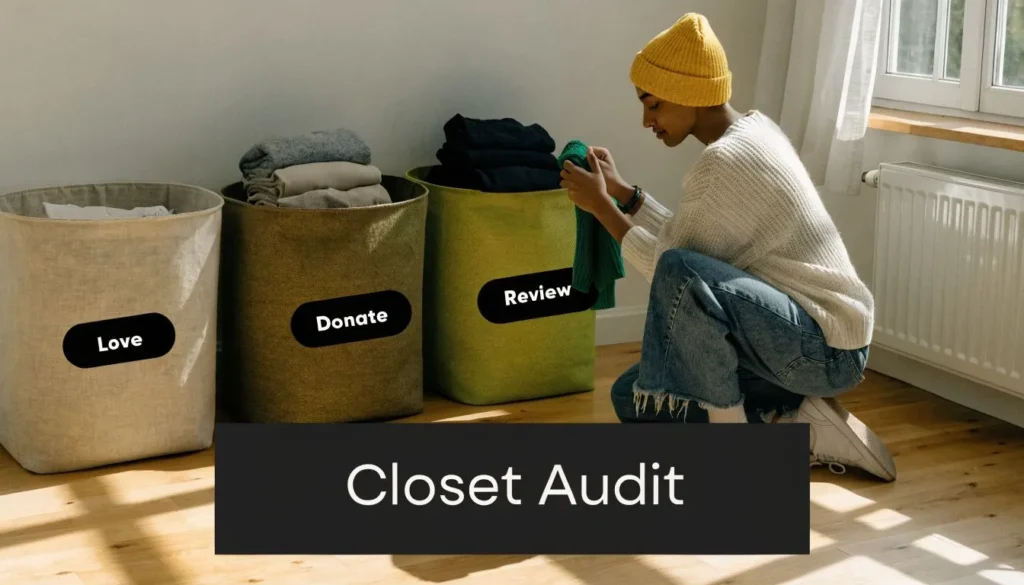
Pull everything out if you can. If that feels overwhelming, work category by category. Use three groups: Love, Review, and Let Go. Keep the decisions simple and fast. If you hesitate for too long on an item, it goes into Review.
Read your Love pile like a stylist
The Love pile tells the truth. It shows what you wear, what feels good on your body, and what fits your daily routine. Spread those pieces out and look for patterns.
Ask better questions than “Is this flattering?” Try these instead:
- Which silhouettes repeat: cropped jacket, full-length trouser, relaxed button-down, slim knit
- Which fabrics feel easy: denim, ponte, cotton poplin, jersey, merino
- Which colors dominate: black, olive, cream, navy, chocolate, soft blue
- Which outfits repeat: jean + knit + loafer, dress + cardigan + sneaker, trouser + tee + blazer
Style takes a concrete form. If you keep five soft knit tops and no structured blouses, your wardrobe is giving you instructions. If every favorite shoe is flat or low-heeled, stop planning a capsule around shoes you admire but won’t wear.
Practical rule: Build from your rotation, not from your fantasy self.
Audit for the life you have now
This part gets skipped in many capsule guides, and it’s why many first attempts fail. A successful wardrobe audit has to account for body and lifestyle shifts. “Pregnancy capsule wardrobe” searches on Pinterest are up 45% year over year, and a 2024 survey found 62% of women over 40 struggle with wardrobe editing due to menopause-related changes, as noted by Modern Minimalism’s discussion of life transitions in wardrobe building.
If your body is changing, don’t force your old wardrobe to serve a new reality. Edit with compassion and precision.
A few adjustments that help:
- During pregnancy or postpartum: prioritize adjustable waistbands, soft layers, and shoes you can wear comfortably all day.
- During menopause or hormonal changes: notice if fabric tolerance has changed. Breathability, softness, and ease often become more important than before.
- With mobility or dexterity concerns: closures, weight of garments, hem length, and shoe entry matter more than trend.
- After a job change: separate “required for this role” from “I thought I should own this.”
Later in the process, visual outfit planning makes decisions much easier.
What to remove first
Don’t start with sentimental pieces. Start with easy wins.
| Group | What belongs there | Why it goes |
|---|---|---|
| Love | You wear it now and feel good in it | It forms the foundation |
| Review | Good item, wrong fit, wrong season, or unclear role | It needs testing, not panic |
| Let Go | Uncomfortable, damaged, duplicated, or tied to a past identity | It creates clutter without service |
If you want a shortcut, hang the Love pieces back first and leave the rest out of prime closet space. That single move often reveals how much of your wardrobe is visual noise.
Define Your Palette and Core Structure
Once you know what you wear, structure becomes easier. This is the point where many people ask the wrong question. They ask, “How many items should be in my capsule?” The better question is, “What structure supports my real week?”
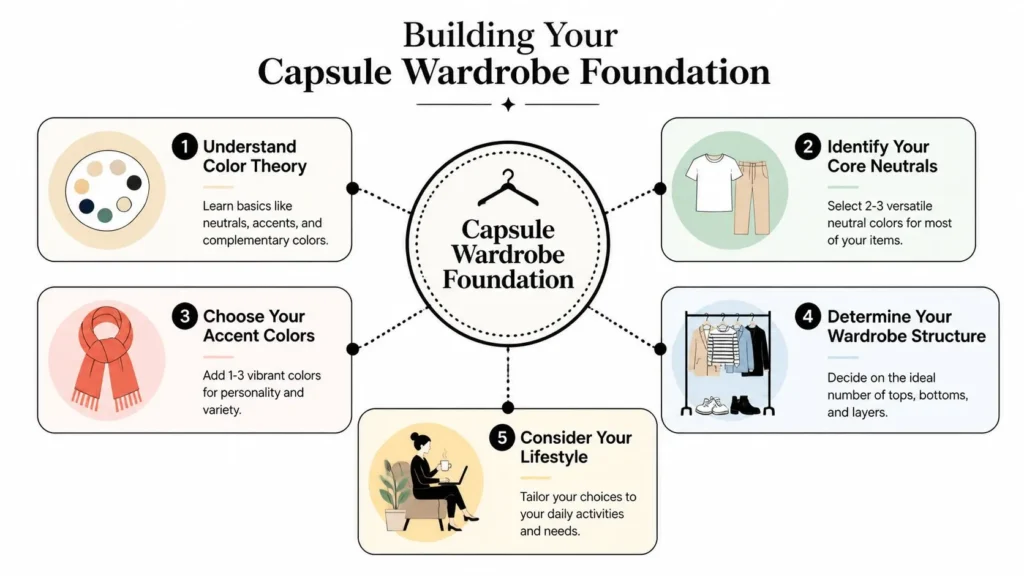
Build a palette you can actually live with
A useful capsule palette is restrained, not sterile. Generally, 2 to 3 core neutrals and 1 to 3 accent colors are effective, but your wardrobe should reflect what you naturally reach for. If you never wear camel, don’t add camel because a guide told you it’s classic.
A simple palette might look like this:
- Core neutrals: black, cream, olive
- Accent colors: rust, soft blue
Another might be:
- Core neutrals: navy, white, grey
- Accent colors: burgundy, forest green
If you need ideas for combining tones in a way that still feels wearable, autumn color pairings in fashion can help you think in families of color rather than one-off shades.
Use modules, not rigid numbers
A modular approach works better than a fixed clothing count because real lives vary. One flexible framework uses repeatable units of 2 pairs of pants, 3 tops, 1 outer layer, and 1 pair of shoes, and a single module creates about 6 outfit combinations, according to The Mom Edit’s capsule wardrobe framework. That’s more useful than chasing a magic number.
Other formulas exist, including a 19-piece seasonal method. Those can be helpful as starting references, but they shouldn’t override your life. A teacher who launders weekly, a consultant who travels, and a parent working from home won’t need the same structure.
Start with category scenarios
Before choosing exact pieces, define your three main clothing situations. I use this with clients because it stops random shopping fast.
For example:
Work life
This might mean polished separates, scrubs, washable dresses, or dark denim and knitwear if your office is relaxed.Off-duty life
School runs, errands, dog walking, grocery trips, casual lunches. This category needs comfort and weather logic.Social or occasion dressing
Dinner out, client events, family gatherings, weekend trips, religious services, or creative-industry events.
If a piece only works in one narrow situation and doesn’t pair broadly, it belongs on probation.
The five-way test
The most reliable filter is simple. Any new item should work in at least five different ways with what you already own. That rule keeps your capsule efficient and exposes weak purchases before they happen.
Use this checklist before you buy:
- Bottoms test: Can this top work with multiple bottoms you already own?
- Layering test: Does it fit under or over your current layers?
- Shoe test: Do at least two pairs of your real shoes work with it?
- Lifestyle test: Can you wear it in your actual week, not just in theory?
- Care test: Will you maintain it, or will it sit because it’s too fussy?
This is how to start a capsule wardrobe without ending up with a “minimal” closet full of impractical gaps.
Create Outfit Formulas and Your Shopping List
A capsule becomes useful when it turns into repeatable outfits. That’s where outfit formulas come in. A formula is a reliable combination you know works, such as straight-leg jeans + fine knit + ankle boot, or pull-on trouser + tee + relaxed blazer + loafer.
Don’t build formulas from Pinterest alone. Build them from your schedule.
Make formulas for your real categories
Choose three to five outfit formulas based on the situations you identified earlier. Keep them simple enough to repeat.
Examples:
- Work formula: trouser + knit top + third layer + flat shoe
- Casual formula: denim + tee + cardigan + sneaker
- Social formula: column dress + cropped jacket + boot
- Heat formula: breathable bottom + tank + overshirt + sandal
- Transit formula: soft pant + knit + lightweight jacket + walking shoe
Write them down. Then go into your closet and build each one with what you already own. This is the “shop your closet” stage, and it’s where the plan gets grounded.
A mini capsule example
Here’s what a small starter capsule might look like when you want enough variety without overcomplicating things.
| Category | Item | Example |
|---|---|---|
| Bottom | Jeans | Straight-leg dark denim |
| Bottom | Trousers | Black pull-on trouser |
| Bottom | Casual pant | Olive cotton pant |
| Top | Tee | White crew-neck tee |
| Top | Knit | Fine black knit |
| Top | Shirt | Blue button-down |
| Top | Tank | Rib tank in cream |
| Layer | Cardigan | Midweight neutral cardigan |
| Layer | Jacket | Cropped utility jacket |
| Dress | Easy dress | Washable midi dress |
| Shoe | Casual shoe | White sneaker |
| Shoe | Polished shoe | Black ankle boot |
That’s not a universal list. It’s an example of balance. You’ve got enough structure to create outfits across several settings, but not so much that the system becomes messy.
Build the shopping list last
Only after you test your formulas should you make a shopping list. This order matters because it turns shopping into problem-solving instead of entertainment.
Look for missing links, not random upgrades. Maybe your wardrobe already has enough tops, but no versatile shoe for polished outfits. Maybe you own plenty of pants, but you’re missing one layer that works over dresses and denim.
Use a short, ranked list:
- Need now: blocks outfits you already want to wear
- Need later: would improve variety, but isn’t urgent
- Nice someday: appealing, but not necessary
If you’re trying to resist trend-driven buying, browsing broader fashion trends for women can be useful only after your core system is in place. Trends should plug into your formulas, not replace them.
This approach also aligns with the bigger reason many people choose a capsule. The fashion industry accounts for 10% of total global emissions, and the capsule wardrobe market is projected to reach $11.42 billion by 2035, according to Business Research Insights on capsule wardrobe market growth. People are moving toward fewer, longer-wearing purchases for a reason.
Maintain Your Capsule and Avoid Common Pitfalls
Most capsule wardrobes don’t fail because people lack discipline. They fail because the wardrobe looked good on paper but didn’t solve the right problem.
The biggest one is fit. People often assume an outfit isn’t stylish enough when the issue is that the rise is wrong, the shoulder line pulls, the shoe shape throws off the proportion, or the fabric feels irritating after two hours. According to domain experts, the primary failure point is confusing fit problems with styling problems, and a constrained color palette can increase perceived outfit variety by 40% to 60% while reducing decision fatigue, as explained in this expert YouTube discussion on capsule wardrobe mistakes and maintenance.
Fix fit before you buy more
If an outfit keeps failing, don’t rush to add another piece. Diagnose it.
Try this sequence:
Check the fit first
Waist, shoulder, sleeve, rise, hem length, and shoe line affect whether an outfit feels right.Check the proportion next
Many “boring” outfits improve when the silhouette is balanced. A fuller pant may need a more compact top. A longer layer may need a cleaner shoe.Check the function last
If the garment wrinkles instantly, rides up, needs constant adjusting, or only works in one temperature range, it won’t earn a place in your capsule.
Buy less, but make each piece prove itself.
Use one-piece-at-a-time discipline
The easiest way to break a capsule is to do a “wardrobe refresh” haul. Multiple purchases made together often compete with each other or duplicate what you already own.
A better maintenance rule is one piece at a time. Add one item, test it with existing outfits, then decide what comes next. This prevents drift and keeps the wardrobe coherent.
A few habits keep the system stable:
- Photograph successful outfits: a phone album beats memory on busy mornings.
- Review problem pieces candidly: if something stays in the maybe zone for months, it usually isn’t earning its space.
- Store off-season items separately: not far away, just out of your immediate visual field.
- Keep the palette tight: that’s what lets a smaller wardrobe create more combinations.
Refresh quarterly, not constantly
You don’t need a dramatic reset every season. You need a quiet review.
Use three questions:
| Question | What you’re checking |
|---|---|
| What did I wear on repeat? | Your true essentials |
| What annoyed me? | Fit, fabric, care, or styling issues |
| What was missing? | Real gaps, not impulse wants |
That’s enough to keep the capsule alive. Small edits beat dramatic overhauls every time.
Embrace Your New Wardrobe Mindset
A capsule wardrobe works best when you stop treating clothing as a series of isolated purchases. The shift is from collecting items to building a system. Once that clicks, the closet gets calmer.
You spend less time negotiating with clothes that almost work. You stop buying duplicates of the same mistake. You learn what your body likes, what your week requires, and what colors and shapes make getting dressed easier. That kind of clarity has practical value, but it also builds confidence. The wardrobe starts feeling like it belongs to you again.
Freedom beats perfection
The strongest capsules aren’t the smallest. They’re the most coherent.
That means your capsule can include color if you wear color. It can include dresses if you live in dresses. It can include sneakers, clogs, soft trousers, or washable knits if that’s what supports your life. The point isn’t to look like a capsule wardrobe template. The point is to make your own wardrobe function with less friction.
The best capsule is the one you can keep wearing through real life changes.
Keep it flexible
Bodies change. Work changes. Climate, caregiving, commuting, and social lives change too. A wardrobe that can’t bend with those changes isn’t efficient. It’s brittle.
So if you’re wondering how to start a capsule wardrobe, start by dropping the fantasy of the perfect final version. Build a draft. Wear it. Notice what works. Edit from evidence. That’s how a capsule becomes useful instead of performative.
A good wardrobe should support your day, your body, and your taste. When it does, getting dressed becomes much less dramatic, and much more reliable.
If you enjoy practical, well-edited writing on fashion and other everyday topics, explore more at maxijournal.com. It’s a good place to keep reading when you want approachable ideas without the noise.
Discover more from Maxi Journal
Subscribe to get the latest posts sent to your email.