On April 22, 2026, the first cargo left Golden Pass LNG from the Texas coast, just 23 days after Train 1 produced its first LNG on March 30, 2026 according to Golden Pass LNG project information. That shipment marked more than a commissioning milestone. It closed the loop on one of the most striking reversals in modern U.S. energy infrastructure.
Introducing Golden Pass LNG
On the upper Texas coast, a terminal built to receive foreign gas ended up illustrating the opposite story. Golden Pass began operating in 2009 as an LNG import and regasification facility near Sabine Pass, at a moment when many energy planners still treated U.S. gas scarcity as a plausible long-term risk. Shale production overturned that assumption faster than many expected. An asset designed for one era suddenly had greater value in another.
That reversal is what makes Golden Pass more than a single industrial project. It is a case study in how energy infrastructure can be repurposed when supply economics change faster than permitting and construction cycles. For investors, it showed that sunk coastal infrastructure could retain strategic value. For policymakers, it showed that U.S. gas abundance was no longer only a domestic price story. It was becoming an export and foreign policy story too.
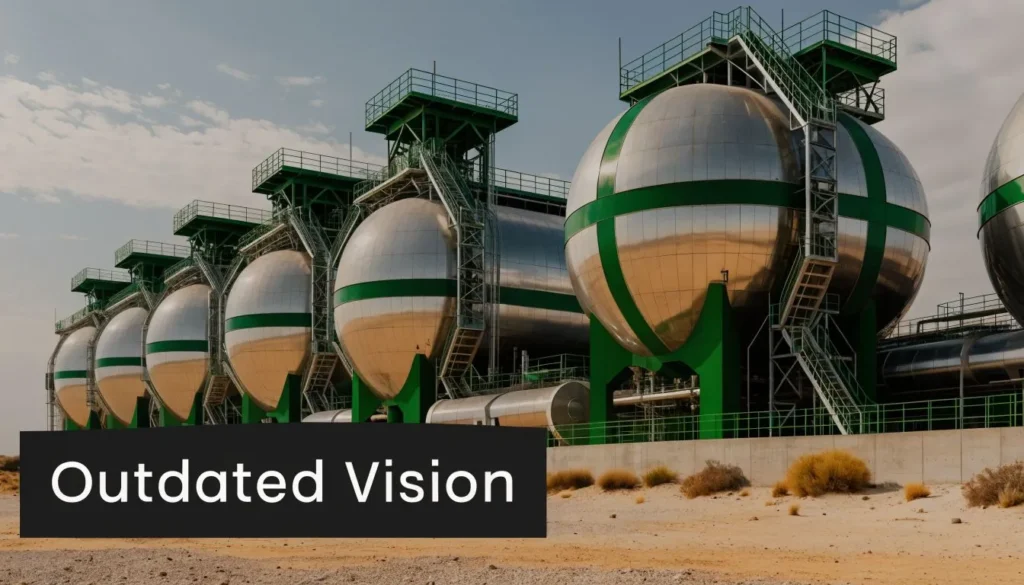
The ownership structure explains why Golden Pass drew so much attention once the export conversion advanced. QatarEnergy holds 70% of the joint venture and ExxonMobil holds 30%. That pairing joined one of the world’s largest LNG exporters with one of the largest U.S. energy companies. In practical terms, it linked global LNG marketing reach, long-cycle project experience, Gulf Coast access, and a balance sheet capable of supporting a multibillion-dollar buildout. Large energy projects often rise or fail on that kind of sponsor quality, not only on engineering.
The facility also matters because of its scale. Once fully online, Golden Pass is designed to produce about 18 million metric tons of LNG per year. Capacity at that level places it among the larger export projects on the Gulf Coast and gives it relevance well beyond Texas. A plant this size can influence regional construction demand, pipeline flows, shipping patterns, and the availability of marginal LNG cargoes for buyers in Europe and Asia.
A simple way to frame it is this. Golden Pass connects a local industrial site to three very different arenas at once:
- U.S. energy markets: It converts domestic natural gas into exportable LNG, reinforcing the United States’ role as a major supplier.
- The Texas and Gulf Coast economy: It concentrates capital spending, industrial employment, contractor demand, and tax base effects in one corridor.
- Global energy security: It adds supply from a politically stable producer at a time when importers are trying to reduce dependence on exposed routes and unreliable suppliers.
That logic resembles the kind of long-horizon capital allocation described in a business plan for large industrial investment. The difference is that Golden Pass operates at national and international scale. Its importance comes from the full lifecycle of the asset: first an import terminal, then a stranded fit for a changed market, and finally an export project with implications for trade balances, alliance politics, and LNG pricing.
The Journey From Import Hub to Export Powerhouse
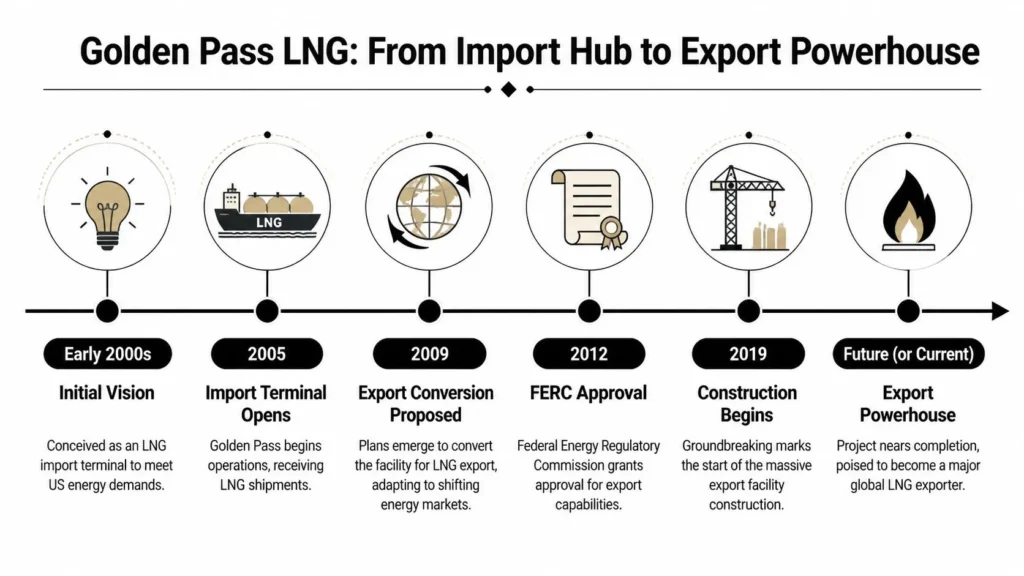
Golden Pass started life in a different energy era. In the 2000s, the United States expected to need more imported gas, so an LNG import terminal on the Texas Gulf Coast looked like a rational long-term bet. Then shale output changed the premise. Domestic supply rose fast, imported LNG became less important, and infrastructure built for scarcity suddenly sat in a market shaped by abundance.
That reversal is the key to understanding why Golden Pass matters. The project was not conceived as an export giant from the beginning. It became one because its owners were sitting on something rare: a coastal industrial site with storage, marine access, and pipeline connections that still had strategic value even after the original business case weakened.
The turning point
A pivot came in 2019, when the sponsors approved a multibillion-dollar conversion of the site into an LNG export terminal. As noted earlier, the buildout was designed to turn an underused import asset into a major outlet for U.S. gas exports.
That decision was larger than an engineering retrofit. It was a judgment about where the global gas market was heading over the next two decades. The owners had to conclude that Asian and European buyers would keep signing long-term LNG contracts, that Gulf Coast gas would remain competitive after liquefaction and shipping, and that an existing terminal could be expanded faster and at lower risk than starting from a blank site.
Why this asset was worth repurposing
Golden Pass had three advantages that made conversion more credible than abandonment.
First, location. A deepwater Gulf Coast position with established marine infrastructure is hard to replicate and harder to permit. Second, legacy assets. Existing tanks, berths, and site preparation shortened the path from concept to construction, even if the export build still required large new liquefaction facilities. Third, sponsorship. Backing from large energy companies gave the project financial staying power and commercial credibility with buyers, contractors, and lenders.
This is why Golden Pass is a useful case study in industrial capital allocation. The owners did not merely preserve an old asset. They reassigned it to a new market with better economics and stronger strategic relevance. Readers interested in long-cycle project economics will recognize the same logic in a business plan for large-scale infrastructure investment, where the question is not only how much to spend, but whether the asset can still earn acceptable returns under changed market conditions.
What the timeline actually shows
The deeper lesson is about optionality. Many industrial projects lose value permanently when their original demand thesis fails. Golden Pass did not, because its geography and physical footprint gave the owners a second path.
That makes the project more than a story about shale gas. It is also a story about asset adaptability. Golden Pass began as a bet that the United States would need imported LNG. It is reaching completion as a bet that U.S. gas can serve overseas demand for years, and that shift carries consequences well beyond one terminal. It supports export capacity on the Gulf Coast, strengthens the commercial link between U.S. gas fields and overseas buyers, and shows how energy infrastructure can move from stranded risk to strategic advantage when market conditions change.
A Look Inside the Technology and Capacity
A cargo leaving Sabine Pass looks simple from offshore. In reality, each shipment depends on a tightly synchronized industrial system that starts with pipeline gas and ends with supercooled fuel loaded onto an LNG carrier. Golden Pass matters because its value is not just in one piece of equipment, but in how treatment, liquefaction, storage, and marine loading are built to work as one export chain.
At the core of the project are three liquefaction trains. Each train has nominal capacity of 5.2 million metric tons per annum, and together they support overall output of about 18 million metric tons per year, as noted earlier. That places Golden Pass among the larger U.S. export terminals and gives it enough scale to matter in both domestic gas flows and Atlantic Basin LNG trade.
How the plant turns gas into LNG
The process starts with feed gas arriving by pipeline. Before the gas can be exported, the plant removes impurities and prepares the stream for cryogenic processing. It then uses propane-precooled mixed refrigerant technology, usually shortened to C3MR, to cool the gas to about -162°C so it can be condensed into a liquid suitable for long-distance shipping.
The technical point is straightforward. Cooling natural gas into LNG cuts its volume sharply, which makes ocean transport economical in a way pipeline-only delivery cannot match. That is the commercial bridge between U.S. shale supply and overseas buyers. Readers comparing gas exports with other parts of the energy system may find it helpful to contrast LNG with renewable energy sources and how they fit into the broader power mix, because the infrastructure, dispatch profile, and trade economics exhibit profound differences.
The infrastructure around the trains
Golden Pass also benefits from legacy assets built during its earlier life as an import terminal. The site includes five LNG storage tanks with capacity of 155,000 cubic meters each and two marine berths for ocean-going carriers, as noted earlier. Reusing those assets lowered the amount of greenfield construction required and helps explain why this site could be converted at large scale rather than rebuilt from scratch elsewhere on the Gulf Coast.
Feed gas supply is just as important as the liquefaction units themselves. The connected Golden Pass Pipeline runs about 70 miles and can deliver up to 2.5 Bcf/d southbound from major producing regions including the Permian and Haynesville, as noted earlier. That pipeline link is one of the project’s most consequential features. It ties export capacity directly to two of the most important U.S. gas basins, which reduces procurement risk and supports high plant utilization if upstream production remains strong.
| Specification | Metric |
|---|---|
| Project output capacity | Approximately 18 million metric tons per year |
| Number of liquefaction trains | Three |
| Capacity per train | 5.2 MTPA nominal |
| Liquefaction temperature | -162°C |
| Core process | Propane-precooled mixed refrigerant (C3MR) |
| Process efficiency | Over 90% |
| Storage tanks | Five |
| Storage per tank | 155,000 cubic meters |
| Marine berths | Two |
| Pipeline length | 70 miles |
| Pipeline delivery capability | Up to 2.5 Bcf/d southbound |
What the scale means in practice
This scale changes the project’s role in the market.
An LNG terminal is only as useful as its narrowest bottleneck. A plant can have large liquefaction capacity, but if storage is limited, berths are congested, or feed gas cannot arrive consistently, the export system loses value fast. Golden Pass was designed around that problem. Its trains, tanks, docks, and pipeline capacity are large enough to support sustained, high-volume operations rather than occasional cargo loading.
That is the deeper significance of the engineering. Golden Pass is not just a processing site on the Texas coast. It is a conversion point that turns inland U.S. gas production into globally tradable supply at industrial scale. In market terms, that means more than additional export tonnage. It means more flexibility for buyers, more pull on Gulf Coast gas demand, and a larger U.S. role in balancing supply shocks across Europe and Asia.
Analyzing the Economic and Environmental Impacts
In Sabine Pass, the economic promise of Golden Pass is easy to see before the first full cargo sails. Years before the terminal reaches steady operations, the project has already pulled in construction labor, engineering work, equipment orders, and port activity across Southeast Texas. That pattern matters because Golden Pass is not a stand-alone plant. It is the latest stage in a longer conversion of U.S. gas into export revenue, local tax base, and strategic industrial demand.
The headline numbers are large. According to the U.S. Department of Energy filing that includes the Perryman Group analysis, construction and the first 25 years of operations are estimated to generate USD 19.0 billion in U.S. gross product and 205,723 job-years of employment. For Jefferson County, Texas, the same analysis estimates USD 18.7 billion in gross product and 197,763 job-years.
Those figures deserve careful reading.
They do not mean Golden Pass will employ more than 200,000 people at the terminal. The Perryman analysis counts direct, indirect, and induced effects across a long time period. In practice, that includes on-site construction crews and operators, but also pipe suppliers, maintenance contractors, marine services, local retailers, and other businesses whose revenue rises when a multibillion-dollar export facility is built and run over decades.
That broader footprint is the true economic story. A project of this size changes more than payroll inside the fence line. It raises demand for regional services, supports port and pipeline activity, and ties local business conditions more closely to global LNG trade. For Jefferson County, that can mean stronger industrial tax revenue and a larger base of skilled energy employment. It also means the local economy becomes more exposed to swings in gas prices, export margins, and the timing of major maintenance cycles.
The project therefore creates both income and concentration risk. Communities that benefit from long-lived energy infrastructure often become more dependent on it.
For readers comparing LNG with lower-carbon options, this explainer on renewable energy is a useful baseline. The policy question is rarely whether energy systems should produce power and fuel with zero trade-offs. The harder question is which mix of gas, renewables, storage, grid investment, and efficiency delivers acceptable reliability, cost, and emissions at the same time.
Environmental effects sit on a different timeline from the jobs case. Construction brings dredging, heavy traffic, noise, and a larger industrial footprint along the Gulf Coast. Operations add another layer of concern because LNG exports carry emissions beyond the terminal itself. Critics focus on the full chain: upstream gas production, pipeline transport, liquefaction, marine shipping, and final combustion overseas.
That lifecycle framing is important. Golden Pass began life as an import terminal and is being remade into an export plant because global gas economics changed. The environmental debate changed with it. An import terminal mainly receives fuel. An export terminal pulls domestic gas to the coast, chills it into LNG, loads it onto ships, and extends the project’s emissions and ecological effects across a much wider system.
A short view of the trade-offs helps clarify the debate:
- Local industrial effects: Large LNG facilities change land use, truck traffic, vessel activity, and the cumulative industrial burden on nearby communities.
- Climate impact: Supporters often stress gas as a reliability fuel, while critics focus on total lifecycle emissions rather than plant-level efficiency alone.
- Economic distribution: Benefits such as wages, contracts, and tax revenue are visible and concentrated. Environmental costs can be longer-term and unevenly shared.
This video offers a useful visual backdrop for that debate.
The most defensible conclusion is mixed. Golden Pass strengthens the U.S. export economy and gives Southeast Texas another durable anchor in the LNG value chain. It also extends the life of Gulf Coast fossil infrastructure at a time when investors, regulators, and communities are under more pressure to cut emissions and limit local environmental harm.
Policymakers back projects like this because the benefits arrive in concrete forms: jobs, tax receipts, export earnings, and energy security. The costs are concrete too, but they are spread across ecosystems, air quality concerns, and the climate consequences of building another long-lived gas asset. Golden Pass sits directly inside that tension, which is why its impact cannot be judged by construction spending alone or by emissions arguments alone.
How Golden Pass Is Reshaping Global Energy Markets
At the height of Europe’s gas shock, every new LNG cargo carried outsized significance. A single train starting up on the U.S. Gulf Coast could influence winter storage plans in Europe, procurement strategy in Asia, and shipping economics across the Atlantic. Golden Pass belongs in that category.
Its market impact starts with scale. Golden Pass adds 18 MTPA of export capacity, a large enough volume to matter beyond Texas. Earlier sections covered the ownership and plant design. What matters here is the market function. New U.S. LNG supply gives buyers another source of flexible cargoes that can move to the region offering the strongest netback, whether that is Europe during a supply scare or Asia during peak seasonal demand.
Geography reinforces that effect. Gulf Coast LNG is connected to deep U.S. gas supply and to two major ocean basins. That makes Golden Pass part of the balancing system for global gas, not just another point of origin. In practical terms, more Atlantic Basin supply reduces the pressure on European buyers to depend on a narrower set of suppliers, while also giving portfolio players more room to redirect cargoes if Asian demand strengthens.
Ownership matters too, for a reason that is easy to miss. Golden Pass gives QatarEnergy export exposure from the United States, not only from the Middle East. That changes the risk profile of its portfolio. If traffic through the Strait of Hormuz becomes more exposed to military tension or insurance costs, U.S. Gulf Coast volumes provide another route to serve long-term customers. For the market, that is a form of diversification at the seller level, not just the buyer level.
The timing is also unusually important. According to the U.S. Energy Information Administration’s analysis of Golden Pass startup timing and U.S. LNG export growth, the project was expected to be the only new U.S. LNG export terminal entering service in 2026, with total U.S. LNG exports projected to average 130 million metric tons per year in 2026 and then increase by another 11 million metric tons per year in 2027. That means Golden Pass is arriving during a period when incremental capacity is scarce relative to demand for reliable supply.
Scarcity changes pricing power. In a tight market, one large new terminal does more than add molecules. It increases buyer confidence that cargoes will be available when storage runs low, pipeline flows fall, or weather shifts demand sharply higher.
There is also a broader policy consequence. Golden Pass strengthens the U.S. position as a swing supplier to allies that want fewer energy ties to politically exposed producers. That does not settle the argument over emissions, methane, or the long-run costs of expanding fossil infrastructure. Those questions remain central to any serious discussion of climate change and the long-term energy transition. But in near- to medium-term energy security terms, Golden Pass increases the number of countries that can replace disrupted supply with U.S.-linked LNG.
The larger conclusion is straightforward. Golden Pass is the end point of a long strategic reversal. A site built to import gas into the United States is becoming part of the system that helps set marginal supply for the world. That arc, from import terminal to export platform, is why the project matters far beyond Southeast Texas.
Navigating Delays and Controversies
For Golden Pass, the hardest part of the transformation from import terminal to export plant came late, after years of engineering and billions already committed. In 2024, the project was hit by a contractor bankruptcy tied to payment disputes. That turned an already complex build into a test of whether deep-pocketed sponsors could keep a strategic energy asset on track after a major execution failure.
The disruption was immediate in Southeast Texas. Thousands of workers were laid off after the lead contractor collapsed, showing how quickly risk on a megaproject moves from corporate balance sheets to household income and local business activity. Restaurants, equipment suppliers, staffing firms, and landlords all feel those shocks long before the first cargo leaves the dock.
What the delay changed in practice
The schedule slip mattered for more than project finance. LNG buyers plan portfolio coverage years ahead. Shipping companies position vessels around expected loading windows. Utilities and traders build supply assumptions into winter procurement. When a terminal the size of Golden Pass moves to the right, the effect reaches well beyond the construction site.
That is why the later startup milestones carried so much weight. As noted earlier in the article, Train 1 reached first LNG production on March 30, 2026, and the first cargo followed in April. Those milestones did not erase the delay. They did establish something markets value more than an original schedule: proof that the asset is operational and capable of joining global trade flows.
The episode also exposed a less obvious point about LNG project risk. Technical complexity is only part of the challenge. Contract structure, payment discipline, labor continuity, and sponsor credibility can be just as important as compressors, tanks, and marine infrastructure. Golden Pass had enough financial and strategic backing to recover. A smaller project without owners such as ExxonMobil and QatarEnergy might not have.
Why the controversy extended beyond construction
Golden Pass also sits inside a larger political argument about long-lived gas infrastructure. Supporters frame it as a supply security asset for allies and a source of export earnings, jobs, and Gulf Coast industrial activity. Critics point to emissions, methane leakage, and the risk of locking in fossil fuel dependence for decades. That broader debate is part of the wider discussion around the long-term effects of climate change.
For policymakers, the project offers a clear lesson. Energy security projects do not avoid controversy solely because demand is strong. They still have to survive permitting scrutiny, labor disruptions, contractor failures, and climate opposition, all while staying financeable.
For investors, the takeaway is more practical. The fundamental question was never whether delays looked bad. They did. The question was whether Golden Pass could cross the line from delayed asset to producing terminal. Once it did, the market logic returned. Lost time reduced near-term revenue and strained confidence, but it did not remove the plant’s strategic role in U.S. exports or its value to buyers seeking another large source of flexible LNG supply.
Frequently Asked Questions About Golden Pass LNG
Some questions come up repeatedly because Golden Pass LNG sits at the intersection of technology, trade, and politics. The answers are straightforward once you separate the plant’s old identity from its current one.
Quick answers that matter
| Question | Answer |
|---|---|
| What is Golden Pass LNG? | It’s an LNG export facility near Sabine Pass, Texas, created by transforming an earlier import terminal into an export hub. |
| Who owns Golden Pass LNG? | The joint venture is owned by QatarEnergy and ExxonMobil. |
| How big is the project? | The export facility has capacity of about 18 million metric tons per year. |
| What does it mean that it used to be an import terminal? | An import terminal receives LNG cargoes and turns them back into gas for domestic use. An export terminal does the reverse by liquefying gas for shipment overseas. |
| How many trains does the plant use? | Three liquefaction trains form the core of the export project. |
| When did the first train start producing LNG? | Train 1 achieved first LNG production on March 30, 2026. |
| Who takes most of the output? | QatarEnergy Trading has secured 70% of the project’s output. |
| Why does the project matter globally? | It adds large-scale U.S. LNG supply at a time when buyers want more reliable and diversified sources. |
Three practical clarifications
- It isn’t just a Texas story: Golden Pass affects buyers in Europe and Asia because LNG cargoes move wherever demand and contracts pull them.
- Its old import role still matters: Existing tanks, berths, and siting helped make the export conversion viable.
- Ranking matters because scale matters: Golden Pass entered the U.S. market as one of the country’s largest LNG export facilities, which is why traders and policymakers follow its startup so closely.
The final takeaway is simple. Golden Pass LNG is more than a plant. It’s a working example of how energy systems adapt when geology, trade patterns, and geopolitics all change faster than infrastructure normally does.
If you like clear, evidence-based analysis on business, energy, science, technology, and culture, explore more commentary and publishing opportunities at maxijournal.com.
Discover more from Maxi Journal
Subscribe to get the latest posts sent to your email.