A proton sounds simple when you first meet it in school. Then physics opens it up, and what looked like a tiny solid bead turns into a restless world of quarks and gluons, flickering with motion, force, and structure.
That hidden world is where much of physical reality gets built.
Journey to the Heart of Matter
Look around the room you’re in. The table, the screen, your hands, the air molecules drifting past your face, all of it seems made of stable, ordinary stuff. But when physicists drill down beneath chemistry and beneath atoms, they find a deeper layer where matter is stitched together by quarks and gluons.
These particles aren’t obscure details at the edge of physics. They are the main ingredients of the visible universe. The U.S. Department of Energy notes that quarks and gluons are the fundamental constituents comprising 99% of all visible matter, and researchers at the Relativistic Heavy Ion Collider study them by creating a quark-gluon plasma at temperatures exceeding 4 trillion degrees, about 250,000 times hotter than the sun’s interior (DOE explanation of quarks and gluons).
That fact changes the scale of the story. Quarks and gluons aren’t just what’s inside a proton. They are what most visible matter ultimately depends on.
The zoom inward
You can think of the journey into matter as a sequence of nested worlds:
- Everyday objects are made of atoms.
- Atoms contain electrons around a nucleus.
- Atomic nuclei contain protons and neutrons.
- Protons and neutrons are made of quarks, held together by gluons.
Each step inward reveals that something once thought fundamental is built from something else. That’s one reason quarks were such a shock. They suggested that particles people already treated as basic, like protons and neutrons, had their own internal architecture.
A useful perspective: if atoms are the letters of chemistry, quarks and gluons are part of the grammar that lets those letters form matter at all.
Why this world feels so strange
Readers often hit a wall here. If quarks and gluons are so important, why haven’t we seen a single quark sitting on its own under a microscope? Why do these particles carry bizarre fractional charges? Why does a force called the “strong” force behave in ways that feel backward compared with everyday intuition?
Those questions aren’t side issues. They are the heart of the subject.
Quarks and gluons force us to let go of the image of matter as tiny marbles. Inside the nucleus, nature behaves more like a dance than a pile of objects. Things are defined by interaction, not isolation. Energy matters as much as ingredients. And the rules are so unusual that physicists had to invent a whole theory, Quantum Chromodynamics, to describe them.
Meet the Fundamental Particle Family
Open a proton in your mind and the scene gets strange fast. Instead of finding tiny solid beads packed neatly together, you meet a small family of particles with odd names, fractional charges, and rules that do not resemble everyday experience.
The main characters are the quarks. There are six kinds, called flavors: up, down, charm, strange, top, and bottom. Physicists sort them into three generations. The first generation, up and down, builds the matter around you. The heavier generations usually appear only in high-energy processes, but they follow the same underlying pattern, which is a clue that nature is organized more like a repeating cast than a pile of unrelated parts.
The strange idea of flavor
“Flavor” sounds lighthearted, but it labels a real physical difference. Each flavor has its own mass and electric charge.
That charge is one of the first shocks in the quark story.
Electrons carry a charge of minus one unit. Protons carry plus one. Quarks, by contrast, come with fractional charges: either +2/3 e or -1/3 e. At first glance, that can feel like a cheat in the math. Why would nature use thirds here when familiar particles seem to come in whole units?
The answer matters because it shows physicists were not inventing exotic features for fun. Fractional charge helped explain the measured properties of known particles. A proton, for example, works out cleanly as two up quarks and one down quark: +2/3, +2/3, and -1/3 add up to +1. A neutron, made of one up and two down quarks, totals 0. The weird numbers were required because the particles we could observe already demanded them.
The six flavors at a glance
| Quark Flavor | Generation | Electric Charge | Approximate Mass |
|---|---|---|---|
| Up | 1 | +2/3 e | ~2.2 MeV/c² |
| Down | 1 | -1/3 e | ~4.7 MeV/c² |
| Charm | 2 | +2/3 e | ~1.27 GeV/c² |
| Strange | 2 | -1/3 e | ~95 MeV/c² |
| Top | 3 | +2/3 e | ~173 GeV/c² |
| Bottom | 3 | -1/3 e | ~4.2 GeV/c² |
A useful pattern shows up right away. Up, charm, and top are the up-type quarks, all with charge +2/3 e. Down, strange, and bottom are the down-type quarks, all with charge -1/3 e.
That split is part of the recipe book of matter. Different combinations give different particles, just as different notes can produce very different chords.
Why six and not just two
If ordinary matter is built mostly from up and down quarks, the heavier flavors can seem like unnecessary extras. They are not. Their discovery showed that quarks were not a convenient sketch for protons and neutrons alone. They were part of a broader pattern running through particle physics.
Nature often repeats successful designs. Electrons have heavier cousins called the muon and tau. Quarks show the same family structure. That repetition is one reason physicists took the quark picture seriously. The family was too orderly to look accidental.
A helpful comparison comes from nuclear reactions. The visible products of a process may be simple, while the full cast behind the process is richer and more structured. You can see that idea in this overview of how fusion reactions work, where the underlying ingredients and interaction rules matter as much as the final result.
Here’s a good visual primer before going further:
And what about gluons
Quarks never tell the whole story by themselves. Gluons carry the strong interaction between quarks, and they do more than sit in the background like tape holding pieces together. They are active parts of the theory, constantly exchanged, constantly shaping what combinations of quarks can exist.
A useful picture is a conversation rather than a scaffold. Quarks are not little stones resting side by side. They are more like dancers whose positions make sense only because signals are being exchanged all the time. Gluons are those signals.
This is also where the “why” starts to sharpen. Once physicists realized quarks had to exist, they still needed a mechanism strong enough to bind them inside protons and neutrons. Gluons supplied that mechanism, and their behavior turned out to be stranger than the force-carrying particles of electromagnetism. That strange behavior is the reason the strong force needs its own special rules, which brings us to color charge.
Quarks tell you what matter is made of. Gluons tell you how that matter stays together.
The Rules of Color and the Strong Force
Open a proton in your mind and the picture gets strange fast. Inside, quarks are not just sitting together like beads in a box. They obey a deeper set of rules, and one of the most important is called color charge.
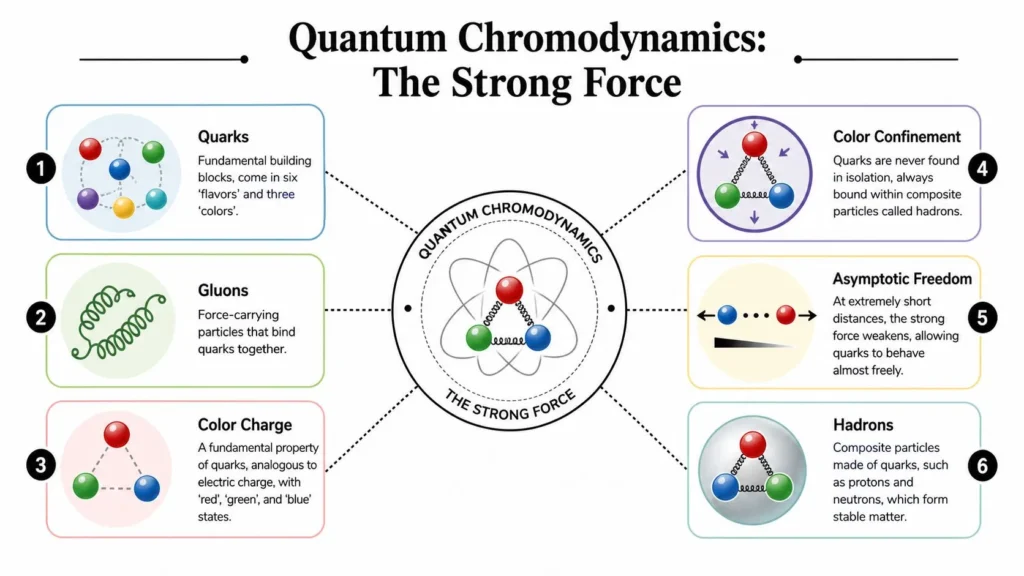
Color charge plays a role similar to electric charge in electromagnetism, but it follows different rules. The name can mislead people at first. Quarks are not physically red, green, or blue. Physicists borrowed color words because they needed labels for a new kind of charge, one that could explain patterns the older quark model could not.
Why color charge had to exist
The need for color was not a matter of fancy terminology. It came from a real crisis in the theory.
Early quark models could describe many particles, but some combinations created a contradiction. Certain particles appeared to contain quarks in arrangements that seemed to violate the quantum rules identical particles must obey. Physicists needed one more hidden label, something that would let quarks be similar in some ways while still remaining distinct in the full quantum description.
Color charge solved that problem.
Oscar Greenberg proposed the basic idea in 1964, and later work developed it into quantum chromodynamics, or QCD. In that theory, gluons carry the color force between quarks, and the history of that development is summarized in CERN Courier’s overview of gluon history.
That is the deeper “why.” Color charge was necessary because nature was refusing to fit inside the earlier model. The extra property made the structure consistent.
How “color neutral” works
A useful visual comparison comes from mixing light. Red, green, and blue light can combine into white, so the separate colors no longer stand out. Quarks behave in a loosely similar way. Their color charges combine into arrangements that are neutral overall.
This point matters because the particles we can observe, such as protons and neutrons, do not spill color charge into the outside world. Their ingredients carry color. The finished object does not.
Two common patterns do the job:
- Three-quark combinations can join red, green, and blue into a neutral state.
- A quark and an antiquark can combine color with anticolor and cancel out.
These color-neutral composites are called hadrons. Protons and neutrons are hadrons, but they are only part of a much larger family.
What gluons actually do
Gluons are the force carriers of QCD, but that phrase can sound more mechanical than the reality. A gluon does not merely act like a tiny marble tossed between quarks. The better picture is an ongoing exchange that continually updates the quarks’ color states while keeping the whole particle color neutral.
That strange behavior helps explain why the strong force needs its own mathematics. Photons, which carry electromagnetism, do not themselves carry electric charge. Gluons do carry color charge. So the strong force can interact with itself in a way electromagnetism does not. The glue is active inside the bond.
Key insight: physicists introduced color charge because quarks alone could not explain the rules matter was following.
If you want a separate example of how particle behavior depends on interaction rules rather than just ingredients, this explainer on what a fusion reaction is offers a helpful comparison.
Why We Never See a Lone Quark
If quarks are real, the obvious question is simple. Why can’t we pull one out and look at it?
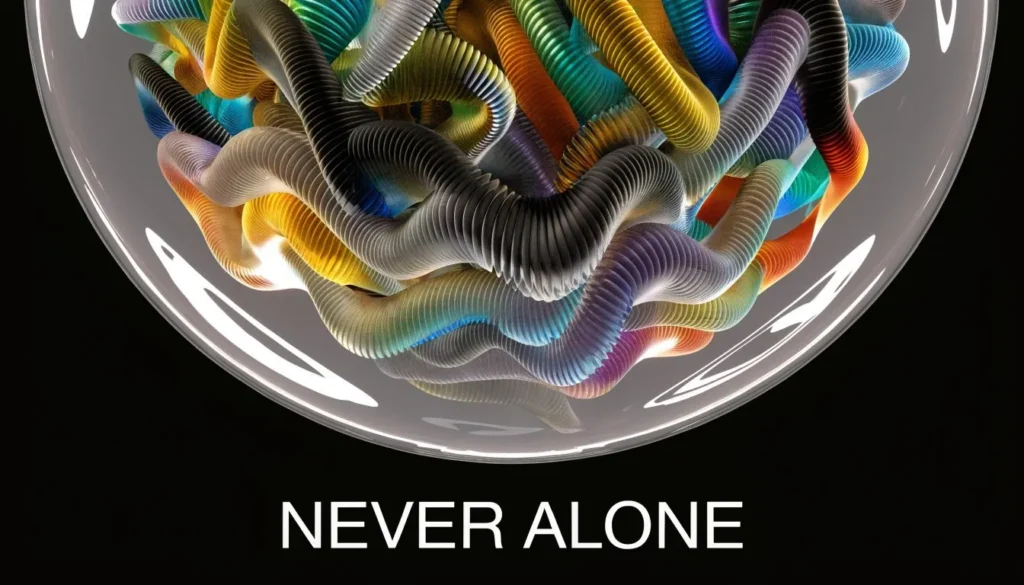
The answer is one of the strangest results in physics: confinement. Quarks appear to be permanently bound inside larger particles. They behave as if nature forbids them from wandering free.
The rubber-band picture
A good analogy is a rubber band stretched between quarks. If you pull electric charges apart, the electromagnetic force weakens with distance. The strong force doesn’t behave that way in the same simple manner. Pulling quarks apart stores more and more energy in the field between them.
That means separation doesn’t become easier as distance grows. It becomes more costly.
At some point, the stored energy can produce new particles rather than deliver an isolated quark. So instead of one lone quark appearing, nature gives you fresh bound combinations. The attempt to isolate a quark just creates new hadrons.
Why that matters
Confinement explains why quarks remained hidden for so long. It also explains why proving their existence required indirect methods. Physicists couldn’t expect to trap one in a bottle and display it the way they might detect an electron.
This is one of those moments where “invisible” doesn’t mean “imaginary.” Wind is invisible too, but its effects are obvious. With quarks, the evidence appears through patterns, scattering, jets, and the structure of composite particles.
The opposite behavior at short distances
Confinement has a surprising partner: asymptotic freedom. When quarks are extremely close together, the strong force weakens, and they move almost as if they are free.
That sounds contradictory until you picture two regimes:
- Farther apart: the bond resists separation strongly.
- Very close together: the interaction becomes weaker.
A crowded-room analogy helps. In a tightly packed crowd, each person has only a tiny bit of room to shift locally. In a similar way, quarks at very short distances can move within the proton with less resistance than you might expect from a force called “strong.”
The strong force is unusual not because it is always strong in the same way, but because its strength depends on scale in a way everyday intuition doesn’t prepare us for.
This behavior became a cornerstone of QCD. It helped explain why quarks can act nearly free in some high-energy experiments while never appearing as isolated particles in ordinary conditions.
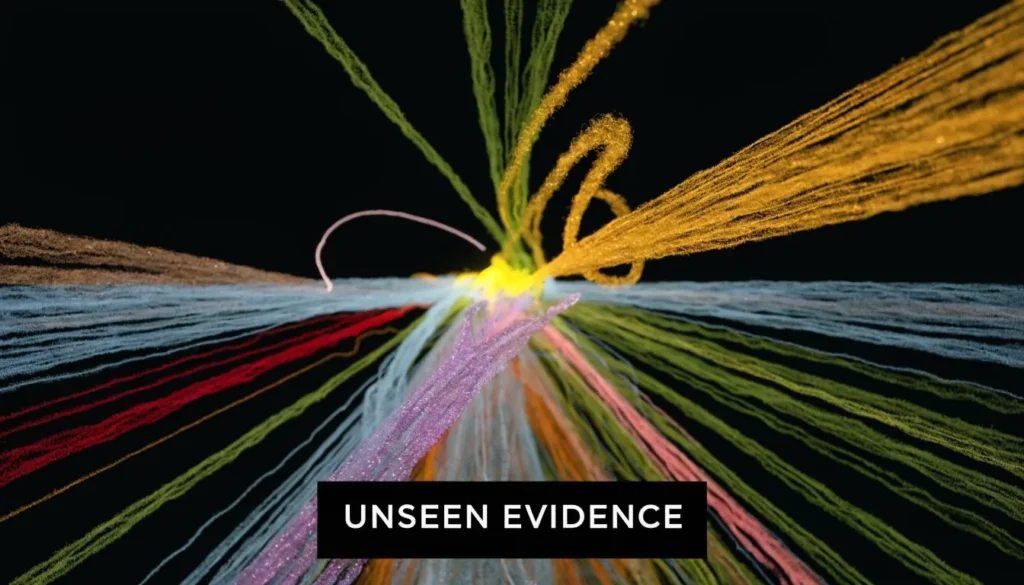
Finding the Unseen Evidence for Quarks
A century ago, physicists thought they were getting close to the bottom layer of matter. Then the particles started piling up. Laboratories kept finding new hadrons with different masses, lifetimes, and charges, and the neat picture of nature turned into something that looked like a museum drawer crammed with unfamiliar fossils.
People called it the particle zoo.
The idea that gave the zoo a pattern
In 1964, Murray Gell-Mann and George Zweig independently proposed the quark model. The bold move was not just naming new ingredients. It was saying that many particles that looked fundamental were really built from smaller pieces.
That mattered because science was drowning in labels. The quark model gave physicists a way to sort the chaos into families and relationships. It answered a deeper question: why did so many hadrons exist, yet seem to follow hidden regularities?
The idea still sounded outrageous. Quarks were assigned fractional electric charges, and nobody had ever caught one on its own.
The experiment that changed the argument
The turning point came at SLAC in 1968. Physicists fired high-energy electrons at protons and studied how the electrons scattered. This method worked like probing a sealed object with tiny, fast bullets and reconstructing the interior from the ricochet pattern.
If the proton were a smooth, indivisible blob, the scattering would have looked smooth too. It did not. The electrons bounced as if they were hitting small, concentrated targets inside the proton.
That was the breakthrough. Physicists still were not seeing quarks directly, but they had strong evidence that the proton contained point-like constituents.
Those experiments also connect naturally to the broader story of the nucleus of an atom, because they revealed that protons and neutrons are not featureless building blocks after all.
Why physicists said “partons” first
Early on, researchers often used the word partons for those hidden internal pieces. That word reflected caution. The experiments clearly pointed to substructure, but the exact interpretation took time to sharpen.
This is how science often works. First comes a stubborn pattern in the data. Then comes a model that explains it. Then more experiments test whether the model really captures what nature is doing.
Later, the partons seen in deep inelastic scattering were identified with quarks, along with gluons carrying part of the proton’s momentum. The strange idea from 1964 was starting to look real.
Hidden things become convincing when different experiments keep pointing to the same invisible machinery.
How jets reveal quarks and gluons
Modern experiments push this detective work much further. Quarks and gluons still do not appear as lonely particles in a detector. Instead, a high-energy quark or gluon triggers a jet, a narrow spray of ordinary particles moving in nearly the same direction.
A jet works like the visible plume behind an invisible firework fragment. You never recover the original fragment by itself, but the spray shows where it went and how energetic it was.
The underlying process is a cascade. A fast quark radiates gluons. Those gluons can radiate more gluons or produce quark-antiquark pairs. What begins as one energetic parton turns into a branching shower, and confinement then packs that shower into hadrons. Detectors record the hadrons. Physicists reconstruct the original quark or gluon from the pattern.
That is one of the beautiful twists in particle physics. The strong force hides quarks from direct view, yet it leaves organized, measurable fingerprints.
Why the case for quarks became overwhelming
No single photograph settled the question. The evidence grew because many different clues fit together at once.
- 1964 brought the quark model, which organized the hadron spectrum.
- 1968 brought deep inelastic scattering, which showed point-like structure inside protons.
- 1974 brought the J/ψ meson, a major confirmation that the quark picture was describing real particles, not just bookkeeping.
- Later discoveries of additional quark flavors and increasingly precise collider results strengthened QCD as the theory of the strong interaction.
That is how physicists proved the existence of something they could never pull out and place on a table. They learned to read traces, patterns, and cascades, and those clues kept telling the same story.
Building Protons and Neutrons from Quarks
A proton in your body has likely existed for billions of years. Inside that tiny, durable object, quarks are in constant motion, held together by gluons in a restless quantum knot. That contrast is part of the wonder. Ordinary matter looks calm from the outside because its inner rules are so exact.
Start with the basic quark recipes.
The proton recipe
A proton contains two up quarks and one down quark.
Their electric charges add up cleanly:
- Up quark: +2/3 e
- Up quark: +2/3 e
- Down quark: -1/3 e
The total is +1 e, which is exactly the proton’s charge.
The neutron recipe
A neutron contains one up quark and two down quarks.
Add those charges and you get:
- Up quark: +2/3 e
- Down quark: -1/3 e
- Down quark: -1/3 e
The total is 0, which matches the neutron’s neutrality.
This is why fractional charge matters so much. It is not a strange mathematical decoration. It is the feature that lets nature build familiar particles with the charges we observe.
There is another rule working at the same time. The three quarks in a proton or neutron must combine to form a color-neutral state. Color charge was introduced because physicists needed a way to make the quark model obey quantum rules and match the hadrons seen in experiments. In a baryon such as a proton or neutron, the three quarks carry different color charges that balance into a neutral whole, much as three beams of colored light can combine to make white.
So a proton is not just a list of ingredients. It is a stable arrangement that works because charge, color, and quantum statistics all fit together at once.
More than three particles in a box
It helps to drop the picture of three tiny balls sitting side by side. A proton works more like a ceaselessly churning system, with quarks exchanging gluons and with energy stored in that motion and binding. The gluons are not passive glue in the everyday sense. They actively shape the proton’s structure.
That point matters because the proton’s mass does not come mainly from adding up the tiny bare masses of its quarks. Much of the mass of ordinary matter comes from the energy of the strong interaction inside hadrons, as discussed in CERN Courier’s overview of gluons and QCD. Einstein’s (E=mc^2) shows up here in a very concrete way. The mass of the proton is largely the energy of quarks and gluons trapped together.
Why ordinary matter holds together
Protons and neutrons are stable hadrons because several pieces click into place at once:
- Their quark charges add to the observed total charge
- Their colors combine to a neutral state
- Gluon exchange binds the quarks strongly
- The quantum arrangement is allowed once color is included
That is the deeper answer to how matter gets built. A proton or neutron is not merely made of quarks. It is made possible by the rules quarks follow.
For a bigger-picture link between these particles and atomic structure, this overview of the nucleus of an atom is a useful next step.
Frontiers and Unanswered Questions in QCD
A strange thing happened as physicists pushed deeper into matter. The closer they looked, the less the proton resembled a finished object and the more it resembled a restless, rule-filled world.
That is why QCD still feels alive as a research field. The basic theory works extraordinarily well. The hard part is understanding how its rules produce the rich, messy behavior seen in real experiments and in the early universe.
The early-universe state of matter
One frontier is the quark-gluon plasma, a state of matter reached at extreme temperatures and densities. Under those conditions, quarks and gluons are no longer bound into individual hadrons in the usual way.
Why does that matter? Because it gives physicists a way to test QCD under conditions far outside everyday matter. A proton on a lab bench is one chapter of the story. The first moments after the Big Bang are another. Quark-gluon plasma lets researchers compare the two and ask how the familiar matter around us emerged from something far hotter, denser, and less orderly.
It is like heating ice until the crystal pattern disappears and a different form takes over, except here the change happens in the most basic ingredients of nuclear matter.
Jets as microscopes of the strong force
Another frontier comes from jets, the narrow sprays of particles produced when quarks or gluons are created in high-energy collisions and then turn into detectable hadrons. A detector does not see the original quark directly. It sees the aftermath, spread outward like the branching pattern of a shattered firework.
That branching is not random. QCD predicts that quarks and gluons radiate in characteristic ways, often producing cascades that favor emissions close in angle and lower in energy. Physicists study the shapes of those particle sprays because the pattern preserves clues about the hidden quark or gluon that started it.
This is part of the deeper theme of QCD. The theory often hides its actors and reveals them through structure.
Researchers compare jet patterns with detailed calculations and simulations to test whether QCD still holds in complicated, real-world events. Even with the theory in hand, carrying out those calculations remains extremely difficult.
The proton still holds mysteries
The proton is familiar. Its inner life is not.
Physicists are still working out how the proton’s properties emerge from quarks and gluons acting together. The best-known example is the proton spin puzzle. If a proton has spin, how much comes from the spins of its quarks, how much from gluons, and how much from internal motion?
That question matters because it gets at the “why,” not just the inventory. Saying a proton is made of quarks is like saying a symphony is made of instruments. True, but incomplete. The full answer lies in the pattern of interactions, the motion, and the rules that let many pieces combine into one stable object with definite properties.
Why this matters philosophically
Quarks and gluons keep teaching the same lesson. Nature does not owe us a simple picture.
The ingredients of visible matter carry fractional electric charge. They follow a “color” rule that has nothing to do with literal color. They behave almost freely when squeezed extremely close together, yet they remain confined when pulled apart. Those ideas sound invented until experiment after experiment shows that they are the right way to describe reality.
That is part of the wonder of physics. The universe is not built to match human intuition. It is built according to patterns we have to earn the right to see.
For readers who enjoy following that question into bigger territory, this essay on whether reality itself could be a kind of constructed model explores a nearby philosophical thread.
Quarks and gluons show that the world becomes stranger as we look deeper, but also more connected. What first seemed impossible, color charge, confinement, a proton built from ceaseless motion, turned out to be how matter really works.
Discover more from Maxi Journal
Subscribe to get the latest posts sent to your email.