You finish Elden Ring, stare at the map one last time, and then do what almost every FromSoftware fan does next. You open a browser tab and start searching for the next souls game.
That impulse makes sense. Elden Ring didn’t just land as another hit RPG. It became the benchmark every future FromSoftware project will be measured against. It reached an estimated 30 million unit sales by April 2025, peaked at 953,426 concurrent Steam players, and by late 2025 40.7% of all players had reached an ending, a completion rate that stands out against many peers, according to this analysis of Elden Ring’s long-tail performance.
Those figures explain the current mood better than any rumor thread can. Players aren’t waiting for a routine sequel. They’re waiting for the studio to answer a harder question: after a game that big, what does escalation even look like?
The Age of Elden Ring Ends What Comes Next
Elden Ring changed the size of the question
A lot of blockbuster games create hype for the follow-up. Elden Ring created something more demanding. It pulled in a huge audience without losing the qualities that made FromSoftware’s reputation in the first place: opacity, tension, failure, recovery, and that unmatched feeling of beating a boss through hard-earned knowledge rather than raw stats.
That’s why the next souls game feels unusually difficult to predict. A direct sequel would satisfy part of the audience, but it could also look cautious. A new IP would give FromSoftware room to surprise people, but it would invite immediate comparison to a game that already stretched the studio’s formula across a massive open world.
The real pressure on FromSoftware isn’t simply making another hard game. It’s proving that Elden Ring wasn’t the endpoint of the formula.
The completion figure matters here. When 40.7% of players reach an ending in a game known for difficulty, that suggests Elden Ring found a better balance between intimidation and momentum than many rivals. It didn’t become softer in the way critics often assume. It became better at pulling people forward.
Why fans are restless now
The post-Elden Ring moment is strange because players can feel two truths at once.
- The studio is stronger than ever. Elden Ring’s scale and staying power raised confidence that FromSoftware can deliver on enormous ambition.
- The genre is more crowded than ever. Soulslike design isn’t niche anymore. It’s one of the most copied templates in action RPGs.
- Familiarity creates risk. The more games imitate the formula, the less room there is for FromSoftware to coast on atmosphere and stamina bars alone.
That tension is why every scrap of news gets overanalyzed. Fans aren’t just asking what comes next in lore terms. They’re asking whether the studio still has another reinvention in it.
The successor needs a different kind of innovation
The easiest prediction is “more Elden Ring.” It’s also the least interesting one.
FromSoftware’s strongest releases usually don’t repeat the previous game at a larger size. They reframe player skill. Bloodborne pushed aggression. Sekiro pushed timing and posture. Elden Ring pushed exploration and build freedom. So the next souls game probably won’t matter most because of its setting. It’ll matter because of what it asks players to learn.
That leads to the issue most fan conversations still avoid. If Elden Ring proved FromSoftware can reach a bigger audience without losing identity, the next step may not be a bigger map or a darker mythology. It may be a smarter philosophy of difficulty, one that separates challenge from friction and lets more players engage with the core experience.
FromSoftware’s Next Move Dissecting the Studio’s Plan
The strongest hard evidence is FMC
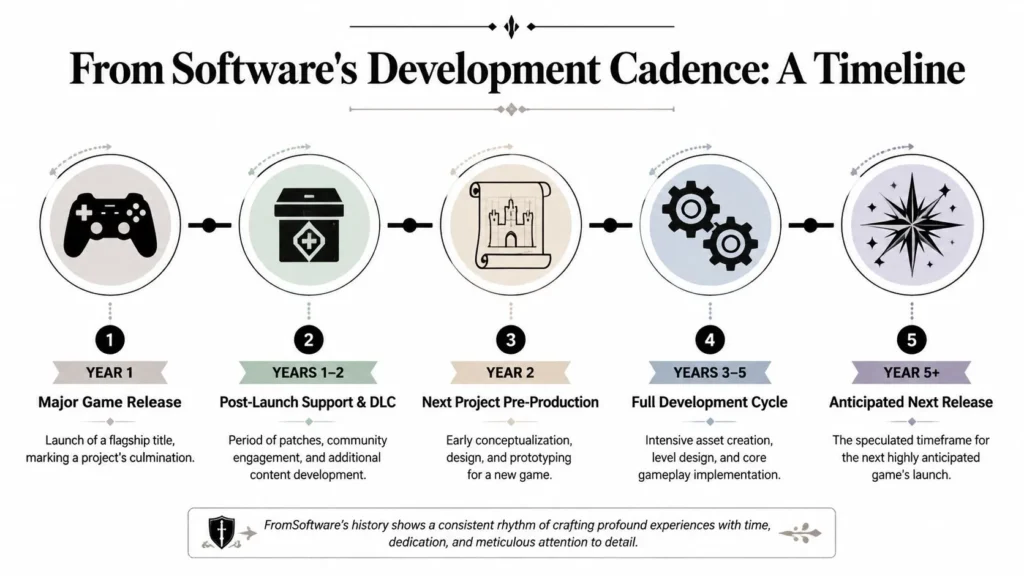
The clearest concrete lead is the reported multiplatform project codenamed FMC, said to be in advanced stages of production and reportedly targeting a 2026 release, according to GameSpot’s report on the unannounced FromSoftware title.
The codename matters because FromSoftware’s internal naming patterns can reveal what a project is not, even when they don’t fully reveal what it is. The reported “F” prefix aligns with franchises like Dark Souls and Armored Core, while Elden Ring reportedly used “GR.” That doesn’t confirm a new Dark Souls, but it does make one conclusion more plausible: this appears to be a core multiplatform project rather than DLC, and it appears distinct from projects outside that naming pattern.
What FMC likely rules out
The most useful way to read the rumor is by elimination.
| Possibility | How FMC affects it |
|---|---|
| Existing DLC | Less likely, because reporting frames FMC as a separate multiplatform title in advanced production |
| A platform-exclusive side project | Less likely, because the reporting specifically describes it as multiplatform |
| A pure Elden Ring follow-up under the same internal pattern | Unclear, but the codename distinction suggests a different internal classification |
That still leaves several real possibilities. It could be a new Dark Souls-related project, another Armored Core installment, or something structurally similar to those lines. What matters most is that it sounds like a major release candidate, not a minor experimental branch.
Why the studio’s positioning matters
FromSoftware doesn’t operate in a vacuum anymore. It now has to manage overlapping expectations across Souls fans, Armored Core fans, and the much broader audience Elden Ring created. A multiplatform title in advanced production suggests the studio wants its next major move to land wide, not narrow.
That also fits how Japanese game development has become increasingly central to global action RPG conversations. Readers tracking regional output can see that broader context in this look at games in Japan and how the market shapes major releases.
Practical rule: When a leak includes a codename, ask what it excludes before you ask what it confirms.
The timeline points to intent, not certainty
A reported 2026 target should be treated as a projection, not a promise. Development schedules move. Internal priorities change. Studios shift resources.
Still, “advanced stages of production” tells us something important even if the date slips. FromSoftware likely isn’t just ideating the next souls game. It appears to be far enough along that speculation can move from fantasy casting into production logic.
That changes the conversation. We’re no longer asking whether something exists. We’re asking what kind of release makes the most sense for a studio that knows the genre it created is now full of imitators, and knows its next announcement will be read as a statement about where action RPG design goes next.
Decoding the Most Credible Rumors and Leaks
The Souls community is unusually good at turning fragments into narratives. A codename becomes a sequel. A hiring post becomes a release window. A blurry screenshot becomes proof of anything people already wanted to believe.
That doesn’t mean all rumors are worthless. It means you need a filter.
Start with the category of rumor
Not all leaks do the same job. Some describe production reality. Others describe fan desire disguised as insider information.
Three categories tend to be worth watching:
Trade reporting and outlet aggregation
If a mainstream outlet reports a project codename, production status, or platform scope, that usually deserves attention. It still isn’t confirmation, but it sits closer to verifiable industry reporting than message-board fiction.Evidence tied to business behavior
Classification data, platform references, or staffing patterns can suggest what a studio is preparing, even when they don’t reveal the game itself.Detailed anonymous claims that match known constraints
These are the hardest to evaluate. A leak becomes more plausible when it doesn’t contradict known production realities and doesn’t promise everything at once.
What to distrust first
A lot of fake Souls leaks share the same tells.
- They’re too complete. Real leaks are often partial, messy, or narrow.
- They sound like a wishlist. If a rumor perfectly combines every fan-favorite mechanic and setting, it’s probably fan fiction with formatting.
- They hide behind certainty. People who know things often speak cautiously because plans change.
- They flatten the studio’s strategy. FromSoftware rarely makes the obvious move in the obvious way.
A good example is how people discuss The Duskbloods. Because it’s a named project in the wider conversation, some fans treat it as interchangeable with the next souls game. That’s a mistake. The more credible reporting around FMC points in the opposite direction by distinguishing the multiplatform codename from other projects rather than folding everything into one announcement cycle.
Ask what the rumor understands about FromSoftware
A leak gets stronger when it reflects the studio’s habits.
Does it understand that FromSoftware often iterates mechanically across games rather than merely repeating them? Does it account for the difference between a core multiplatform release and a side project? Does it leave room for the studio to zig where players expect it to zag?
Those questions matter more than cinematic details about dragons, kingdoms, or poison swamps.
Later discussions often help show how rumor culture snowballs once a project enters public imagination.
A better way to read leak season
Use this quick test before you believe any new claim about the next souls game:
| Question | Why it matters |
|---|---|
| Does it match known production information? | Contradictions usually expose fake leaks fast |
| Is the claim narrow or bloated? | Narrow claims are more believable than all-in-one reveal fantasies |
| Would this make sense as a studio move? | Plausibility beats excitement |
| Is anyone treating uncertainty honestly? | Serious reporting leaves room for revision |
A believable leak usually gives you less than you want, not more.
That’s the hardest discipline for fans. We want revelation. The most credible rumors usually offer limitation instead.
How the Souls Formula Will Evolve
The movement trend is already visible
If you ignore setting and focus on player verbs, FromSoftware has been moving in one direction for years. Combat has become faster, traversal more expressive, and character options more specialized.
That pattern looks sharper in recent analysis of the studio’s design direction. According to this breakdown of FromSoftware’s combat evolution, Elden Ring: Nightreign introduces faster overall speed than base Elden Ring, removes fall damage, and adds “supernatural” ability systems. The implication is hard to miss. The next game is likely to push movement velocity, verticality, and ability-driven mastery further than the older stamina-first Souls model.

That would be a major philosophical shift. Traditional Souls difficulty often came from what the player could not do. Limited healing, committed animations, punishing falls, and restricted mobility created danger by reducing your options. The newer trend suggests FromSoftware may create challenge by giving players more tools, then demanding sharper judgment in how they use them.
Difficulty may shift from restriction to complexity
The next souls game becomes interesting.
A faster, more vertical, more ability-heavy FromSoftware title doesn’t automatically become easier. In some ways, it can become more demanding. Players have to read more states, manage more cooldowns or abilities, and understand more encounter layers.
Here’s the key distinction:
- Restriction-based challenge says, “You are weak, slow, and exposed.”
- Complexity-based challenge says, “You are powerful, but the game expects mastery.”
That second path would let FromSoftware preserve intensity while refreshing the formula. It would also solve a growing problem in the genre. Once dozens of imitators copy dodge-roll timing and corpse-runs, the old markers of difficulty stop feeling unique. A richer movement and ability language gives the studio space to separate itself again.
The question fans avoid is accessibility
Most discussion of the next souls game still circles the same topics: lore, bosses, map scale, weapon classes. The under-covered issue is whether FromSoftware changes how players enter and progress through the experience.
Industry commentary has flagged that blind spot directly. There is virtually no coverage on whether FromSoftware will include accessibility features to broaden the game’s reach, even though that question matters as much as any mechanic reveal. That same analysis notes the broader importance of the issue and cites the World Health Organization estimate that 1.3 billion people experience disabilities, in this discussion of the accessibility gap in Souls speculation.
The studio now faces a real creative test. Many fans hear “accessibility” and immediately assume “easy mode.” That’s a narrow reading. Accessibility can mean clearer UI, better remapping, improved readability, alternative input support, visual cues, or modular assist systems that don’t flatten the game’s identity.
Critical point: Difficulty and accessibility are not the same design problem.
A brutal boss can stay brutal while the game around it becomes easier to perceive, parse, and physically traverse. That distinction matters because FromSoftware now has a larger audience than it had in the Dark Souls era, and larger audiences contain more varied needs.
The smartest outcome is selective adaptation
I don’t think the next souls game needs a generic difficulty slider to evolve. That would be the least imaginative version of “accessibility.” What it likely needs is a more modern menu of options that lets players tune friction without removing consequence.
That could include:
- Control flexibility that respects different physical needs
- Readability improvements for attacks, menus, and status effects
- Optional assistance layers that help with onboarding rather than flattening endgame challenge
If FromSoftware adopts that approach, it won’t be “selling out.” It’ll be doing what its best games already do: separating meaningful challenge from unnecessary obstruction.
And if it refuses entirely, that refusal will say something too. It would signal that the studio still sees harshness itself, not just mastery, as central to its identity. Either choice would shape how the next souls game is remembered.
Contenders Beyond FromSoftware in the Soulslike Arena
The next souls game won’t arrive into the same market that greeted Dark Souls or even Sekiro. It’ll launch into a field crowded with games explicitly trying to borrow, remix, or outscale the formula FromSoftware popularized.
That crowding is no longer anecdotal. The soulslike category on Steam jumped from 9 releases in 2015 to 371 in 2024, before dipping to 207 in 2025, according to WNHub’s market analysis of soulslike releases and regional demand. Many of those are smaller projects, but the important point isn’t just volume. It’s that the genre has become a recognized commercial lane.
The competition is now global and top-heavy
The same WNHub analysis shows how concentrated the paying audience has become. Asia-Pacific gamers purchased 97% of all soulslike copies in 2025, and Black Myth: Wukong reached 20.3 million units. Those are not niche signals. They show a genre with mass appeal, especially in markets that increasingly shape what rises to the top.
That context changes how we should think about FromSoftware’s next move. Its biggest competition may no longer be “other Souls clones” in the old sense. It may be major action RPGs that absorb parts of the formula while packaging them with different cultural settings, pacing, and production values.
What rivals can offer that FromSoftware sometimes won’t
Competing studios can be more flexible in certain areas because they don’t carry the same legacy burden. They can adopt cleaner onboarding, louder storytelling, or broader accessibility from the start without fans accusing them of betraying a sacred design code.
That’s why the next souls game has to compete on more than pedigree. Brand prestige still matters, but players now have alternatives. Anyone browsing recommendations for the best games to play on PC right now will see a gaming environment where action RPG fans can move between styles rather than waiting on one studio alone.
The crowded field creates one advantage for FromSoftware
Paradoxically, saturation may help the studio that started it all.
When a genre floods with imitators, players start noticing the difference between surface mimicry and deeper design confidence. Plenty of games can reproduce checkpoints, boss gates, and melancholy worlds. Fewer can build the exact rhythm of danger, discovery, and authored surprise that FromSoftware still handles better than most of the field.
Competitors have proved the formula is durable. FromSoftware now has to prove it still owns the sharpest version of it.
That’s why the next souls game doesn’t need to be the biggest soulslike ever made. It needs to feel like the one only this studio could have made.
How to Track News and Verify Future Updates
If you want to follow the next souls game without drowning in nonsense, build a simple verification habit. Most bad reporting spreads because fans treat every rumor as a reveal and every content creator as a reporter.
Start with the obvious rule. Official statements outrank interpretation. If FromSoftware or a publishing partner says something directly, that’s the baseline. Everything else sits below it.
Build a source ladder
Use a hierarchy instead of scrolling one feed and hoping for the best.
Official channels first
Watch studio announcements, platform showcases, and publisher statements before you trust summaries from anyone else.Established reporting second
If a mainstream games outlet reports production details, compare its wording carefully. Distinguish between “reportedly,” “in development,” and “announced.” Those words matter.Community analysis third
Dataminers, forum regulars, and YouTube analysts can be useful, but they work best as interpreters, not foundations.Anonymous posts last
Treat them as entertainment until stronger evidence appears.
Watch for the underreported details
The loudest conversations will keep centering on bosses, lore, and release windows. That leaves one of the most important topics easy to miss. As noted in earlier analysis, there is very little discussion of whether FromSoftware will address accessibility in any meaningful way, even though that issue could shape how many players can engage with the next game at all.
So when official interviews, previews, or feature pages arrive, don’t just scan for weapon names and map size. Check for:
- Control remapping and input options
- HUD and text readability
- Visual and audio assist settings
- How the game explains mechanics without overexplaining them
Those details tell you more about the studio’s direction than most cinematic trailers will.
A quick verification checklist
Before sharing any “next souls game” update, run it through this list:
| Check | What to look for |
|---|---|
| Wording | Does the claim say “announced,” “reported,” or “rumored”? |
| Origin | Can you trace it back to an identifiable source? |
| Scope | Is it one detail, or a giant package of convenient fan desires? |
| Consistency | Does it fit the known picture, or rewrite it entirely? |
One more habit helps. Learn the difference between a credible citation and a circular one. A lot of gaming rumor coverage rewrites another rewrite of a claim until the original source disappears. If you want a cleaner framework for evaluating that chain, this guide on how to find credible sources for research is useful well beyond games coverage.
Follow the claim backward. If it dissolves into screenshots, aggregation, and vibes, it wasn’t solid to begin with.
The next souls game will generate a long season of speculation because FromSoftware has earned that level of attention. But the most valuable skill for fans now isn’t guessing the title. It’s learning which scraps of information deserve belief, which deserve caution, and which deserve a quick mute.
If you want more clear, evidence-based writing on games, tech, culture, and the wider trends shaping them, visit maxijournal.com. It’s an independent publication built for readers who want sharp commentary without the usual noise.
Discover more from Maxi Journal
Subscribe to get the latest posts sent to your email.