You’re probably in one of two camps right now. You either finished Shadow of the Tomb Raider years ago and have been waiting for Lara’s next proper leap forward, or you’re hearing the noise around the new tomb raider and trying to work out whether this is another reboot, a remake, or the start of something bigger.
The interesting part is that it’s a bit of all three in spirit, even when the projects themselves are different. Tomb Raider is no longer in a place where a new game can merely look sharper and tell a larger story. The series has to answer a harder question. Who is Lara Croft now?
That question matters because Tomb Raider isn’t just another legacy name. The franchise passed 100 million lifetime unit sales by October 2024 and stands as the 14th best-selling video game series in history, according to Statista’s Tomb Raider lifetime sales tracking. When a series has that kind of history, every new entry has to satisfy two audiences at once. It has to give longtime fans the poised, capable raider they remember, and it has to build on the grounded, hard-earned version of Lara that the Survivor era made central.
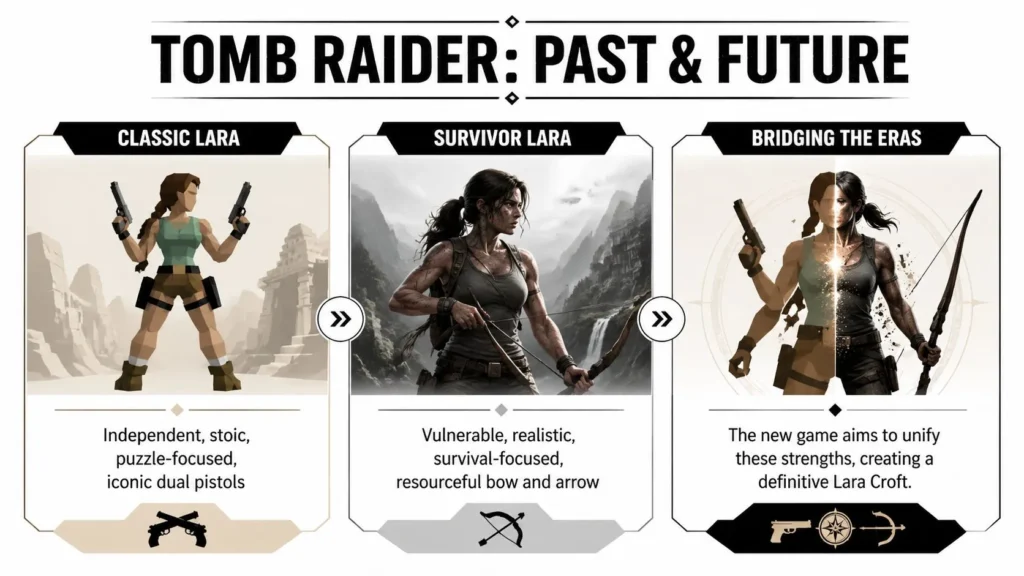
That’s why the most useful way to look at the new tomb raider isn’t as a checklist of features. More significantly, Crystal Dynamics appears to be pushing toward a unified Lara, one who connects the classic adventurer and the modern survivor into a single, definitive version of the character.
The Next Chapter for Lara Croft Begins
For years, the post-Shadow conversation had a strange split to it. Fans wanted the confidence, puzzle-heavy solitude, and swagger of classic Lara back, but many also didn’t want to lose the emotional credibility the Survivor trilogy rebuilt from scratch. That tension has defined nearly every serious discussion around the next game.
The current moment feels different because the franchise isn’t drifting between identities anymore. It’s consolidating them. That’s the part worth paying attention to.
Why this game carries unusual pressure
A lot of long-running series can afford a transitional installment. Tomb Raider really can’t. Lara is too iconic, and the series history is too visible. One weak directional choice gets magnified immediately because players know exactly what classic Tomb Raider felt like, and they also know what the 2013 reboot achieved.
The next mainline game doesn’t just need to be good. It needs to make the different versions of Lara feel like the same person.
That challenge is bigger than story. It reaches into traversal, tone, combat rhythm, puzzle density, and even animation. If Lara moves like the Survivor-era character but talks like the classic-era icon, players will notice the mismatch. If the game pushes blockbuster set pieces but forgets the lonely, archaeological pull that made the originals special, that will also feel off.
What fans should actually watch for
The most revealing signs won’t be flashy. They’ll be practical.
- How Lara initiates the adventure: Is she reacting to catastrophe, or seeking out danger with confidence?
- How the tombs are framed: Are they optional side attractions, or the heart of the fantasy?
- How combat is balanced: Does Lara feel hunted, or in control?
- How exploration flows: Is traversal there to connect action scenes, or is movement itself part of the thrill?
Those choices will tell you more about the new tomb raider than any cinematic trailer ever could.
What We Know About the New Tomb Raider Release
The confirmed information is still selective, so the best way to approach this is like a release briefing. Separate what’s been stated from what fans are projecting onto it.
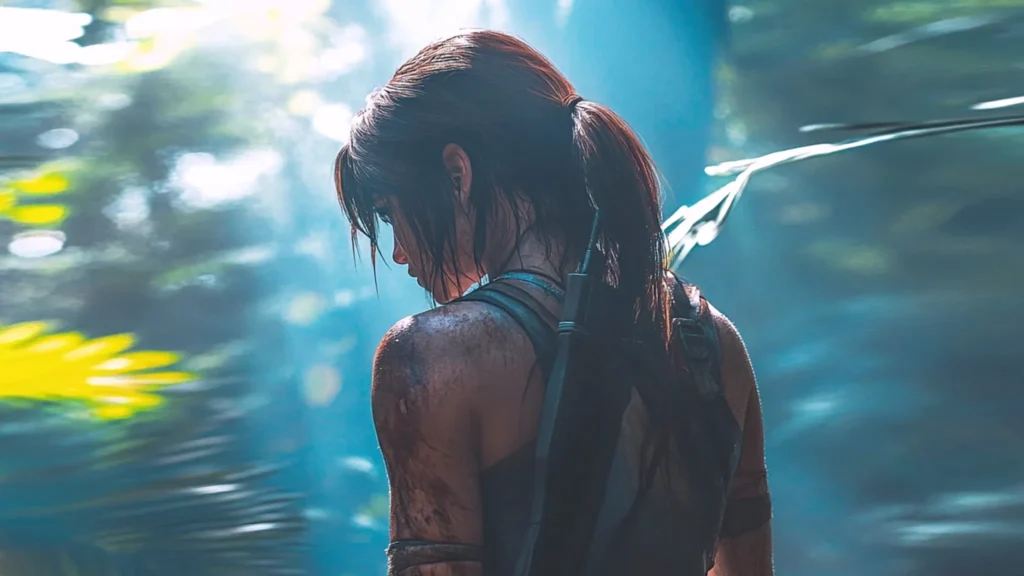
The practical release picture
Crystal Dynamics is the studio tied to this next phase, with Amazon Games involved on the publishing side. That matters because it suggests a project being positioned as a major platform release rather than a smaller stopgap sequel.
There’s also a separate 2026 remake project in the franchise orbit, Tomb Raider Legacy of Atlantis, but fans should be careful not to treat every announcement as the same product. The franchise is active on more than one front, and that creates confusion fast if you’re not distinguishing remake from new mainline direction.
What you should assume and what you shouldn’t
A smart rule here is simple. Treat official platform and timing language as provisional until store pages, retail listings, or publisher scheduling lock it down. Big projects move. Names change. Editions appear late.
What’s more useful at this stage is understanding the likely shape of the rollout:
Reveal first, specifics later
Major action-adventure games often show tone and world before they show systems. If you haven’t seen full menus, edition breakdowns, or preorder structure yet, that isn’t unusual.Platform messaging will signal ambition
If the new tomb raider is framed for current-generation hardware and PC, that usually means the team wants fewer technical compromises around world density, traversal complexity, and simulation.Collector appeal is almost guaranteed in spirit
Tomb Raider has a strong memorabilia culture. Even without firm public details on editions, this is the kind of release that naturally lends itself to art books, statues, soundtrack extras, or cosmetic bonuses.
Buying rule: Don’t preorder on brand loyalty alone. Wait for a real gameplay demonstration that shows traversal, puzzle design, and combat in uninterrupted play.
That’s especially important with Tomb Raider, because polished trailers can sell atmosphere while hiding whether the actual game loop is exploration-first or action-first. With this series, that distinction changes everything.
Uniting the Survivor and the Classic Raider
The most promising idea around the new tomb raider is also the hardest one to execute. It isn’t just “bring back dual pistols” or “make Lara less vulnerable.” Those are surface signals. The true task is building a Lara who plausibly contains both histories.
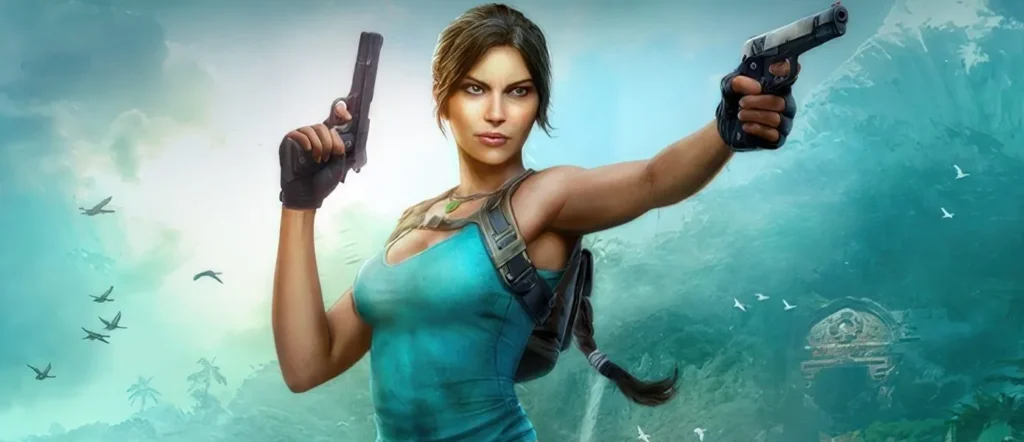
A useful clue comes from the game’s reported scale and setting. The new game is described as the largest open-world scope in the series’ history, set across northern India, according to Feral Interactive’s referenced material on the new Tomb Raider direction. That kind of space matters because it supports a different version of Lara. A broader, more traversal-driven world fits a hero who isn’t merely escaping danger but deliberately mastering it.
Why a unified Lara needs a different posture
Classic Lara usually entered a place as the most capable person in the room. Survivor-era Lara earned capability through damage, fear, and adaptation. Both versions work. The challenge is that they produce different dramatic engines.
A unified Lara needs to carry the emotional intelligence of the newer games without remaining stuck in constant trauma response. She should read danger clearly, make bold decisions, and still feel human when things go wrong. That balance is the entire character brief.
In practical terms, that means the writing has to avoid two common mistakes:
Overcorrecting into invincibility
If Lara becomes too polished, she stops feeling contemporary and risks turning into a mascot instead of a person.Clinging to perpetual fragility
If every scene still treats her like she’s proving she can survive, the character never evolves.
Why northern India makes sense
A setting like northern India offers strong terrain variety, verticality, ruins, modern intrusion, and room for competing factions. Those ingredients suit a Lara who’s operating by judgment rather than panic.
“Unified” should appear in gameplay as much as dialogue. A more experienced Lara should proceed with intention. She should read ancient spaces quickly, improvise with tools confidently, and approach conflict as a problem to solve, not just an ordeal to endure.
The best version of unified Lara won’t feel like a compromise. She’ll feel like the natural endpoint of both eras.
That’s also why an open structure can help if the team uses it well. Open worlds aren’t automatically better for Tomb Raider. They can dilute tension and bury tomb design under checklist content. But if the world is built around routes, ruins, layered discovery, and meaningful traversal, then a larger scope becomes a character statement. Lara belongs in motion. She should look like someone who chooses the hardest path because she knows she can handle it.
Signs the unification is working
Here’s what I’d look for in any serious gameplay showing:
- Proactive exploration: Lara pursues mysteries because she wants answers, not because a disaster forced her there.
- Calm competence in traversal: Movement should look assured without becoming frictionless.
- Less reactive dialogue: She shouldn’t narrate fear constantly. Curiosity, skepticism, and confidence should lead.
- Puzzle authority: The game should present Lara as intellectually dominant in ancient spaces.
If those pieces land, the new tomb raider could do something the series has been circling for years. It could finally make “classic” and “modern” feel like phases of one believable life.
Redefining Exploration and Combat
Unreal Engine 5 is easy to oversell because the terminology sounds dramatic. Lumen. Nanite. Chaos Physics. Most players don’t care about engine branding by itself. They care about whether tombs feel more tactile, traversal feels less scripted, and combat stops looking like disconnected encounter arenas.
That’s where the new tomb raider has real potential.
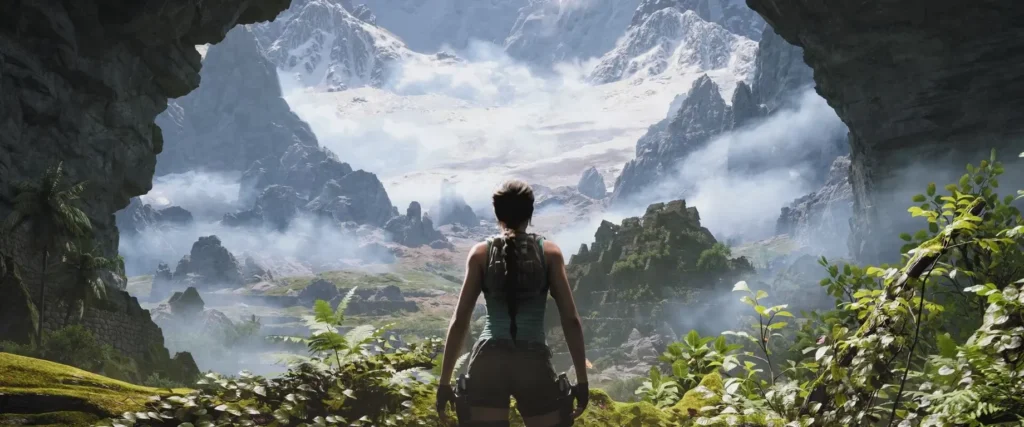
The clearest confirmed point is that the game’s use of Unreal Engine 5 allows for advanced environmental destruction via Chaos Physics and expanded traversal mechanics that work with Nanite’s virtualized geometry for a highly detailed world, as described on the Steam listing for Tomb Raider Legacy of Atlantis. Even if you strip away the technical language, the implication is straightforward. The environment should matter more moment to moment.
What the engine shift should change for players
In older Tomb Raider games, environments often fell into two categories. They were either gorgeous backdrops or puzzle machines with tightly controlled interactions. UE5 creates room for something messier and better, where the spaces can still be authored carefully but react more dynamically.
That matters in three areas.
Tombs should feel physical again
The best tombs aren’t just puzzle boxes. They’re places with weight, risk, and texture. Better lighting can help, but the bigger win is reactivity. If debris, collapse, rope systems, water flow, and destruction feed into puzzle-solving, exploration becomes more than climbing to the next white-painted ledge.
A practical test for the new tomb raider is whether the tombs encourage observation over prompt-following. If players can read a chamber, notice unstable architecture, and exploit the space creatively, then the technology is serving design instead of replacing it.
Traversal can become a real skill
Traversal in the Survivor trilogy often looked athletic and cinematic, but it was sometimes more guided than fans admitted. That style works for pacing, but it can flatten the sense of discovery.
A grapple hook tied into physics systems offers a better path if handled carefully. It can make movement expressive, not just permissive. Swinging, yanking objects, triggering collapses, crossing gaps, and interacting with layered geometry all create a stronger raider fantasy than simple context-sensitive climbing.
- What works: routes with multiple readable options, momentum-based movement, traversal tools that also affect puzzles
- What doesn’t: endless handholds, automated jumps, and movement systems that look elaborate but solve themselves
For players keeping an eye on the broader PC space, this is also the kind of release that could end up on lists of the best games to play on PC right now if the simulation and traversal systems hold up in practice, not just in trailers.
Combat has to stop fighting the fantasy
Tomb Raider combat often lands in an awkward middle space. If it gets too heavy and militarized, Lara starts feeling like she wandered out of a different franchise. If it becomes too sparse or passive, the action side loses bite.
The way forward is environmental combat. Not more enemies for the sake of noise, but fights where terrain, traps, verticality, and destruction matter.
Field note: Tomb Raider combat is strongest when Lara feels agile and inventive, not when she’s pinned into repetitive cover exchanges.
That means Chaos Physics is more than spectacle if enemies and level layouts are built around it. A collapsing floor, a destructible support beam, a grapple-assisted takedown, or a hazard triggered by smart positioning all fit Lara better than generic firefights.
A short gameplay clip gives a clearer sense of the tone developers seem to be chasing.
The biggest trade-off
There is a risk here. More systemic worlds can weaken handcrafted pacing. Tomb Raider needs authored moments. It needs chambers that feel ancient and intentional, not procedural in spirit. If the team leans too hard into open-ended systems, the game could lose the tight cause-and-effect design that made the best tombs memorable.
The ideal balance is clear. Use UE5 to make authored spaces richer, not looser. Give Lara more tools, but keep level design legible. Let combat emerge from the environment, but don’t let spectacle replace tension.
If Crystal Dynamics hits that balance, exploration and combat won’t just look better. They’ll finally reinforce the same fantasy.
Evolving From Survivor and Honoring the Classics
The cleanest way to understand the new tomb raider is to compare the series’ three major identities side by side. The classics established the icon. The reboot rebuilt the person. The next game has to make those strengths coexist.
The commercial case for evolving from the Survivor formula is obvious. The 2013 reboot sold 14.5 million units, and the Survivor Trilogy contributed 38 million units to the franchise total, according to VGChartz’s Tomb Raider sales overview. That formula worked. The mistake would be assuming that success means it shouldn’t change.
Tomb Raider Evolution Comparison
| Feature | Classic Era (1996-2003) | Survivor Trilogy (2013-2018) | New Tomb Raider (2026) |
|---|---|---|---|
| Lara’s identity | Stoic, self-directed raider | Grounded, vulnerable survivor | Aimed at a unified, experienced Lara |
| Core fantasy | Solitary tomb exploration | Origin story and endurance | Confident adventure with modern emotional depth |
| Movement | Deliberate platforming precision | Cinematic traversal and survival climbing | Broader traversal with more systemic interaction |
| Combat feel | Acrobatic, arcade-leaning | Heavier, more cinematic and improvised | Best fit is agile combat shaped by the environment |
| Puzzle role | Central to progression | Strong, but often secondary to story momentum | Needs to reclaim a leading role |
| World structure | Structured levels | Semi-open hubs and story corridors | Larger world design with exploration emphasis |
What the classics still do better
Classic Tomb Raider understood something many action games forget. Isolation is part of the appeal. Lara didn’t need constant radio chatter, endless factions, or frequent emotional exposition to hold attention. The silence was part of the atmosphere.
That older design also respected player orientation. You learned spaces through movement and failure. The controls could be rigid, but the geometry had logic. You felt like you were mastering a hostile place.
What the Survivor games improved
The reboot era solved a different problem. It made Lara emotionally readable for a modern audience and gave the series blockbuster momentum. It also tightened animation, environmental storytelling, and the sense of physical struggle.
For newcomers, that formula remains the easiest entry point. It’s one reason Tomb Raider still resonates in global gaming conversations, including markets and player communities often discussed in features about gaming culture and trends in Japan, where legacy characters and modern presentation often coexist in interesting ways.
The next game shouldn’t reject Survivor. It should graduate from it.
That’s the distinction that matters. The bow, crafting instincts, improvised problem-solving, and grounded body language all have value. But they need to serve a Lara who has already become herself.
What must be carried forward and what should be left behind
- Keep the grounded animation work because it makes traversal and danger believable.
- Keep environmental storytelling because tombs and ruins need context.
- Bring back stronger puzzle primacy so archaeology isn’t just cosmetic.
- Reduce over-scripted peril because constant near-death sequences lose impact.
- Restore a sense of cool-headed control so Lara feels like a raider again.
If the new tomb raider can take the reboot’s credibility and reconnect it with the classics’ confidence, it won’t feel nostalgic or apologetic. It’ll feel overdue.
The Team and Vision Behind the New Adventure
Big adventure games reflect business decisions as much as creative ones. That doesn’t make them cynical. It just means you can often see the intended scale, audience, and franchise role by looking at who’s backing the project and how they’re positioning it.
Crystal Dynamics remains the key name because it already handled the modern reinvention of Tomb Raider. That history matters. The studio knows how to present Lara to a contemporary audience, but it also carries the baggage of choices fans still debate, especially around combat density and cinematic pacing.
Why the broader franchise plan matters
The new game isn’t arriving in isolation. It’s part of a wider revival that includes a live-action series on Prime Video, which signals a coordinated media push around the property, as noted by TombRaider.com’s remaster feature roundup. That kind of strategy usually means the publisher and rights holders want a clearer, more stable version of the character at the center.
That’s another reason the unified-Lara approach makes so much sense. A fragmented version of the character is hard to build a wider franchise around. A definitive version travels better across games, TV, marketing, and licensing.
What to look for in trailers and demos
The smartest way to read upcoming footage is to ignore the spectacle first and study behavior.
- Watch Lara’s default demeanor: calm confidence tells you more than explosions do.
- Watch how often the camera gives control back to the player: too many interruptions can signal another heavily scripted structure.
- Watch the tomb spaces: if they look like visual set dressing, that’s a warning sign.
- Watch encounter design: if every fight looks like a conventional shooter arena, the unification pitch may be skin deep.
A strong Tomb Raider reveal should make you want to explore a chamber, not just survive a collapse.
That’s the standard worth holding the new tomb raider to.
Your Guide to Staying Updated
Following this game closely is mostly about filtering noise. Tomb Raider attracts speculation fast, especially when a new project is trying to bridge old and new audiences at the same time.
The best approach is simple. Track official channels, wishlist the game once its store pages are stable, and judge each update by three criteria: does Lara feel more self-possessed, do tombs look central, and does the gameplay show real interaction rather than cinematic suggestion?
For day-to-day tracking, it also helps to keep a short list of reliable gaming and tech coverage in your rotation instead of chasing every rumor thread. A broader roundup of tech and gaming news sources worth following can save time if you want fewer repeats and better signal.
If the current direction holds, the new tomb raider could mark the cleanest identity the series has had in years. Not a reset. Not a retreat. A version of Lara Croft that finally feels complete.
If you enjoy clear, grounded coverage of games, technology, entertainment, and culture, visit maxijournal.com. It’s an independent online magazine publishing fresh writing across gaming and far beyond it, with approachable commentary for curious readers and contributors alike.
Discover more from Maxi Journal
Subscribe to get the latest posts sent to your email.