You’re probably here because you want bangs, but thin hair makes the idea feel risky. That hesitation is reasonable. A fringe can make fine hair look fuller and softer, or it can expose every sparse section at the front if the cut is wrong.
The difference isn’t just the haircut. It’s the system behind it. With bangs for thin hair, the cut, the shape, the product weight, the blow-dry direction, and the trim schedule all matter. When those pieces work together, bangs stop being a gamble and start acting like a built-in volume trick.
Why Bangs Can Be a Game Changer for Thin Hair
You see it first in the mirror at the front hairline. The part reads wider by midday, the roots lie close to the scalp, and the style can look flatter from the front than it does from the sides. A well-cut fringe changes that visual balance fast because it puts shape, texture, and controlled movement in the exact area the eye notices first.
That visual change is not just about cutting shorter pieces around the forehead. It comes from placement. Bangs can soften a sparse-looking hairline, break up a broad parting, and create overlap between strands. That overlap matters on fine or low-density hair because a few light pieces crossing over each other usually look fuller than the same hair hanging straight down.
In salon terms, bangs work as an optical correction. They redirect attention, add a stronger outline around the face, and give the style a more deliberate finish.
The best results usually come from fringe shapes with air and bend.
Practical rule: Thin hair looks fuller when the fringe has lightness at the ends, lift at the root, and a shape that encourages strands to fall over one another. Hair looks thinner when bangs are cut too thick, too blunt, or styled flat against the forehead.
Why this works on fine hair
A flattering fringe changes what the eye reads first:
- Attention shifts forward: The face-framing area takes focus before the part or crown does.
- Strands overlap: Fine hair gains visual density when pieces cross instead of separating into see-through sections.
- Edges blur gaps: Wispy or angled ends hide spacing better than a hard, straight line.
- Lift lasts longer: Shorter front sections are often easier to direct with a round brush or lightweight styler, which helps support volume through the day.
There is also a real trade-off here. Bangs can make thin hair look fuller overall, but only if the section taken for the fringe is small and strategic. Remove too much hair from the front, and the top and sides lose support. That is why thin hair usually responds better to a lighter fringe with smart placement than a thick, heavy bang that demands more density than the hair can give.
The science matters after the cut too. Fine hair collapses easily because it has less bulk to prop itself up, and heavy creams or oils can make that happen faster. A fringe succeeds when the cut pattern, product weight, and blow-dry direction work together. Done well, bangs do more than cover the forehead. They create a fuller-looking front section that helps the entire haircut read thicker.
The Most Flattering Bangs for Fine Hair
Fine hair does best with bangs that create movement, overlap, and lift without stealing too much density from the front hairline. The best fringe shapes share one trait. They make a small amount of hair look like more by controlling how light hits the ends and how the strands sit on top of each other.
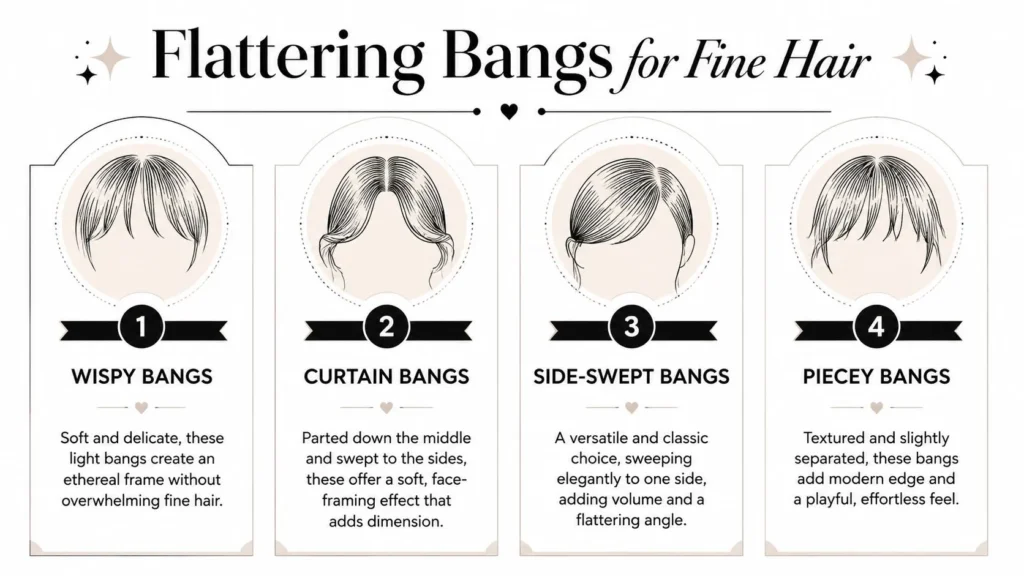
Wispy bangs
Wispy bangs are usually the safest starting point. I recommend them often for clients with fine texture because they use a narrow section, keep the perimeter soft, and avoid that hard see-through line that blunt bangs can create on sparse fronts.
They also hold up better on imperfect hair days. If the roots fall flat by noon or the forehead gets a little oily, a wispy fringe still reads soft and airy instead of stringy. That is a big advantage with fine hair, where small changes in oil or humidity show fast.
Another reason they flatter is visual. Feathered ends scatter light more gently than a dense, solid edge, so the fringe looks fuller without looking heavy.
Curtain bangs
Curtain bangs work well for fine hair because they spread the shape outward instead of asking one thick panel to cover the whole forehead. That outward sweep creates width at the cheekbones and helps the front layers support the fringe.
They are also practical. A curtain shape gives you some room if your hairline is uneven, your density is stronger at the temples than the center, or you do not want to style a full bang every morning. With the right cut, they can air-dry into a soft bend or be polished with a quick blow-dry.
The best version for thin hair is usually lighter through the center and slightly longer at the corners. That keeps the middle from separating too much while letting the sides blend into the haircut.
Curtain bangs usually look fuller when the shortest pieces are not too short. A little extra length gives fine hair more surface area to bend and stack.
Side-swept bangs
Side-swept bangs are one of the most reliable options in the salon for low-density hair. The diagonal direction does a lot of the work. Hair crossing from one side to the other naturally layers over itself, and that overlap creates the illusion of more body.
They are especially useful if density is uneven. A side sweep lets you direct hair toward the area that needs softness, coverage, or balance. It also grows out gracefully, which makes it easier to maintain if you are new to bangs.
From a styling standpoint, side-swept bangs respond well to root lift at the base and a slight bevel through the ends. Fine hair rarely needs much product here. Usually it needs better direction.
Micro and soft blunt variations
A classic heavy blunt fringe is a tough ask for thin hair, but softer versions can work beautifully. A soft blunt bang keeps a clear shape while the ends stay textured enough to avoid that stiff, flat curtain effect. A micro variation can also suit fine hair if the section is narrow and the line is slightly broken up.
This is a more technical cut. It shows every mistake. If the stylist takes too much width, the sides look hollow. If the line is cut too dense, the fringe can separate into strings within hours. Done well, though, it gives fine hair a polished, editorial finish that lighter bangs do not always deliver.
What usually works less well
Some bang trends fight the natural behavior of fine hair instead of working with it.
- Heavy blunt bangs: They remove too much hair from the front and often expose thinness at the crown and sides.
- Over-texturized piecey bangs: They can turn wispy in the wrong way and make gaps more obvious.
- Strong arched bangs: They need more built-in density to keep the curve looking full from edge to edge.
If you want a sharper look, ask for structure with softness at the ends. Fine hair can absolutely wear bangs. It just needs a shape that supports volume after the cut, not one that depends on density that is not there.
Finding Your Perfect Match Bangs and Face Shapes
You can show the same bang photo to two people with thin hair and get two very different results. Face shape is part of the reason. Bangs change the visual proportions of the forehead, cheekbones, jaw, and hairline, so the best choice is the one that creates balance without asking fine hair to fake density it does not have.

The goal is simple. Use line, width, and softness in the fringe to shift what the eye notices first.
A quick matching guide
| Face shape | Bangs that usually flatter | Why it works |
|---|---|---|
| Oval | Wispy, curtain, soft micro | Oval faces usually carry more bang shapes without losing balance |
| Round | Side-swept curtain bangs | Diagonal lines create a longer, narrower impression |
| Square | Curtain or side-swept | Softer edges reduce visual sharpness through the jaw and forehead |
| Heart | Wispy or side-swept | These break up forehead width without adding bulk |
| Long | Fuller curtain or soft blunt | More horizontal shape helps offset facial length |
A guide from Salon 1150 on the best bangs for thin hair by face shape notes that side-swept and curtain shapes are especially useful on round faces because the diagonal line visually lengthens the face. That principle tracks with what I see behind the chair. Angled movement tends to be more forgiving than a straight-across fringe on fine hair because it adds shape without exposing every gap.
How to read your own features
Few clients fit one textbook face shape, and that is completely normal. I get better results by reading the strongest feature first. Look at where your face appears widest, where the forehead sits, and whether your jaw reads soft or angular. Then choose a fringe that offsets that feature rather than matching it.
Use these cues:
- Face widest at the cheeks: Ask for a bang with diagonal flow. It pulls the eye outward and down instead of straight across.
- Forehead feels prominent: Side-swept or broken-up wispy bangs usually soften that area better than a dense line.
- Jaw looks strong or angular: Feathered or curved edges keep the fringe from looking too severe.
- Face looks long: Keep enough fullness through the bang so it stays visible and creates width.
- Hairline is fine or see-through: Choose a narrower bang section so the front still looks full once styled.
The science involved is important. Fine hair creates volume partly through optical effect. A soft bend, a diagonal parting, or a slightly fuller center can make the front hairline look denser because the eye reads shadow and movement as fullness.
Age, softness, and maintenance reality
Curtain bangs often suit mature clients with fine or thinning hair because they soften the hairline and blend into the rest of the cut as they grow. They also give you more flexibility on lower-volume days. If the roots are flat, you can split them wider. If the hair is freshly styled, you can bring them forward for more coverage.
Maintenance still matters. If bangs get oily fast, they separate and the face-shape effect disappears. A lightweight routine and the right wash products help preserve that airy finish. If you are reassessing your haircare, this guide to the best drugstore conditioners for fine hair that will not weigh bangs down is a useful place to start.
A flattering fringe works because it guides the eye well, holds its shape between washes, and respects the limits of thin hair. That is the match worth asking for.
How to Style Bangs for Maximum Volume
A good cut can still fall flat if the styling routine is wrong. Thin hair responds quickly to product overload, excess moisture, and heavy conditioning. The styling protocol has to build lift without coating the hair.

A proven routine described by KilgourMD’s expert tips on thin hair and bangs starts with damp hair and volumizing mousse, then uses a round brush during blow-drying to create root lift. The same guidance warns that conditioner should only be applied to bangs every 2-3 shampoos so they don’t get oily and weighed down.
Start with the right moisture level
Bangs shouldn’t be dripping wet when you style them. If they’re too wet, the hair stretches and sticks to the forehead. That makes lift harder to build.
Towel-dried or lightly damp hair is the sweet spot. At that stage, the hair still has flexibility, but it’s ready to hold shape.
Product order matters
For thin hair, every product needs a job. If it doesn’t serve the shape, skip it.
Use this order:
- Heat protectant first: Keep it light and even.
- Volumizing mousse second: Focus at the roots and through the underside, not just the top.
- No heavy oils or creams before drying: They flatten the fringe before it has a chance.
If you’re also rethinking your wash routine, a lightweight formula from guides to the best drugstore conditioner is usually a better fit than anything rich or overly creamy for the front hairline area.
The blow-dry technique that actually lifts
Most of the volume comes from this specific technique. The round brush isn’t just for polish. It sets direction and root support.
- Pull the bangs forward, then up: That gives the root some rise before you decide the final direction.
- Overdirect side to side: Drying the fringe in the opposite direction first helps reduce separation.
- Roll the brush slightly at the ends: That creates bend instead of a flat sheet.
- Use low heat with controlled airflow: Thin hair gets stressed fast under aggressive heat.
Here’s a visual walkthrough for the mechanics:
Small adjustments that make a big difference
A fringe on thin hair often needs minor resets during the day. That doesn’t mean the cut is wrong. It means the hair is fine and the forehead area gets warm and oily faster.
Try these fixes:
- Use your fingers, not a paddle brush: A brush can flatten the root you built earlier.
- Refresh with a quick blast of air: Even a brief blow-dry reset can bring back shape.
- Keep hands off the bangs: Touching them transfers oil and breaks up separation.
- Condition the rest of the hair more than the fringe: The front needs lift more than slip.
The best styling product for bangs is often restraint. Thin hair looks bigger when it’s clean, light, and movable.
Keeping Your Bangs Perfect Maintenance and Trimming
You wake up, smooth the fringe into place, and suddenly it sits in your lashes instead of floating above the brows. Thin hair reaches that point fast. A few extra millimeters can flatten the shape, split the ends apart, and make the front look sparser than it really is.
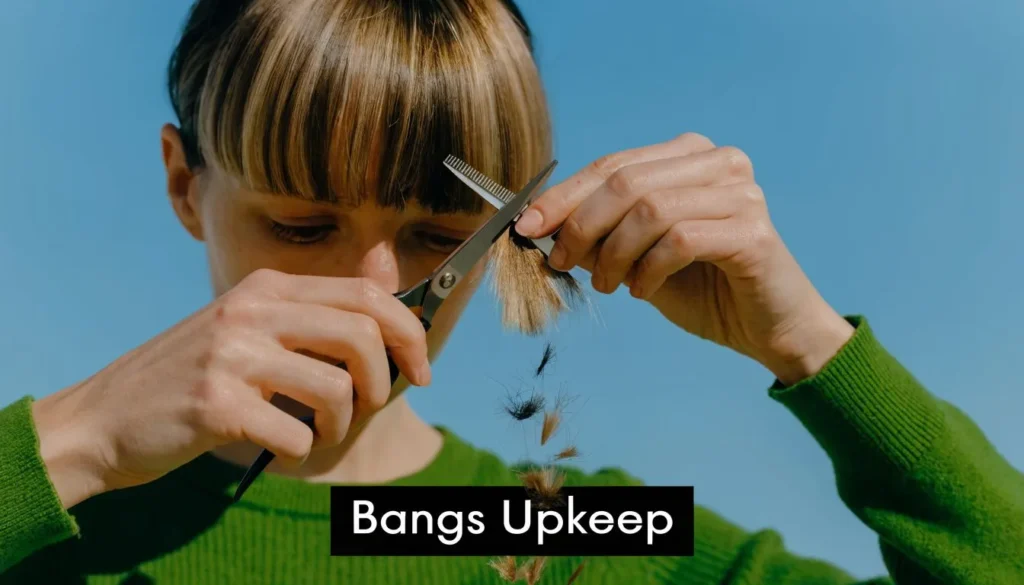
That is why bang maintenance matters as much as the original cut. On fine hair, length, weight, oil, and growth pattern all show up quickly at the hairline. Salon 1150’s guide to bangs for thin hair notes that curtain and side-swept bangs often need trims every 2 to 3 weeks to keep their shape. That schedule makes sense in the chair. Once the edge gets too long, the bangs stop lifting and start separating.
What proper maintenance looks like
Good upkeep protects density first, then shape. Thin hair does not give much room for correction, so the best routine is gentle and consistent.
- Schedule small fringe trims: Tiny cleanups keep the line light and prevent that heavy, overgrown curtain effect.
- Watch tension at the hairline: Tight clips, rough brushing, and forceful round-brush pulling can weaken the shortest front hairs over time.
- Trim less than you think: A stylist can always refine a soft edge. Hair removed from a thin fringe is slow to replace.
- Treat only the ends if they look dry: A pinhead amount from a guide to how argan hair oil works on dry hair ends can soften tips without collapsing the root.
The science is simple. Volume in bangs comes from low weight at the front and enough spring at the root to resist oil and gravity. Once the perimeter gets too long or the ends get frayed, the fringe reflects more scalp, not less.
When to trim at home and when not to
At-home trimming is reasonable for a very small cleanup. Keep the bangs dry, let them fall naturally, and remove only the longest pieces that clearly sit outside the intended line. Point-cutting with sharp shears is safer than making one blunt horizontal cut.
Anything beyond that belongs with a stylist.
Reshaping thin bangs is technical work because every snip changes density distribution. Take too much from the center and the fringe looks see-through. Cut the corners too short and the bangs lose the side support that makes them appear fuller.
The best maintenance routine keeps the edge soft, the root light, and the hairline free from daily stress.
Grow-out needs a plan
Grow-out is where many good bangs start to fail. People tug them to the side, pin them back tightly, or keep trimming the middle shorter while the outer pieces lag behind. That creates holes in the shape and extra stress right where thin hair is already fragile.
A better approach is controlled blending. Let the center gain a little length, soften the corners, and shift the fringe into face-framing pieces on purpose. The result looks cleaner, and the front keeps more density while it transitions.
Common Mistakes to Avoid With Bangs on Thin Hair
The biggest mistake is assuming more hair in the fringe means more volume. Usually it means the opposite. If you take too much from the front, the bangs may look heavy for a day, but the top and sides lose support.
Another common problem is using products designed to force texture. Pomades, thick creams, and oily serums can make thin bangs separate into strings. On fine hair, weight shows immediately.
Three habits that ruin the effect
- Cutting the fringe too thick: This robs density from the rest of the haircut. Ask for a smaller, more strategic section.
- Styling against the natural growth pattern: If you have a cowlick, don’t demand a rigid blunt line that fights it every morning.
- Overloading with smoothing treatments: If you’re considering a sleekening service, read a balanced guide to the best keratin treatment and think carefully about whether your bangs need softness and lift more than flatness and control.
Better alternatives
If you want fullness, choose overlap and direction. If you want polish, use a round brush and low heat instead of piling on product. If your texture bends or waves, work with that movement. Thin hair usually looks better when the style has a little air in it.
The goal isn’t to make your bangs behave like thick hair. The goal is to make thin hair look intentional, flattering, and easy to wear.
Frequently Asked Questions About Bangs for Thin Hair
Will bangs make the rest of my hair look thinner?
They can if the stylist takes too large a section. They usually don’t if the fringe is cut conservatively. The best bangs for thin hair use just enough hair to create shape while leaving the top and sides supported.
What if I have a cowlick at the front?
You can still get bangs, but the cut has to respect the growth pattern. Side-swept or curtain bangs are often easier than a strict blunt fringe because they give the hair somewhere natural to go. Styling them while damp is important because cowlicks set quickly as the hair dries.
Can I get bangs if my thin hair is wavy or curly?
Yes, but the shape needs to be adapted. The stylist should account for shrinkage, spring, and how much the front expands as it dries. Softer, longer fringe shapes usually give more control than short, compact ones.
How often should I wash just my bangs?
Wash them when they look oily or split apart. Many people with thin hair find that the fringe needs more frequent refreshing than the rest of the head because it sits on the forehead. A quick sink rinse and restyle is often enough.
Are blunt bangs always a bad idea?
Not always. They’re just less forgiving. A softened version with light texture can work better than a dense, hard line. If your hair is very fine and low density, wispy, curtain, or side-swept shapes are usually easier to live with.
What should I bring to the salon?
Bring photos, but also bring language. Say that you want bangs that preserve density, stay light at the root, and blend with the rest of your haircut. That tells a stylist you care about the mechanics, not only the look.
How do I know if my bangs are cut correctly?
You should be able to style them without a fight. They shouldn’t need a heavy product load to sit properly. And they shouldn’t leave the rest of your hair looking sparse. Good bangs for thin hair feel balanced, not borrowed from the rest of the haircut.
If you enjoy practical, well-explained guides like this, explore maxijournal.com for approachable writing across fashion, health, science, arts, travel, entertainment, and more. It’s a strong place to find fresh reads and clear commentary without the usual clutter.
Discover more from Maxi Journal
Subscribe to get the latest posts sent to your email.